Selecting the right vector database is arguably the most crucial technical decision when building a robust Retrieval-Augmented Generation (RAG) application. In a RAG architecture, the large language model (LLM) is only as good as the context it receives. If your retrieval system cannot efficiently find and deliver the most relevant, up-to-date, and secure information from your vast enterprise data stores, the LLM will struggle with hallucinations, outdated responses, and lack of specificity. The best vector database for rag in 2026 isn’t universally a single product; it’s the solution that most effectively balances retrieval quality, performance, scalability, security, and operational simplicity for your specific workload requirements.
Key Takeaways
- Retrieval Quality is Paramount: Impressive infrastructure specs matter less than the database’s ability to return genuinely relevant information. Prioritize features like hybrid search and reranking support.
- Workload Determines Choice: Prototypes may thrive on lightweight, open-source options like Chroma, while planet-scale production RAG often demands fully managed services like Pinecone for operational simplicity and reliability.
- AI Agents Shift Requirements: Agentic workflows need more than knowledge retrieval; they require vector databases with strong metadata filtering and low-latency updates for state management and long-term memory.
- Ingestion Freshness Matters: For dynamic data environments, the ability to rapidly ingest, index, and query new information (upserts) is non-negotiable.
- Security is Not Optional: Production-ready RAG demands robust access controls, data isolation (especially for multi-tenant apps), and comprehensive monitoring.
What Is a Vector Database and Why Does RAG Need One?
To understand why a specialized vector database is essential, it helps to first define Retrieval-Augmented Generation. According to the NIST Glossary, Retrieval-Augmented Generation (RAG) is “an architectural framework that enables a Large Language Model (LLM) to access and utilize data from external knowledge sources, not included in its pre-training data, to improve the accuracy and relevance of its generated responses.”
An LLM’s knowledge is static, frozen at the point its training data was collected. A RAG architecture allows the model to “look up” relevant information before generating an answer, much like a student taking an open-book exam. This “lookup” is where the vector database comes into play.
How Vector Databases Power RAG
Traditional databases excel at keyword matching and exact lookups. They struggle, however, with capturing semantic meaning. A specialized vector database solves this by storing data not as text or numbers, but as embeddings—long lists of numbers (vectors) generated by a machine learning model.
These embeddings represent the semantic meaning of a chunk of data (text, image, audio) in a high-dimensional space. Critically, data with similar meanings end up closer together in this vector space. When a user asks a question, that query is also converted into an embedding. The vector database then performs a vector search (or similarity search) to find the stored embeddings that are nearest to the query embedding, effectively retrieving the most semantically relevant information.
In a RAG pipeline, these steps occur in near-real-time:
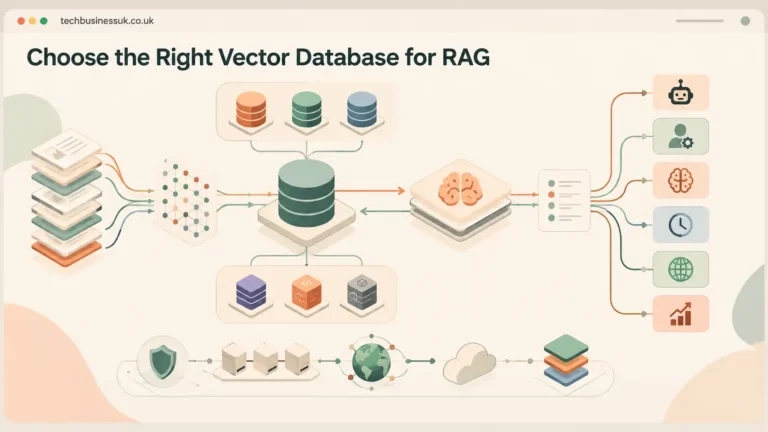
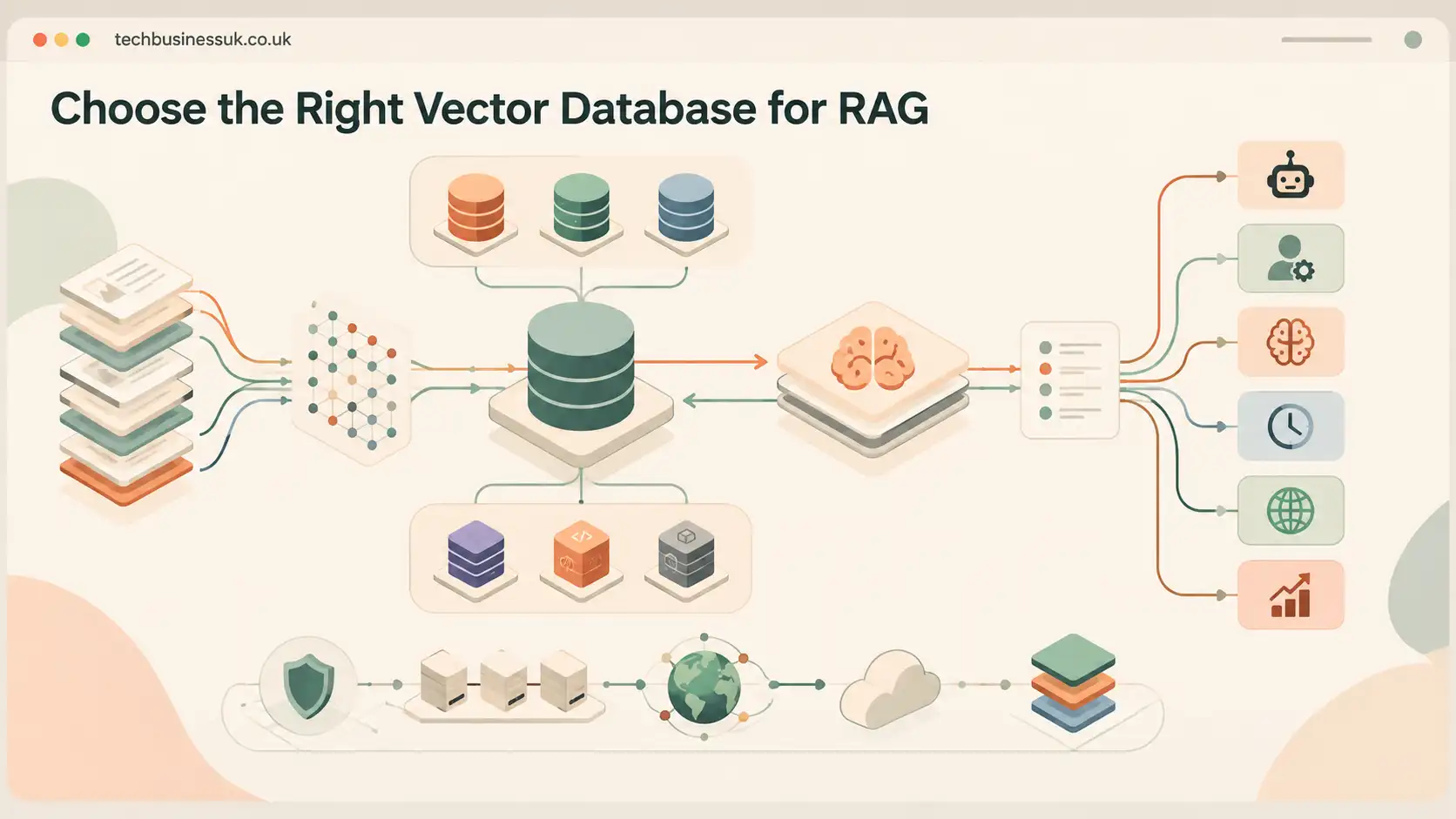
- Ingestion: Enterprise data is chunked, embedded, and stored in the vector database with metadata.
- Retrieval: A user query is embedded. The vector database retrieves relevant chunks via vector search.
- Generation: The retrieved chunks are added to the LLM’s prompt as context, enabling it to generate an informed, accurate response.
Vector Database vs. Traditional Database
Conventional relational databases (like PostgreSQL) or NoSQL stores (like MongoDB) are optimized for structured queries: “Find all customers in London who spent over £500.” They are exceptional for transactional data where exact precision is required.
However, they fail when faced with unstructured, semantically driven queries: “Show me documents discussing innovative approaches to sustainable supply chains.” Keyword search might return documents mentioning “supply chains” and “sustainable,” but it will miss documents that use synonyms like “green logistics” or “regenerative procurement” unless specifically indexed.
Vector databases are purpose-built for this exact scenario. They use specialized indexing algorithms (like HNSW or DiskANN) designed for rapidly navigating high-dimensional vector space. While traditional databases have added vector search extensions (such as pgvector for PostgreSQL), dedicated vector stores are typically optimized for higher ingestion rates, lower latency at extreme scale, and specialized RAG features like hybrid search (combining keyword and vector results).
What Makes a Vector Database Suitable for RAG?
Not all vector search implementations are equal when it comes to powering RAG. A robust vector database for rag must go beyond simple approximate nearest neighbor (ANN) search. It requires a suite of features optimized for the retrieval stage of the RAG pipeline.
Key suitability factors include:
- Hybrid Retrieval: The ability to combine semantic vector search with traditional keyword search (BM25) to improve relevance, especially for product names or specific terminology.
- Advanced Filtering: Pre-filtering and post-filtering capabilities based on metadata (e.g., “only search documents marked ‘public’ and created in 2025”). This is critical for data access control and reducing search space.
- Scalability & Latency: RAG applications often start with millions of vectors and scale to billions. The database must maintain low millisecond query latency as data volume and query throughput grow.
- Reranking Support: Some databases integrate with cross-encoder models to rerank the top-K retrieved results for even higher precision before sending context to the LLM.
- Production Readiness: Robustness, high availability (HA), backups, disaster recovery (DR), and extensive monitoring (often referred to as LLM observability).
- Integrations: Seamless connections with popular RAG frameworks (LangChain, LlamaIndex) and LLM providers.
How to Choose the Best Vector Database for RAG
Choosing the right option requires evaluating several dimensions based on your specific use case. What works for a simple internal chatbot may not be appropriate for a customer-facing, planet-scale RAG application.
Search Accuracy and Retrieval Quality
The core mission of RAG is relevance. If your retrieved context is incorrect or missing key information, your LLM will fail. Don’t assume similarity search alone is enough.
- Similarity Metrics: Ensure the database supports the distance metrics appropriate for your embedding model (e.g., Cosine Similarity, Dot Product, Euclidean Distance).
- Hybrid Search: Combining keyword search with vector search is often mandatory for production RAG. It addresses limitations where vector search might struggle with specific names, IDs, or exact phrases.
- Reranking: Evaluate if the database supports or easily integrates with rerankers, which can dramatically improve the top-1 or top-3 relevance, reducing the context size sent to the LLM and lowering costs.
- Evaluation Metrics: Assess the database based on RAG evaluation metrics such as Recall (did we find all relevant docs?) and Precision (how many retrieved docs were actually relevant?).
Performance, Latency, and Scalability
Performance is rarely an issue at 10,000 vectors, but it becomes critical at 100 million.
- Latency: How quickly does the database return results? Production RAG usually demands <50ms query latency for a seamless user experience.
- Throughput (QPS): How many queries per second can the database handle? Assess this under load, not just in isolation.
- Indexing Speed: How long does it take to embed and index large datasets?
- Scalability: Does the database scale horizontally? Can you easily add nodes to handle more vectors or more concurrent queries?
Cost and Operational Complexity
The trade-off between managed services and self-hosted solutions is a major decision point.
- Managed Services (SaaS): Examples include Pinecone. These offer operational simplicity, high availability, and auto-scaling, allowing you to focus on application logic. The primary cost is usually a predictable monthly subscription or usage-based pricing.
- Self-Hosted / Open Source: Examples include Chroma. These offer maximum control, data residency compliance (keeping all data on your own infrastructure), and no licensing costs. However, they introduce significant operational complexity. Your team is responsible for infrastructure provisioning, patching, scaling, backups, and monitoring, which often leads to higher total cost of ownership (TCO) in production.
How to Choose a Vector Database for Global Apps
Applications serving a worldwide user base add significant complexity to the database decision. When determining how to choose a vector database for global apps, you must prioritize geographic distribution.
- Regional Availability: Does the managed service operate in regions close to your users to minimize network latency? For self-hosted, can you deploy clusters across multiple regions?
- Data Residency: Many jurisdictions demand that personal data remains within national borders (e.g., GDPR in Europe). Your vector database must support data isolation by region or country.
- Multi-Region Architecture: Global applications require databases that can either replicate data across regions for low-latency access or support active-active configurations. Consider how the database handles cross-region consistency and disaster recovery.
Choosing the right infrastructure for global reach is part of a broader strategy for applied AI for enterprises. As organizations scale their AI initiatives internationally, the vector database becomes a critical component of their global data strategy.
Best Vector Database for RAG 2026: Top Options Compared
In 2026, the market for vector databases is mature and highly segmented. Several specialized players and established database vendors offer strong solutions. We will focus on two prominent options, analyzing their documented capabilities.
Pinecone for RAG
Pinecone is a pioneer and a leading example of a managed vector database offered as a service (SaaS). It is explicitly built to handle the complexities of production-scale RAG applications.
According to Pinecone’s official documentation, its primary strengths are its serverless architecture, operational simplicity, and planet-scale capabilities.
- Suitability for RAG: Pinecone is a strong candidate for production RAG. It handles the infrastructure overhead of managing complex indexing algorithms (like HNSW), allows for seamless horizontal scaling to handle billions of vectors, and maintains low query latency even at extreme scale.
- Retrieval Capabilities: It offers robust metadata filtering, allowing for complex queries that combine semantic search with structured data (e.g., “Find product recommendations semantically similar to this description, but only in the ‘electronics’ category and priced below £100”). It also supports hybrid search (combining dense vector search with sparse vector/keyword results).
- Operational Simplicity: As a managed service, Pinecone removes the burden of managing server infrastructure, backups, and scaling, which makes it attractive for enterprise RAG where stability and security are paramount.
- Production Readiness: Pinecone emphasizes enterprise security, high availability, and integrations with major LLM and RAG frameworks.
Chroma Vector Database for RAG
Chroma is a popular open-source vector database (Apache 2.0 license) focused heavily on developer experience and simplicity, particularly during the prototyping and early development stages of RAG.
Chroma’s documentation highlights its simplicity and ease of use for developers building AI applications.
- Suitability for RAG: Chroma is an excellent choice for individual developers, researchers, and small teams prototyping RAG applications or building internal tools. Its lightweight architecture makes it incredibly easy to get started—you can install it with
pip install chromadband run it in-memory or as a self-hosted server. - Retrieval Capabilities: Chroma supports core vector search functionality, embedding generation using popular models (e.g., from OpenAI or Hugging Face), and metadata filtering.
- Development Experience: Its primary differentiator is its developer-centric design, allowing for rapid iteration and integration with Python tools.
- Self-Hosting: For teams requiring maximum data control, Chroma’s open-source nature allows for full self-hosting on private infrastructure, directly addressing data residency concerns. It is important to note that scaling and managing a self-hosted Chroma cluster in production will require significant DevOps expertise.
Other Leading Vector Database Options
While Pinecone and Chroma are prominent, they represent specific archepoints on the managed-vs-open-source spectrum.
- Qdrant: A popular, production-grade open-source vector database (written in Rust) known for high performance and an advanced, developer-friendly API. It offers robust filtering, hybrid search capabilities, and a managed cloud option.
- Milvus: One of the most mature open-source vector databases (from the LF AI & Data Foundation). Milvus is known for extreme scalability and is well-suited for planet-scale RAG, though it comes with higher operational complexity when self-hosted. A managed cloud version is available.
- Weaviate: A strong open-source option that treats data as objects in a graph, allowing for semantic search combined with symbolic search. It has a robust ecosystem, includes hybrid search, and offers a managed cloud service.
- pgvector (PostgreSQL extension): For organizations deeply invested in PostgreSQL,
pgvectoradds strong vector search capabilities. This allows teams to leverage their existing PostgreSQL expertise and maintain relational and vector data in a single system. However, for extreme scale (hundreds of millions or billions of vectors), specialized vector stores may offer superior performance and RAG-specific features.
Managed vs. Open-Source Vector Databases
The fundamental choice for many organizations is between managed services and open-source solutions.
| Feature | Managed Vector Databases (e.g., Pinecone) | Open-Source Vector Databases (e.g., Chroma – Self-Hosted) |
|---|---|---|
| Operational Effort | Very Low (Infrastructure managed by vendor) | High (Infrastructure, scaling, backups managed by your team) |
| Data Residency | Medium (Depends on vendor’s region support; data is off-premise) | Very High (Data stays on your infrastructure, ideal for strict compliance) |
| Scalability | High (Often auto-scales horizontally, handled by vendor) | Varies (Requires expertise; can be complex to scale clusters) |
| Initial Cost | Variable (Subscription/Usage fees; predictable OPEX) | Very Low (No licensing costs; infrastructure CAPEX/OPEX applies) |
| Total Cost (Production) | Predictable (Can be higher for SaaS fees, but lower TCO on DevOps) | Unpredictable (Often higher TCO due to significant DevOps/Infrastructure costs) |
| Control & Customization | Low (Limited to API and configuration options) | High (Full control over software, deployment, and optimization) |
For many enterprises, the best vector database for rag 2026 is often the managed path, as it accelerates time-to-market and reduces operational risk. Open-source shines for prototypes, cost-sensitive non-critical workloads, and strict air-gapped or regulatory requirements demanding full data control.
Vector Database for LLM Applications and AI Agents
The role of vector databases is expanding beyond simple knowledge lookup for chatbots. They are now essential infrastructure for complex LLM applications and autonomous vector database for ai agents.
Vector Database for LLM Knowledge Retrieval
As established, vector databases provide the dynamic knowledge retrieval that makes RAG function. They allow LLM applications to access proprietary data (e.g., internal wikis, product catalogs, customer emails) and provide contextually relevant answers. Without this external knowledge base, LLMs are restricted to their training data, making them unsuitable for most enterprise-specific tasks.
Vector Database for AI Agents
AI agents are LLM-powered systems that can reason, plan, and execute actions using tools. Vector databases are critical for several aspects of agentic workflows:
- Tool Selection: Agents can use vector search to find the most relevant API tool for a specific task based on semantic descriptions of tool capabilities.
- Persistent Context: Agents need to maintain state and context across multiple turns or tasks. A vector database can store and retrieve conversation history, task progress, and user interactions.
- Long-Term Memory: Agents require a persistent way to “remember” information learned from previous interactions or external data, moving beyond the limitations of the short-term context window.
Best Vector Database for AI Memory Capabilities
Different AI applications require different forms of memory. When evaluating the best vector database for ai memory capabilities, consider these characteristics:
| Memory Type | Database Requirement | Critical Metric |
|---|---|---|
| Short-Term Context (Conversation State) | Ultra-low latency retrieval and extremely rapid updates (upserts). | Query Latency & Index Freshness |
| Long-Term Memory (Persisted Knowledge) | Reliable persistence, durable backups, and efficient similarity search over large, potentially historical datasets. | Scalability & Durability |
| Semantic Memory (Conceptual Associations) | Strong support for vector search and high-quality embeddings. Hybrid search helps with exact phrase recall. | Retrieval Quality (Recall/Precision) |
| User-Specific Memory | Robust multi-tenancy support for data isolation and complex metadata filtering (e.g., user_id = 'user123'). | Advanced Filtering & Security |
Databases optimized for rapid ingestion and low-latency updates are typically preferred for agentic memory, as agents constantly update their knowledge and state based on new observations.
Performance: Real-Time Data Ingestion and LLM Integration
Performance in RAG is about more than just query speed. The best vector database for real-time data ingestion must efficiently handle continuous data streams to ensure retrieved context is up-to-date.
Best Vector Database for Real-Time Data Ingestion
Many RAG workloads are not static. Customer support chatbots need data from the latest product updates; news assistants must ingest articles within minutes of publication; agentic memory must reflect actions just taken.
A strong vector database for real-time data ingestion requires:
- Rapid Upserts: Efficient handling of updates and insertions (upserts), allowing new or modified documents to be searchable almost instantly.
- Streaming Support: Seamless integration with data streaming platforms like Apache Kafka or Amazon Kinesis.
- Incremental Updates: The ability to update existing documents or embeddings incrementally without requiring a full index rebuild.
- Index Freshness: How quickly can data be queried after ingestion? Look for databases that offer “near-real-time” (NRT) indexing.
Managed services like Pinecone excel in this area, abstracting the complexity of high-throughput ingestion pipelines. Qdrant and Milvus also offer strong production ingestion capabilities.
Embedding and Indexing Performance
The overall RAG performance is heavily dependent on the efficiency of the full pipeline. While the vector database handles search and retrieval, several pre-steps influence performance:
- Embedding Generation: The time it takes to chunk text and generate embeddings using models (e.g., via OpenAI’s
text-embedding-3). This often introduces more latency than the vector database search itself. - Indexing Workflow: How quickly the database can build optimized indices for large batches of new vectors. A slow indexing process can make RAG results stale.
- Metadata Integration: Efficiently merging structured metadata with vector embeddings during the ingestion and search process.
Measuring and optimizing these components is a part of comprehensive performance engineering, similar to tracking RAG evaluation metrics in production, where indexing time and retrieval latency directly affect the final RAG quality and costs.
LLM and Framework Integrations
While not a direct “performance” metric, strong integrations are essential for accelerating development and reducing architectural complexity.
Robust vector databases offer:
- Client SDKs: Native, well-documented client libraries for major programming languages (especially Python and JavaScript).
- RAG Frameworks: Direct connectors and integrations for LangChain, LlamaIndex, Flowise, and other popular RAG and AI orchestration tools.
- LLM Providers: Streamlined workflows for combining vector search results with LLM prompts from OpenAI, Anthropic, Cohere, and open-source models (e.g., via Hugging Face).
Verify that the database supports the frameworks you intend to use without relying on custom, hard-to-maintain integration code.
Vector Database Security, Reliability, and Production Readiness
Transitioning a RAG application from prototype to production demands a rigorous focus on enterprise-grade security and reliability.
Access Control and Data Isolation
Protecting sensitive enterprise data is paramount. Your vector database must support robust multi-tenancy.
- Authentication & Authorization: Strong mechanisms for verifying user identity and enforcing granular permissions (e.g., using API keys or RBAC).
- Tenant Isolation: For SaaS applications serving multiple customers, data for each customer (“tenant”) must be strictly isolated. This often involves storing
tenant_idas metadata and applying mandatory pre-filtering during every vector search query to ensure no data leaks between customers. - Metadata Filtering: Beyond simple search, this is a core security control. Filters like
department = 'finance'orclearance = 'secret'must be enforced consistently to prevent unauthorized context retrieval.
RAG Security and Data Privacy
RAG applications introduce unique data privacy risks. When discussing applied AI for enterprises, security teams are rightly concerned about data leakage and governance.
- Sensitive Data in Embeddings: While embeddings are numerical vectors, they are technically representations of the original text. Organizations must treat embeddings with the same level of care and security as the source documents, especially when using public cloud embedding services.
- Retrieval Permissions: Ensure that retrieval permissions are synchronized with the original document storage permissions. An employee should not be able to retrieve sensitive HR data via a RAG chatbot if they lack direct access to those files.
Availability, Backups, and Disaster Recovery
For mission-critical RAG applications, the vector database must be highly resilient.
- High Availability (HA): Databases must support cluster replication and multi-node setups to eliminate single points of failure. For managed services, look for strong Service Level Agreements (SLAs) on uptime.
- Backups: Comprehensive, regular, and validated backups are essential. Managed services typically automate this process.
- Disaster Recovery (DR): For global applications, a robust DR plan involving geographic replication is critical to survive regional cloud outages.
To maintain production readiness, organizations need continuous operational visibility. This is where LLM observability in production becomes mandatory, allowing teams to monitor latency spikes, retrieval failures, multi-tenant performance issues, and unexpected token consumption in real-time.
Common Mistakes When Choosing a Vector Database
Choosing a vector database is a long-term architectural commitment. Avoid these frequent pitfalls:
Choosing Based Only on Popularity
A common mistake is selecting a vector database merely because it has a high number of GitHub stars or is trending on social media. While popularity indicates a strong developer community and a likely robust ecosystem, it does not guarantee suitability for your specific workload. A database designed for simple, Python-native prototyping (like Chroma) might be fundamentally inappropriate for handling billions of vectors and hundreds of managed customer tenants in a global multi-region production app. Base your decision on technical requirements, performance benchmarks relevant to your scale, and production support capabilities, not social proof.
Ignoring Retrieval Quality
It is easy to get distracted by infrastructure specifications—millisecond query times, terabyte storage capacity, and horizontal scalability metrics. While these are important, they are all subservient to the core requirement of RAG: retrieval quality. A incredibly fast vector database that returns marginally relevant or incorrect context is worthless. Prioritize a database’s ability to support advanced retrieval techniques like hybrid search, complex metadata filtering, reranking integration, and semantic similarity optimization. Use established RAG evaluation metrics in production to benchmark and continuously measure actual retrieval relevance against your expected standards.
Underestimating Scale and Data Growth
Prototypes usually work flawlessly on local development machines with a few thousand vectors. Production systems often see rapid data ingestion rates, growing context windows, and expanding query volumes. A database architecture that lacks proper sharding, horizontal scaling, or efficient memory management will inevitably hit a performance wall, leading to unacceptable latency or system failure as you scale. When evaluating vector search infrastructure, project your data and query volume for at least the next 12–24 months. Ensure the database can scale cost-effectively and seamlessly, either by adding nodes in a managed service or sharding clusters in a self-hosted environment.
Overlooking Vendor Lock-In
Vendor lock-in is a serious concern for enterprise RAG. Proprietary indexing algorithms, unique API features, specialized metadata filtering approaches, and restrictive licensing models can make it incredibly difficult and expensive to migrate data or switch vendors later. Before committing to a proprietary SaaS vector database, evaluate data portability: How easy is it to export all vectors and metadata in a standardized format? Assess the complexity of migrating to an alternative open-source vector store. Favor databases that support standard APIs, open protocols, and have multiple deployment options (e.g., both managed SaaS and self-hosted open-source).
Vector Database Decision Matrix: Which Option Fits Your RAG Workload?
This decision matrix provides a practical starting point for matching your specific RAG workload requirements with the most suitable database architecture and approach. No single vector database is universally the best; the right choice depends on balancing operational constraints, scaling needs, data residency, and budget.
| RAG Workload Type | Key Requirements | Best Option Strategy | Managed Examples | Open-Source Examples |
|---|---|---|---|---|
| Small Projects & Prototypes | Lowest overhead, rapid setup, developer experience, Python focus. | Start with lightweight, embedded open-source. | N/A | Chroma, SQLite-vec, LanceDB |
| Small-to-Medium Non-Critical RAG | Predictable cost, data control, moderate DevOps skills available. | Self-hosted or managed-open-source. | Weaviate Cloud, Qdrant Cloud | Weaviate (Self-Hosted), Qdrant (Self-Hosted) |
| Enterprise RAG | High availability, security (multi-tenancy, RBAC), scalability, monitoring, SLA. | Fully managed SaaS (predictable OPEX) or managed-open-source for control. | Pinecone, Milvus Zilliz, Elastic Serverless | Milvus (Managed), Weaviate (Managed) |
| AI Agents & Memory | Rapid ingestion, low latency updates, robust metadata. | Databases optimized for fast updates (upserts). | Pinecone, Qdrant Cloud | Qdrant (Self-Hosted), Aerospike |
| Global & Real-Time Apps | Low geographic latency, data residency, streaming updates, HA. | Managed SaaS with extensive region support or complex global self-hosting. | Pinecone (Multi-region), Elastic | Milvus (Distributed), Cassandra (Cassandra-Vector) |
Best Option for Small RAG Projects
For prototypes, internal hacks, personal learning projects, or applications with very small knowledge bases (under 10,000 documents), the primary requirement is minimizing operational friction. The goal is to get a functional RAG pipeline running in minutes, not days. Lightweight, embedded open-source options are ideal. The database runs in-memory or as part of your local application, requires zero infrastructure provisioning, and has a developer-centric API. Cost is effectively zero (ignoring your local machine’s electricity).
Best Option for Enterprise RAG
Enterprise RAG applications demand reliability, security, governance, and the ability to scale to millions or billions of vectors without performance degradation. For critical business functions (e.g., legal search, internal engineering support, customer-facing chatbots), operational simplicity and reliability take priority over raw software license costs. This workload generally favors fully managed SaaS vector databases like Pinecone. These services handle high availability, backups, horizontal scaling, security patching, and monitoring (often integrating with LLM observability in production tools), allowing your engineering team to focus on the RAG pipeline relevance and user experience. Strict data residency demands might push enterprises toward managed open-source solutions (like Weaviate or Milvus managed cloud) or robust, distributed open-source installations, but this introduces significant DevOps overhead.
Best Option for AI Agents and Memory
AI agents present unique challenges. They require not only persistent long-term storage but also ultra-low latency for short-term state management and incredibly rapid updates (upserts) to reflect actions just executed. When agents constantly write and update their conversation history or state, database ingestion freshness becomes the primary metric. The ideal vector database for this use case must prioritize very low latency, massive concurrent write support, near-real-time index freshness, and complex multi-tenant metadata filtering. Specialized high-performance engines like Qdrant or highly optimized managed services like Pinecone are strong contenders.
Best Option for Global and Real-Time Applications
For global applications serving users worldwide and real-time streaming pipelines, the core requirements are minimizing geographic latency and maximizing ingestion freshness. The vector database must support geographic distribution—allowing for data residency compliance and local low-latency access across multiple regions. Real-time applications need a vector database that is optimized for streaming data ingestion (e.g., integrating with Kafka) and near-real-time indexing, ensuring new information is searchable within milliseconds or seconds. This workload usually requires a fully managed SaaS solution with extensive regional availability and robust automated scaling, as self-hosting distributed clusters globally adds immense complexity and operational risk.
Real-World Example: Choosing a Vector Database for a Production RAG Application
To illustrate how these factors apply, let’s look at a realistic scenario for a global enterprise application.
RAG Application Requirements
A large multinational healthcare provider is building a RAG-powered clinical support assistant. The assistant will retrieve information from patient electronic health records (EHRs), medical research papers, and proprietary internal clinical guidelines to help doctors answer questions.
Key Requirements:
- Data Scale: Initial ingest of 20 million research paper abstracts (approximately 20 million vectors), expanding quickly to include patient EHRs (potentially billions of vectors).
- Data Residency & Compliance: Strictest requirement—patient data for European users must remain within European borders (GDPR compliance), US data in the US (HIPAA compliance), etc. Data isolation between patients must be absolute.
- Latency: Query latency must be under 30 milliseconds to ensure a fluid user experience during time-critical clinical workflows.
- Ingestion Freshness: Medical research papers must be ingestible within 10 minutes of publication; patient records must be updated nearly instantly (NRT).
- Security: Mandatory metadata pre-filtering by patient ID (
patient_id=123) and clinician clearance level (clearance='doctor'). Strong multi-tenant data isolation. - Availability: Mission-critical application requiring 99.9% uptime and validated disaster recovery across multiple regions.
Comparing Candidate Databases
- Managed SaaS (e.g., Pinecone): Strong candidate for initial scale and low latent queries. However, managing strict data residency across multiple regions for distinct patient and research datasets might require managing multiple, separate Pinecone instances/projects across different cloud regions, increasing operational overhead. It must support multi-tenant filtering natively and securely.
- PostgreSQL with pgvector: Familiar to the team. Good for smaller datasets and basic metadata filtering. However, managing billions of high-dimensional vectors, ensuring low-latency retrieval under extreme concurrent load, and achieving global multi-region replication while maintaining real-time freshness would be operationally complex and potentially costly at this scale compared to specialized vector stores.
- Enterprise Open-Source (e.g., Weaviate – Self-Hosted): Strong consideration. Self-hosting provides full data control, directly addressing strict GDPR and HIPAA residency requirements (deploying clusters privately in each required region). Weaviate supports advanced hybrid search and robust multi-tenancy filtering. However, the operational complexity of managing large, distributed, high-availability clusters across multiple global regions (US, EU, APAC) privately is immense and would require a dedicated DevOps team.
Recommended Architecture
The healthcare provider decides to use a Self-Hosted Enterprise Open-Source (e.g., Weaviate) architecture.
Justification:
While managed SaaS offers simpler operations, the critical requirements for full data residency control (privately deployed in the EU and US regions separately) and strict compliance (HIPAA and GDPR) are non-negotiable. Self-hosting provides the necessary air-gapped environment and total control over data isolation. A production-grade open-source engine like Weaviate offers advanced filtering and hybrid search required for high-precision clinical retrieval. To manage the immense operational complexity of distributed multi-region deployments privately, they partner with Weaviate for enterprise support and prioritize comprehensive monitoring, logging, and performance engineering, effectively making Weaviate the core infrastructure layer of their secure medical knowledge base.
Frequently Asked Questions About Vector Databases for RAG
What Is the Best Vector Database for RAG in 2026?
There is no universally “best” option; the ideal solution depends on balancing your specific workload requirements against budget and operational capabilities. For production-scale enterprise RAG where stability, security, and low latency are prioritized over software licensing costs, fully managed SaaS vector databases like Pinecone are often preferred. For prototypes, internal applications, Python-focused developers, or strictly air-gapped environments demanding full data control, open-source options like Chroma (self-hosted) are excellent choices.
Is Pinecone Better Than Chroma for RAG?
They are designed for different archetypes and use cases, rather than one being inherently “better.” Pinecone is a fully managed cloud service (SaaS) built for production-scale, multi-tenant RAG applications where minimal operational overhead, high availability, and horizontal scaling are critical. Chroma is an open-source vector database focused on simplicity, rapid prototyping, and developer experience, especially during early development. It is lightweight, can run embedded, and allows for full self-hosting but requires significant DevOps expertise to scale for planet-scale production.
What Is the Best Vector Database for AI Agents?
AI agents place extreme demands on a vector database, requiring both ultra-low latency for short-term state management and massive, high-throughput ingestion with near-real-time index freshness (NRT) to persist learned state or tasks. For this reason, the best option is often a vector database explicitly optimized for rapid writes (upserts) and rapid index updates, such as high-performance specialized engines (like Qdrant) or managed SaaS solutions built for scale. Strong metadata support is also mandatory for agent context management.
What Is the Best Vector Database for Real-Time Data Ingestion?
A vector database suitable for real-time ingestion must prioritize incremental updates, fast indexing workflows, efficient handling of high-throughput upserts, and index freshness (NRT). Managed services like Pinecone are operationally simplest for this task, abstracting the complexity of ingestion pipelines. Production-grade open-source databases like Milvus and Qdrant also offer strong real-time capabilities but require more specialized engineering expertise when self-hosted at scale.
How Do I Choose a Vector Database for Global Apps?
Choosing a vector database for global applications requires prioritizing geographic distribution and strict data residency compliance. For managed SaaS solutions, verify regional availability across all user locations. For self-hosted solutions, evaluate the complexity of deploying, sharding, and replicating clusters privately across multiple global regions while maintaining low latency and legal compliance (e.g., GDPR in Europe, HIPAA in the US).
Can a Vector Database Store LLM Memory?
Yes, vector databases are the primary infrastructure layer for implementing persistent long-term memory for LLM applications and AI agents. Agents store user interactions, task state, and learned conceptually associated facts as vector embeddings in the database. When the agent receives a new task, it performs vector search to retrieve relevant memories from previous interactions or knowledge bases into its active context window.
{
  "@context": "https://schema.org",
  "@type": "FAQPage",
  "mainEntity": [
    {
      "@type": "Question",
      "name": "What Is the Best Vector Database for RAG in 2026?",
      "acceptedAnswer": {
        "@type": "Answer",
        "text": "There is no universally 'best' option; the ideal solution depends on balancing your specific workload requirements against budget and operational capabilities. For production-scale enterprise RAG where stability, security, and low latency are prioritized over software licensing costs, fully managed SaaS vector databases like Pinecone are often preferred. For prototypes, internal applications, Python-focused developers, or strictly air-gapped environments demanding full data control, open-source options like Chroma (self-hosted) are excellent choices."
      }
    },
    {
      "@type": "Question",
      "name": "Is Pinecone Better Than Chroma for RAG?",
      "acceptedAnswer": {
        "@type": "Answer",
        "text": "They are designed for different archetypes and use cases, rather than one being inherently 'better.' Pinecone is a fully managed cloud service (SaaS) built for production-scale, multi-tenant RAG applications where minimal operational overhead, high availability, and horizontal scaling are critical. Chroma is an open-source vector database focused on simplicity, rapid prototyping, and developer experience, especially during early development. It is lightweight, can run embedded, and allows for full self-hosting but requires significant DevOps expertise to scale for planet-scale production."
      }
    },
    {
      "@type": "Question",
      "name": "What Is the Best Vector Database for AI Agents?",
      "acceptedAnswer": {
        "@type": "Answer",
        "text": "AI agents place extreme demands on a vector database, requiring both ultra-low latency for short-term state management and massive, high-throughput ingestion with near-real-time index freshness (NRT) to persist learned state or tasks. For this reason, the best option is often a vector database explicitly optimized for rapid writes (upserts) and rapid index updates, such as high-performance specialized engines (like Qdrant) or managed SaaS solutions built for scale. Strong metadata support is also mandatory for agent context management."
      }
    },
    {
      "@type": "Question",
      "name": "What Is the Best Vector Database for Real-Time Data Ingestion?",
      "acceptedAnswer": {
        "@type": "Answer",
        "text": "A vector database suitable for real-time ingestion must prioritize incremental updates, fast indexing workflows, efficient handling of high-throughput upserts, and index freshness (NRT). Managed services like Pinecone are operationally simplest for this task, abstracting the complexity of ingestion pipelines. Production-grade open-source databases like Milvus and Qdrant also offer strong real-time capabilities but require more specialized engineering expertise when self-hosted at scale."
      }
    },
    {
      "@type": "Question",
      "name": "How Do I Choose a Vector Database for Global Apps?",
      "acceptedAnswer": {
        "@type": "Answer",
        "text": "Choosing a vector database for global applications requires prioritizing geographic distribution and strict data residency compliance. For managed SaaS solutions, verify regional availability across all user locations. For self-hosted solutions, evaluate the complexity of deploying, sharding, and replicating clusters privately across multiple global regions while maintaining low latency and legal compliance (e.g., GDPR in Europe, HIPAA in the US)."
      }
    },
    {
      "@type": "Question",
      "name": "Can a Vector Database Store LLM Memory?",
      "acceptedAnswer": {
        "@type": "Answer",
        "text": "Yes, vector databases are the primary infrastructure layer for implementing persistent long-term memory for LLM applications and AI agents. Agents store user interactions, task state, and learned conceptually associated facts as vector embeddings in the database. When the agent receives a new task, it performs vector search to retrieve relevant memories from previous interactions or knowledge bases into its active context window."
      }
    }
  ]
}
About the Author