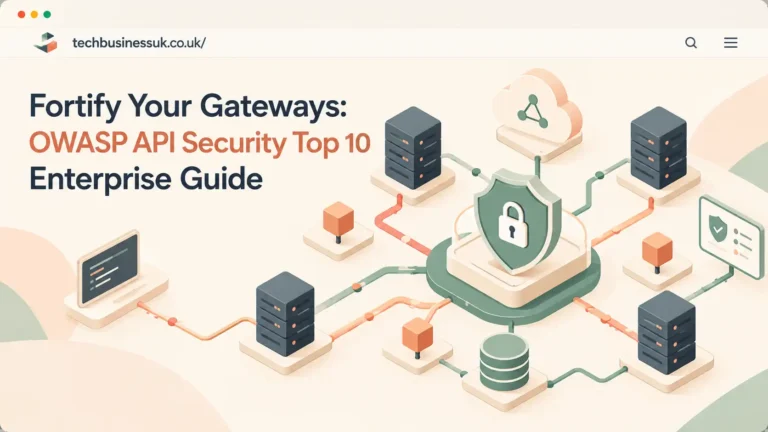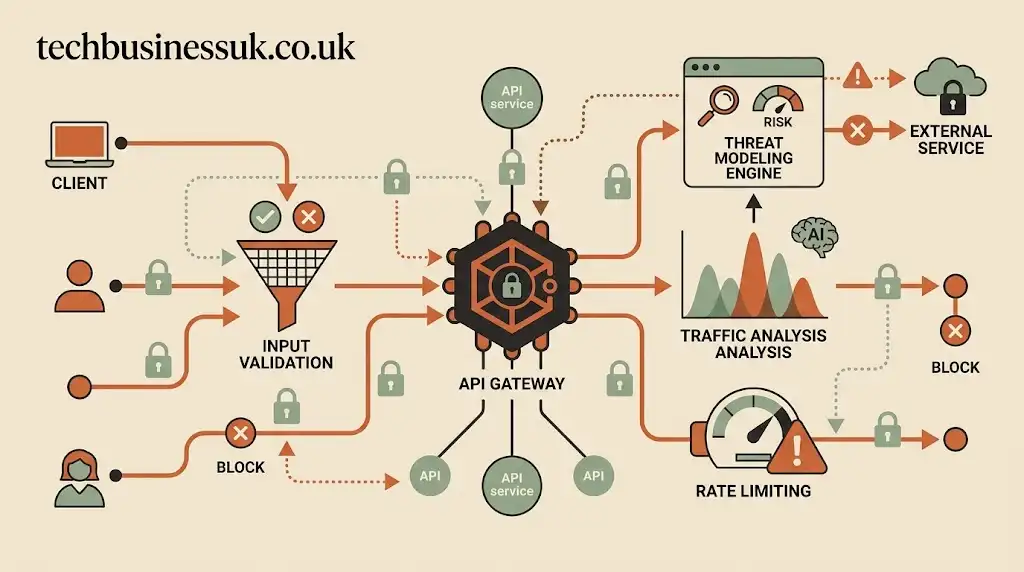
- Core Objective: Shift API security left by identifying design flaws before writing code.
- Frameworks Covered: Compare STRIDE for microservices against PASTA for enterprise risk.
- Key Process: Map trust boundaries, build Data Flow Diagrams (DFDs), and validate against OWASP API Top 10.
- Automation Goal: Integrate Policy-as-Code (OPA) and Threat-as-Code into GitOps CI/CD pipelines.
1. Shift-Left API Security Architecture
API threat modelling is the foundational architecture practice of identifying, categorizing, and mitigating structural security flaws before code is compiled, containerized, and deployed to production environments. In modern cloud-native software engineering characterized by microservices, multi-cloud ingress gateways, and high-frequency CI/CD pipelines, reactive security patching is no longer a viable operational posture. Relying exclusively on dynamic application security testing (DAST) or periodic third-party penetration testing to uncover structural design errors introduces severe engineering overhead, inflated remediation costs, and prolonged windows of vulnerability.
API Security Lifecycle Transformation
As enterprise digital ecosystems scale, unmanaged API sprawl and undocumented “shadow endpoints” rapidly expand an organisation’s attack surface. In line with official NCSC guidance on securing HTTP-based APIs, any interface shared outside your security boundary must undergo dedicated, service-specific threat analysis. Traditional application security threat modelling historically focused on monolithic web applications, relying heavily on perimeter firewalls, network segmentation, and basic session cookies. However, microservice topographies require a fundamental structural pivot: shifting security to the left of the software development lifecycle (SDLC). By embedding systematic threat reviews into the design phase, security architects ensure that trust boundaries, payload validation specifications, and identity delegation protocols are hardened prior to code execution.
To build a resilient enterprise security foundation, threat modelling must integrate directly into your broader suite of enterprise API testing tools, bridging design-phase analysis with continuous runtime validation.
2. What is API Threat Modelling?
At its core, what is threat modelling in an API context? It is a structured, repeatable engineering discipline that deconstructs an API architecture, identifies potential attack vectors across data flow paths, and defines cryptographic, policy-based, and structural countermeasures.
Unlike monolithic applications where security logic is concentrated at a single perimeter, distributed APIs expose dozens—or hundreds—of distinct ingress points across public internet boundaries, partner networks, and internal microservice channels. Traditional web application threat modelling primarily addresses client-side state manipulation, cross-site scripting (XSS), and basic SQL injection (SQL). In contrast, API threat modelling focuses on deeper architectural flaws unique to stateless, decoupled interfaces. These include Broken Object Level Authorization (BOLA), Broken Property Level Authorization (BPLA), rate-limiting bypasses, and unauthorized data exfiltration through unmasked Data Transfer Objects (DTOs).
Web Application vs. API Threat Modelling Surface
| Architectural Vector | Traditional Web Application Threat Surface | Modern API Surface |
|---|---|---|
| Trust Boundary | Single, monolithic perimeter (Edge WAF / Load Balancer) | Distributed boundaries (Edge Gateway, Service Mesh, Sidecars) |
| State Management | Stateful (Server-side sessions, cookies) | Stateless (JWTs, OAuth2 bearer tokens, API Keys) |
| Primary Vulnerabilities | Cross-Site Scripting (XSS), CSRF, SQL Injection | BOLA, BFLA, Mass Assignment, Rate Limit Exhaustion |
| Data Flow Exposure | Server-rendered HTML views | Raw JSON, gRPC/Protobuf streams, GraphQL query trees |
| Access Control Engine | Centralised Role-Based Access Control (RBAC) | Decentralised, fine-grained Attribute/Policy-Based Access Control |
Integrating threat modelling cybersecurity practices into the initial API design phase prevents these critical structural flaws from ever entering the codebase, drastically lowering remediation costs, protecting intellectual property, and securing enterprise data paths against zero-day exploits.
3. Enterprise Threat Modelling Frameworks for APIs
Evaluating architectural risk across modern API topographies requires a structured framework. Relying on informal code reviews or ad-hoc scanning inevitably exposes production environments to systemic design flaws. Enterprise security architects primarily leverage two methodologies—STRIDE and PASTA—to systematically uncover vulnerabilities, isolate attack surfaces, and validate trust boundaries.
STRIDE Threat Modelling for REST, gRPC & GraphQL
Originally developed by Microsoft, the STRIDE threat modelling framework categorises architectural threats based on their operational impact across system components.
THE STRIDE FRAMEWORK
1. Spoofing (Identity Deception)
Spoofing occurs when an attacker impersonates a legitimate client, microservice, or external identity provider.
- API Threat Vectors: Forged JSON Web Tokens (JWTs) using alg: “none” key confusion vulnerabilities, stolen API keys, or unauthenticated inter-service calls executing inside a flat pod network.
- Mitigation Strategy: Enforce strict RS256/ES256 asymmetric cryptographic signature verification at the edge gateway. Require mutual TLS (mTLS) with SPIFFE/SPIRE identity attestation across internal microservice meshes.
2. Tampering (Data Alteration)
Tampering involves the unauthorized modification of data in transit, at rest, or within memory during payload processing.
- API Threat Vectors: HTTP parameter pollution, JSON payload mutation, gRPC binary stream tampering, and schema validation bypasses targeting vulnerable backends.
- Mitigation Strategy: Enforce strict contract validation against OpenAPI 3.1 specs or Protocol Buffer definitions at the ingress API gateway layer. Configure gateways to explicitly reject unvalidated payload fields using
additionalProperties: falsewith an explicit400 Bad Request.
3. Repudiation (Non-Repudiation Failure)
Repudiation threats manifest when an application fails to generate cryptographically verifiable logs, preventing incident response teams from proving an attacker’s actions.
- API Threat Vectors: Executing unauthenticated administrative API calls, deleting tenant resources without persistent correlation IDs, or writing logs to mutable, local storage buffers.
- Mitigation Strategy: Centralise immutable audit logging streams signed with HMAC chains. Require mandatory W3C
traceparentand distributed correlation header propagation across all upstream services.
4. Information Disclosure (Data Leakage)
Information disclosure occurs when an API inadvertently leaks sensitive data, internal architectural details, or PII to unauthorized consumers.
- API Threat Vectors: Mass assignment exposing internal ORM database schemas, returning full stack traces in HTTP
500 Internal Server Errorresponses, or serving unmasked data payloads in GET responses. - Mitigation Strategy: Decouple internal database entities from external Data Transfer Objects (DTOs). Implement response payload filtering and centralized field-level encryption at the API edge.
5. Denial of Service (Service Degradation)
Denial of Service (DoS) attacks aim to exhaust underlying compute, memory, database connection pools, or network bandwidth, causing service latency or total system outages.
- API Threat Vectors: Deeply nested GraphQL query loops (Cyclic Queries), unthrottled batch processing endpoints, regex-based payload parsing attacks (ReDoS), and heavy HTTP request floods.
- Mitigation Strategy: Implement multi-tiered rate limiting based on authenticated tenant IDs and IP reputation scores. Enforce query-depth analysis and query-cost analysis on GraphQL resolvers alongside strict HTTP request body size limits.
6. Elevation of Privilege (Unauthorized Access)
Elevation of privilege occurs when a user or compromised client execution thread bypasses access controls to perform administrative functions or access foreign data.
- API Threat Vectors: Broken Function Level Authorization (BFLA), manipulation of user role parameters inside request bodies (e.g., changing
"isAdmin": falsetotrue), or exploiting insecure direct object references. - Mitigation Strategy: Implement Policy-as-Code authorization frameworks such as Open Policy Agent (OPA) or AWS Cedar. Enforce mandatory, fine-grained access control policies at every microservice boundary rather than relying solely on edge-level authentication.
PASTA: Process for Attack Structure and Threat Analysis
While STRIDE offers a developer-centric methodology for categorising technical flaws, PASTA threat modelling provides an enterprise, risk-centric framework consisting of seven sequential stages:
PASTA & STRIDE Threat Modeling Methodology Process Flow
▼
- Define Objectives: Align security engineering goals directly with business impact, operational SLAs, and regulatory compliance mandates (SOC 2 Type II, ISO 27001, PCI-DSS v4.0).
- Define Technical Scope: Bounding the full API ecosystem topography, mapping external ingress gateways, service mesh proxies, third-party webhooks, and cloud-hosted data stores.
- Application Decomposition: Constructing multi-tiered Data Flow Diagrams (DFDs) that meticulously illustrate entry points, logical trust boundaries, data transformation steps, and persistence layers.
- Threat Analysis: Aggregating threat intelligence targeting specific API protocols (REST, gRPC, GraphQL, WebSockets) and cataloguing real-world attack vectors.
- Vulnerability Analysis: Systematically scanning for structural design weaknesses using static application security testing (SAST), software bill of materials (SBOM) auditing, and architectural flaw mapping.
- Attack Modeling: Building realistic attack trees that demonstrate how combined technical vulnerabilities (e.g., BOLA combined with mass assignment) lead directly to asset compromise.
- Risk & Impact Analysis: Quantifying financial, legal, and operational risk metrics to prioritize countermeasure implementation based on security investment return (ROSI).
| Framework | Target Persona | Primary Focus | Best Used For |
|---|---|---|---|
| STRIDE | Developers, Software Architects | Component-level vulnerability classification | Technical threat discovery during API design |
| PASTA | CISOs, Enterprise Risk Officers | Risk-based alignment & financial impact | Compliance, audit, and strategic portfolio defense |
4. The 4-Step API Threat Modelling Process
To operationalise threat modelling across fast-moving engineering teams, organisations require a repeatable, multi-step threat modelling process. Executing these formal threat modelling steps ensures systematic security coverage throughout the software development lifecycle.
API Threat Modeling Implementation Process
Step 1 — Deconstruct Architecture & Trust Boundaries
Begin by establishing a clear inventory of every communication component within the API ecosystem. Isolate client-to-gateway ingress pathways, gateway-to-microservice internal routing, database queries, and third-party API integration points.
Crucially, identify all trust boundaries—the logical or physical demarcation lines where data transitions between differing levels of security controls (e.g., from the public internet across a WAF into a DMZ, or from an ingress proxy to an internal Kubernetes pod network).
Step 2 — Map Data Flow Diagrams (DFDs)
A comprehensive threat modelling diagram visualises how data moves through the application infrastructure.
Microservices Trust Boundaries & Perimeter Architecture
When building DFDs specifically for API architectures:
- Catalogue All Entry Points: List all exposed HTTP methods, REST routes, gRPC services, GraphQL resolvers, and WebSocket listeners.
- Trace Data Transformations: Document how inbound request payloads are parsed, sanitized, transformed across queues (Apache Kafka, RabbitMQ), and cached (Redis, Memcached).
- Identify Data Stores: Map all locations where sensitive data, tokens, or PII are stored, ensuring transport encryption and access policies are clear.
Step 3 — Identify & Classify API Vulnerabilities
Map identified threat paths directly against enterprise threat catalogues and the OWASP API Security Top 10. For each endpoint exposed in the DFD, evaluate its susceptibility to broken authorization, injection attacks, and resource consumption vectors. Validate these identified risks in execution phases by applying dedicated API penetration testing methodologies to verify whether theoretical attack paths are exploitable in live environments.
Step 4 — Implement Mitigation Controls & Countermeasures
Define technical mitigations for every validated threat path. Mitigations must be enforced programmatically through system architecture rather than relying on manual developer discipline.
Implementing Policy-as-Code (Open Policy Agent Example)
To prevent BOLA and BFLA vulnerabilities programmatically, enterprise teams decouple authorization logic from application code using Open Policy Agent (OPA). Below is an example Rego policy evaluating user claims against tenant boundaries:
package api.authz

default allow = false

# Allow access if user belongs to tenant and holds required role
allow {
    input.method == "GET"
    input.path == ["v1", "tenants", tenant_id, "orders"]
    token_claims.tenant_id == tenant_id
    user_has_role(token_claims.roles, "OrderReader")
}

token_claims = claims {
    [_, payload, _] := io.jwt.decode(input.headers.authorization)
    claims := payload
}

user_has_role(roles, required) {
    roles[_] == required
}
Enforce runtime defence controls across your ingress tier by routing verified architectural mitigations into robust API gateway security controls, including inline schema validation, mTLS termination, and centralised token introspection.
5. API Threat Modelling Tools & Automation
As enterprise engineering teams scale, manual threat modelling using whiteboards and static spreadsheets creates operational bottlenecks. Leading technical organisations deploy automated threat modelling tools that integrate directly into developer IDEs, code repositories, and GitOps CI/CD pipelines.
Enterprise Threat Modelling Tool Matrix
| Tool Name | Licensing Model | CI/CD Integration | Primary Enterprise Use Case |
|---|---|---|---|
| Microsoft Threat Modeling Tool | Free / Proprietary | Low (Manual Desktop Application) | STRIDE-based analysis for Windows ecosystems |
| OWASP Threat Dragon | Open Source | Medium (CLI / Docker / Web) | Developer-friendly visual STRIDE diagramming |
| PyTM | Open Source | High (Python Code-as-Threat-Model) | GitOps pipelines parsing code into DFDs |
| IriusRisk | Enterprise SaaS / Paid | High (Native REST API / CI/CD Plugins) | Automated enterprise scale & compliance mapping |
Threat-as-Code Implementation
Integrating Threat-as-Code tools (such as PyTM or HCL Accelerate) allows engineering teams to describe system architecture using declarative configuration files.
When developers open a pull request updating an OpenAPI specification, automated pipeline scripts parse the spec, re-generate the system data flow diagram, evaluate security rules using Open Policy Agent (OPA), and automatically flag newly introduced untrusted endpoints before code is merged.
Automated Shift-Left Security & GitOps Pipeline Flow
6. Emerging Vectors: AI & LLM Threat Modelling
The rapid integration of Large Language Model (LLM) agents and generative AI into enterprise systems introduces novel API attack surfaces. When executing an AI security threat modelling LLM review, security teams must expand traditional boundary analysis to address non-deterministic processing flows and autonomous agent capabilities.
LLM Security & Indirect Prompt Injection Vector
Key threat vectors emerging from AI-exposed APIs include:
- Indirect Prompt Injection via Webhooks/APIs: An attacker injects malicious instructions into data consumed by an API (e.g., a customer feedback endpoint). When an internal LLM agent processes this API payload, it interprets the untrusted string as system commands, executing unintended administrative actions on downstream endpoints.
- Insecure Output Handling / Excessive Agency: LLM agents equipped with function-calling capabilities can execute downstream API calls without proper user authorization checks, leading to automated BOLA or arbitrary data deletion.
- Vulnerabilities in AI-Generated Code: Developers using AI coding assistants may introduce endpoints missing mandatory authorization decorators or schema validation checks, creating shadow API drift.
Evaluating these evolving vectors requires mapping specialised mitigations against emerging AI-generated API security risks, ensuring autonomous model calls and generated code snippets are subject to identical Zero-Trust validation boundaries as human-written microservices.
Executive Summary & Governance Checklist
API threat modelling transitions security from a reactive bottleneck into an automated design-phase discipline. By formalising system boundaries, leveraging frameworks like STRIDE and PASTA, and integrating Threat-as-Code into CI/CD workflows, enterprise organisations eliminate architectural flaws prior to deployment.
Enterprise API Threat Modelling Governance Checklist
- Mandate Design-Phase Reviews: Require a completed threat model for all new API services and major v2 breaking schema updates.
- Standardise Threat Frameworks: Apply STRIDE for developer-level engineering reviews and PASTA for business risk alignment.
- Automate DFD Generation: Utilise OpenAPI 3.1 specs to dynamically map data flows and entry points.
- Enforce Edge Schema Validation: Reject non-conforming API requests at the ingress gateway using automated schema policies.
- Integrate Policy-as-Code: Decouple authorization logic from application code, validating access via OPA engines.
- Audit AI & Third-Party Boundaries: Evaluate prompt injection and excessive agency vectors across all LLM-integrated API endpoints.
Frequently Asked Questions (FAQs)
How often should an enterprise update its API threat models?
Threat models should be dynamic assets. They must be updated automatically whenever architectural changes alter a data flow diagram, such as introducing new ingress endpoints, modifying authentication protocols, integrating third-party webhooks, or deploying major version increments.
Who is responsible for conducting API threat modelling sessions?
Threat modelling is a collaborative process led by Security Architects in tandem with Lead Software Engineers, Product Owners, and DevOps/SRE leads. Security provides the framework and governance, while engineering teams provide deep domain context on system boundaries and data flows.
Can threat modelling replace dynamic penetration testing?
No. Threat modelling uncovers structural design flaws before code is compiled, whereas penetration testing validates runtime implementation bugs in live environments. Both disciplines are complementary components of a comprehensive API security architecture.
About the Author