Modern web and mobile ecosystems rely heavily on interconnected microservices, single-page applications, and third-party integrations. Delegated authorization forms the backbone of these distributed systems. Rather than sharing root credentials across application boundaries, systems require a standardized framework to issue scoped, short-lived permissions.
The OAuth 2.0 framework provides this exact mechanism. However, misconfigurations during implementation leave critical enterprise endpoints vulnerable to account takeover, authorization bypass, and token theft. Securing OAuth 2.0 requires understanding core grant types, enforcing strict token handling protocols, and aligning architecture with the latest security updates, such as the RFC 9700 Security Best Current Practice guidelines.
Key Takeaways
- Default to PKCE: Proof Key for Code Exchange (RFC 7636) is no longer just for mobile apps. Modern security baselines require PKCE across all public and confidential clients using the Authorization Code flow.
- Eliminate Legacy Flows: Implicit Grants and Resource Owner Password Credentials (ROPC) carry severe architectural security risks. Shift all legacy systems toward Authorization Code with PKCE or Client Credentials.
- Enforce Strict Redirect Validation: Strict string equality matching on redirect URIs prevents token leakage, authorization code interception, and open redirect vulnerabilities.
- Secure Front-End Storage: Avoid holding access or refresh tokens in
LocalStorageorSessionStorage. Use the Backend-For-Frontend (BFF) pattern withHttpOnly,SameSite=Strictencrypted session cookies.- Implement Refresh Token Rotation: Mitigate replay risks by invalidating an entire refresh token family instantly whenever a previously consumed refresh token is re-presented to the authorization server.
What Is OAuth 2.0? Protocol Core Concepts & Architecture
OAuth 2.0 is an open standard protocol for authorization designed to give client applications limited access to protected user resources without exposing user credentials. It decouples the authorization process from the resource server, allowing access tokens to act as delegated, cryptographically verifiable permissions.
Understanding Delegated Authorization vs Authentication
A common architectural error involves using OAuth 2.0 directly to authenticate users. OAuth 2.0 handles authorization—answering what actions a client application can perform on behalf of an entity. It does not natively handle authentication—confirming who the user actually is.
When an application relies solely on an access token to identify an end-user, it introduces significant authorization mix-up risks. Authentication layers like OpenID Connect (OIDC) build on top of OAuth 2.0 by adding an ID token (id_token), which contains structured user profile claims. For a fundamental breakdown of these boundaries, see our detailed guide on Authentication vs Authorization.
+-------------------+                               +-------------------+
|                   |-----(A) Authorization Request--->|                   |
|                   |                               |   Resource        |
|                   |<----(B) Authorization Grant---|   Owner           |
|                   |                               |                   |
|   Client App      |                               +-------------------+
|                   |
|                   |                               +-------------------+
|                   |-----(C) Authorization Grant--->|                   |
|                   |                               |   Authorization   |
|                   |<----(D) Access Token----------|   Server          |
+-------------------+                               +-------------------+
          |
          |                                         +-------------------+
          |                                         |                   |
          +------------(E) Access Token------------>|   Resource        |
                                                    |   Server          |
          <------------(F) Protected Resource-------|                   |
                                                    +-------------------+
Core Roles: Resource Owner, Client, Authorization Server, and Resource Server
The framework establishes strict boundaries between four distinct roles, as defined in the official IETF RFC 6749 OAuth 2.0 Authorization Framework:
- Resource Owner: The entity capable of granting access to a protected resource (typically the end-user).
- Client: The application making resource requests on behalf of the resource owner with its permission. Clients are classified as public (unable to maintain confidential credentials, such as single-page web apps or mobile apps) or confidential (capable of securely storing secrets, such as server-side applications).
- Authorization Server: The server issuing access tokens to the client after successfully authenticating the resource owner and obtaining authorization.
- Resource Server: The API server hosting protected resources, capable of accepting and validating access tokens presented by clients.
Access Tokens, Refresh Tokens, and Bearer Credentials
Tokens form the operational currency of OAuth 2.0:
- Access Token: A credential string (opaque string or JSON Web Token) representing authorization. It carries specific scopes, an expiration timestamp, and target audience identifiers.
- Refresh Token: A long-lived credential used exclusively between the client and the authorization server to obtain new access tokens without requiring re-authentication by the resource owner.
- Bearer Credentials: A security model where any party holding the token can use it without proving ownership of a private cryptographic key. Learn more about handling authorization headers in our article on What Is a Bearer Token?.
OAuth 2.0 Grant Types: Selecting the Right Flow
Grant types represent the specific architectural paths a client takes to obtain an access token. Choosing the correct flow depends directly on the client type, deployment environment, and trust model.
Authorization Code Flow with PKCE (RFC 7636)
The Authorization Code flow involves exchanging an authorization code for an access token via a back-channel request. To protect public and confidential clients against code interception attacks, modern standards mandate adding Proof Key for Code Exchange (PKCE), as formally outlined in IETF RFC 7636 Proof Key for Code Exchange.
 +--------+                               +---------------+
 |        |--(A)- Authorization Request ->|   Resource    |
 |        |       + Code Challenge        |     Owner     |
 |        |                               +---------------+
 |        |                                       |
 |        |<-(B)- Authorization Code -------------+
 | Client |
 |        |                               +---------------+
 |        |--(C)- Authorization Code ---->| Authorization |
 |        |       + Code Verifier         |    Server     |
 |        |                               +---------------+
 |        |<-(D)- Access Token -------------------+
 +--------+
- Code Verifier Creation: The client generates a high-entropy cryptographically random string ($V$) between 43 and 128 characters long.
- Code Challenge Derivation: The client transforms $V$ using SHA-256 hashing:
$$\text{Code_Challenge} = \text{Base64URL}(\text{SHA256}(V))$$
- Authorization Request: The client redirects the user to the Authorization Server, passing the
code_challengeandcode_challenge_method=S256. - Code Issuance: The Authorization Server redirects back to the client with a short-lived authorization code.
- Token Exchange: The client sends the authorization code along with the unhashed
code_verifier($V$) via a POST request to the/tokenendpoint. - Verification: The Authorization Server hashes the provided
code_verifierand compares it to the originalcode_challenge. If they match, tokens are issued.
Client Credentials Grant for Machine-to-Machine Communication
When applications communicate directly without user interaction (such as cron jobs, microservices, or backend daemons), the Client Credentials grant is used.
POST /oauth/v2/token HTTP/1.1
Host: auth.enterprise.com
Content-Type: application/x-www-form-urlencoded
Authorization: Basic Base64(client_id:client_secret)

grant_type=client_credentials&scope=read%3Areports%20write%3Alogs
The server verifies client credentials directly and returns an access token scoped to the client’s service permissions.
Device Authorization Grant (RFC 8628)
Designed for input-constrained hardware such as smart TVs, IoT gateways, or CLI tools, RFC 8628 decouples the input device from the secondary browser device used for authentication:
- The device requests an authorization code from the server.
- The server responds with a
user_code, adevice_code, and a verification URL (verification_uri). - The device displays the user code and URL on screen while polling the token endpoint in the background.
- The user navigates to the URL on a laptop or smartphone, enters the code, and completes login.
- Upon user completion, the background polling request succeeds and delivers tokens to the device.
Deprecated Flows: Why Implicit and Password Grants (ROPC) Are Obsolete
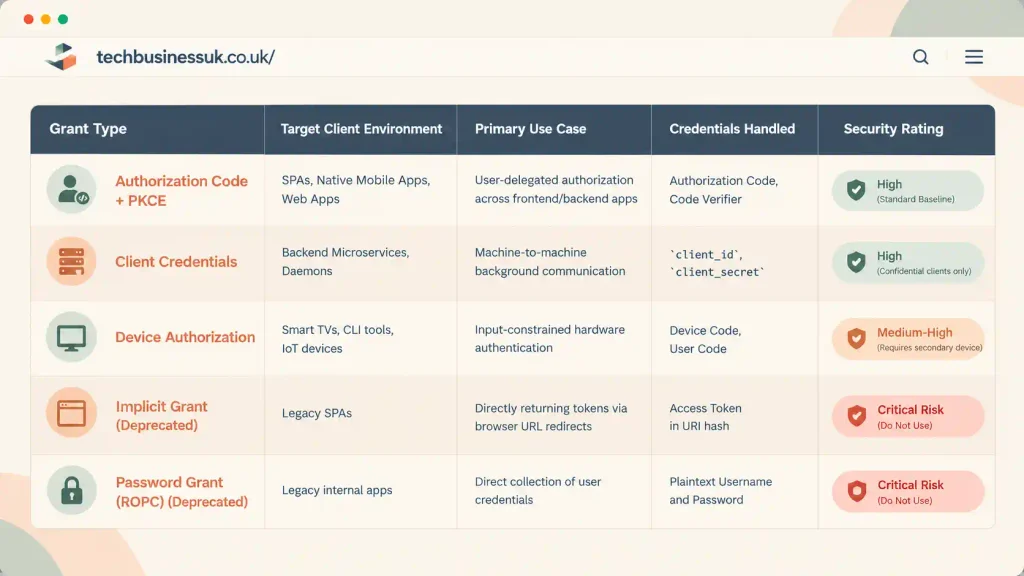
Modern enterprise security baselines explicitly forbid the following legacy flows:
- Implicit Grant: Returned access tokens directly in the URL hash fragment (
#access_token=...). This exposed access tokens to browser history, proxy access logs, and malicious browser extensions. - Resource Owner Password Credentials (ROPC): Required users to type their primary account credentials directly into the client application. This completely bypasses multi-factor authentication (MFA), exposes plain-text credentials to application code, and breaks the core principle of delegated authorization.
Comparing OAuth 2.0 Grant Types and Security Profiles
Modern Security Standards & Threat Mitigation (RFC 9700)
The Internet Engineering Task Force (IETF) published RFC 9700 to consolidate OAuth 2.0 Security Best Current Practice guidelines. Incorporating these requirements into your architecture defends against evolving threat vectors across modern web environments, as highlighted by security frameworks from the OWASP API Security Project.
Protecting Redirect URIs and Mitigating CSRF Attacks
Authorization servers must enforce strict string matching for all registered redirect URIs. Wildcards, path traversal parameters, or partial domain matching allow attackers to manipulate parameters and exfiltrate authorization codes.
INSECURE VALIDATION (Wildcard):
https://*.example.com/oauth/callback -> Vulnerable to subdomain takeover

SECURE VALIDATION (Exact String Matching):
https://app.example.com/oauth/callback -> Enforced strictly
Cross-Site Request Forgery (CSRF) in OAuth occurs when an attacker tricks a target victim’s browser into completing an authorization flow initiated by the attacker, binding the victim’s account to the attacker’s resources. Implementing PKCE naturally protects against code-based CSRF. For non-PKCE flows, anti-CSRF binding tokens passed via the state parameter are mandatory.
Preventing Token Injection and Mix-Up Attacks
In environments using multiple Authorization Servers, an attacker can execute a mix-up attack by tricking a client into exchanging an authorization code issued by an honest server at an attacker-controlled endpoint.
To prevent mix-up attacks:
- Authorization servers must return the issuer identifier parameter (
iss) in authorization responses:[https://app.example.com/cb?code=AUTH_CODE_123&iss=https%3A%2F%2Fauth.enterprise.com](https://app.example.com/cb?code=AUTH_CODE_123&iss=https%3A%2F%2Fauth.enterprise.com) - The client verifies that the returned
issmatches the intended Authorization Server before sending the code exchange request. - For confidential clients, replace static secrets with cryptographic assertion mechanisms such as Mutual TLS (mTLS) or Private Key JWT (
private_key_jwt).
Managing Token Lifecycles with Refresh Token Rotation
Because refresh tokens carry long lifespans, compromised tokens give malicious actors persistent access to enterprise resources. Implementing Refresh Token Rotation limits this risk:
Normal Exchange:
Client sends RT_1 -> Server issues AT_2 + RT_2 (RT_1 is invalidated)

Compromise / Replay Detected:
Attacker presents reused RT_1 -> Server invalidates RT_1, RT_2, and revokes active session family.
When a client presents an existing refresh token ($RT_1$), the server issues a new access token ($AT_2$) alongside a fresh refresh token ($RT_2$), immediately invalidating $RT_1$. If an attacker intercepts $RT_1$ and attempts to reuse it later, the server detects the breach, flags $RT_1$ as already consumed, and revokes the entire associated token lineage instantly.
Enterprise API Governance & Architectural Patterns
Scaling OAuth 2.0 across enterprise microservices requires robust token routing and centralized identity management.
Backend-For-Frontend (BFF) Architecture for Web Applications
Browser environments cannot securely store long-lived tokens due to Cross-Site Scripting (XSS) risks. The Backend-For-Frontend (BFF) pattern resolves this by placing a dedicated lightweight server layer between the Single-Page Application (SPA) and downstream APIs.
+---------------+              +-------------------+              +-----------------------+
|  SPA Client   | <---HTTP---> |    BFF Server     | <---OAuth--->|  Authorization Server |
|  (Browser)    |   Cookies    | (Confidential)    |    Tokens    |  & Microservices      |
+---------------+              +-------------------+              +-----------------------+
- The SPA communicates with the BFF layer using encrypted,
HttpOnly,SameSite=Strict,Securesession cookies. - The BFF handles all OAuth 2.0 protocol interactions server-side as a confidential client.
- Upon issuing tokens, the BFF stores access and refresh tokens inside secure server sessions or encrypted key-value stores.
- When the browser makes API requests, the BFF interceptor extracts the session cookie, attaches the corresponding access token to the upstream HTTP
Authorizationheader, and forwards the request.
API Gateway Integration and Token Validation Strategies
At the network edge, API Gateways validate tokens before routing requests to inner microservices. Learn how authentication logic fits into gateway architectures in our guide on What Is an API Gateway?.
                 +-------------------+
                 |    API Gateway    |
                 +-------------------+
                   /               \
       Stateless  /                 \ Introspection
      Validation /                   \ (RFC 7662)
                v                     v
     +---------------------+   +---------------------+
     | Public Key Set JWKS |   | Auth Server Endpoint|
     +---------------------+   +---------------------+
Gateways perform token verification using one of two primary strategies:
- Decentralized JWT Verification: The gateway downloads and caches JSON Web Key Sets (JWKS) from the authorization server. It verifies access token signatures statelessly using public keys, ensuring minimal latency.
- Centralized Token Introspection (RFC 7662): For opaque tokens, the gateway makes a synchronous back-channel call to the Authorization Server’s
/introspectendpoint. This allows real-time revocation checks at the cost of additional network latency.
Scope Design and Least-Privilege Access Control
Scopes define the structural access parameters of an issued token. Effective scope design follows hierarchical, action-resource naming conventions:
[service]:[resource]:[action]

Examples:
- payments:invoices:read
- users:profile:write
- admin:system:reboot
Microservices must strictly evaluate scopes on incoming requests. An access token scoped to payments:invoices:read must be rejected immediately if presented to a DELETE /payments/invoices/102 route.
Common OAuth 2.0 Implementation Mistakes
Despite comprehensive RFC specifications, developers frequently introduce critical vulnerabilities during implementation.
Misconfiguring PKCE and Weak Cryptographic Verifiers
A common error involves generating predictable code_verifier strings or using weak pseudo-random number generators (PRNGs):
// INSECURE IMPLEMENTATION
const codeVerifier = Math.random().toString(36).substring(2); // Low entropy

// SECURE IMPLEMENTATION (Node.js)
const crypto = require('crypto');
const codeVerifier = crypto.randomBytes(32)
  .toString('base64url'); // High entropy, cryptographically strong
Additionally, setting code_challenge_method=plain forces the authorization server to compare plain text strings directly, bypassing the SHA-256 transformation and rendering PKCE useless against network sniffing. Always enforce S256.
Storing Tokens in Vulnerable Browser Storage
Placing access or refresh tokens into window.localStorage or window.sessionStorage allows any malicious third-party JavaScript package or XSS vector to read token strings directly.
// INSECURE: Vulnerable to XSS token theft
localStorage.setItem('access_token', tokenResponse.access_token);

// SECURE: Store tokens in HttpOnly cookies managed by a BFF server layer
document.cookie = "session_id=...; Secure; HttpOnly; SameSite=Strict";
Over-Scoping Tokens and Ignoring Scope Enforcement
Applications often default to requesting broad, all-encompassing scopes (e.g., scope=admin or scope=*) to simplify integration. This violates the principle of least privilege. If a broad token leaks, an attacker gains full access to the target API surface.
Insecure Verification of JSON Web Tokens (JWTs)
When resource servers parse JWT access tokens, common implementation errors include:
- Accepting the
noneAlgorithm: Failing to reject JWT headers containing"alg": "none", allowing attackers to bypass signature validation by submitting unsigned payloads. - Ignoring Audience (
aud) and Issuer (iss) Claims: Validating cryptographic signatures while failing to confirm that the token was generated by a trusted issuer specifically for the receiving API service.
Testing and Validating OAuth 2.0 Endpoints
Verifying authorization server behavior requires structured automated security scans and integration testing.
Automated Vulnerability Scanning for Auth Endpoints
Automated testing tools intercept HTTP requests during the OAuth grant cycle to test for common vulnerabilities:
- Redirect Manipulation: Injecting external domains into
redirect_uriparameters to test for wildcards or path traversal gaps. - Token Replay: Re-submitting an authorization code or rotated refresh token to verify immediate rejection.
- Alg None Attacks: Stripping the signature from a JWT access token, altering claims, setting
alg: none, and testing if the API gateway accepts the payload.
Intercepting and Verifying Token Exchanges in CI/CD
Integrating token evaluation assertions into continuous integration pipelines ensures auth regressions are caught early:
import jwt
import requests
import unittest

class TestOAuthSecurity(unittest.TestCase):

    def test_token_expiration_and_claims(self):
        # Obtain token from server
        response = requests.post("https://auth.staging.local/oauth/token", data={
            "grant_type": "client_credentials",
            "client_id": "test_service",
            "client_secret": "test_secret"
        })
        token = response.json().get("access_token")

        # Unverified decode for inspection
        header = jwt.get_unverified_header(token)

        # Assert mandatory algorithm
        self.assertEqual(header["alg"], "RS256")

        # Verify payload structure with strict options
        payload = jwt.decode(
            token,
            options={"verify_signature": False} # Validated separately at Gateway
        )
        self.assertIn("aud", payload)
        self.assertEqual(payload["iss"], "https://auth.staging.local")

if __name__ == "__main__":
    unittest.main()
Decision Matrix: Choosing the Optimal OAuth 2.0 Architecture
Use the following architectural decision framework to match specific client constraints with the appropriate grant flow, storage model, and token validation strategy:
Start
  |
  +--> Is this machine-to-machine communication with no user context?
  |      |-- YES: Use [Client Credentials Grant] -> Store credentials in Vault/K8s Secrets.
  |      +-- NO: Continue...
  |
  +--> Is the device input-constrained (e.g., Smart TV, CLI tool)?
  |      |-- YES: Use [Device Authorization Grant (RFC 8628)].
  |      +-- NO: Continue...
  |
  +--> Is the application a browser-based SPA or native mobile app?
         |-- YES: Use [Authorization Code Flow with PKCE (S256)].
         |        +-- For Web SPAs: Wrap with [BFF Pattern], store session in HttpOnly cookies.
         |        +-- For Mobile: Use Claimed HTTPS Custom Schemes / Universal Links.
         |-- NO (Traditional Server-Side Web App):
                  Use [Authorization Code Flow with PKCE] + Confidential Client Secrets.
Frequently Asked Questions About OAuth 2.0
What is the difference between OAuth 2.0 and OpenID Connect (OIDC)?
OAuth 2.0 is designed purely for delegated authorization, issuing access tokens used to request protected resources. OpenID Connect (OIDC) is an identity layer built on top of OAuth 2.0 that provides authentication, returning an additional id_token containing user identity assertions.
Why is PKCE recommended for confidential clients as well as public clients?
While PKCE originally mitigated code interception on public clients, it provides strong defense-in-depth for confidential clients as well. It binds token requests directly to the original authorization request, preventing authorization code injection, CSRF attacks, and code leakage via referrer headers.
How do I invalidate an OAuth 2.0 access token before it expires?
Stateless JWT access tokens cannot be revoked natively without checking a central store. To revoke them instantly, authorization servers implement OAuth 2.0 Token Revocation (RFC 7009), publishing revoked token IDs (jti) to a high-speed Redis blacklist checked by API gateways during request routing.
Should I use JWTs or opaque tokens for my access tokens?
Use JWTs when microservices need to validate permissions statelessly without making network calls back to the authorization server. Use opaque tokens when instant revocation is mandatory, requiring resource servers to validate tokens synchronously using RFC 7662 introspection.
How do I secure OAuth 2.0 redirect URIs in native mobile applications?
Native mobile apps must avoid custom URI schemes (such as myapp://) because malicious third-party apps can register the same custom scheme on the operating system. Instead, use claimed HTTPS links—such as Android App Links or iOS Universal Links—which cryptographically verify domain ownership through server-hosted asset files.
What is the purpose of OAuth 2.0 Authorization Server Metadata (RFC 8414)?
RFC 8414 defines a standardized discovery endpoint (typically hosted at /.well-known/oauth-authorization-server) that exposes server configuration metadata. Clients and gateways use this endpoint to auto-discover supported grant types, public keys (JWKS), scopes, and token endpoints automatically.
{
  "@context": "https://schema.org",
  "@type": "FAQPage",
  "mainEntity": [
    {
      "@type": "Question",
      "name": "What is the difference between OAuth 2.0 and OpenID Connect (OIDC)?",
      "acceptedAnswer": {
        "@type": "Answer",
        "text": "OAuth 2.0 is designed purely for delegated authorization, issuing access tokens used to request protected resources. OpenID Connect (OIDC) is an identity layer built on top of OAuth 2.0 that provides authentication, returning an additional id_token containing user identity assertions."
      }
    },
    {
      "@type": "Question",
      "name": "Why is PKCE recommended for confidential clients as well as public clients?",
      "acceptedAnswer": {
        "@type": "Answer",
        "text": "While PKCE originally mitigated code interception on public clients, it provides strong defense-in-depth for confidential clients as well. It binds token requests directly to the original authorization request, preventing authorization code injection, CSRF attacks, and code leakage via referrer headers."
      }
    },
    {
      "@type": "Question",
      "name": "How do I invalidate an OAuth 2.0 access token before it expires?",
      "acceptedAnswer": {
        "@type": "Answer",
        "text": "Stateless JWT access tokens cannot be revoked natively without checking a central store. To revoke them instantly, authorization servers implement OAuth 2.0 Token Revocation (RFC 7009), publishing revoked token IDs (jti) to a high-speed Redis blacklist checked by API gateways during request routing."
      }
    },
    {
      "@type": "Question",
      "name": "Should I use JWTs or opaque tokens for my access tokens?",
      "acceptedAnswer": {
        "@type": "Answer",
        "text": "Use JWTs when microservices need to validate permissions statelessly without making network calls back to the authorization server. Use opaque tokens when instant revocation is mandatory, requiring resource servers to validate tokens synchronously using RFC 7662 introspection."
      }
    },
    {
      "@type": "Question",
      "name": "How do I secure OAuth 2.0 redirect URIs in native mobile applications?",
      "acceptedAnswer": {
        "@type": "Answer",
        "text": "Native mobile apps must avoid custom URI schemes (such as myapp://) because malicious third-party apps can register the same custom scheme on the operating system. Instead, use claimed HTTPS links—such as Android App Links or iOS Universal Links—which cryptographically verify domain ownership through server-hosted asset files."
      }
    },
    {
      "@type": "Question",
      "name": "What is the purpose of OAuth 2.0 Authorization Server Metadata (RFC 8414)?",
      "acceptedAnswer": {
        "@type": "Answer",
        "text": "RFC 8414 defines a standardized discovery endpoint (typically hosted at /.well-known/oauth-authorization-server) that exposes server configuration metadata. Clients and gateways use this endpoint to auto-discover supported grant types, public keys (JWKS), scopes, and token endpoints automatically."
      }
    }
  ]
}
About the Author