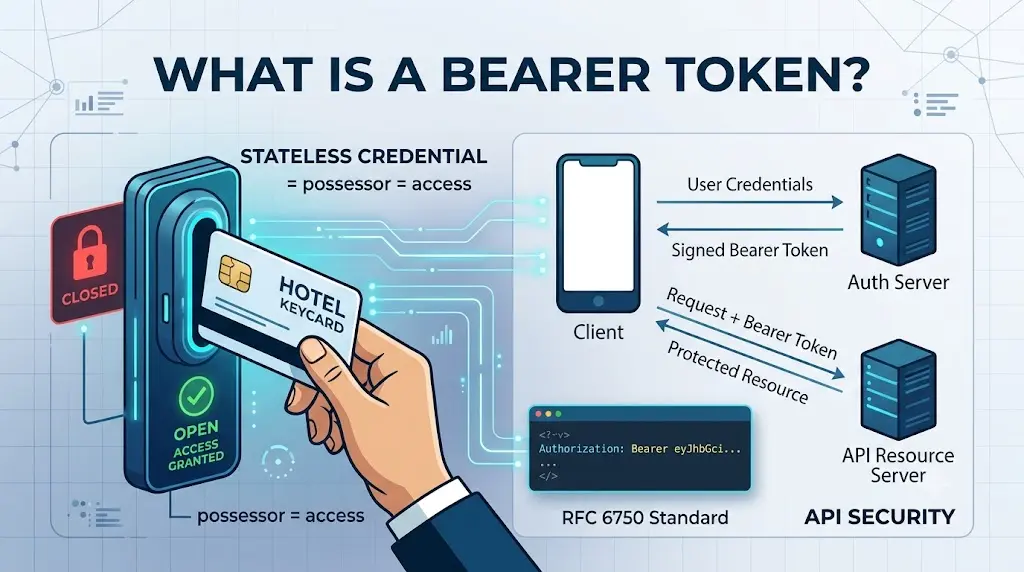
Imagine walking up to a hotel room door with an electronic keycard. The lock doesn’t ask for your full name, passport, or fingerprint—it simply checks if the keycard in your hand is valid. Whoever holds (or “bears”) that keycard gets access.
This is precisely what a bearer token is in modern digital security.
Understanding what is an access token is fundamental for backend engineers, security architects, and full-stack developers. Whether you are building RESTful microservices, securing single-page applications (SPAs), or configuring OAuth 2.0 authorization flows, bearer tokens serve as the global industry standard for passing stateless access credentials between clients and backend servers.
Bearer Token Definition & RFC 6750 Standard
In software engineering and API security, a bearer token is a cryptic access credential granting system access to whichever entity possesses it, without requiring the client to present additional cryptographic proof of identity with each request.
Standardized under RFC 6750 by the Internet Engineering Task Force (IETF), security string function as the default token type for OAuth 2.0 frameworks. When an application makes an API call, it attaches this string inside the standard HTTP request headers. The receiving server validates the token’s validity, scope, and expiration window before serving the requested payload.
The Official Authorization Header Syntax
To transmit a bearer token in an HTTP request, pass it inside the Authorization header field using the standard Bearer scheme:
GET /api/v1/user/settings HTTP/1.1
Host: api.example.com
Authorization: Bearer eyJhbGciOiJIUzI1NiIsInR5cCI6IkpXVCJ9.eyJzdWIi...
Syntax Rule: Notice the case-sensitive keyword Bearer followed by a single space before the encoded token string. Omitting the space or misspelling the prefix causes authorization handlers to throw 401 Unauthorized errors.
How Bearer Tokens Work in API Architecture
The lifecycle of a bearer credential follows a stateless 4-step sequence across the client, authorization server, and resource server:
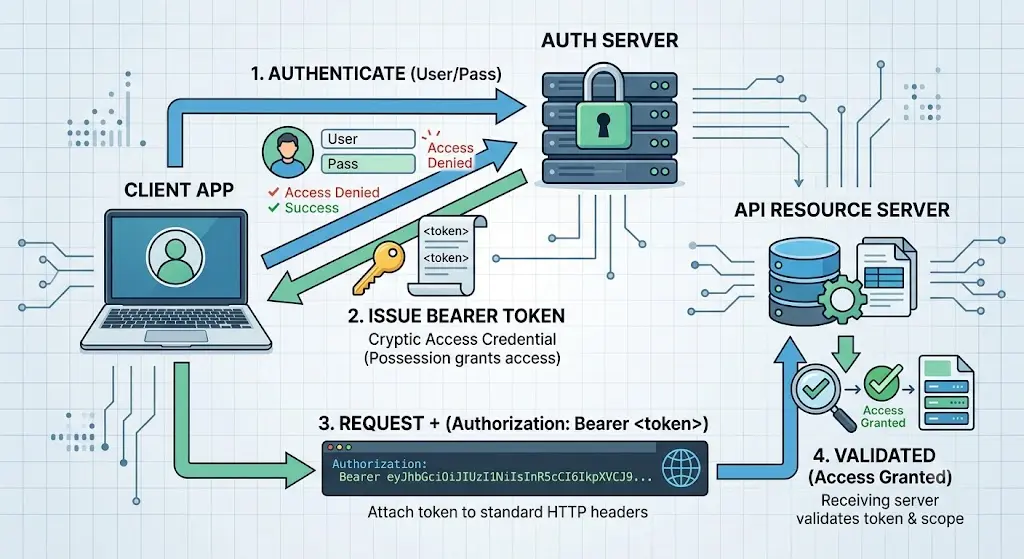
- Authentication: The client sends credentials (e.g., username/password or API client secret) to the authorization server.
- Token Issuance: Upon verification, the auth server generates a signed string and returns it to the client inside a JSON response body.
- Transmission: The client stores the token securely and attaches Authorization: Bearer <token> to all subsequent HTTP requests targeting protected endpoints.
- Validation & Decoupling: The API resource server verifies the token’s signature or checks it against a high-speed cache like Redis, serving the resource without hitting the primary database.
Bearer Token vs JWT vs API Key: Key Differences
Developers often confuse bearer tokens, JSON Web Tokens (JWTs), and API Keys. While they frequently work together in backend development, their architectural roles differ significantly.
- Bearer vs. JWT: “Bearer” refers to the delivery mechanism (how access is granted based on possession). “JWT” refers to the data format. A JWT is simply a structured format often used as a security string.
- Bearer vs. API Key: API Keys identify the calling application for billing, analytics, or project rate limits. Bearer Tokens authorize the end-user session interacting with the application.
To evaluate automated tools for scanning API endpoints for weak authorization schemes, see our round-up of top API Security Tools.
Bearer Tokens in ML Model Serving Pipelines
As machine learning transitions from experimental Jupyter Notebooks to robust, production-ready microservices, the spotlight has shifted to a critical architectural imperative: securing model inference endpoints. When organizations deploy computationally intensive large language models (LLMs)—such as Llama 3, Stable Diffusion, or fine-tuned BERT variants—via REST APIs or gRPC endpoints, access key have universally adopted as the primary mechanism for authorizing prediction requests.
Why is this shift occurring? The short answer is scalability and latency.
The Latency Argument: Stateless Over Session-Based
Traditional authentication, reliant on session cookies and server-side state lookups, introduces a serious bottleneck. Scalability suffers. A single ML inference API might need to manage 5,000 to 10,000 concurrent prediction calls per minute. This is where milliseconds matter.
Stateless tokens, typically implemented as JSON Web Tokens (JWT), empower the API gateway to validate access through extremely lightweight cryptographic signature checks. By verifying claims such as exp (expiration) and scope (permissions) on the edge, the backend system avoids resource-intensive lookups in a centralized database. This architectural choice shaves critical milliseconds off every inference call, directly translating to a superior user experience and significantly reduced cloud compute costs.
Enforcing Scopes: Preventing Model Theft and Runaway Costs
Furthermore, granular token scoping is mission-critical for enterprise-grade ML platforms. The stakes are high.
A single, carefully crafted bearer credential can encode specific permissions that dictate exactly what a client can access. For example, a token might authorize a user to query a lightweight, efficient 7B parameter model, while restricting access to a far more computationally expensive, high-latency 70B parameter enterprise variant. Without proper token scoping and strict resource isolation, organizations are exposed to devastating risks:
- Model Theft: Unauthorized access can allow malicious actors to reverse-engineer proprietary models through extensive querying.
- Runaway Inference Bills: Inadvertent or intentional access to massive models can explode operational budgets overnight.
Security Best Practices for Platform Engineers
For platform engineers and AI architects, implementing stateless authentication is non-negotiable. However, validating the token is only the beginning. True security requires defense-in-depth:
- Real-Time Anomaly Detection: Implement robust endpoint monitoring to detect sudden, suspicious spikes in inference requests originating from a single token. This can indicate a compromised credential or a brute-force scraping attempt.
- Request Nonces: For batch prediction jobs, which are often idempotent, use request nonces to effectively prevent replay attacks.
Ultimately, if you are architecting AI infrastructure, a deep understanding of API security tools and stateless validation is just as vital to production success as understanding the underlying transformer architecture.
Developer Code Example:
Here is a production-grade Python snippet using FastAPI’s native HTTPBearer class to extract and validate authorization tokens from incoming headers:
from fastapi import FastAPI, Depends, HTTPException, status
from fastapi.security import HTTPBearer, HTTPAuthorizationCredentials

app = FastAPI(title="Bearer Authentication API")

# Initialize HTTPBearer security scheme
bearer_scheme = HTTPBearer()

# Simulated token validation lookup
VALID_BEARER_TOKENS = {
    "secret-access-token-123",
    "eyJhbGciOiJIUzI1NiIsInR5cCI6IkpXVCJ9"
}

async def verify_bearer_token(
    credentials: HTTPAuthorizationCredentials = Depends(bearer_scheme)
) -> str:
    """
    Extracts 'Bearer <token>' from the Authorization header and verifies active access rights.
    """
    token = credentials.credentials
    if token not in VALID_BEARER_TOKENS:
        raise HTTPException(
            status_code=status.HTTP_401_UNAUTHORIZED,
            detail="Invalid or expired Bearer Token",
            headers={"WWW-Authenticate": "Bearer error=\"invalid_token\""},
        )
    return token

@app.get("/api/v1/user/dashboard")
async def get_dashboard_data(token: str = Depends(verify_bearer_token)):
    return {
        "status": "success",
        "message": "Authorized access granted via Bearer Token.",
        "active_token_snippet": f"{token[:10]}..."
    }
When handling token validation at scale, running verification functions asynchronously prevents thread blocking. For an in-depth breakdown of non-blocking concurrency models, read our analysis on Python Async vs Sync Systems Architecture.
Critical Bearer Token Security Risks & Mitigations
Because they rely entirely on possession, anyone who intercepts a valid bearer token can impersonate the client until the token expires. Securing them requires layered protection:
1. Enforce HTTPS / TLS Globally
Never transmit bearer tokens over plain HTTP. Without Transport Layer Security (TLS), malicious actors on public networks can capture unencrypted HTTP headers via network sniffing tools like Wireshark.
2. Secure Client-Side Storage
- Web Applications: Storing access tokens in browser localStorage or sessionStorage leaves them exposed to Cross-Site Scripting (XSS) attacks. Store access tokens inside HttpOnly, SameSite=Strict cookies whenever possible.
- Mobile Clients: Store tokens within native hardware-backed storage, such as iOS Keychain or Android Keystore.
3. Pair with Single-Use Nonces
To stop attackers from replaying intercepted authorization calls, combine bearer token headers with request timestamps and single-use nonces. To see how cryptographic nonces mitigate automated replay risks, check out our guide on What Does Nonce Mean in Security.
Conclusion
Mastering bearer tokens is essential for designing modern, stateless REST APIs and microservice architectures. By enforcing HTTPS encryption, configuring short token expiration windows, and pairing authorization tokens with client-side storage best practices, you can build seamless user authentication while maintaining high-grade API defense.
Frequently Asked Questions
What is a bearer token in simple terms?
It is a digital pass or access keycard. Whoever holds (bears) the token string is instantly granted access to an API resource without re-entering a username or password.
What is the RFC 6750 standard?
RFC 6750 is the official technical specification published by the IETF that dictates how HTTP bearer tokens must be formatted, transmitted, and validated within OAuth 2.0 frameworks.
What is the difference between a Bearer Token and a JWT?
An access token specifies the transmission mechanism (sending credentials via Authorization: Bearer), whereas a JWT defines a data structure (a Base64 JSON payload with digital signatures). JWTs are frequently used as the internal format for bearer tokens.
Can a bearer token be stolen and reused?
Yes. Because bearer tokens grant access based solely on possession, an attacker who intercepts a valid token can use it until it expires. This vulnerability is why bearer tokens must always be transmitted over HTTPS and given short lifespan limits.
How long should a bearer token remain valid?
Best practices dictate keeping bearer tokens short-lived—typically 15 to 60 minutes. Using brief expiration windows minimizes the exposure window if a token is intercepted, relying on secure refresh tokens to maintain long-lived user sessions.
About the Author

1 thought on “What is a Bearer Token: The Ultimate Definition, Header Examples & Trusted Security”