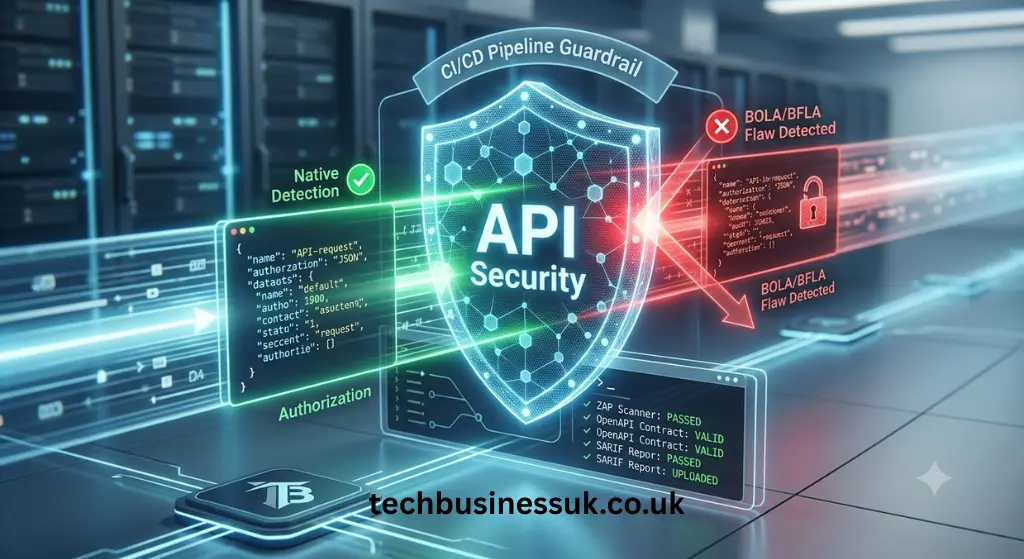
The Critical Shift From Testing to Continuous Security
In our last guide, we broke down the best api testing tools to validate your workflows and keep your endpoints functional. But let’s be real for a second: ensuring an API works is only half the battle. You also have to ensure it can’t be exploited. Today, we are shifting our focus to api security tools to show you how to automate vulnerability scanning, implement api security best practices, and deploy defensive api security solutions that stop attackers right in their tracks.
An API that passes functional tests can still be a massive security liability. Your unit tests might confirm that a GET /api/v1/user/9921 request successfully returns a valid JSON payload with a 200 OK status code. However, standard testing blocks rarely check what happens when a user authenticated as ID 9922 intentionally requests the data for ID 9921.
Security vulnerabilities hide behind structurally perfect code. If your testing pipeline is only checking for schema validation and response times, you are completely blind to structural logic flaws. To protect your software supply chain, you must transition from simple assertion checks to active, adversarial security scanning.
The 2026 API Security Stack: At a Glance
If you are looking for immediate deployment options, here is a quick directory of the top 7 tools reviewed in detail below:
| Tool | Core Focus | Best For |
| 42Crunch | Contract Enforcement | Design-first REST ecosystems |
| StackHawk | Local Pipeline DAST | Developer-led CI/CD workflows |
| Escape.tech | AI-Driven Fuzzing | Agentless GraphQL & REST discovery |
| Levo.ai | eBPF Traffic Mapping | Continuous pre-production telemetry |
| Akamai Security | Global Estate Discovery | Massive enterprise attack surfaces |
| Traceable AI | Distributed Tracing | Complex microservice environments |
| OWASP ZAP | Open-Source Testing | Budget-conscious custom scripting |
At-a-Glance Comparison: The Top 7 API Security Tools for 2026
Moving beyond basic functional assertions requires choosing a tool that fits tightly into your active development lifecycle. To make an informed decision, you must evaluate how each tool from our summary stack operates, its unique technical advantage, and where it falls short. Here is a candid, engineer-to-engineer review of the top 7 platforms.
1. 42Crunch: Contract Enforcement
42Crunch approaches API security from a design-first framework. Instead of waiting to scan a live, running endpoint, it analyzes your OpenAPI/Swagger definitions before a single line of code goes live.
- Best For: Design-first REST environments.
- Key Capability: It scores your API contract definitions against security best practices, pointing out loose schemas, missing authentication scopes, and weak data types. In production, its micro-API firewall enforces those exact contract boundaries, instantly dropping requests that deviate from the schema.
- The Trade-off: If your development team treats OpenAPI documentation as an afterthought rather than a source of truth, 42Crunch will introduce friction to your delivery pipeline.
2. StackHawk: Local Pipeline DAST
StackHawk brings Dynamic Application Security Testing (DAST) directly into the developer’s local environment and CI/CD pipelines.
- Best For: Developer-led CI/CD workflows.
- Key Capability: It spins up concurrently with your integration tests, systematically targeting your local endpoints with malicious inputs. It is designed to find injection flaws, broken object-level authorization (BOLA), and configuration errors while the code is still fresh.
- The Trade-off: It relies heavily on you providing seed data or pre-configured collections (like Postman or OpenAPI specs) to properly map out authenticated application routes.
3. Escape.tech: AI-Driven Fuzzing
Escape specializes in agentless, zero-configuration discovery with a heavy emphasis on GraphQL and modern REST architectures.
- Best For: Agentless GraphQL & REST discovery.
- Key Capability: By leveraging feedback-driven business logic fuzzing, Escape automatically maps entire API schemas from the outside looking in. It generates complex, multi-step sequence attacks to find multi-endpoint logic flaws without requiring internal pipeline integration.
- The Trade-off: Because it operates externally, it won’t provide deep, internal line-of-code stack traces for remediation.
4. Levo.ai: eBPF Traffic Mapping
Levo takes a unique, low-overhead approach by using extended Berkeley Packet Filters (eBPF) to monitor the Linux kernel layer.
- Best For: Continuous pre-production telemetry.
- Key Capability: It captures and maps live, production machine-to-machine traffic without requiring application-level code modifications or heavy sidecar proxies. This allows it to automatically build real-time behavioral baselines, classify sensitive data schemas (PII/PHI), and surface logic-based anomalies.
- The Trade-off: Its primary strength lies in runtime environment coverage, meaning it acts as a continuous safety net rather than a tool to test code branches before merge.
5. Akamai Security: Global Estate Discovery
Akamai uses its massive global edge network delivery footings to handle API sprawl across massive enterprise environments.
- Best For: Massive enterprise attack surfaces.
- Key Capability: By parsing massive volumes of edge traffic, it catalogs every public-facing endpoint across your organization. It is designed to instantly flag “shadow APIs” (undocumented endpoints forgotten by developers) and “zombie APIs” (deprecated legacy endpoints left online).
- The Trade-off: It is built for macroscopic infrastructure visibility and perimeter defense; it won’t replace localized, developer-centric pipeline fuzzing.
6. Traceable AI: Distributed Tracing
Traceable targets complex microservice architectures where an exploit might traverse multiple internal services before execution.
- Best For: Complex microservice environments.
- Key Capability: It weaves into your application performance monitoring (APM) and service mesh data streams to analyze distributed traces. By evaluating end-to-end user journeys across microservices, it detects advanced, distributed BOLA/BSTA attacks that isolated edge firewalls miss.
- The Trade-off: Deep distributed tracing setup can require intrusive instrumentation across heavily varied language runtimes.
7. OWASP ZAP: Open-Source Testing
OWASP Zed Attack Proxy (ZAP) is the industry-standard open-source tool for manual and automated security scanning.
- Best For: Budget-conscious custom scripting.
- Key Capability: ZAP serves as a highly scriptable intercepting proxy. It lets security engineers write custom scripts to intercept, modify, and replay API traffic to stress-test custom business logic on a minimal budget.
- The Trade-off: Out of the box, it requires significant manual configuration and upkeep compared to modern commercial platforms that offer native CI/CD abstractions.
Modern API Security Solutions: Why WAFs Fail
Traditional firewalls are blind to the unique architectural flaws of modern endpoints. For years, development teams relied entirely on Web Application Firewalls (WAFs) to intercept external threats at the network perimeter. A legacy WAF inspects incoming payloads for known malicious signatures, such as SQL injection strings or cross-site scripting scripts.
The fundamental problem is that modern API exploits do not look like malicious injections. When an attacker targets an endpoint, they bypass traditional perimeters by exploiting broken object-level authorization (BOLA). They log in legally, receive a legitimate JSON Web Token (JWT), and then alter parameters inside the API request to access resource fields belonging to other accounts.
Because the traffic uses standard HTTPS protocols, carries a valid authentication token, and requests valid JSON schemas, your perimeter firewall marks it as entirely safe.
| Security Feature | Traditional WAF Capabilities | Dedicated API Security Tools |
|---|---|---|
| Threat Inspection Focus | Inspects network signatures and known attack strings. | Analyzes unique application logic and user behavior patterns. |
| BOLA/BFLA Detection | Blind. Cannot detect authorization parameter manipulation. | Native. Maps relationships between tokens and requested asset IDs. |
| Schema Enforcement | Basic HTTP protocol validation only. | Strict validation against live OpenAPI/Swagger contracts. |
| Inventory Management | Requires manual definition of routed endpoints. | Automated discovery of undocumented “shadow” APIs. |
Shifting security left is the only reliable way to catch these structural errors. Relying on reactive, production-side monitoring means you are simply waiting for an incident response team to handle a data breach after it happens. Modern development teams deploy purpose-built api security tools directly inside their CI/CD pipelines.
By executing automated vulnerability scanning on every pull request, you can actively simulate access control manipulation, token expiration failures, and resource exhaustion bugs before your code ever hits an external server. This brings security enforcement into alignment with the OWASP API Security Top 10 framework without adding human bottleneck points to your release cycles.
Evaluation Criteria: How to Choose an API Security Tool
Selecting the right platform requires evaluating how cleanly a scanner weaves into an active engineering workflow. If a security platform adds massive friction or slows down feature delivery, developers will naturally find ways to bypass it. To find a solution that balances rigorous protection with developer velocity, you must evaluate three core pillars.
1. Shift-Left CI/CD Pipeline Integration
True shift-left security means catching structural vulnerabilities before code ever reaches a staging or production environment. Legacy security scanners were designed to run periodically as slow, standalone processes, often managed by a siloed security team completely separate from development.
Modern engineering demands that your chosen software hooks directly into your version control system, such as GitHub Actions, GitLab CI/CD, or Bitbucket Pipelines. The tool should trigger automatically upon every pull request, executing lightweight, passive context analysis alongside your standard unit tests. This immediate feedback loop allows software engineers to patch logic flaws or exposed endpoints directly within their IDEs before code commits can mutate into production liabilities.
2. High-Accuracy Testing and Low False Positive Rates
Alert fatigue is the fastest way to kill a team’s security posture. When a scanner repeatedly flags normal routing behavior, secure endpoints, or intentional data structures as high-severity vulnerabilities, developers quickly stop taking the tool seriously.
Advanced testing tools utilize dynamic semantic analysis and API blueprint parsing to understand the explicit context of your data layer. Rather than tossing generic alerts for every unencrypted parameter, the platform should actively validate threats through contextual fuzzing—sending manipulated test requests to see if the API actually breaks. Prioritizing platforms that verify their findings minimizes noise, keeps your security dashboard clean, and ensures your team only spends development cycles patching genuine exploits.
3. Comprehensive Visibility and Contract Compliance
You cannot protect what you do not know exists on your servers. Over time, fast-moving development sprints naturally leave behind forgotten, unmapped endpoints—frequently referred to as shadow or rogue APIs.
The baseline capability of an enterprise security tool must include continuous, automated discovery of your live attack surface. It should constantly parse your code repositories to automatically generate and update OpenAPI (Swagger) specifications. By matching real-time traffic profiles against your documented design contracts, the tool immediately highlights undocumented paths, missing authentication headers, or unauthorized data exposures that violate your core architectural guidelines.
Implementing API Guardrails: From Baseline Scans to CI/CD Automation
Deploying security software means nothing if the tools operate in a vacuum. To move from theoretical protection to hard infrastructure rules, engineering teams must follow a two-phased playbook: establishing an unshakeable, non-breaking baseline scan, and then codifying automated guardrails to block vulnerable pull requests before they ever breach your environment.
Phase 1: Establishing the Baseline via Passive Scanning
The baseline scan is your initial diagnostic phase. When introducing security tools to an existing codebase, running aggressive active fuzzing immediately is a mistake; it creates massive noise, disrupts staging environments, and risks breaking down active databases.
Passive scanning acts as an out-of-band proxy that monitors standard API request-and-response traffic without mutating payloads or altering values. To set up an effective baseline:
- Route existing integration tests (such as Playwright, Newman, or Cypress workflows) through your security tool’s local proxy port.
- Execute your functional test suite completely. As your tests trigger real business logic, the proxy passively captures the underlying traffic schemas.
- Audit contract discrepancies by allowing the scanner to automatically generate an OpenAPI draft based on live traffic, highlighting hidden endpoints or leaked backend headers.
The following configuration demonstrates how to implement this passive diagnostic loop within a weekly GitHub Actions workflow:

# .github/workflows/api-security-baseline.yml
name: API Security Baseline Scan

on:
  schedule:
    - cron: '0 2 * * 0' # Runs automatically every Sunday at 2 AM to track drift
  workflow_dispatch:

jobs:
  baseline-scan:
    runs-on: ubuntu-latest
    steps:
      - name: Checkout Codebase
        uses: actions/checkout@v4

      - name: Spin Up Local API Service
        run: |
          docker-compose up -d api-service
          sleep 10 # Ensures database migrations settle

      - name: Execute Passive Security Proxy
        run: |
          docker run -d -p 8080:8080 --name secure_proxy zaproxy/zap-stable zap.sh -daemon -port 8080 -host 0.0.0.0 -config api.disablekey=true

      - name: Run Functional Test Suite via Proxy
        env:
          HTTP_PROXY: http://localhost:8080
          TARGET_URL: http://localhost:3000
        run: |
          npm ci
          npm run test:integration -- --url=$TARGET_URL

      - name: Parse Security Baseline Inventory
        run: |
          curl -s http://localhost:8080/OTHER/core/other/htmlreport/ > api-security-baseline-report.html
Phase 2: Enforcing Hard CI/CD Pipeline Guardrails
An audited baseline allows you to shift directly into automated blocking states. In this stage, you transition the security scanner from passive monitoring into an active pipeline gatekeeper.
Automated guardrails ensure that if a developer introduces a pull request containing a high-severity flaw—such as broken object-level authorization (BOLA) or unauthenticated routes—the continuous integration (CI) build actively fails and blocks the code from merging into production.
To enforce this continuous validation, implement the following pull request pipeline configuration:
# .github/workflows/api-security-guardrail.yml
name: API Security Guardrail Gate

on:
  pull_request:
    branches: [ main, develop ]

jobs:
  security-gate:
    runs-on: ubuntu-latest
    steps:
      - name: Checkout PR Branch
        uses: actions/checkout@v4

      - name: Run Contextual API Security Scan
        uses: zaproxy/action-api-scan@v0.7.0
        with:
          token: ${{ secrets.GITHUB_TOKEN }}
          format: openapi
          target: './docs/openapi-spec.json' # Uses your design contract
          rules_file_name: '.zap/security-policy.conf' # Enforces customized alert rules
          fail_action: true # CRITICAL: This line forces the PR build to break on policy failures

      - name: Enforce SARIF Security Upload
        if: always()
        uses: github/codeql-action/upload-sarif@v3
        with:
          sarif_file: 'results.sarif'
By committing a policy configuration file (like .zap/security-policy.conf) directly into your repository, you define the exact risk thresholds for your application. For example, you can set the pipeline to flag informational alerts as simple logs, while instantly breaking the build if any test case exposes a critical structural vulnerability.
Conclusion: Balancing Velocity and Security in the API Era
The velocity of modern software deployment is changing forever. However, the organizations that thrive in this new landscape will not be the ones that code the fastest, but those that can successfully mitigate API security concerns without destroying developer velocity.
API-centric architectures are massive force multipliers, but an unreviewed code stack is a recipe for a catastrophic breach. By transitioning from blind trust to active verification, your engineering team can safely leverage the incredible productivity gains of distributed architectures while keeping your core intellectual property completely secured.
The Secure-by-Design API Checklist
- Conduct Spec Audits: Enforce schema validation on all commits using a contract checker to eliminate input validation vulnerabilities before execution.
- Implement Automated Guardrails: Integrate automated vulnerability scanning inline inside GitHub Actions to break the build on critical OWASP vulnerabilities.
- Map Shadow APIs: Deploy traffic-monitoring or eBPF-based discovery engines to continuously catalog unmapped and zombie endpoints.
- Harden Authentication: Never allow unencrypted bearer tokens or parameter-manipulation vulnerabilities to pass peer reviews.
- Apply Least Privilege: Ensure every authorization token strictly matches the structural context of the database resources it is requesting.
Read this too: API Testing Tools
Frequently Asked Questions (FAQs)
Q1: Can a standard Web Application Firewall (WAF) protect against BOLA?
No. WAFs inspect payloads for known malicious structural signatures like SQL injections. They are completely blind to logic tampering (like changing user ID variables inside a valid request schema) because the traffic looks like legitimate HTTPS user transactions.
Q2: What is the primary difference between passive and active API scanning?
Passive scanning monitors standard, flowing traffic schemas out-of-band without altering values. Active scanning actively injects modified values, malicious parameters, and fuzzing payloads into endpoints to check if they break under stress.
Q3: How do “shadow APIs” occur, and how do we prevent them?
Shadow APIs are undocumented or forgotten endpoints created during fast deployment cycles. You prevent them by using automated telemetry platforms or eBPF scanners to map out every live route on your network automatically.
About the Author

2 thoughts on “7 Best API Security Tools to Stop Production Exploits”