APIs form the digital connective tissue connecting microservices, legacy databases, mobile applications, and third-party partner ecosystems. Without a unified operational strategy, organizations rapidly suffer from endpoint sprawl, unpatched security vulnerabilities, and broken integration pathways. API lifecycle management delivers the structured governance framework required to control digital assets from initial concept to safe sunsetting. Managing endpoints systematically ensures high availability, strict security compliance, and frictionless developer adoption across complex architectures.
Key Takeaways
- End-to-End Governance: Successful api lifecycle management standardizes every phase—from initial design and automated testing to runtime ingress and graceful retirement.
- API-First Strategy: Defining OpenAPI schemas before writing code eliminates integration bottlenecks and aligns development teams early.
- Shift-Left Security: Enforcing security testing, contract validation, and schema checks early in CI/CD pipelines prevents costly production vulnerabilities.
- Platform Choice: Choosing between commercial api management platforms vs custom in house tooling dictates long-term scaling overhead and operational flexibility.
What Is API Lifecycle Management and Why Does It Matter?
At its core, API lifecycle management encompasses the complete set of processes, tools, and policies used to design, deploy, secure, monitor, and decommission application programming interfaces. As modern architectures transition toward microservices and event-driven systems, the number of internal and external endpoints grows exponentially. Unmanaged APIs create severe operational friction, resulting in orphaned code, untracked shadow APIs, and fragmented security policies.
Establishing a disciplined lifecycle framework replaces ad-hoc development with predictable engineering routines. It ensures that every endpoint complies with corporate security baselines, adheres to performance SLAs, and provides reliable developer documentation. Aligning early engineering workflows with specialized API testing tools guarantees that endpoints pass stringent functional and contract tests before exposing data to external consumers.
Phase 1: API Strategy and Digital Transformation
A successful API initiative starts with business strategy rather than technical implementation. Engineering leaders must identify the primary business objectives driving the API program—whether that means modernizing internal legacy software, creating partner integrations, or building revenue-generating public products.
[ Business Goals ] ---> [ API Product Roadmap ] ---> [ Developer Portal Strategy ]
Defining clear monetization models and rate tiers early shapes technical requirements. Additionally, teams must plan the developer portal strategy during this phase. A well-designed portal serves as the primary storefront for developers, offering self-service onboarding, interactive documentation, and immediate API key provisioning.
Phase 2: API Architecture and Specification Design
Adopting an API-first methodology ensures that contracts are fully established before writing underlying service logic. Teams write machine-readable specs using the OpenAPI Initiative best practices framework, establishing uniform data formats, query parameters, and response codes across all services.
When selecting protocol styles, teams balance architectural requirements:
- REST: Ideal for resource-oriented operations, standard HTTP caching, and broad public consumption.
- GraphQL: Excellent for complex, highly nested data queries where clients require precise field selection.
- gRPC / WebSockets: Designed for high-throughput microservice communication and low-latency streaming.
Standardizing schemas across development teams eliminates integration surprises later, ensuring consistent error responses and uniform authentication mechanisms.
Phase 3: Development, Mocking, and Implementation
Once schema definitions pass architectural review, engineering teams generate mock servers directly from the OpenAPI specification. Mocking and decoupling dependencies allows frontend developers, mobile engineers, and third-party partners to build against functional endpoints while backend teams implement core business logic.
                  +---> [ Mock Server ] ---> Frontend / Mobile Teams
[ OpenAPI Spec ] -|
                  +---> [ Service Logic ] ---> Backend Engineering
Parallel development dramatically reduces time-to-market. Developers use automated code generators to create server stubs and client SDKs, maintaining strict alignment with design contracts and preventing custom, non-standard implementations.
Core Stages of the Enterprise API Lifecycle
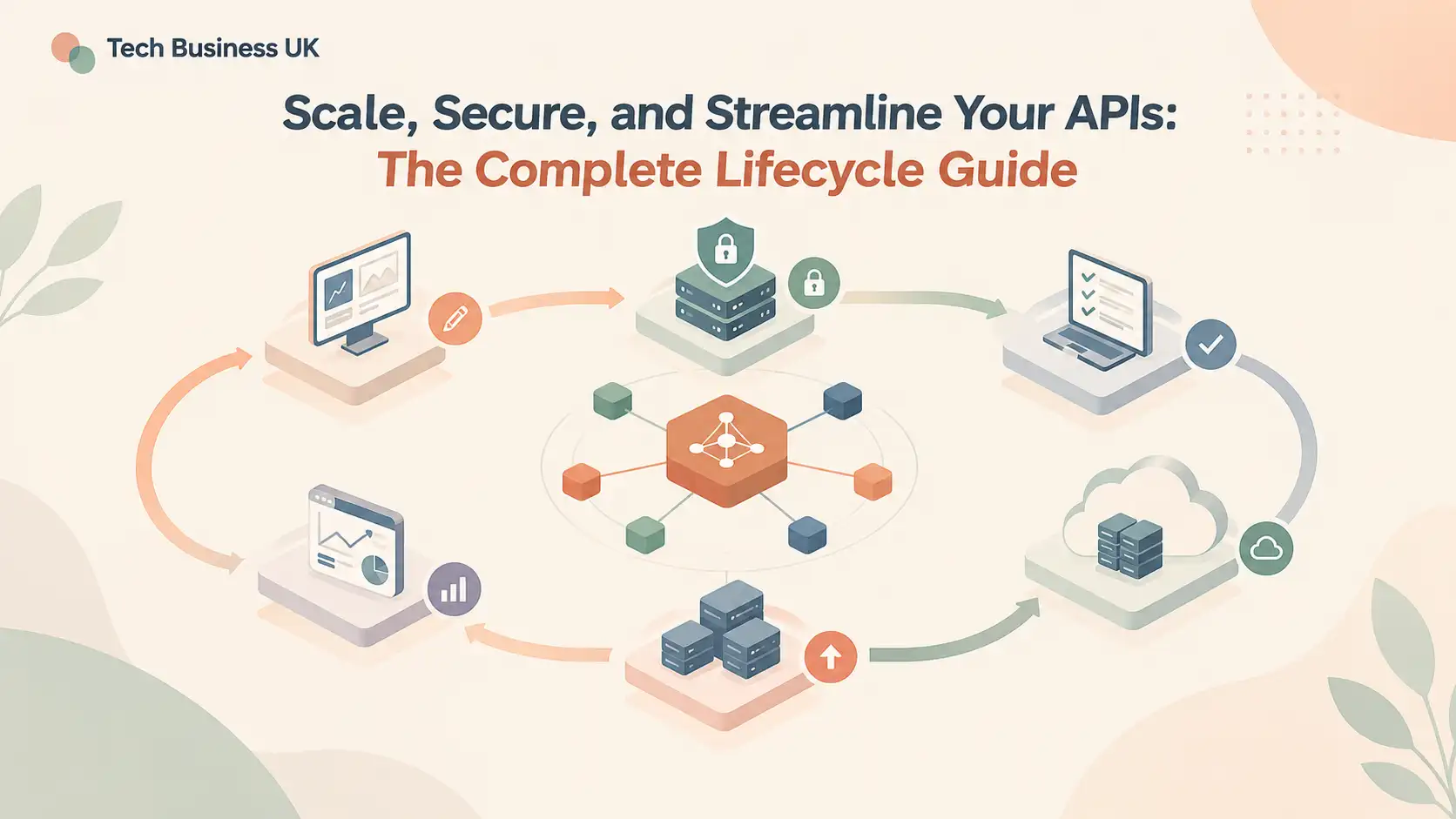
Executing the core stages of the enterprise api lifecycle requires combining continuous delivery automation, robust perimeter defense, and continuous observability.
+-----------------------------------------------------------------------------------+
|                     CORE STAGES OF THE ENTERPRISE API LIFECYCLE                  |
+-----------------------------------------------------------------------------------+
|  [Phase 4: QA]  -->  [Phase 5: Ingress]  -->  [Phase 6: Observability]  -->  [Phase 7] |
|   Contract &          mTLS, Gateway            Metrics, Tracing,        Deprecation  |
|   Security Tests      & Rate Limits            & SLA Tracking           & Sunsetting |
+-----------------------------------------------------------------------------------+
Phase 4: Automated Testing and Quality Assurance
Quality assurance begins inside the CI/CD pipeline long before code reaches production servers. Automated contract testing verifies that updates never violate established OpenAPI schemas or break client integrations unexpectedly.
Testing strategies must cover four critical layers:
- Functional Unit Testing: Validates business logic handling and response formatting.
- Contract Testing: Ensures strict consumer-provider payload compatibility.
- Security Vulnerability Scanning: Identifies authorization flaws, injection risks, and weak token checks.
- Load and Stress Testing: Simulates peak traffic bursts to expose memory leaks and concurrency bottlenecks.
Phase 5: Deployment, Gateway Ingress, and Runtime Security
Deploying endpoints into production demands centralized traffic control. An API gateway acts as the primary ingress point, inspecting incoming HTTP requests, enforcing strict rate-limiting policies, and terminating TLS connections. Implementing API gateway security controls protects backend microservices from automated bot attacks and denial-of-service attempts.
Client Request ---> [ API Gateway: Auth / Rate Limit / mTLS ] ---> Internal Microservice
Gateways authenticate traffic using modern standards like OAuth 2.0 and JSON Web Tokens (JWT). For East-West microservice traffic inside Kubernetes clusters, enforcing mutual TLS (mTLS) guarantees encrypted, authenticated communication across all internal boundaries.
Phase 6: Monitoring, Analytics, and API Observability
Runtime operations require complete visibility into health, performance, and usage trends. Observability platforms ingest structured log entries, metrics, and distributed traces to monitor endpoint performance continuously.
Key operational metrics include:
- Latency (p95 / p99): Measuring exact response durations across distinct regional locations.
- Error Rates (4xx / 5xx): Isolating client-side configuration issues from backend runtime failures.
- Throughput (RPS): Tracking total requests per second to evaluate capacity requirements.
- Token Consumption: Monitoring API usage by individual tenant for accurate billing and quota enforcement.
SLA performance dashboards alert engineering teams immediately when error thresholds spike or latency degraded beyond acceptable limits.
Phase 7: Versioning, Deprecation, and Graceful Retirement
Every software asset eventually reaches its end-of-life. Managing breaking changes gracefully prevents disruption for downstream enterprise clients. When major architectural updates require breaking schema changes, teams issue new major versions via URL paths (e.g., /v2/) or custom request headers.
Retiring legacy endpoints requires adherence to formal standards like the RFC 8594 Sunset header specification. The API returns explicit Sunset HTTP headers indicating the exact future date of decommission. Clear developer portal notifications, automated usage warnings, and extended migration windows ensure clients transition smoothly before legacy service shutdown.
API Management Platforms vs. Custom In-House Tooling
Choosing between commercial api management platforms vs custom in house tooling is a pivotal architectural decision. Off-the-shelf management platforms—such as Apigee, Kong Enterprise, or AWS API Gateway—provide pre-packaged developer portals, analytics engines, access control frameworks, and gateway routers.
+-----------------------------------------------------------------------------+
|               COMMERCIAL PLATFORMS VS. CUSTOM IN-HOUSE TOOLING              |
+------------------------------------+----------------------------------------+
| Commercial Management Platforms    | Custom In-House Tooling                |
+------------------------------------+----------------------------------------+
| • Turnkey security & governance    | • High operational engineering burden  |
| • Pre-built developer portals      | • Tailored integration flexibility     |
| • Enterprise vendor support        | • Zero licensing fees / OSS basis      |
+------------------------------------+----------------------------------------+
Conversely, building custom infrastructure using open-source reverse proxies (like NGINX or Envoy) combined with custom developer portals offers maximum flexibility. However, custom stacks demand significant ongoing engineering overhead to maintain security patches, custom analytics connectors, and administrative dashboards.
For deeper insights on choosing commercial platforms, review our comprehensive API Management Platform Guide.
Enterprise Feature Comparison: API Platform Paradigms
Selecting the right architecture requires comparing core platform attributes against business operational constraints:
| Feature / Criteria | Commercial API Platforms (Apigee, Kong) |
Cloud-Native Gateways (AWS, Azure API Management) |
Custom Open-Source Stacks (Envoy + Custom Portals) |
|---|---|---|---|
| Deployment Complexity | Low to Moderate Managed / Hybrid | Low Fully Managed Cloud | High Dedicated Platform Team |
| Customizability | Moderate Plugin Ecosystems | Moderate Cloud-Vendor Locked | Unlimited Full Source Code Access |
| Security Controls | Turnkey WAF · OAuth · OIDC · Rate Limiting | Integrated Cloud IAM | Manual Policy Coding & Proxy Configuration |
| Developer Portal | Built-in Out of the Box | Built-in Basic Portal | Custom Development Web Application Required |
| Total Cost of Ownership | High Licensing Fees Low Development Overhead | Usage-Based Pay-As-You-Go | Zero License Costs Higher Maintenance Cost |
Common API Lifecycle Management Mistakes
Even experienced engineering organizations make critical operational errors during expansion. Avoiding these common api lifecycle management mistakes preserves system stability and engineering efficiency.
Neglecting API-First Design and Schema Governance
Building backend endpoints prior to establishing formal contracts leads to inconsistent parameter naming, mismatched date structures, and missing error payloads. Without centralized contract validation using the OpenAPI Specification Guide, teams spend dozens of hours refactoring production code and writing bespoke parsing routines.
Treating API Security as an Afterthought
Delaying security reviews until right before release frequently stalls product launches. Failing to inspect API parameters for vulnerability risks like Broken Object Level Authorization (BOLA) exposes sensitive customer records. Teams must reference the official OWASP API Security Top 10 framework during initial architectural design to embed strict validation and access controls early.
For additional strategies on securing boundary traffic, consult our guide on API Gateway Security.
Mismanaging Versioning and Breaking Client Integrations
Releasing unannounced payload changes or mutating field types within existing versions breaks client applications unexpectedly. Forcing abrupt, unannounced API deprecations damages customer trust and strains developer relationships.
API Governance Decision Matrix: Choosing the Right Framework
Selecting an effective governance model depends on organizational structure, regulatory compliance requirements, and engineering scale. Use this api governance decision matrix to identify the ideal operational model:
                  Is your engineering organization heavily centralized?
                                    /              \
                                  YES               NO
                                  /                  \
                    [ Centralized Governance ]     Do teams require fast autonomy?
                     Strict rules, central gateway       /               \
                                                       YES                NO
                                                       /                   \
                                            [ Federated Model ]     [ Decentralized ]
                                            Shared specs, local     Complete local control
                                            gateway execution       (Risk of endpoint sprawl)
1. Centralized Governance Model
- Best For: Highly regulated industries (banking, healthcare, government).
- Execution: A dedicated API Center of Excellence (CoE) approves all specifications, manages gateway deployments, and enforces strict security baselines across the enterprise.
2. Federated Governance Model
- Best For: Scaling tech enterprises with multiple independent business units.
- Execution: The CoE sets global design policies and automated CI/CD linting rules, while individual product teams retain autonomy over implementation schedules and gateway configurations.
3. Decentralized / Autonomous Model
- Best For: Early-stage startups and rapid prototyping teams.
- Execution: Individual engineering squads design, deploy, and manage endpoints independently. Offers high velocity, but carries elevated risk of endpoint sprawl as the team scales.
Frequently Asked Questions About API Lifecycle Management
What is the difference between an API gateway and an API management platform?
An API gateway is a runtime traffic proxy that processes live requests, enforcing authentication, rate limits, and routing. An API management platform includes the gateway alongside administrative tools like developer portals, analytics dashboards, policy engines, and lifecycle orchestration controls.
How does API lifecycle management support microservices architecture?
Lifecycle management standardizes service contracts, automated testing, and security policies across distributed microservices. It ensures teams can update individual microservices independently without breaking downstream internal dependencies or client integrations.
How often should APIs be audited for security and compliance?
APIs require continuous automated vulnerability scanning inside CI/CD deployment pipelines, paired with real-time runtime monitoring. Additionally, formal penetration testing and comprehensive compliance reviews should occur at least annually or after major architectural updates.
What is the best strategy for versioning enterprise APIs?
URI path versioning (e.g., /api/v1/resource) is widely considered the clearest strategy for public APIs due to its readability. Header-based versioning is also popular for internal microservices where clean URL structures are preferred.
When should an old API version be fully retired?
An old API version should be retired only after a clearly communicated deprecation window—typically 6 to 12 months for enterprise applications. Decommissioning requires explicit HTTP Sunset headers, active outreach to consumers still calling legacy endpoints, and complete traffic migration.
How do API testing tools fit into continuous lifecycle management?
Testing tools integrate directly into automated CI/CD pipelines to validate OpenAPI schema compliance, run regression suites, and execute security scans before code reaches production. They prevent broken endpoints, schema drift, and security flaws from being exposed to live traffic.
About the Author