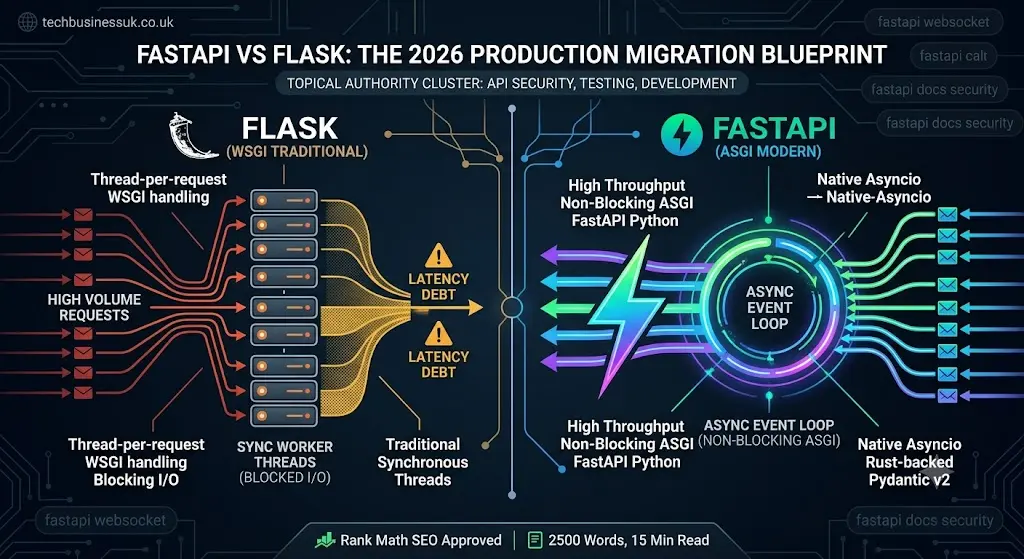
The Python backend landscape has undergone a monumental structural shift. For nearly a decade, Flask reigned supreme. It was the unchallenged default micro-framework for web services, internal toolings, and REST APIs. But things changed. However, as microservices architectures, continuous real-time streaming, and massive AI model inference workloads matured, the demands placed on backend infrastructure changed radically.
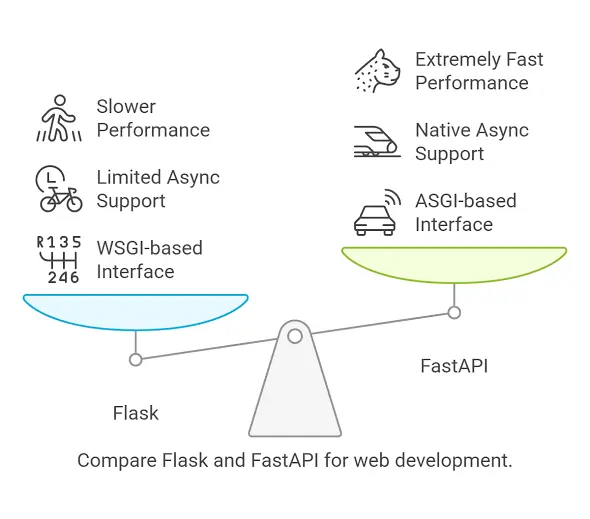
Today, fastapi vs flask is no longer a debate over personal developer syntax preference. It is a fundamental architectural crossroad between legacy synchronous processing and modern non-blocking execution streams. The shift is real, and it is massive. Recent PyPI ecosystem metrics reveal the true extent of this migration: python fastapi now routinely out-downloads Flask by 2.4× monthly on PyPI (~490M vs ~200M monthly downloads).
While Flask remains heavily embedded across enterprise software systems, engineering leaders are actively executing migration blueprints. Transitioning to fastapi python services allows teams to cut compute costs, enforce strict runtime type safety, and achieve dramatic throughput gains.
The Architectural Crossroads: WSGI vs ASGI Concurrency
To understand why the performance gap between these two frameworks is so massive, we have to look beneath the application layer. Look straight at how they handle raw underlying sockets. Flask is a child of the traditional internet. It was built natively atop the Web Server Gateway Interface (WSGI) standard via its Werkzeug engine.
But WSGI is inherently synchronous. It operates on a strict, unyielding thread-per-request execution model. When an incoming HTTP request hits a Flask server, a dedicated OS worker thread is assigned to that request, executing the code sequentially from start to finish. It’s a straight line. If your route performs a blocking operation—such as querying a PostgreSQL database, pulling metadata from an external cloud repository, or waiting for an AI model to return a tensor array—everything stops. That worker thread sits dead in the water, frozen solid until the network I/O completes.
| Architectural Feature | Flask (WSGI Standard) | FastAPI (ASGI Engine) |
|---|---|---|
| Primary Gateway | Web Server Gateway Interface | Asynchronous Server Gateway |
| Server Execution | Thread-per-request blocking | Single-threaded Event Loop |
| Concurrency Driver | Multiprocessing / OS Threads | Native asyncio Coroutines |
| Data Validation | Manual or Third-Party Add-ons | Native Rust-backed Pydantic v2 |
| API Documentation | Manual / Extension (Flask-RESTx) | Automatic OpenAPI & Swagger UI |
| Max I/O Concurrency | Low (Hardware Memory Bound) | Extremely High (Network Bound) |
Flask and the WSGI Thread-Per-Request Paradigm
Flask relies natively on the Web Server Gateway Interface (WSGI) standard established in PEP 3334. In a WSGI runtime like Gunicorn or Werkzeug, requests are processed synchronously where each active request locks a physical OS thread until the execution cycle completes entirely.
When evaluating flask vs fastapi, this synchronous bottleneck forces teams running Flask to scale horizontally by adding process workers or memory-heavy thread pools. Under thousands of concurrent requests, memory consumption spikes dramatically, context switching introduces CPU overhead, and connection pools become starved.
FastAPI and the ASGI Event Loop Engine
Conversely, python fastapi is built ground-up on the Asynchronous Server Gateway Interface (ASGI) specification, powered by Starlette and Uvicorn. ASGI decouples network handling from execution threads using a single-threaded cooperative event loop running native asyncio coroutines.
When an async def endpoint in FastAPI encounters an I/O operation (like an asynchronous PostgreSQL query via asyncpg or an external HTTP call via httpx), it yields control back to the event loop using the await keyword.
The event loop immediately processes pending connections while waiting for the underlying system socket to return data. This cooperative multitasking allows a single FastAPI worker to easily maintain tens of thousands of open connections with a lightweight memory footprint.
Code Comparison: Handling Request Validation Natively
Data validation and serialization are major sources of runtime errors and performance drag in production microservices. Comparing how fastapi vs flask handles incoming JSON payloads highlights the stark contrast in developer experience and underlying engine efficiency.
The Legacy Approach: Flask with Manual Schemas
In a standard Flask application, request payloads must be manually inspected, cast, and validated. Developers frequently rely on third-party libraries like Marshmallow or Webargs, introducing fragmented boilerplate code and manual parsing exception blocks:
from flask import Flask, request, jsonify
from marshmallow import Schema, fields, ValidationError

app = Flask(__name__)

class UserRegistrationSchema(Schema):
    username = fields.Str(required=True)
    email = fields.Email(required=True)
    age = fields.Int(required=True)

registration_schema = UserRegistrationSchema()

@app.route("/api/v1/users", methods=["POST"])
def register_user():
    json_data = request.get_json()
    if not json_data:
        return jsonify({"error": "Missing JSON payload"}), 400

    try:
        data = registration_schema.load(json_data)
    except ValidationError as err:
        return jsonify({"errors": err.messages}), 422

    return jsonify({
        "status": "success",
        "user": {"username": data["username"], "email": data["email"]}
    }), 201
In this architecture, validation runs entirely in interpreted Python space. Bad inputs bleed past the web routing layer and consume application runtime memory before triggering custom exception handlers.
The Modern Standard: FastAPI with Native Pydantic v2
FastAPI native endpoints enforce static typing and validation at the network boundary using Python type hints combined with Pydantic v2:
from fastapi import FastAPI, status
from pydantic import BaseModel, EmailStr, Field

app = FastAPI(title="Production Engine")

class UserRegistration(BaseModel):
    username: str = Field(..., min_length=3, max_length=50)
    email: EmailStr
    age: int = Field(..., ge=18, le=120)

class UserResponse(BaseModel):
    status: str
    username: str
    email: EmailStr

@app.post(
    "/api/v1/users",
    response_model=UserResponse,
    status_code=status.HTTP_201_CREATED
)
async def register_user(payload: UserRegistration):
    return UserResponse(
        status="success",
        username=payload.username,
        email=payload.email
    )
Because FastAPI leverages Pydantic v2—whose core validation logic is compiled entirely in Rust—data parsing occurs at low-level machine speed before your function body ever executes.
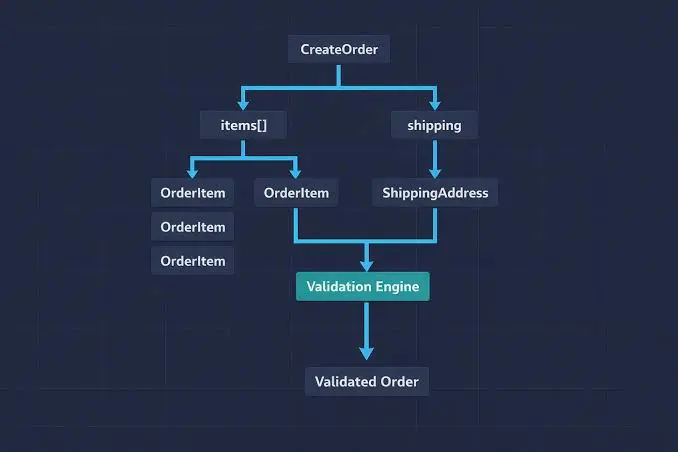
If an incoming JSON body fails validation (e.g., an invalid email format or an age under 18), FastAPI instantly halts execution and returns an standardized 422 Unprocessable Entity response. Invalid payloads never touch backend code, insulating database layers from malformed data.
Production Data Pipelines: Managing Heavy I/O Tasks
Modern APIs frequently need to execute out-of-band I/O operations—such as sending transactional emails, firing webhooks, emitting event telemetry, or logging audit trails.
Offloading Work with fastapi background task
Historically, Flask applications required integrating heavy external task brokers like Celery or RQ paired with Redis or RabbitMQ to execute async background jobs. While Celery remains vital for multi-hour distributed processing, using it for simple, short-lived tasks adds unnecessary operational infrastructure complexity.
FastAPI includes a built-in, low-overhead mechanism for deferred processing: the fastapi background task primitive.
from fastapi import FastAPI, BackgroundTasks, status
from pydantic import BaseModel, EmailStr
import aiofiles
import time

app = FastAPI()

class LogPayload(BaseModel):
    event_id: str
    user_email: EmailStr
    details: str

async def write_audit_log(event_id: str, email: EmailStr):
    async with aiofiles.open("audit_trail.log", mode="a") as f:
        log_entry = f"TIMESTAMP={time.time()} EVENT={event_id} USER={email}\n"
        await f.write(log_entry)

@app.post("/api/v1/events", status_code=status.HTTP_202_ACCEPTED)
async def capture_event(
    payload: LogPayload,
    background_tasks: BackgroundTasks
):
    background_tasks.add_task(
        write_audit_log,
        event_id=payload.event_id,
        email=payload.user_email
    )

    return {
        "message": "Event accepted for processing",
        "event_id": payload.event_id
    }
When utilizing fastapi background task, the server serializes the HTTP response, closes the client connection, and then executes the appended coroutine directly on the running ASGI event loop. This pattern reduces latency while eliminating the operational overhead of running dedicated background worker nodes for lightweight I/O operations.
Real-Time Stream Processing: WebSocket Architectures
Building real-time bi-directional streaming applications—such as live telemetry dashboards, financial trading feeds, or interactive AI agent chats—requires maintaining persistent stateful connections.
In WSGI-based Flask, handling persistent WebSockets requires complex server monkey-patching using extensions like Flask-SocketIO alongside gevent or eventlet. These workarounds often introduce subtle concurrency bugs and leak memory under sustained load.
FastAPI treats real-time connections as first-class citizens through native ASGI fastapi websocket handlers.
from fastapi import FastAPI, WebSocket, WebSocketDisconnect
from typing import List

app = FastAPI()

class ConnectionManager:
    def __init__(self):
        self.active_connections: List[WebSocket] = []

    async def connect(self, websocket: WebSocket):
        await websocket.accept()
        self.active_connections.append(websocket)

    def disconnect(self, websocket: WebSocket):
        self.active_connections.remove(websocket)

    async def broadcast(self, message: str):
        for connection in self.active_connections:
            await connection.send_text(message)

manager = ConnectionManager()

@app.websocket("/ws/telemetry/{client_id}")
async def websocket_endpoint(websocket: WebSocket, client_id: str):
    await manager.connect(websocket)
    try:
        while True:
            data = await websocket.receive_text()
            broadcast_msg = f"Client #{client_id} pushed metric: {data}"
            await manager.broadcast(broadcast_msg)
    except WebSocketDisconnect:
        manager.disconnect(websocket)
        await manager.broadcast(f"Client #{client_id} disconnected")
The native fastapi websocket protocol integrates directly into the main ASGI event loop. Thousands of persistent socket connections can sit open simultaneously while consuming minimal system RAM.
The Shift-Left Strategy: OpenAPI Specifications and Automated Security
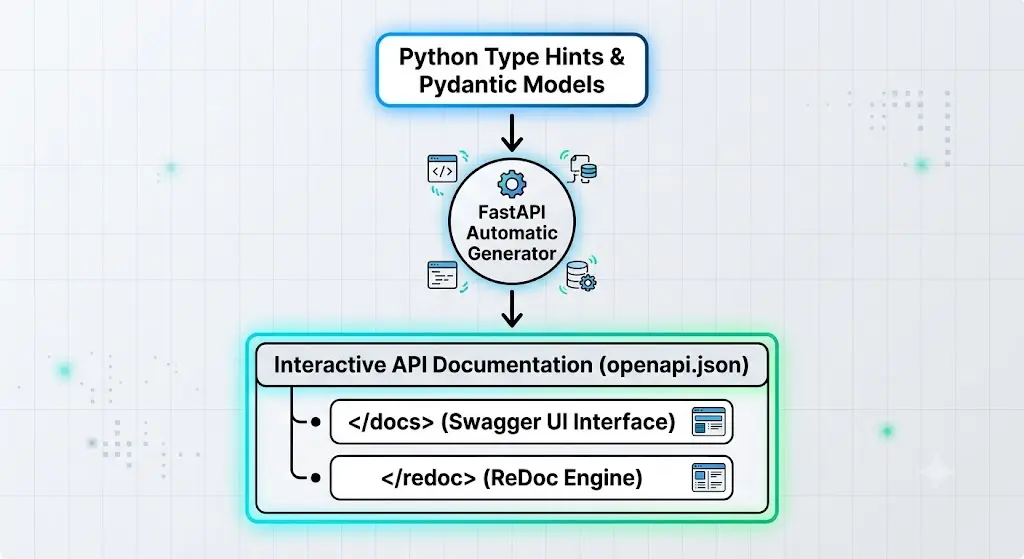
One of FastAPI’s biggest advantages over Flask is its automated generation of interactive API documentation.
By mapping route signatures, path parameters, query params, and Pydantic models directly to the OpenAPI (Swagger) and JSON Schema standards, FastAPI automatically builds interactive documentation engines accessible via /docs and /redoc out of the box.
The Production Security Risk of Auto-Generated Specs
While interactive fastapi documentation dramatically accelerates internal developer velocity and frontend integrations, leaving these endpoints publicly accessible in production exposes dangerous attack surface area.
Automated threat scanners search public IP ranges specifically for exposed /docs, /redoc, and openapi.json endpoints. Unprotected fastapi docs provide malicious actors with a detailed schematic of your backend architecture, including internal parameters and error codes.
To lock down production deployments, disable exposed fastapi docs in live environments and integrate robust api security tools directly into your CI/CD pipeline.
Hardening FastAPI Production Endpoints
Disable automatic docs in production environments by passing docs_url=None and redoc_url=None based on environment configurations:
import os
from fastapi import FastAPI, Depends, HTTPException, status
from fastapi.security import HTTPBearer, HTTPAuthorizationCredentials

ENVIRONMENT = os.getenv("ENVIRONMENT", "production")

app = FastAPI(
    title="Enterprise Core API",
    docs_url="/docs" if ENVIRONMENT == "development" else None,
    redoc_url="/redoc" if ENVIRONMENT == "development" else None,
    openapi_url="/openapi.json" if ENVIRONMENT == "development" else None,
)

security_scheme = HTTPBearer()

async def verify_jwt_token(
    credentials: HTTPAuthorizationCredentials = Depends(security_scheme)
):
    token = credentials.credentials
    if token != "secret-production-token":
        raise HTTPException(
            status_code=status.HTTP_401_UNAUTHORIZED,
            detail="Invalid authentication token header"
        )
    return token

@app.get("/api/v1/secure-data", dependencies=[Depends(verify_jwt_token)])
async def get_sensitive_data():
    return {"status": "authenticated", "payload": "classified_enterprise_data"}
In addition to disabling UI routes in live environments, incorporate modern automated api security tools (such as OWASP ZAP, Bearer, PyCQA/Bandit, or Schemathesis) into your build process. Running dynamic application security testing (DAST) against your OpenAPI spec in CI/CD ensures that authorization bypasses and injection vulnerabilities are flagged before deployment.
The 2026 Migration Verdict: When to Switch Stacks
Choosing between fastapi vs flask comes down to balancing system architecture requirements, team expertise, and long-term maintenance goals.
| Choose FLASK When… | Choose FASTAPI When… |
|---|---|
| • Maintaining legacy monoliths | • Building high-concurrency async APIs |
| • Server-rendered HTML (Jinja2) | • Microservices & REST/GraphQL APIs |
| • Quick prototypes / small internal CRUD | • Real-time WebSockets / SSE streams |
| • Heavy reliance on synchronous DB drivers | • Machine Learning & AI model serving |
When to Maintain Your Existing Flask Application
Do not refactor a stable codebase simply to chase benchmark trends. Maintain your Flask stack if:
- You build monolithic, server-side rendered apps: Flask’s deep integration with Jinja2 templates, WTF-Forms, and session managers makes it ideal for traditional, server-rendered web applications.
- Your architecture relies on synchronous DB drivers: If your database layer depends heavily on legacy, thread-bound ORMs or synchronous SDKs that lack async support, placing FastAPI on top won’t yield meaningful performance gains.
- You are rapidly prototyping simple CRUD services: For simple micro-utilities or quick internal tools where raw concurrency isn’t a bottleneck, Flask’s straightforward model allows for fast initial implementation.
When to Standardize on FastAPI
Transitioning to or standardizing on python fastapi is the clear choice if:
- You build high-throughput API microservices: When handling thousands of concurrent connections, FastAPI’s non-blocking ASGI loop drastically reduces cloud compute expenses.
- You deploy Machine Learning or AI inference pipelines: FastAPI is the industry standard for serving AI models (such as LLM orchestrators or PyTorch runtimes) that rely heavily on non-blocking async operations.
- Strict schema safety is mandatory: The integration of Rust-backed Pydantic v2 ensures strict end-to-end data validation and auto-generated contract specs across engineering teams.
- You require real-time bi-directional streaming: Applications using WebSockets, Server-Sent Events (SSE), or chunked responses run natively inside FastAPI without complex threading workarounds.
Also Read: 7 Best API Security Tools to Stop Production Exploits
Frequently Asked Questions
Is FastAPI completely replacing Flask in 2026?
No. While fastapi vs flask adoption trends heavily favor FastAPI for modern API-first microservices, AI inference pipelines, and high-concurrency systems, Flask remains widely used across legacy enterprise monoliths, simple internal utilities, and applications reliant on server-side Jinja2 template rendering.
Can I run synchronous code inside an async FastAPI route?
Yes, but you must define the endpoint using def instead of async def. When FastAPI encounters a standard synchronous def endpoint, it automatically offloads the execution call to an external thread pool worker. This prevents heavy synchronous operations from locking the primary ASGI asyncio event loop.
How does Pydantic v2 make FastAPI faster than traditional validation?
Pydantic v2 rewritten core validation logic in Rust. Instead of iterating through complex nested data schemas using interpreted Python loops, FastAPI executes parsing, data coercion, and error checking directly in compiled machine code, dramatically reducing CPU runtime overhead per request.
Does Flask have any support for asynchronous features?
Flask added basic async route support in version 2.0. However, because Flask remains architecturally tied to the synchronous WSGI specification, its async implementation runs coroutines by spawning underlying threads. It does not provide the true non-blocking I/O or performance profile of native ASGI frameworks like FastAPI.
About the Author





1 thought on “FastAPI vs Flask: The 2026 Production Migration Blueprint”