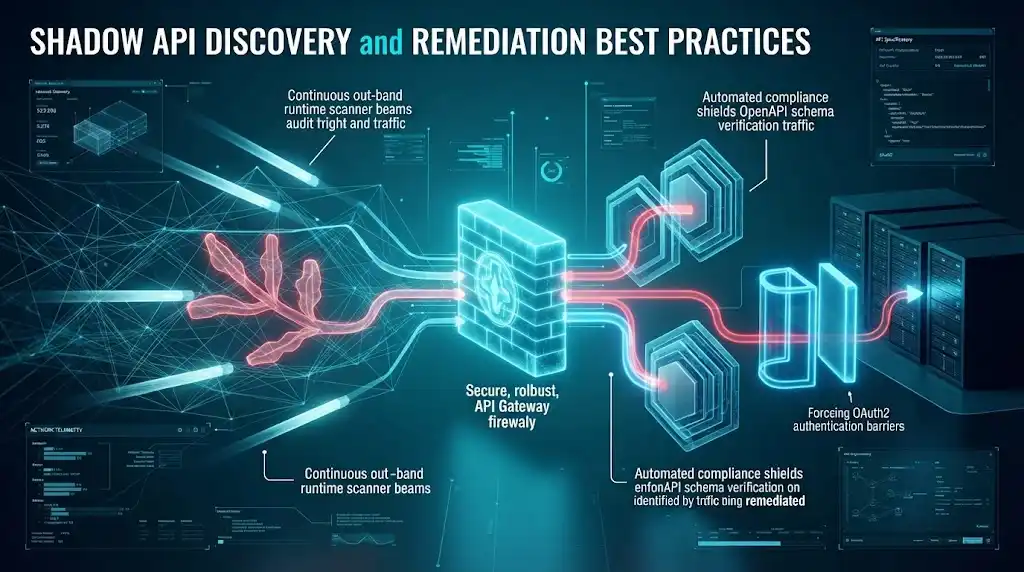
1. Introduction: The Unseen Attack Surface
What is a Shadow API?
A Shadow API is an active, production-facing API endpoint that is built, deployed, or managed outside the awareness of the organization’s security and IT governance teams.
The Core Security Dilemma
“You can’t protect what you can’t see.”
If an API endpoint does not exist in your security asset inventory, it receives no automated patch management, no security monitoring, and no Web Application Firewall (WAF) rule coverage.
Modern Context: Rapid Deployment & API Sprawl
The shift toward microservice architectures, serverless computing, and continuous integration/continuous deployment (CI/CD) pipelines has fundamentally altered software delivery. Engineering teams deploy code multiple times per day. In this high-velocity paradigm:
- Decoupled feature teams build and expose endpoints to meet tight product deadlines.
- Temporary debugging routes, testing endpoints, and beta features are pushed to staging or production environments.
- Manual documentation inevitably falls behind actual codebase state, triggering rapid API sprawl.
As organizations scale their cloud footprints across multi-region environments, the delta between documented API schemas and actual deployed routes widens, creating the precise operational conditions in which shadow APIs proliferate.
2. Why Shadow APIs Are a Major Security Risk
Shadow APIs represent a prime target for threat actors because they combine high privilege with zero visibility. Within the OWASP API Security Top 10, this architectural flaw maps directly to API9:2023 – Improper Inventory Management.
VULNERABILITY COMPOUNDING ON UNDOCUMENTED ENDPOINTS
When an endpoint is not registered on the primary API gateway, it operates outside the scope of centralized authorization plugins. As a result, common attack vectors manifest with severe impact:
- Broken Object Level Authorization (BOLA): Attackers iterate over numeric or UUID parameters (e.g.,
GET /internal/v1/debug/user/10842) on an unmonitored route. Because no authorization policy evaluates whether the requester owns object10842, the endpoint returns the data. - Broken Object Property Level Authorization (BOPLA): Without dynamic response filtering enforced by centralized schema definition files, shadow endpoints frequently serialize and return complete data models—including password hashes, internal status flags, and payment tokens.
Compliance Blind Spots: GDPR, SOC 2, HIPAA, and PCI-DSS
Modern regulatory frameworks mandate strict control over Personally Identifiable Information (PII) and Protected Health Information (PHI). Shadow APIs create immediate non-compliance across multiple standards:
- GDPR (General Data Protection Regulation): Article 30 mandates that data controllers maintain a comprehensive Record of Processing Activities (RoPA). Shadow APIs transferring customer PII represent unrecorded processing activities, triggering severe fine structures under Article 83.
- SOC 2 (Trust Services Criteria): Under CC6.1 and CC6.6, organizations must maintain logical access controls and boundary defenses across all public interfaces. Undocumented endpoints invalidate SOC 2 Type II audit assertions regarding perimeter security.
- HIPAA Security Rule: 45 CFR § 164.312 requires technical safeguards, access controls, and audit logs for all electronic PHI (ePHI) transmissions. Shadow endpoints processing medical data lack audit trails, violating federal mandates.
- PCI-DSS 4.0: Requirement 6.3.2 explicitly requires organizations to maintain an accurate inventory of all custom software components and custom APIs.
Financial and Reputational Impact of Undocumented Endpoints
The economic cost of a breach occurring through a shadow API is significantly higher than standard application-level incidents. Because shadow endpoints lack logging integration, breach detection times (MTTD) increase dramatically.
According to global breach metrics, breaches involving unmonitored shadow infrastructure take over 200 days to identify. This extended dwell time allows attackers to exfiltrate vast datasets quietly, compounding regulatory penalties, forensic remediation expenses, and long-term brand erosion.
3. Comparing API Inventory Risks
To build an effective inventory governance model, AppSec teams must differentiate between different states of unmanaged and managed endpoints. Official managed endpoints maintain updated contract schemas defined under the OpenAPI 3.1 Specification.
COMPREHENSIVE API TAXONOMY COMPARISON
4. How Shadow APIs Are Created: The Architectural Root Causes
Understanding the technical drivers behind shadow API creation is vital for engineering sustainable countermeasures. These endpoints rarely result from malicious intent; they are created by systemic operational patterns.
1. Rapid CI/CD Cycles & Microservices Sprawl
In modern microservices architectures, services are decomposed into granular components owned by separate engineering squads. Continuous integration pipelines push container updates automatically upon pull request approval.
When a front-end team requires a custom dataset payload, a backend team may quickly expose a new controller endpoint (e.g., /api/v2/internal/user-summary). If the team fails to update the repository’s central OpenAPI definition file, the pipeline compiles and deploys the executable route anyway. The endpoint enters production as a functional shadow API.
2. Unmonitored Third-Party Integrations & Developer Workarounds
To accelerate development cycles, engineers often integrate third-party SaaS webhooks or build custom administrative wrappers. Common examples include:
- Exposing callback endpoints to accept dynamic payloads from payment gateways or marketing platforms.
- Building custom internal administrative routes (e.g.,
/api/admin/bulk-export) to bypass manual database queries during customer support escalations. - Bypassing corporate API gateways during initial testing phases by hardcoding direct IP or cloud load balancer ingress routes into client applications.
3. Ephemeral Cloud Infrastructure & AI-Driven API Interactions
The combination of infrastructure-as-code (IaC) and autonomous AI systems introduces dynamic endpoint generation:
- Ephemeral Staging Environments: Automated feature-branch environments spin up complete microservice stacks in the cloud. If firewall rules or routing tables expose these temporary instances publicly, they become accessible shadow targets that persist long after testing completes.
- Autonomous AI Agents & Tooling: Modern generative AI platforms and agentic frameworks programmatically generate API calls, dynamic webhook handlers, and function-calling wrappers. When AI pipelines dynamically instantiate endpoints or modify route schemas without strict schema linting, they induce instantaneous API inventory drift.
5. How to Discover and Detect Shadow APIs
Eliminating undocumented endpoints requires a multi-layered Code-to-Cloud discovery strategy and deploying automated API security testing tools alongside kernel-level eBPF packet tracing. Relying on single-point monitoring solutions is ineffective; organizations must inspect network traffic, container runtimes, API proxy logs, and source code repositories simultaneously.
       ┌────────────────────────────────────────────────────────┐
       │             CODE-TO-CLOUD DISCOVERY PIPELINE           │
       └────────────────────────────────────────────────────────┘
                                   │
      ┌────────────────────────────┼────────────────────────────┐
      ▼                            ▼                            ▼
[ Static Code Analysis ]  [ Kernel Traffic (eBPF) ]   [ Schema Drift Engine ]
  - Abstract Syntax Trees   - Low-overhead tracing      - Live logs vs. OpenAPI
  - Controller Parsing      - L7 HTTP path extraction   - Automated diff alerts
      │                            │                            │
      └────────────────────────────┼────────────────────────────┘
                                   ▼
                   [ Unified Inventory Engine ]
1. Code-to-Cloud Discovery Protocols
Kernel-Level Traffic Tracing via eBPF
Traditional network packet capture methods introduce unacceptable CPU performance overhead in high-throughput production clusters. Extended Berkeley Packet Filter (eBPF) solves traditional network overhead by executing sandbox programs directly inside the Linux kernel without altering kernel source code or loading external modules.
By attaching eBPF programs to socket events (sys_enter_connect, sys_enter_accept), security teams trace Layer 7 HTTP/gRPC requests directly from kernel space. This captures every inbound and outbound API call across all running containers, exposing shadow routes instantly—even if traffic bypasses application-level logging entirely.
API Gateway Ingress Log Aggregation
For organizations routing traffic through edge proxies (e.g., Kong, Envoy, AWS API Gateway), raw ingress access logs provide a critical discovery data stream. By ingesting access logs into centralized SIEM or analytics engines, security teams extract unique requested paths and HTTP methods.
Static Code Analysis (SAST) & Controller AST Parsing
Discovery must begin before code hits production. By parsing the Abstract Syntax Tree (AST) of application source code inside CI/CD pipelines, SAST tools identify routes defined in code annotations:
Python
# Example: AST-based Route Extraction Script using Python's ast module
import ast
import os

class APIRouteVisitor(ast.NodeVisitor):
    def __init__(self):
        self.routes = []

    def visit_FunctionDef(self, node):
        # Scan function decorators for framework routing patterns (e.g., FastAPI / Flask)
        for decorator in node.decorator_list:
            if isinstance(decorator, ast.Call) and hasattr(decorator.func, 'attr'):
                if decorator.func.attr in ['get', 'post', 'put', 'delete', 'patch']:
                    if decorator.args and isinstance(decorator.args[0], ast.Constant):
                        self.routes.append({
                            'method': decorator.func.attr.upper(),
                            'path': decorator.args[0].value,
                            'line': node.lineno
                        })
        self.generic_visit(node)

def extract_codebase_routes(target_directory):
    discovered_routes = []
    for root, _, files in os.walk(target_directory):
        for file in files:
            if file.endswith('.py'):
                file_path = os.path.join(root, file)
                with open(file_path, 'r', encoding='utf-8') as f:
                    try:
                        tree = ast.parse(f.read(), filename=file_path)
                        visitor = APIRouteVisitor()
                        visitor.visit(tree)
                        for r in visitor.routes:
                            r['file'] = file_path
                            discovered_routes.append(r)
                    except SyntaxError:
                        continue
    return discovered_routes

# Usage
if __name__ == "__main__":
    routes = extract_codebase_routes("./src")
    print(f"[AST DISCOVERY] Found {len(routes)} routes in source code.")
2. Automated Schema Drift Detection Pipeline
The core technical engine for discovering shadow APIs relies on continuously computing the delta between actual runtime traffic and registered OpenAPI specs.
Below is a complete, production-ready Python implementation demonstrating how to evaluate live production gateway access logs against an official openapi.yaml specification to surface undocumented shadow routes:
Python
import json
import re
import yaml

class ShadowAPIDetector:
    def __init__(self, openapi_spec_path):
        self.spec_paths = set()
        self.compiled_patterns = []
        self._load_spec(openapi_spec_path)

    def _load_spec(self, path):
        """Parse OpenAPI specification and extract registered path patterns."""
        with open(path, 'r', encoding='utf-8') as f:
            spec = yaml.safe_load(f)

        paths = spec.get('paths', {}).keys()
        for p in paths:
            self.spec_paths.add(p)
            # Convert OpenAPI dynamic path parameters like {id} into Regex matchers
            regex_pattern = re.sub(r'\{[^}]+\}', r'[^/]+', p)
            self.compiled_patterns.append(re.compile(f"^{regex_pattern}$"))

    def is_path_registered(self, raw_path):
        """Validate if a raw incoming HTTP request path matches the specification."""
        # Direct exact match check
        if raw_path in self.spec_paths:
            return True

        # Regex check against parameterized paths
        for pattern in self.compiled_patterns:
            if pattern.match(raw_path):
                return True
        return False

    def analyze_gateway_logs(self, log_entries):
        """Process ingress log batch and identify shadow API endpoints."""
        shadow_findings = []

        for entry in log_entries:
            method = entry.get('method', 'GET').upper()
            path = entry.get('path', '')
            client_ip = entry.get('client_ip', '0.0.0.0')

            if not self.is_path_registered(path):
                shadow_findings.append({
                    'method': method,
                    'path': path,
                    'client_ip': client_ip,
                    'status': 'UNDOCUMENTED_SHADOW_API'
                })

        return shadow_findings

# Example Execution
if __name__ == "__main__":
    # Mock OpenAPI Spec file content structure
    mock_spec_yaml = """
    openapi: 3.0.3
    info:
      title: Production Enterprise API Gateway
      version: 1.0.0
    paths:
      /api/v1/users:
        get: {}
      /api/v1/users/{id}:
        get: {}
      /api/v1/orders:
        post: {}
    """

    # Save temporary spec file for testing
    with open("temp_openapi.yaml", "w") as f:
        f.write(mock_spec_yaml)

    # Initialize Detector
    detector = ShadowAPIDetector("temp_openapi.yaml")

    # Live incoming ingress proxy access logs
    production_logs = [
        {"method": "GET", "path": "/api/v1/users", "client_ip": "192.168.1.50"},
        {"method": "GET", "path": "/api/v1/users/8942", "client_ip": "192.168.1.51"},
        {"method": "POST", "path": "/api/v1/orders", "client_ip": "10.0.0.12"},
        {"method": "GET", "path": "/api/v1/internal/debug-dump", "client_ip": "45.33.22.11"},  # Shadow Endpoint
        {"method": "DELETE", "path": "/api/v1/users/admin-override", "client_ip": "45.33.22.11"} # Shadow Endpoint
    ]

    findings = detector.analyze_gateway_logs(production_logs)

    print("\n--- SHADOW API DETECTION REPORT ---")
    for alert in findings:
        print(f"[ALERT] {alert['status']}: {alert['method']} {alert['path']} from IP: {alert['client_ip']}")
6. Actionable Prevention and Governance Framework
Continuous discovery must be paired with programmatic enforcement. Preventing shadow API proliferation requires establishing strict Zero-Trust policies across the software development lifecycle (SDLC).
[ Developer Commit ] ──► [ CI/CD Spec Linting ] ──► [ Gateway Strict Schema ] ──► [ Runtime OPA Auth ]
                              (Shift-Left)               (Edge Rejection)            (Zero Trust)
1. Implementing Zero-Trust Ingress Enforcement
Do not allow unregistered routes to reach application instances. Configure API Gateways (e.g., NGINX, Envoy, Kong) to enforce strict schema validation at the perimeter:
- Default Deny Gateway Policies: Configure edge proxies to drop any incoming request whose route is not explicitly mapped in an uploaded OpenAPI schema file.
- Mutual TLS (mTLS): Enforce mTLS for all inter-service (east-west) traffic within service meshes. Requiring valid X.509 certificates for microservice communication prevents arbitrary container endpoints from accepting unauthorized connections.
2. Shifting Security Left: Automated Pull Request Scanning
Integrate API schema verification directly into developer git workflows. Using pre-commit hooks and GitHub Actions:
- Enforce Spec Linting: Use tools like Spectral to lint OpenAPI files during code compilation. Reject pull requests that introduce new API routes without corresponding schema updates.
- Automated Spec Generation: Utilize framework plugins (e.g.,
fastapiauto-docs,springdoc-openapi) to generateopenapi.jsonspecs automatically upon code build, eliminating human documentation errors.
3. Policy-as-Code & Runtime Authorization via OPA
Decouple authorization logic from application code. By deploying Open Policy Agent (OPA) as a sidecar container alongside application microservices, access policies are evaluated dynamically against central rule definitions.
Below is an example Open Policy Agent policy written in Rego, enforcing that requests are allowed only if the endpoint exists within an approved system inventory:
Code snippet
package api.authz

import future.keywords.in

default allow = false

# Approved central API inventory
approved_inventory := {
    "GET": ["/api/v1/users", "/api/v1/health"],
    "POST": ["/api/v1/orders", "/api/v1/auth/login"]
}

# Allow request ONLY if method and path exist in approved inventory AND user is authenticated
allow {
    some path in approved_inventory[input.http_method]
    path == input.http_path
    input.user_role != "anonymous"
}
7. Executive Summary & Governance Checklist
Managing shadow API risk transitions API security from a reactive patching exercise into a structural engineering discipline. By combining low-level kernel discovery, automated schema drift detection, and strict edge enforcement, enterprise organizations eliminate operational blind spots before attackers exploit them.
Enterprise API Inventory Governance Checklist
- Mandate Edge Gateway Routing: Enforce central API gateway routing for 100% of public and internal service routes.
- Automate Schema Drift Alerts: Deploy automated scripts or discovery tools to cross-reference live gateway logs against published OpenAPI specifications daily.
- Enforce CI/CD Spec Linting: Block pull requests that add new application controllers without an accompanying OpenAPI schema update.
- Deploy eBPF Kernel Tracing: Utilize kernel-level tracing in Kubernetes clusters to detect unmanaged east-west container communication.
- Decommission Legacy Routes (Zombie APIs): Establish strict sunset timelines for legacy API versions, removing ingress proxy rules completely upon end-of-life.
- Integrate Policy-as-Code: Decouple authorization logic from codebase implementations by enforcing access controls through Open Policy Agent (OPA) engines.
Frequently Asked Questions
What is the difference between a Shadow API and a Zombie API?
A Shadow API is an unmanaged, undocumented endpoint actively running in production that security teams have never logged into their inventory. A Zombie API is a deprecated or legacy endpoint (e.g., an old /v1/ service) that was previously documented but left active in production without maintenance or patch management.
Why do standard Web Application Firewalls (WAFs) fail to block Shadow APIs?
Traditional WAFs inspect incoming HTTP traffic for signature-based attack patterns (such as SQL injection or Cross-Site Scripting). If an attacker sends a syntactically valid HTTP request to an undocumented shadow endpoint, the WAF classifies the request as normal traffic and permits execution.
How does Shadow API security relate to OWASP API9:2023?
OWASP categorizes shadow and zombie APIs directly under API9:2023 — Improper Inventory Management. This classification highlights how missing documentation, unmonitored deployments, and lack of endpoint tracking expand an enterprise’s attack surface.
About the Author

2 thoughts on “Shadow API Security: How to Detect and Remediate Hidden Endpoints”