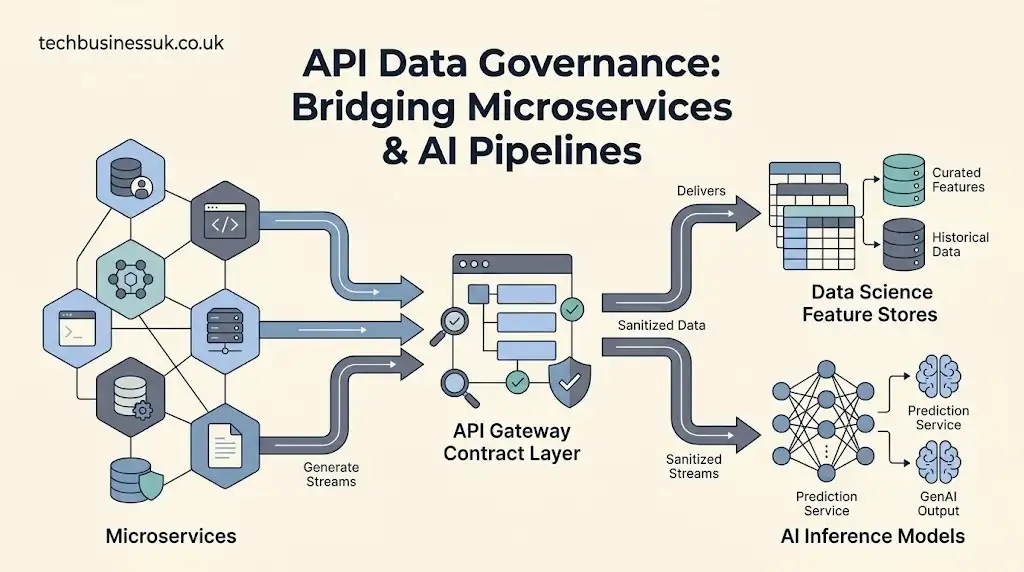
The rapid adoption of microservices, distributed cloud backends, and decoupled client applications radically transformed software engineering over the last decade. Organizations scaled faster by breaking monolithic systems into modular REST, GraphQL, and gRPC endpoints. However, this expansion triggered an unexpected operational burden: untamed API sprawl. Engineering teams found themselves managing thousands of unmapped, undocumented, and unsecured endpoints without a unified framework for enterprise API governance.
Today, enterprise technology is experiencing another seismic shift—the transition from deterministic software systems to autonomous artificial intelligence, Large Language Models (LLMs), and predictive machine learning (ML) models.
As engineering teams rush to deploy Retrieval-Augmented Generation (RAG) architectures, train neural networks, and integrate vector databases, they are making the exact same structural misstep. They are transitioning directly from API sprawl to uncontrolled data sprawl.
While standard API sprawl fragments application communication, data sprawl silently corrupts machine learning model inputs, introduces severe compliance liabilities, and leads to silent model drift in production. Implementing a strict API data governance framework is no longer just a backend housekeeping task—it is the foundational requirement for scaling secure, high-performance software and artificial intelligence.
1. What is API Data Governance?
Defining API Data Governance in Modern Software Architecture
API data governance represents the critical intersection of software engineering, cybersecurity, and data lifecycle management. While traditional API management focuses on traffic routing, rate limiting, and developer portals, API data governance governs the payload itself.
It establishes strict contractual standards for how data is structured, validated, sanitized, classified, and transformed as it moves across network boundaries. It treats every API request and response payload as an immutable contract between software systems, external partners, and machine learning models.
The Dual Challenge: Managing API Sprawl and Data Sprawl
Managing API infrastructure across hybrid and multi-cloud environments requires balancing two distinct forms of operational technical debt:
- API Sprawl: The uncontrolled proliferation of shadow APIs, abandoned legacy endpoints, and undocumented microservice interfaces that expand the external attack surface. Teams looking to eliminate unmonitored endpoints should implement dedicated strategies for Shadow API Security.
- Data Sprawl: The unmonitored replication, drift, and fragmentation of structured and unstructured data across vector indexes, training caches, and streaming pipelines.
+-----------------------------------------------------------------------------------+
|                            ENTERPRISE DATA ENGINE                                 |
|                                                                                   |
|  +-------------------+      API Data Governance Contract    +------------------+  |
|  | Microservices &   | ==================================>  | Data Pipelines & |  |
|  | Software Endpoints|     Schema, Privacy & Encryption     | MLOps Ingestion  |  |
|  +-------------------+                                      +------------------+  |
|                                                                                   |
+-----------------------------------------------------------------------------------+
Without unified API data governance, data sprawl inevitably follows API sprawl. When endpoint schemas drift or drop fields unexpectedly, downstream data science pipelines ingest corrupted features without throwing explicit system errors.
Key Differences Between Standard API Management and Data Governance
| Capability Dimension | Standard API Management | Enterprise API Data Governance |
|---|---|---|
| Primary Scope | Traffic management, proxy routing, rate limits | Payload integrity, schema lifecycle, data lineage |
| Security Focus | Perimeter defense, JWT validation, DDoS prevention | Field-level encryption, PII masking, payload sanitization |
| Data Quality Control | HTTP response code verification using automated API testing tools | Real-time schema validation, data drift detection |
| Target Consumers | Mobile applications, web clients, third-party developers | Machine learning models, feature stores, AI agents, analytics engines |
2. Why API Data Governance is Critical for Data Science and Machine Learning
The Contract Layer: How APIs Serve Features and Machine Learning Models
In modern MLOps architectures, APIs serve as the primary operational link between data engineering and model inference. Machine learning estimators do not query raw transactional databases directly during real-time inference. Instead, they query low-latency feature serving layers via REST or gRPC endpoints.
+------------------+         +-----------------------+         +-------------------+
|  Client Request  | ------> |  API Gateway & Schema | ------> |  Feature Store &  |
|  (Inference)     |         |  Contract Validation  |         |  Inference Engine |
+------------------+         +-----------------------+         +-------------------+
When an API endpoint serves as an inference gateway, the data payload must match the exact mathematical representation used during offline model training. Even minor structural variations in payload formatting—such as returning a null value instead of a default zero, or altering timestamp string formats—can degrade inference accuracy without crashing the application.
Preventing Training-Serving Skew and Latent Space Corruption
One of the most elusive failure modes in production machine learning is training-serving skew. This occurs when the feature values delivered to a model during real-time inference diverge from the historical distributions used during offline training.
A primary cause of training-serving skew is ungoverned API data transformations. For example, if an upstream microservice changes an integer field to a float or silently renames a key, a machine learning model might process the malformed input and generate erroneous predictions. Incorporating an open-source solution like the Feast Feature Store into your API layer guarantees that features remain consistent across both batch training and real-time inference endpoints.
Exposing Tensors, Embeddings, and Representation Learning Vectors via REST and gRPC
Modern deep learning systems rely heavily on representation learning—converting complex, multi-modal input data (text, images, network graphs) into dense vector embeddings. Exposing these dense mathematical representations via public or internal APIs creates unique payload governance requirements:
- Fixed Dimensionality: Vector endpoints must strictly enforce dimension counts (e.g., verifying that incoming text embeddings consistently match a 1,536-dimension boundary).
- Precision Standard: Floating-point representations (FP32, FP16, INT8) must remain uniform across service invocations to avoid loss of precision in distance calculations.
- Payload Serialization: High-throughput deep learning services often swap out verbose JSON strings for serialized Protocol Buffers over gRPC to reduce transfer overhead and preserve mathematical precision.
3. Key Pillars of an Enterprise API Data Governance Framework
A robust enterprise API data governance strategy relies on four structural pillars to protect data integrity and maintain system availability.
+--------------------------------------------------------------------------+
|                   PILLARS OF API DATA GOVERNANCE                         |
+--------------------------------------------------------------------------+
| 1. Contract Enforcement  | Strict OpenAPI 3.1 & Protobuf schemas         |
| 2. Lineage & Privacy     | PII identification, field masking, tracing    |
| 3. Zero Trust Security   | Fine-grained authorization & mTLS             |
| 4. Traffic Control       | Adaptive throttling & payload sanitization    |
+--------------------------------------------------------------------------+
1. Schema Validation & Contract Enforcement (OpenAPI 3.1 & Protocol Buffers)
Every request entering your network perimeter should undergo strict, automated contract validation. Instead of letting downstream application logic parse malformed data, the API gateway or sidecar proxy should reject invalid requests immediately at the ingress boundary.
Following defined API Design Best Practices alongside standardized contract frameworks like OpenAPI 3.1 or Protocol Buffers ensures that:
- Data types, ranges, regex constraints, and required fields are explicitly defined.
- Payload parameters are typed, preventing arbitrary JSON injections.
- Breaking contract updates are flagged automatically using modern API testing tools integrated into continuous integration (CI/CD) pipelines before deployment.
2. Data Classification, Privacy & Lineage across REST & GraphQL Endpoints
API data governance mandates full visibility into how sensitive information moves across internal and external networks. Modern compliance mandates such as GDPR, CCPA, and HIPAA require continuous tracking of Personally Identifiable Information (PII).
Effective data governance workflows classify payload fields at runtime:
- Tagging: Annotating fields containing credit card numbers, email addresses, or health records directly within the schema file.
- Dynamic Masking: Redacting or hashing sensitive keys at the gateway layer based on client permissions before the response leaves the secure boundary.
- Lineage Tracking: Propagating trace headers across microservices to generate automated data-flow maps, making auditing straightforward. Evaluating your deployment pipelines through comprehensive Compliance Testing safeguards endpoints before they reach production.
3. Zero Trust Security, OAuth 2.0, and Fine-Grained Authorization
A core tenet of modern security is assuming that network perimeters are inherently untrusted. Establishing a Zero Trust posture requires verifying identity, context, and permissions at every API request.
Organizations must implement robust identity controls:
- Authentication: Verifying requesting entities using short-lived access credentials. Understanding the core distinctions in Authentication vs Authorization ensures that identity verification and resource permissions remain properly separated across services.
- Fine-Grained Authorization: Implementing Attribute-Based Access Control (ABAC) or Role-Based Access Control (RBAC) to ensure clients can only access specific endpoints and payload fields.
- Mutual TLS (mTLS): Encrypting all service-to-service (East-West) traffic within service meshes to prevent eavesdropping and payload tampering.
4. Rate Limiting, Throttling & Payload Sanitization
Protecting backend systems from resource exhaustion and intentional denial-of-service attacks requires active traffic controls. Unrestricted payload sizes or unthrottled request frequencies can destabilize database clusters and inference nodes.
To mitigate operational risks, engineering teams should:
- Deploy an adaptive leaky bucket algorithm to smooth out traffic bursts and prevent backend service degradation.
- Enforce absolute size bounds on incoming JSON or gRPC messages to block memory allocation attacks.
- Sanitize inputs against SQL injection, cross-site scripting (XSS), and deep JSON nesting vulnerabilities.
4. Bridging API Data Governance with MLOps and Deep Learning
Integrating generative AI, Large Language Models, and deep learning architectures into enterprise applications introduces novel compliance and security risks.
               +------------------------------------------------+
               |              INFERENCE PIPELINE                |
               +------------------------------------------------+
                                       |
                                       v
               +------------------------------------------------+
               |          API Data Governance Gateway           |
               | - Structural Schema Check                      |
               | - PII Redaction & Masking                      |
               | - Adversarial Prompt Inspection                |
               +------------------------------------------------+
                                       |
                     +-----------------+-----------------+
                     |                                   |
                     v                                   v
       +---------------------------+       +---------------------------+
       |   Feature Store Lookup    |       |   Enterprise LLM Service  |
       |  (Feast / Databricks)     |       |   (Function / Tool Call)  |
       +---------------------------+       +---------------------------+
Integrating Feature Stores (Feast, Databricks) with API Gateways
Connecting feature stores to enterprise API gateways provides a unified pattern for feature serving. Organizations choosing the right API Management Platform can seamlessly integrate storage engines like Feast or Databricks to enforce:
- Read-Time Auditing: Logging every feature request along with the requesting model version to maintain full auditability for regulated AI applications.
- Rate & Latency Control: Enforcing strict SLAs so real-time feature lookup requests do not degrade user experience.
- Access Scoping: Restricting access to proprietary feature sets to prevent unauthorized downstream data mining.
Governing Function Calling and Agentic AI (Model Context Protocol / MCP)
As autonomous AI agents gain the ability to trigger API actions via function calling, governing endpoint interaction becomes critical. AI models can generate non-deterministic outputs, leading to unexpected API requests.
When implementing agentic integration architectures like the Model Context Protocol (MCP), API data governance acts as a protective boundary:
- Parameter Boundary Enforcement: Verifying that LLM-generated arguments strictly conform to expected schema types before executing downstream side effects.
- Human-in-the-Loop Triggers: Routing high-risk operations (such as financial transactions or data deletions) through approval queues when confidence scores drop below predefined thresholds.
- State Drift Prevention: Ensuring that sequence-dependent API execution chains maintain context integrity without corrupting enterprise databases.
Securing Real-Time Deep Learning Inference Endpoints
Deep learning models exposed over HTTP or gRPC are vulnerable to specialized exploitation tactics, including prompt injection, data extraction, and model inversion attacks.
To secure live AI endpoints:
- Implement strict payload inspection to block adversarial prompts and malicious input patterns before they hit LLM contexts.
- Enforce strict output sanitization to prevent models from inadvertently leaking sensitive system prompts or confidential training data.
- Apply modern API security mitigations to protect against common threat vectors detailed in the OWASP API Security Top 10.
5. Standardizing API Errors, Versioning & Deprecation
Maintaining operational stability across distributed systems requires predictable communication patterns—especially when endpoints handle complex automated data pipelines.
Machine-Readable Error Payloads (RFC 9457 / RFC 7807)
Generic, unstructured error responses like {"error": "something went wrong"} hinder automated debugging and client error recovery. Systems should adopt standardized, machine-readable formats such as RFC 9457 (Problem Details for HTTP APIs).
JSON
{
  "type": "https://api.enterprise.com/errors/invalid-feature-schema",
  "title": "Invalid Input Payload Schema",
  "status": 400,
  "detail": "The 'user_embeddings' array length must equal exactly 1536 dimensions.",
  "instance": "/v1/predictions/user-churn",
  "invalid-params": [
    {
      "name": "user_embeddings",
      "reason": "Expected 1536 dimensions, received 512."
    }
  ]
}
A structured error response enables consuming applications, MLOps monitoring scripts, and developer tooling to handle exceptions programmatically without manual intervention.
URL Path vs Header Versioning Strategies for Data Pipelines
Evolving data contracts requires a clear strategy for managing breaking schema updates. Implementing robust API Governance Models guides how teams navigate versioning trade-offs:
- URL Path Versioning (
/v1/features/customers): The recommended approach for major, non-backwards-compatible contract changes. It provides explicit boundaries that are easy to route, monitor, and cache at the proxy layer. - Header / Content Negotiation (
Accept: application/vnd.company.v2+json): Useful for minor content modifications while keeping URIs clean. However, it can complicate caching strategies and downstream data pipeline configuration.
Managing Sunset Headers and Deprecation Lifecycles
Retiring legacy API endpoints without disrupting operational pipelines requires structured deprecation management:
- Announce Deprecation Early: Inject standardized HTTP headers (
Deprecation: trueandSunset: Wed, 11 Nov 2026) into response payloads to give downstream consumers advance notice. - Monitor Usage Telemetry: Track consumer traffic using dedicated telemetry tools to identify legacy clients still invoking deprecated resources.
- Graceful Sunset Execution: Automatically transition non-compliant clients to fallback endpoints or return informative
410 Goneerror codes once the sunset date passes.
6. Implementation Checklist: Building Your API Data Governance Strategy
Engineering leaders can follow this execution roadmap to build an enterprise-grade API data governance framework from the ground up:
+--------------------------------------------------------------------------+
|              API DATA GOVERNANCE IMPLEMENTATION ROADMAP                  |
+--------------------------------------------------------------------------+
| Phase 1: Discovery & Schema Cataloging                                   |
|  [ ] Scan network for shadow endpoints and unmapped data schemas         |
|  [ ] Establish a central OpenAPI 3.1 catalog as the source of truth     |
|                                                                          |
| Phase 2: Gateway Contract Enforcement                                    |
|  [ ] Deploy automated schema validation at ingress proxies               |
|  [ ] Configure PII detection and masking rules across payloads           |
|                                                                          |
| Phase 3: Security & Rate Control Integration                             |
|  [ ] Implement OAuth 2.0 authentication and fine-grained authorization   |
|  [ ] Enforce leaky bucket rate limits and payload size bounds            |
|                                                                          |
| Phase 4: MLOps & AI Pipeline Alignment                                   |
|  [ ] Connect feature store endpoints to governed API gateways           |
|  [ ] Deploy prompt injection and output sanitization filters for LLMs    |
+--------------------------------------------------------------------------+
Key Metrics & KPIs to Measure Governance Success
Evaluating the effectiveness of your API data governance program relies on tracking distinct operational metrics:
- Schema Compliance Rate: The percentage of production API traffic that strictly validates against registered OpenAPI or Protocol Buffer schemas (Target: >99.99%).
- Shadow API Reduction: The total count of unmapped, unmonitored endpoints discovered and either brought under governance or decommissioned.
- Training-Serving Skew Incidents: The frequency of production model accuracy drops linked directly to payload formatting drift or missing feature fields.
- Mean Time to Remediate (MTTR) Contract Breaking Changes: The time required for engineering teams to update schemas, inform downstream consumers, and deploy non-breaking patches.
According to research published by the National Institute of Standards and Technology (NIST), early structural enforcement of software boundaries significantly reduces production vulnerabilities and downstream system maintenance costs. Furthermore, data protection frameworks outlined by the European Data Protection Board (EDPB) highlight that automated payload sanitization and explicit consent tracing are indispensable components of modern data compliance. Additionally, engineering guidelines from the Internet Engineering Task Force (IETF) emphasize that standardizing contract mechanisms reduces integration fragmentation across complex distributed systems.
Frequently Asked Questions (FAQs)
Q1: How does API data governance differ from traditional data governance?
Traditional data governance focuses primarily on static data assets—managing access policies, metadata catalogs, and retention rules for data warehouses and data lakes. API data governance focuses on data in transit, enforcing real-time schema compliance, privacy masking, and threat protection at the exact moment payload data crosses network service boundaries.
Q2: Why is API data governance vital for generative AI and LLM tool calling?
Generative AI models and LLM agents operate non-deterministically. When AI agents execute real-world actions via function calling, API data governance acts as a deterministic safety barrier. It validates that LLM-generated input arguments match expected data types and value ranges, preventing models from passing malformed parameters or executing unauthorized operations against enterprise backends.
Q3: What tools are used to enforce API data governance in cloud-native environments?
Cloud-native API data governance relies on a multi-tiered stack:
- API Gateways & Service Meshes: Kong, Apigee, Envoy, and Istio for traffic control, mTLS, and gateway-level schema validation.
- Schema Catalogs & Contract Tools: Swagger/OpenAPI 3.1, Buf (for Protocol Buffers), and Postman.
- MLOps Feature Stores: Feast and Databricks Unity Catalog for governing feature serving and preventing training-serving skew.
About the Author


1 thought on “API Data Governance: The Blueprint for Modern Enterprise & AI Architecture”