Deploying Retrieval-Augmented Generation (RAG) applications to enterprise users requires more than simple accuracy checks. Traditional NLP evaluation metrics like BLEU or ROUGE—which measure superficial n-gram token overlaps—fail completely when assessing generative models. An output can share zero exact words with a source document while remaining 100% factually accurate, or it can copy tokens directly while fabricating critical details.
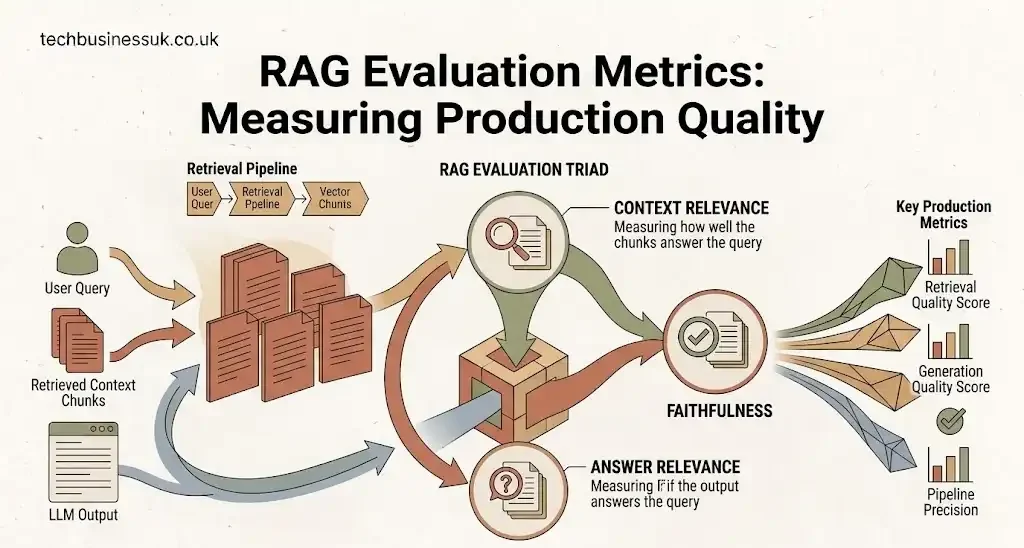
To transition RAG applications from experimental pilots into reliable enterprise systems, engineering teams must deploy reference-free, LLM-as-a-judge RAG evaluation metrics. Measuring performance across the RAG Triad—Context Relevance, Faithfulness, and Answer Relevance—allows teams to pinpoint failure points, eliminate hallucinations, and enforce strict continuous evaluation within a broader Applied AI enterprise guide.
1. The Death of Surface-Level NLP Metrics in Generative AI
For over two decades, evaluating natural language processing systems relied almost exclusively on string-matching heuristics. Automated frameworks computed lexical overlap between candidate text and reference human annotations. While these metrics served well for machine translation and exact sentence summarization, they are fundamentally broken for generative, open-domain RAG architectures.
+-------------------------------------------------------------------------+
|                  TRADITIONAL TOKEN METRICS (BLEU / ROUGE)                |
|  Direct Token Matching  |  Requires Human Baseline  |  Ignores Context  |
+-------------------------------------------------------------------------+
                                     |
                                     v (Fails on Generative Reasoning)
+-------------------------------------------------------------------------+
|                    REFERENCE-FREE LLM-AS-A-JUDGE                        |
| Semantic Verification | Triad Decomposition | Real-Time Production Logs |
+-------------------------------------------------------------------------+
Why BLEU, ROUGE, and METEOR Fail RAG Applications
Traditional metrics compare a model output against a single “ground truth” reference string using token matching algorithms. The underlying mathematical formulations calculate precision and recall based on n-gram occurrences:
BLEU = BP × exp( Σ wn log(pn) )
Where pn represents the modified n-gram precision, wn is the weight assigned to each n-gram length, and BP is the brevity penalty enforcing length constraints:
- BP = 1 (if candidate length > reference length)
- BP = exp(1 – r / c) (if candidate length ≤ reference length)
Here c is the length of the candidate response, and r is the reference sentence length.
In production enterprise applications, this mathematical framework introduces severe architectural flaws:
- Paraphrase Ignorance: An LLM can generate a completely valid, highly articulate response using technical synonyms or restructured clauses. Because the token overlap pn evaluates to near zero against a static reference string, the calculated BLEU score drops, falsely flagging a correct response as a system failure.
- Contextual Invisibility: Standard string-matching metrics completely ignore the retrieved context chunks. A response can match a human ground-truth string perfectly while directly contradicting the context retrieved at runtime. This allows hallucinated or outdated information to pass through automated testing gates undetected.
- Reference Dependency: Generating static reference datasets for thousands of dynamic, multi-tenant enterprise queries is practically impossible. Enterprise RAG systems process unpredictable combinations of internal documentation, database records, and live user queries where no single “correct” text response exists.
2. The RAG Triad: Core Metrics for Production Reliability
To address these limitations, modern MLOps architectures decouple evaluation into three distinct sub-metrics. The RAG Triad gives you a practical framework to evaluate your system by separating the search phase from the generation phase. Instead of treating your RAG setup like a black box, it breaks down performance across three specific checkpoints so you can see exactly where things break.
                          [ USER QUERY (Q) ]
                            /            \
                           /              \
   (1. Context Relevance) /                \ (3. Answer Relevance)
                         v                  v
               [RETRIEVED CONTEXT (C)] ---> [LLM RESPONSE (A)]
                                (2. Faithfulness)
Context Relevance (Retrieval Metric)
- What it measures: How much of the retrieved text actually helps answer the user’s prompt, versus how much bloat came along for the ride.
- Failure Mode: When this score drops, your search step is feeding the model unnecessary clutter, off-topic passages, or weak semantic hits that dilute the context window.
- Engineering Fix: Rethink your document splitting (like switching to parent-child chunking), add a cross-encoder reranking step, or fine-tune your embedding models to better capture domain specifics.
Mathematically, Context Relevance evaluates the proportion of sentences in the retrieved context C = {c1, c2, …, cm} that directly contribute to resolving the query Q:
Context Relevance = (Number of Relevant Chunks in C) / (Total Chunks in C)
Faithfulness / Groundedness (Generation Metric)
- What it measures: Whether every single claim the model makes can be traced directly back to the provided source passages.
- Failure Mode: A drop in faithfulness means the model is hallucinating—falling back on its general pre-training memory or pulling details out of thin air that don’t exist in your retrieved data.
- Engineering Fix: Tighten up your system prompt constraints, drop the decoding temperature down to 0.0, or upgrade to a higher-capacity foundation model with stronger instruction-following capabilities.
Faithfulness measures the factual alignment between the generated answer A and the retrieved context C. The response A is decomposed into a set of atomic statements V(A) = {v1, v2, …, vk}:
Faithfulness = (Number of Supported Statements in V) / (Total Statements in V)
Answer Relevance (End-to-End Metric)
- What it measures: How directly the final response actually answers what the user asked, regardless of how well-grounded the search results were.
- Failure Mode: Low answer relevance usually looks like a response that is technically accurate and well-supported, but completely misses the intent of the original question.
- Engineering Fix: Update your prompt templates with clear few-shot examples or add explicit formatting and focus rules to guide the output generation.
To calculate Answer Relevance without a reference sentence, an LLM judge generates synthetic queries Qsynth = {q1, q2, …, qn} directly from the generated answer A. The vector embeddings of these synthetic queries are compared against the embedding of the original query Q via cosine similarity:
Answer Relevance = Average Cosine Similarity( Embedding(Q), Embedding(Qsynth) )
3. Implementing RAG Evaluation Frameworks: Ragas vs. TruLens
When it comes to putting LLM-based evaluations to work in a live environment, two open-source frameworks lead the pack: Ragas and TruLens.
+-----------------------------------------------------------------------+
|                             RAGAS                                     |
| Reference-Free Metrics Library | Batch Scoring | Deep Dataset Audits   |
+-----------------------------------------------------------------------+
                                    |
                                    v
+-----------------------------------------------------------------------+
|                            TRULENS                                    |
| Real-Time Tracing | Feedback Functions | Record-Level Debugging       |
+-----------------------------------------------------------------------+
1. Ragas (Retrieval Augmented Generation Assessment)
Ragas is a specialized, lightweight metrics library designed for batch evaluation of RAG datasets. It excels during development and CI/CD testing pipelines by turning raw evaluation logs into programmatic assertions.
Python
from ragas import evaluate
from ragas.metrics import (
    faithfulness,
    answer_relevancy,
    context_precision,
    context_recall
)
from datasets import Dataset

# Construct evaluation dataset from production traces
eval_payload = {
    "question": ["What is the maximum API execution timeout for tier 2 enterprise tenants?"],
    "contexts": [[
        "Tier 2 enterprise tenants are allocated a maximum request window of 30 seconds per API payload.",
        "System timeouts trigger an automatic 504 Gateway error if background workers exceed allocation limit."
    ]],
    "answer": ["Tier 2 enterprise tenants have a maximum API execution timeout of 30 seconds."]
}

dataset = Dataset.from_dict(eval_payload)

# Execute automated multi-metric evaluation
score_results = evaluate(
    dataset=dataset,
    metrics=[
        faithfulness,
        answer_relevancy,
        context_precision,
        context_recall
    ]
)

# Convert results into structured pandas dataframe for CI/CD gates
df_scores = score_results.to_pandas()
print(df_scores[['faithfulness', 'answer_relevancy', 'context_precision']])
2. TruLens
TruLens (maintained by Snowflake) focuses on active application instrumentation, real-time feedback functions, and record-level tracing. Instead of running evaluations purely offline, TruLens instruments the actual execution chain of your application.
Python
from trulens.core import TruSession
from trulens.providers.openai import OpenAI as fOpenAI
from trulens.core import Feedback
from trulens.apps.custom import TruCustomApp

session = TruSession()
session.reset_database()

# Initialize evaluation provider (LLM-as-a-Judge)
provider = fOpenAI(model_engine="gpt-4o-mini")

# Define the RAG Triad feedback functions with Chain-of-Thought reasoning
f_context_relevance = (
    Feedback(provider.relevance_with_cot_reasons, name="Context Relevance")
    .on_input()
    .on_argument("contexts")
)

f_faithfulness = (
    Feedback(provider.faithfulness_with_cot_reasons, name="Faithfulness")
    .on_argument("contexts")
    .on_output()
)

f_answer_relevance = (
    Feedback(provider.relevance_with_cot_reasons, name="Answer Relevance")
    .on_input()
    .on_output()
)

# Wrap your custom RAG execution pipeline for continuous instrumentation
tru_rag_recorder = TruCustomApp(
    custom_rag_engine,
    app_id="Enterprise_RAG_Production_v2",
    feedbacks=[f_context_relevance, f_faithfulness, f_answer_relevance]
)

# Execute within recorder context
with tru_rag_recorder as recording:
    custom_rag_engine.query("What is the maximum API execution timeout for tier 2 enterprise tenants?")
4. Comprehensive Metric Comparison Matrix
The table below breaks down the technical execution parameters, runtime overhead, and primary deployment environments for modern generative evaluation frameworks compared to legacy token-matching systems.
5. Operationalizing Evaluation in CI/CD and Production
Deploying RAG evaluation metrics requires a dual-stage architecture to manage evaluation costs and inference latency.
                    PRODUCTION EVALUATION WORKFLOW
+--------------------------------------------------------------------+
| STAGE 1: REAL-TIME TRACING (Lightweight Guardrails & Sampling)      |
| Trace 100% of runs; run LLM-as-a-Judge on 5-10% production sample   |
+--------------------------------------------------------------------+
                                  |
                                  v
+--------------------------------------------------------------------+
| STAGE 2: BATCH CI/CD REGRESSION (Ragas / Synthetic Datasets)       |
| Run automated test suite on pull requests to prevent regressions   |
+--------------------------------------------------------------------+
Stage 1: Pre-Deployment CI/CD Gatekeeping
Before any new system prompt, chunking parameter, or embedding model is deployed to production, it must pass through an automated integration pipeline.
- Synthetic Golden Dataset Generation: Manually writing thousands of test queries is inefficient. Use tools like Ragas or specialized LLMs to generate a synthetic test suite directly from your vector database documents.
- Automated Assertion Thresholds: Integrate Python test scripts into GitHub Actions or GitLab CI. Enforce hard blocking thresholds before code can be merged into production branches:
Python
def test_rag_pipeline_quality():
    # Execute batch run on golden dataset
    results = run_ragas_evaluation(golden_dataset)

    # Assert minimum acceptable scores for production readiness
    assert results['faithfulness'] >= 0.92, "Deployment blocked: Faithfulness score dropped below 0.92 SLA."
    assert results['answer_relevancy'] >= 0.88, "Deployment blocked: Answer Relevancy dropped below 0.88 SLA."
    assert results['context_precision'] >= 0.85, "Deployment blocked: Context Precision dropped below 0.85 SLA."
Stage 2: In-Flight Production Sampling and Cost Management
Running an expensive foundation model as an LLM judge on 100% of live user traffic creates prohibitive API costs and introduces unwanted system overhead. To maintain continuous observability without blowing through operational budgets:
- Asynchronous Tracing: Never evaluate queries synchronously in the main request-response path. Stream input queries, retrieved context IDs, and generated outputs to a background message queue (e.g., Apache Kafka, AWS SQS) using comprehensive LLM observability in production infrastructure.
- Statistical Sampling Strategy: Route a configurable sample rate (5% to 10%) of non-sensitive production logs to your asynchronous LLM-as-a-judge evaluation workers. Increase sampling automatically during canary deployments or major model version shifts.
- Tiered Evaluator Models: Use highly optimized, smaller foundation models (such as GPT-4o-mini, Claude 3 Haiku, or fine-tuned Llama-3-8B instances) exclusively for running judgment evaluation prompts. This reduces evaluation cost per query by up to 95% compared to using flagship frontier models.
6. Advanced Evaluation Patterns: Synthetic Test Generation and LLM-as-a-Judge Calibration
To achieve true enterprise-grade evaluation rigor, advanced engineering teams must solve two common operational bottlenecks: generating comprehensive test suites without manual human labor and preventing systemic bias in LLM evaluators.
Automated Synthetic Test Set Generation
Relying exclusively on historic production logs to evaluate RAG pipelines creates a blind spot for edge cases. Synthetic data generation uses your existing document corpus to automatically craft realistic test suites containing varied query types:
[Vector Store Documents]
           |
           +---> (Extract Document Passages)
           |
           +---> [LLM Query Generator]
           |            |
           |            +---> Simple Query: "What is the refund window?"
           |            +---> Multi-Context Query: "Compare tier 1 and tier 2 SLA limits."
           |            +---> Conditional Query: "If a user cancels after 30 days, what fee applies?"
           |
           v
[Structured Synthetic Golden Dataset]
By generating synthetic test cases that explicitly span multiple document chunks, conditional logic, and domain-specific vocabulary, engineers can evaluate RAG system performance across the full distribution of potential user queries before launching to production.
Calibrating LLM Evaluators Against Human Expertise
Using an LLM to evaluate another LLM introduces inherent risks, including positional bias (preferring responses placed earlier in the prompt), verbosity bias (favouring longer, more wordy responses regardless of accuracy), and self-enhancement bias (evaluator models scoring their own generated text higher than outputs from competing model providers).
To calibrate an automated evaluator:
- Human Alignment Audit: Curate a small, high-confidence dataset containing 100 to 200 query-context-response triplets manually scored by domain expert engineers.
- Correlation Calculation: Calculate the Pearson correlation coefficient (r) between human expert scores (Yhuman) and automated judge outputs (Yjudge):
r = Covariance( Yhuman, Yjudge ) / [ StdDev( Yhuman ) × StdDev( Yjudge ) ]
- Prompt Calibration Iteration: If the correlation coefficient drops below r = 0.80, iteratively refine the judge’s evaluation prompt by providing explicit Chain-of-Thought (CoT) reasoning steps, detailed scoring rubrics, and explicit few-shot calibration examples until the evaluator’s judgments align reliably with human expert decisions.
7. Connecting Evaluation Insights to Architectural Remediation
A score of 0.65 in Faithfulness or Context Precision is useless unless it triggers specific, targeted engineering interventions. The matrix below links evaluation metric failures directly to architectural fixes across your RAG stack:
+-------------------+-----------------------------------+---------------------------------------+
|  Metric Failure   |          Root Cause Diagnosis     |          Architectural Remediation    |
+-------------------+-----------------------------------+---------------------------------------+
| Low Context       | - Chunk sizes too large           | - Implement parent-child indexing     |
| Precision         | - Weak vector similarity matching  | - Add cross-encoder reranking stage   |
|                   | - Keyword mismatch on acronyms    | - Deploy hybrid search (Dense + BM25) |
+-------------------+-----------------------------------+---------------------------------------+
| Low Faithfulness  | - System prompt too permissive    | - Set temperature to 0.0              |
| (Hallucinations)  | - Model relying on pre-training   | - Add explicit strict grounding rules |
|                   | - Context window token overflow   | - Enforce pre-generation guardrails   |
+-------------------+-----------------------------------+---------------------------------------+
| Low Answer        | - Prompt instruction drift        | - Add few-shot response examples      |
| Relevance         | - Verbose, unformatted generation | - Enforce JSON/Markdown output schema |
+-------------------+-----------------------------------+---------------------------------------+
When continuous evaluation alerts flag drops in accuracy or safety performance, deployment gates should dynamically trigger active safety mechanisms like AI guardrails to filter out bad outputs before they ever reach end users.
Furthermore, if your evaluation pipeline uncovers structural failures in how documents are parsed or stored, refer to our complete Enterprise RAG Architecture guide to re-architect your underlying ingestion pipelines, hybrid retrieval engines, and vector store configurations.
8. Frequently Asked Questions (FAQ)
What is the difference between reference-free and reference-based RAG metrics?
Reference-based metrics require a manually created “ground truth” answer dataset to compare against the model’s output. Reference-free metrics evaluate the response relying only on the user query, retrieved context, and generated output—making them ideal for scoring dynamic production traffic without human labeling.
How do you measure LLM hallucinations automatically?
LLM hallucinations are measured automatically using the Faithfulness (or Groundedness) metric. An LLM-as-a-judge extracts individual factual claims from the generated answer and checks whether each claim is explicitly supported by the retrieved context passages. The final score represents the ratio of supported claims to total claims.
How can teams control LLM-as-a-judge API costs during evaluation?
To optimize evaluation costs, use smaller, cost-effective models (such as GPT-4o-mini or Claude 3 Haiku) as evaluation judges, sample a percentage of production traffic asynchronously rather than evaluating every query synchronously, and cache identical query-context evaluations in memory.
Can RAG evaluation metrics be run synchronously in production?
Running full LLM-as-a-judge evaluations synchronously in the request-response path is strongly discouraged due to added latency (often adding 1 to 3 seconds per request) and increased model API costs. Best practice dictates capturing traces synchronously while offloading evaluation calculations to asynchronous background workers.
About the Author




1 thought on “RAG Evaluation Metrics: How to Measure and Eliminate LLM Hallucinations in Production”