Modern enterprise software architectures are fundamentally distributed. As organizations transition from monolithic codebases to microservice-based, event-driven, and multi-cloud environments, the sheer volume of application programming interfaces (APIs) expands exponentially. Scaling microservices without centralized governance creates severe API sprawl, critical security blind spots, unmonitored shadow APIs, and friction among internal and external developer teams.
Selecting and implementing the right API management platform is no longer just an infrastructure choice for DevOps leads—it is a core strategic requirement for engineering directors, security architects, and Chief Information Officers (CIOs). While backend developers can rapidly deploy REST, GraphQL, or gRPC endpoints using modern frameworks, managing consumer access, API versioning, monetization, compliance auditing, and zero-trust security requires a unified enterprise architectural layer.
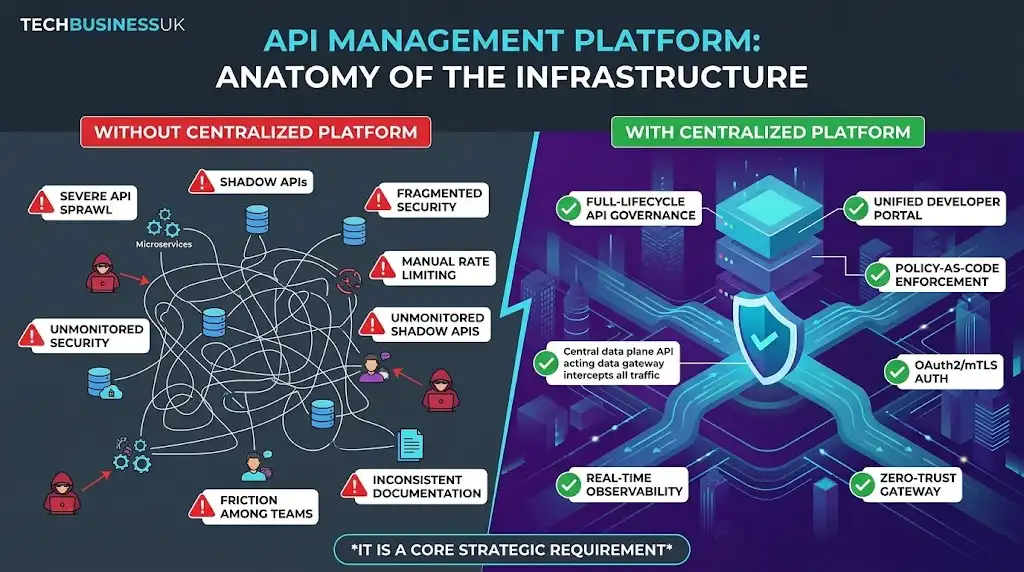
Without a centralized API management platform, organizations face fragmented access control mechanisms, inconsistent documentation, uncoordinated rate-limiting strategies, and an inability to track data exfiltration across disparate endpoints. This guide provides a comprehensive technical breakdown of full-lifecycle API management, detailing architectural components, operational security controls, multi-cloud evaluation frameworks, and implementation blueprints.
An enterprise API management platform serves as the central control plane and runtime defense layer for distributed systems. It extends beyond basic HTTP request routing to provide full-lifecycle API governance, interactive developer portals, fine-grained analytics, policy-as-code security, and automated deployment pipelines. Choosing between open-source extensibility (Kong, Tyk), cloud-managed ecosystems (AWS, Azure, GCP), or enterprise integration middleware (Apigee, MuleSoft) requires evaluating multi-cloud flexibility, total cost of ownership (TCO), and identity provider integrations.
1. Deconstructing the Architecture: API Gateway vs API Management Platform
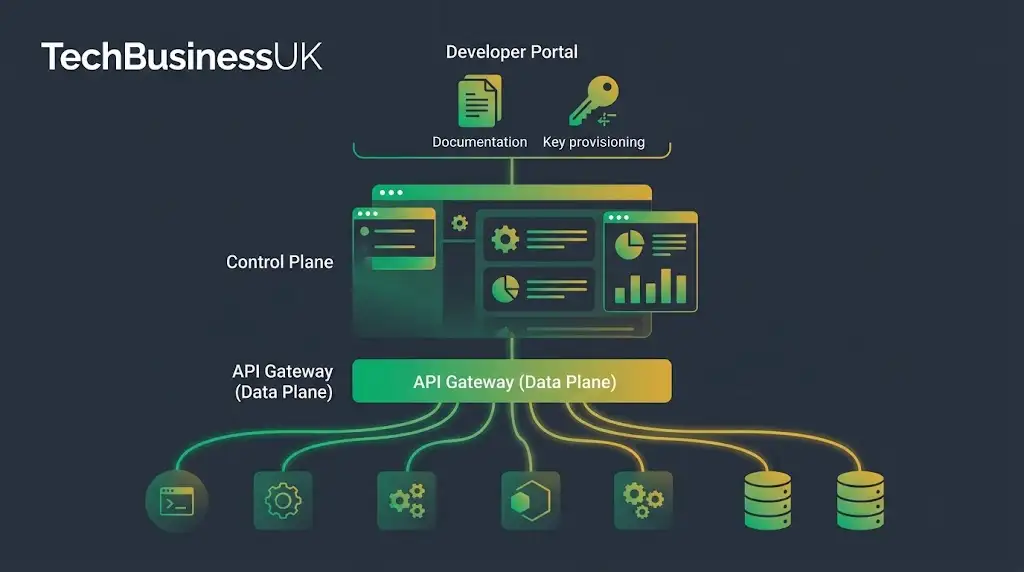
Engineering teams often treat the terms “API Gateway” and “API Management Platform” as interchangeable synonyms. However, conflating runtime traffic execution with full-lifecycle governance leads to significant architectural gaps. An API management platform is a modular, multi-tier ecosystem that subsumes the API gateway as a single execution component within a much broader operational control plane.
- Policy Configuration (YAML/Git)
- Role-Based Access Control (RBAC)
- Lifecycle Phase Governance
- Interactive OpenAPI Docs
- Self-Service Key Provisioning
- SDK Generation & Code Samples
The Data Plane (Runtime Execution Layer)
The Data Plane consists of physical API gateway instances deployed at the edge of your network or directly in front of microservice clusters. Its primary function is the ultra-low-latency processing of inline data traffic.
Key operational responsibilities include:
- Protocol Translation: Converting client-side REST/HTTP requests into internal gRPC calls or legacy SOAP payloads.
- TLS Termination & mTLS Enforcement: Offloading cryptographic decryption overhead from backend services while enforcing mutual TLS (mTLS) for zero-trust service-to-service communication.
- Token Validation & Introspection: Validating incoming OAuth2 Bearer tokens, JSON Web Tokens (JWTs), or API keys against local cryptographic caches or remote Identity Providers (IdPs).
- Traffic Shaping: Applying token-bucket or leaky-bucket algorithms to enforce strict global and per-consumer rate limits.
The Control Plane (Governance & Administration Layer)
The control plane is the administrative brain of the system. It manages configurations, policy definitions, route bindings, and environmental deployments. Rather than directly processing runtime client traffic, it pushes state changes to distributed data plane nodes. Key responsibilities include:
- Centralized Policy Management: Defining rate limits, CORS configurations, transformations, and security guardrails via declarative formats (JSON/YAML) or GitOps workflows.
- Role-Based Access Control (RBAC): Restricting which engineering teams can modify route definitions, promote endpoints from staging to production, or revoke API consumer keys.
- API Lifecycle State Machine: Tracking and transitioning APIs across defined lifecycle stages: Design → Development → Testing →Published → Deprecated →Retired.
Detailed Comparison: Gateway vs. Platform
| Architectural Capability | Standalone API Gateway | Full-Lifecycle API Management Platform |
|---|---|---|
| Primary Architectural Role | High-speed, inline runtime proxy. | End-to-end administration, discovery, security, and analytics. |
| User Persona Focus | DevOps engineers, SREs, network administrators. | API product managers, external developers, enterprise architects. |
| Deployment Footprint | Lightweight edge daemon or sidecar container. | Distributed cluster (Control Plane + Data Plane + Storage + Portal). |
| Security Capabilities | Basic IP masking, TLS, rate limiting, header checks. | Fine-grained OAuth2/OIDC, OPA integration, anomaly detection. |
| Consumer Onboarding | Manual provisioning via config files or API calls. | Automated, self-service developer portal with instant credential generation. |
| Monetization & Billing | None (requires custom development). | Native usage metering, tiered subscription tiers, payment gateway links. |
| Observability Depth | Raw access logs, basic Prometheus metrics. | Historical trend analysis, consumer-level usage tracking, SLA reports. |
2. Core Operational Pillars of an Enterprise API Management Platform
Deploying a mature API management platform requires establishing four foundational operational pillars. These pillars guarantee that internal and external API consumption remains fast, secure, observable, and frictionless.
Pillar 1: Developer Portal & Frictionless Onboarding (DX)
Developer experience (DX) dictates the speed of internal microservice integration and external partner adoption. A poorly integrated platform forces developers to submit manual support tickets to obtain API keys or read outdated PDF documentation. An enterprise-grade developer portal provides:
- Interactive API Catalog: Automatically rendering OpenAPI (Swagger), AsyncAPI, or GraphQL schema definitions into searchable, interactive web interfaces. Developers can execute live API calls within a sandboxed “Try It Out” environment.
- Self-Service Credential Provisioning: Allowing authenticated users to create developer applications, obtain client IDs/secrets, configure OAuth2 redirect URIs, and rotate compromised keys automatically.
- Automated SDK & Client Library Generation: Converting API schemas into native client SDKs across multiple languages (Python, TypeScript, Go, Java) directly within the portal interface.
- Community & Support Integration: Providing changelogs, deprecation schedules, system status indicators, and direct support channels for API consumers.
Pillar 2: API Lifecycle & Schema Governance
Without rigid schema governance, API drift causes downstream breaking changes, runtime exceptions, and security vulnerabilities. An enterprise API management platform acts as the single source of truth for schema validation:
- Schema Validation at the Edge: Incoming client payloads are validated against defined JSON or Protocol Buffer schemas before reaching internal microservices. Requests with invalid properties, malformed data types, or unauthorized extra fields are rejected immediately with a
400 Bad Request. - Version Control & Deprecation Workflows: Supporting path-based (
/v1/users), header-based (Accept: application/vnd.company.v2+json), or query-parameter-based versioning. The platform tracks API consumption by version, allowing teams to notify consumers who are still calling legacy/v1/routes before setting an endpoint state to Deprecated. - CI/CD Pipeline Automation: Integrating with developer tools like GitHub Actions, GitLab CI, or Jenkins to lint OpenAPI documents, run breaking-change detectors, and deploy updated proxy configurations using GitOps methodologies.
Pillar 3: Zero-Trust Security & Perimeter Defense
APIs represent the primary attack surface for modern enterprise data breaches. An API management platform forms the perimeter shield within a Zero-Trust Architecture (ZTA):
- Centralized Authentication & Federated Identity: Integrating with enterprise Identity Providers (e.g., Okta, Auth0, Ping Identity, Azure AD) via OAuth2, OpenID Connect (OIDC), or SAML 2.0. The platform abstracts identity handling from backend developers.
- Fine-Grained Authorization: Combining Scope-Based access control with Policy-as-Code engines like Open Policy Agent (OPA). The gateway can make dynamic authorization decisions based on token claims, client IP, request method, and payload content.
- Perimeter Defense Controls: Centralizing defenses against runtime threats, including runtime API gateway security strategies to mitigate Broken Object Level Authorization (BOLA), mass assignment, and DDoS attempts.
Pillar 4: Real-Time Observability & Analytics
Centralized traffic inspection allows engineering teams to convert raw network logs into actionable operational intelligence:
- Performance Telemetry: Measure global request volumes, throughput (requests per second), and latency distribution across p50, p90, p95, and p99 to pinpoint lagging upstream microservices.
- Business & Monetization Metrics: Tracking endpoint usage by tenant ID, consumer organization, or geographic location. These metrics feed directly into monetization engines to calculate tier-based billing cycles.
- Distributed Tracing Integration: Injecting and propagating standardized tracing headers (e.g., W3C Trace Context, Jaeger, Zipkin) into downstream microservices to enable complete end-to-end request path tracing.
3. Comparative Analysis: Open-Source vs. Cloud-Native vs. Enterprise Middleware
Selecting an API management platform requires aligning architectural capabilities with organizational structure, internal engineering skill, and operational budgets. The vendor landscape is categorized into three primary architectural tiers:
Tier 1: Open-Source & Cloud-Native Extensible
Platforms in this category are designed for modern, containerized environments within the broader CNCF Cloud Native Landscape. They prioritize lightweight execution, high throughput, and multi-cloud flexibility.
- Key Vendors: Kong Enterprise, Tyk, KrakenD.
- Architectural Mechanics: Typically built on high-performance C/Lua (Nginx) or Go engines. They use lightweight plugins to extend runtime functionality and separate the control plane from distributed edge data planes.
- Strengths: Extreme performance (sub-millisecond overhead), native Kubernetes Ingress Controller integration, low memory footprints, and complete protection against cloud-vendor lock-in.
- Weaknesses: Requires strong internal DevOps and Kubernetes expertise to deploy, scale, and maintain underlying storage backends (e.g., PostgreSQL, Redis).
Tier 2: Cloud-Managed Ecosystems
Fully managed platform services offered directly by hyper-scale cloud providers. They integrate natively with proprietary cloud infrastructure, identity systems, and serverless runtimes.
- Key Vendors: AWS API Gateway, Azure API Management (APIM), Google Cloud API Gateway.
- Architectural Mechanics: Control and data planes are completely managed and auto-scaled by the cloud vendor. Developers configure routes and policies using cloud-native infrastructure-as-code (IaC) tools like Terraform, AWS CloudFormation, or Azure ARM templates.
- Strengths: Zero operational server maintenance, seamless scale-to-zero capabilities, low initial cost, and native integration with cloud identity services (e.g., AWS Cognito, Azure Active Directory) and serverless compute (e.g., AWS Lambda, Azure Functions).
- Weaknesses: Deep vendor lock-in, unpredictable monthly billing for high-volume workloads, and limited cross-cloud or on-premises deployment capabilities.
Tier 3: Enterprise Integration & Middleware
Heavyweight, full-suite enterprise platforms engineered for complex corporate digital transformations, legacy system integration, and global API ecosystems.
- Key Vendors: Google Cloud Apigee, Salesforce MuleSoft Anypoint Platform, IBM API Connect.
- Architectural Mechanics: Comprehensive suites that bundle sophisticated ESB (Enterprise Service Bus) capabilities, complex protocol translation engines, advanced B2B partner portals, and out-of-the-box monetization features.
- Strengths: Superior protocol transformation capabilities (e.g., mapping legacy SOAP/XML to modern REST/JSON), deep enterprise compliance governance, and pre-built connectors for legacy ERP/CRM systems (SAP, Salesforce).
- Weaknesses: Extremely high licensing costs, steep learning curves, heavy resource consumption, and slow operational setup times.
Comprehensive Platform Evaluation Matrix
| Evaluation Criteria | Open-Source & Extensible (e.g., Kong, Tyk) |
Cloud-Managed Ecosystems (e.g., AWS/Azure APIM) |
Enterprise Middleware (e.g., Apigee, MuleSoft) |
|---|---|---|---|
| Primary Deployment Model | Multi-Cloud, On-Premises, Kubernetes Native. | Single-Cloud Managed SaaS / Serverless. | Hybrid Cloud, On-Premises, Enterprise Core. |
| Performance Overhead | Ultra-low latency (< 2 ms processing). | Variable (subject to cloud cold starts). | Moderate latency overhead due to complex transformation. |
| Vendor Lock-In Risk | Low (Runs on any infrastructure). | High (Tightly coupled to cloud ecosystem). | Moderate to High (Proprietary runtime DSLs). |
| DevOps Requirements | High (Requires container orchestration skills). | Low (Infrastructure managed by cloud vendor). | Moderate (Managed control plane, custom deployments). |
| Protocol Transformation | Basic (JSON-to-JSON, header rewrites). | Moderate (Mapping JSON parameters to cloud specs). | Advanced (SOAP to REST, XML to JSON, Mainframe connectors). |
| Extensibility Model | Custom plugins via Lua, Go, WebAssembly (Wasm). | Cloud Functions / Lambda integrations. | Enterprise Java, DataWeave, proprietary policy engines. |
| Pricing Model | Open Source Core / Per-Node Enterprise License. | Pay-per-call / Request volume tiering. | Tiered annual subscription / Enterprise core licensing. |
4. Architectural Deep Dive: Implementing Policy-as-Code & Zero-Trust Governance
A key function of a modern API management platform is enforcing security policies deterministically without hardcoding logic into microservice applications. Modern platforms use Policy-as-Code (PaC) to decouple policy definitions from application source code.
- Extract Client TLS Cert & Bearer Token
- Construct JSON Context Payload:
{ User, Roles, Method, Path, Source IP }
- Is Token Valid & Unexpired?
- Does Role match Path Perms?
- Is Source IP inside Whitelisted CIDR?
Policy-as-Code Integration with Open Policy Agent (OPA)
By integrating Open Policy Agent (OPA) or similar policy engines with your API management platform, security teams write declarative access policies in languages like Rego. The gateway passes request metadata (token claims, request path, HTTP method, client IP) to OPA for instantaneous evaluation before proxying the request downstream.
Rego Policy Example for API Gateway Route Enforcement:
package api.authz

# Default decision: Reject all incoming requests
default allow = false

# Allow access if the user possesses the required role and valid tenant context
allow {
    # Verify the request method is GET
    input.method == "GET"

    # Match path structure: /api/v2/tenants/{tenant_id}/financials
    input.path = ["api", "v2", "tenants", tenant_id, "financials"]

    # Ensure user's JWT tenant claim matches the requested URL tenant parameter
    input.token.claims.tenant_id == tenant_id

    # Ensure user holds the required authorization role
    user_has_role(input.token.claims.roles, "financial_auditor")
}

# Helper rule to validate role presence in user array
user_has_role(roles, required_role) {
    roles[_] == required_role
}
Edge Rate Limiting & Resource Throttling Mechanics
To protect internal systems from resource exhaustion, brute-force attempts, and Denial-of-Wallet attacks, an API management platform executes multi-tiered rate limiting strategies using a distributed cache (such as Redis):
- Global Gateway Limits: Setting absolute caps on total incoming platform requests (e.g., maximum 50,000 RPS) to prevent perimeter network collapse.
- Tenant-Level SLA Limits: Enforcing dynamic limits based on the consumer’s subscription plan (e.g., Free Tier: 100 requests/min; Enterprise Tier: 10,000 requests/min).
- Endpoint-Level Spike Arrests: Placing restrictive limits on expensive or resource-intensive endpoints (e.g., login attempts or heavy database aggregation calls restricted to 5 RPS per client IP).
To execute rate limiting without introducing latency bottlenecks, gateway nodes use the Distributed Leaky Bucket or Sliding Window Log algorithm stored inside in-memory data structures:
rate:client_123:api_v1ZREMRANGEBYSCORE rate:client_123:api_v1 0 (1000 - 60)
ZCARD rate:client_123:api_v1
↳ Add current timestamp:
ZADD rate:client_123:api_v1 1000 1000[ ALLOW REQUEST ]
[ BLOCK REQUEST ] (Return HTTP 429 Too Many Requests)
5. Enterprise Selection Framework & Decision Methodology
Selecting the right API management platform requires a structured evaluation framework that maps technical requirements against operational capabilities. Follow this step-by-step methodology during vendor procurement:
- Multi-cloud vs. Single Cloud?
- Protocol requirements (REST, gRPC, SOAP)?
- Self-service portal capabilities?
- CI/CD & GitOps integration?
- mTLS support?
- IdP federation (OAuth2/OIDC)?
Step 1: Audit Your Infrastructure Topology
- Multi-Cloud / Hybrid Cloud: If your workload is distributed across AWS, GCP, and on-premises data centers, eliminate single-cloud managed gateways unless you plan to run multiple independent gateway control planes. Look toward vendor-agnostic platforms like Kong or Tyk.
- Single Cloud / Serverless: If your stack is exclusively hosted in a single provider (e.g., AWS) and makes heavy use of serverless runtimes (AWS Lambda, Fargate), AWS API Gateway offers the path of least operational resistance.
Step 2: Evaluate Protocol Requirements
- Modern Microservices: If your services communicate primarily via REST, gRPC, WebSockets, or GraphQL, ensure the platform offers native schema inspection and route routing for these formats.
- Legacy System Transformation: If you must expose legacy enterprise assets (SOAP, XML, mainframe protocols) as modern REST endpoints, prioritize Enterprise Integration Middleware solutions like MuleSoft or Apigee.
Step 3: Assess Security & Compliance Controls
Verify that the platform natively supports enterprise identity integration using standard OAuth2 and mTLS authentication protocols. The platform must enforce token validation at the edge and integrate with your existing SIEM (Splunk, Datadog) for audit logging.
Step 4: Calculate Total Cost of Ownership (TCO)
Calculate costs using three-year projections based on expected request growth:
Total TCO = Licensing + Hosting + DevOps
- Cloud-Managed (Pay-Per-Call): Starts cheap, but costs scale exponentially at high volumes (e.g., hundreds of millions of requests per month).
- Self-Hosted Enterprise: Higher upfront licensing and setup costs, but marginal cost per request approaches zero as traffic grows.
7. Conclusion: Modernizing Your API Strategy
Adopting an enterprise API management platform marks a fundamental transition in how an organization builds, secures, and ships software. Moving away from custom, developer-written access controls toward a unified control plane reduces operational overhead, eliminates security blind spots, and provides a seamless developer experience for internal and external engineers.
Whether your team selects a lightweight, open-source Kubernetes ingress gateway, a fully managed cloud-native platform, or a robust enterprise integration suite, the key to success lies in strict schema governance, automated API testing tools integrated into CI/CD pipelines, and continuous zero-trust security enforcement at the edge.
Frequently Asked Questions (FAQs)
Q: What is the core difference between an API gateway and an API management platform?
A: An API gateway is a lightweight runtime data plane proxy that executes request routing, TLS termination, and rate limiting. An API management platform is an enterprise-wide control plane that encompasses the API gateway alongside developer portals, API design tools, lifecycle governance, analytics, and monetization.
Q: How does an API management platform improve microservices security?
A: It centralizes security controls at the network edge, enforcing OAuth2/OIDC authentication, mutual TLS (mTLS), rate limiting, payload schema validation, and Policy-as-Code checks before requests reach internal application services.
Q: When should an enterprise choose open-source API management over cloud-managed services?
A: Open-source extensible platforms (such as Kong or Tyk) are ideal for multi-cloud, hybrid, or Kubernetes-native architectures where avoiding vendor lock-in, maintaining sub-millisecond latency, and running custom plugins are top priorities.
Q: What is the role of Policy-as-Code in API management?
A: Policy-as-Code decouples authorization and security rules from backend application logic. Using tools like Open Policy Agent (OPA), security policies are defined declaratively and evaluated at the gateway level dynamically.
About the Author

3 thoughts on “API Management Platform Guide: Stop Sprawl & Secure APIs”