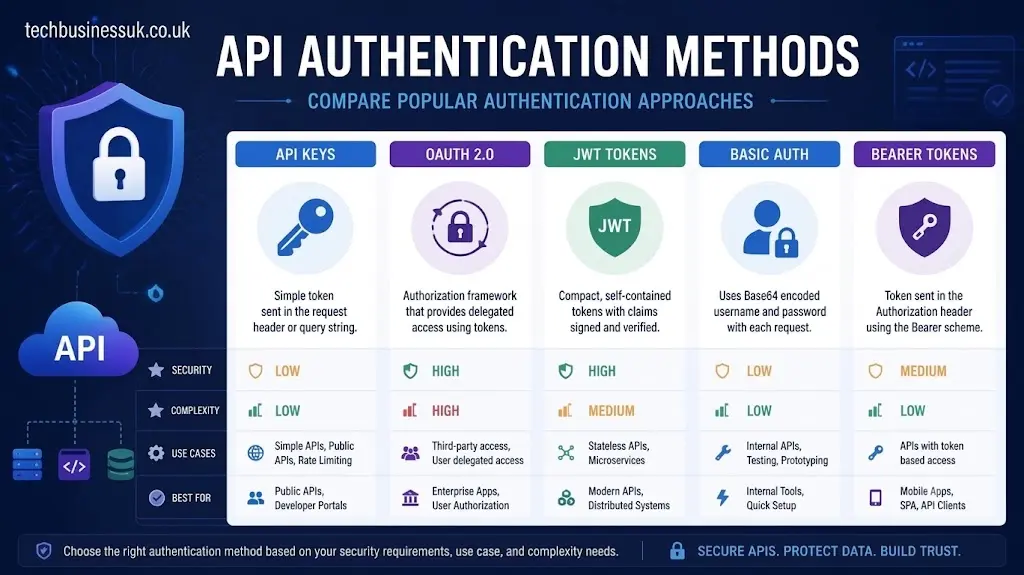
API authentication methods are protocols and frameworks to verify the identity of a client before allowing access to an API endpoint . Validation of digital credentials before executing application logic, modern API authentication methods protect backend microservices from unauthorized access and credential exploitation.
The Front Door of Your Architecture
You have tested your endpoints thoroughly using the right API testing tools. You have configured telemetry and real-time alerts. But they are useless if an unauthenticated user can bypass your gateway and execute commands on your database.
Authentication sits directly at the perimeter of our infrastructure. It dictates who gains access to our endpoints—and who gets turned away at the door.
In modern software architecture, to be relied on simple passwords or static credentials is a liability. Modern distributed systems, cloud-native deployments, and AI agent workloads require scalable, multi-layered identity mechanisms.
In this comprehensive guide, we will evaluate the core API authentication methods available today. We will analyze how each pattern works under the hood, provide standard HTTP request header specs, demonstrate code implementations, and guide you through choosing the optimal strategy for your application.
What Is API Authentication?
API auth just checks your Identity and proves who is making the request.
When an app like a mobile frontend or a partner service sends an HTTP request, the backend needs to know it’s legit.
Without API authentication methods, an application endpoint is an open doorway. By spamming your endpoints, hackers can easily crash servers and exploit your data.
Modern auth works by attaching cryptographic proof; like an API key or an access token, to every request.
API API Authentication vs. API Authorization
Developers frequently conflate authentication with authorization. These two steps run sequentially in your gateway, but they do different jobs:
- Authentication (AuthN): Validates identity.
Example: Checking that a request includes a signed JSON Web Token (JWT) from the identity provider.
- Authorization (AuthZ): Enforces permissions.
Example: Verifying that the authenticated user has the admin:write scope before allowing a record deletion.
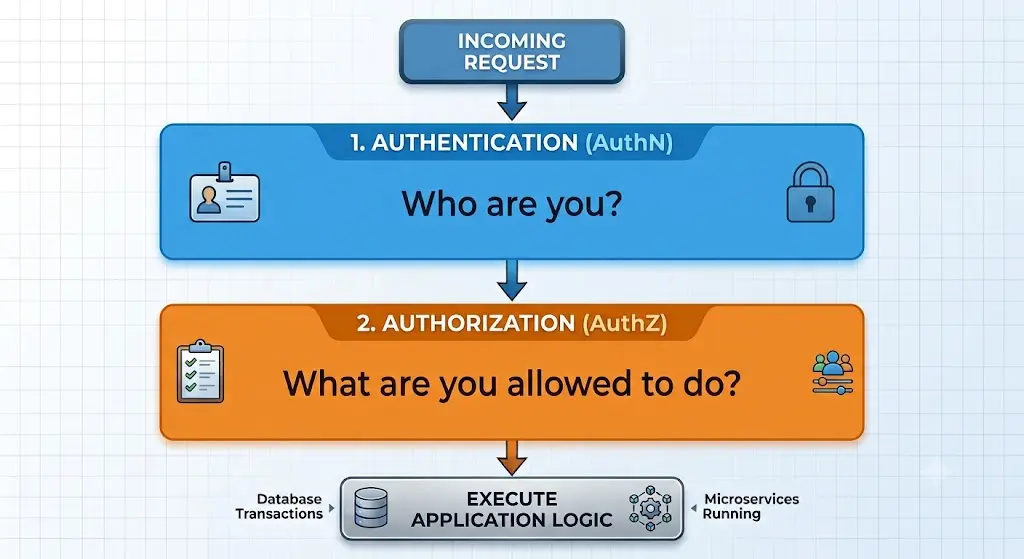
Authentication always comes first. Once an identity is verified, authorization checks if that identity can execute the requested endpoint.
Core API Authentication Methods
Different architectures need different identity patterns. Here is how the standard production options compare.
1. API Keys
An API key is a persistent secret string assigned to a client. The client attaches this string to an HTTP header or query parameter on every outgoing call.
Header Format
GET /v1/telemetry HTTP/1.1
Host: api.example.com
X-API-Key: ak_live_9f83a2b1c4e567890
Trade-offs:
- Pros: Simple to generate, easy to test, and perfect for basic rate limiting on developer portals or internal scripts.
- Cons: Keys are plain bearer credentials with no built-in expiration. If someone commits a key to a public repository, anyone can use it, and you can’t tie key usage to specific individual users.
2. Basic Authentication
Basic Auth is part of the original HTTP spec. The client concatenates a username and password with a colon, encodes the string in Base64, and passes it inside the Authorization header.
Header Format
GET /v1/admin/health HTTP/1.1
Host: api.example.com
Authorization: Basic dXNlcm5hbWU6cGFzc3dvcmQ=
(Note: dXNlcm5hbWU6cGFzc3dvcmQ= is just username:password in Base64.)
Trade-offs:
- Pros: Universally supported by almost every HTTP library, browser, and cURL command without extra dependencies.
- Cons: Base64 is simple encoding, not encryption. Transmitting credentials over unencrypted HTTP exposes raw passwords to network listeners. Passing user credentials on every request needlessly inflates your attack surface. Restrict this to local development or legacy internal setups over HTTPS.
3. Bearer Tokens & JWTs
Bearer authentication operates on a simple premise: whoever holds the token gets access. The dominant format for bearer credentials today is the JSON Web Token (JWT), as defined in industry standard RFC 7519.
Trade-offs:
Cons: Revocation is difficult. Because a JWT carries its own expiration timestamp, a compromised token remains valid until it expires unless you build a token blocklist using an in-memory store like Redis.
Pros: Completely stateless. Backend microservices verify the token’s cryptographic signature using a public key or shared secret, skipping database lookups entirely.
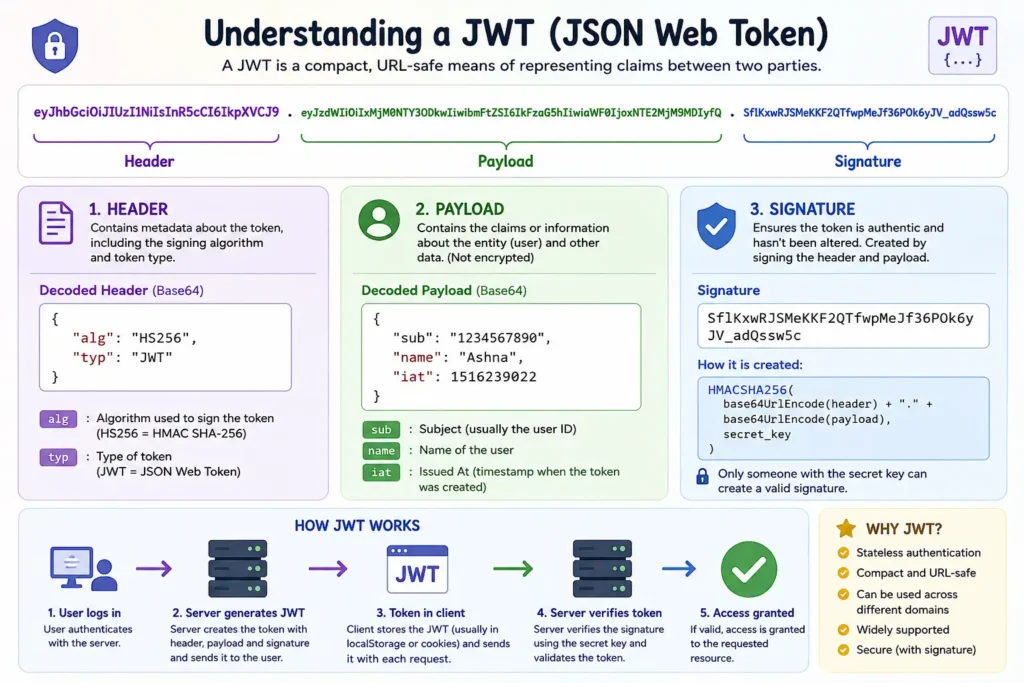
Decoded Parts
- Header: Specifies the signing algorithm (e.g., HS256 or RS256).
{ "alg": "HS256", "typ": "JWT" }- Payload: Contains user metadata and identity statements (claims).
{
  "sub": "user_89123",
  "name": "Alex Mercer",
  "role": "editor",
  "iat": 1774560000,
  "exp": 1774563600
}- Signature: Created by signing the encoded header and payload using a secret key or private key. This prevents tampering.
Header Format
GET /v1/user/profile HTTP/1.1
Host: api.example.com
Authorization: Bearer eyJhbGciOiJIUzI1NiIsInR5cCI6IkpXVCJ9...
4. OAuth 2.0 & OpenID Connect (OIDC)
OAuth 2.0 is a delegation framework, not a standalone authentication protocol. It lets third-party apps request scoped access to user resources without ever touching user credentials. Paired with OpenID Connect (OIDC)—an identity layer built on top of OAuth 2.0—it issues an id_token alongside standard access tokens to handle user identity.
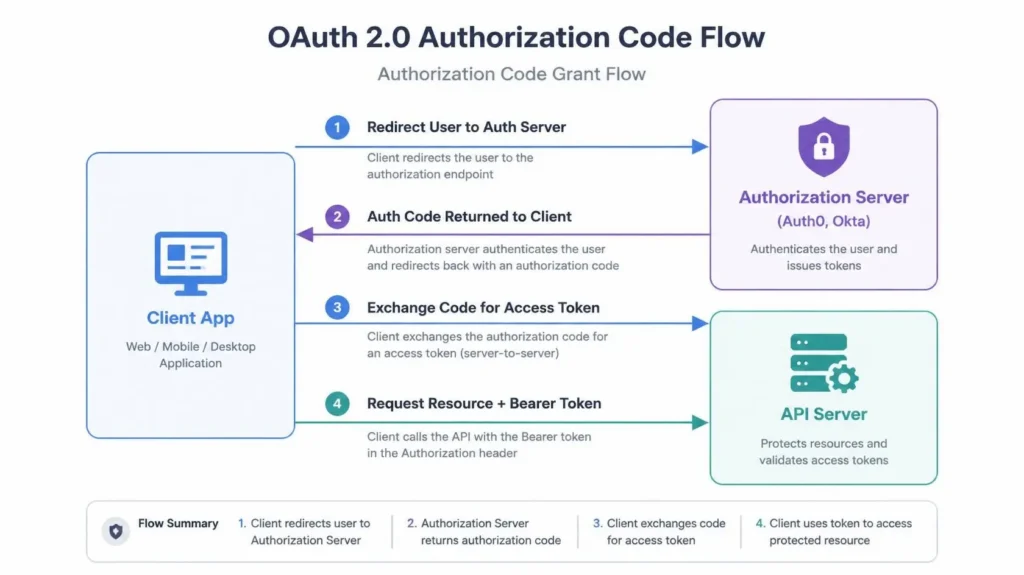
Trade-offs:
Cons: Higher operational complexity. You have to manage identity providers, authorization code exchanges, redirect URLs, and PKCE parameters for mobile and browser apps.
Pros: The gold standard for user-facing applications. It supports granular permission scopes (read:profile, write:orders), centralized access control, Single Sign-On (SSO), and short token lifespans.
5. Session-Based Authentication
The standard pattern for monolithic web apps. Upon login, the server stores a session record in memory or Redis and writes a unique session ID to an HTTP-only cookie in the browser.
Header Format
GET /dashboard HTTP/1.1
Host: example.com
Cookie: session_id=s%3A98a2f1c...; Secure; HttpOnly; SameSite=Strict
Trade-offs:
- Pros: Instant revocation. Deleting a session key from your backend cache logs out the user immediately across all devices.
HttpOnlycookie flags also protect session IDs from client-side XSS attacks. - Cons: Highly stateful. Every API request forces a database or Redis lookup to validate the session key, creating performance bottlenecks as traffic scales across distributed services.
6. Mutual TLS (mTLS)
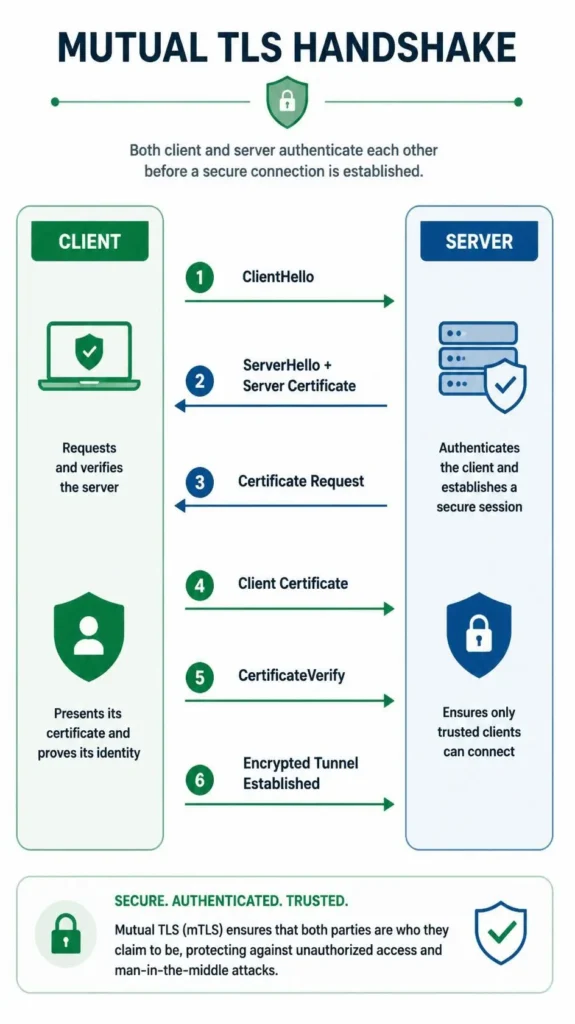
Standard TLS verifies the server’s identity to the client. Mutual TLS works both ways: the client and server authenticate each other using X.509 digital certificates during the initial TLS handshake.
Trade-offs:
- Pros: No passwords or application-layer tokens to manage. Authentication happens at the network transport layer before your backend application code even executes, eliminating standard application-level token interception risks.
- Cons: Significant infrastructure management. Distributing, rotating, and revoking client certificates requires dedicated Public Key Infrastructure (PKI) tooling.
Method Comparison
| Method | Security Level | Setup Effort | Scalability | Primary Use Case |
|---|---|---|---|---|
| API Keys | Low–Medium | Very Low | High | Public developer tools, internal scripts, simple rate limiting |
| Basic Auth | Very Low | Very Low | High | Local dev, legacy internal endpoints (HTTPS required) |
| JWT / Bearer | High | Medium | Very High | Stateless services, Single Page Applications (SPAs) |
| OAuth 2.0 / OIDC | Very High | High | High | Third-party access, enterprise SSO, delegated workflows |
| Session-Based | Medium–High | Low | Medium | Traditional web apps, server-rendered portals |
| mTLS | Very High | High | High | Zero-trust microservices, finance, healthcare integrations |
OAuth 2.0 vs. JWT: Clarifying the Difference
Comparing OAuth 2.0 and JWTs directly is a common mix-up. They operate at entirely different layers:
- OAuth 2.0 is the process. It defines how a user approves access, how applications request authorization, and how tokens pass between servers.
- JWT is the format. It defines how identity claims are formatted, encoded, and mathematically signed into a portable string.
Most modern setups use both together. OAuth 2.0 handles the authorization flows, and the access tokens issued at the end of those flows are formatted as signed JWTs.
Code Example: Verifying JWTs in FastAPI
Here is a practical Python/FastAPI pattern for inspecting incoming requests, reading Bearer JWTs from the Authorization header, and verifying signatures before executing endpoint logic:
from fastapi import FastAPI, Depends, HTTPException, status
from fastapi.security import HTTPBearer, HTTPAuthorizationCredentials
import jwt
from typing import Dict

app = FastAPI(title="Secure API Gateway")
security = HTTPBearer()

# Read secrets from environment variables or a key manager in production
JWT_SECRET_KEY = "your-production-super-secret-key-change-this"
ALGORITHM = "HS256"

def verify_jwt_token(credentials: HTTPAuthorizationCredentials = Depends(security)) -> Dict:
    """
    Validates Bearer JWT signatures and expiration times.
    Returns claims if valid.
    """
    token = credentials.credentials
    try:
        payload = jwt.decode(
            token,
            JWT_SECRET_KEY,
            algorithms=[ALGORITHM],
            options={"verify_exp": True}
        )
        return payload
    except jwt.ExpiredSignatureError:
        raise HTTPException(
            status_code=status.HTTP_401_UNAUTHORIZED,
            detail="Token expired.",
            headers={"WWW-Authenticate": "Bearer"},
        )
    except jwt.InvalidTokenError:
        raise HTTPException(
            status_code=status.HTTP_401_UNAUTHORIZED,
            detail="Invalid token signature.",
            headers={"WWW-Authenticate": "Bearer"},
        )

@app.get("/v1/secure-dashboard")
async def get_dashboard_data(user_claims: Dict = Depends(verify_jwt_token)):
    """
    Protected route accessible only with a valid JWT.
    """
    return {
        "status": "authenticated",
        "user_id": user_claims.get("sub"),
        "assigned_role": user_claims.get("role", "standard_user"),
        "message": "Access granted."
    }
API Security Vulnerabilities & Prevention
Even bulletproof authentication setup fails when backend logic makes bad assumptions. I see developers fall into these three traps all the time:
1. Broken Object Level Authorization (BOLA)
BOLA consistently tops OWASP security lists. Why? Because it’s absurdly easy to exploit. A user logs in legally, gets a valid token, and then manually edits a number in their browser’s URL—changing /v1/orders/1001 to /v1/orders/1002. Suddenly, they’re looking at someone else’s receipt.
Passing the identity check at your gateway doesn’t mean much here. Gateway validation proves who made the call, but your controller code still has to check if that specific user_id actually owns the record they’re trying to touch.
2. Replay Attacks
Say a hacker sniffs an incoming HTTP payload on an open network. If that request holds a valid auth header, they don’t bother trying to decrypt it. They just copy the raw request and fire it at your server fifty times.
Stop this cold by forcing HTTPS everywhere, shortening token lifespans, and rejecting signed headers that lack recent timestamps or unique nonces.
3. Credential Stuffing & Brute Force
Automated scripts constantly probe routes like /login or /oauth/token, hammering them with millions of stolen username-password combos bought off dark web forums.
Your best defense here is multi-layered: enforce strict IP and identity rate limits right at the gateway level, force MFA, and set up automatic alerts when failed login attempts spike out of nowhere.
AI Agent Authentication
By 2026, a huge chunk of your API traffic isn’t coming from human fingers on keyboards—it’s autonomous AI agents executing background tasks. This creates two distinct auth challenges:
- Handling Dual Identity: When an agent calls an endpoint, your server needs to track two separate entities at once—the end user who owns the data, and the agent runtime making the request. Modern setups pass user identity inside the primary JWT while tagging agent details using custom claims like
agent_idor customX-Agent-IDheaders. - Locking Down Scope with MCP: Giving an AI agent broad administrative rights is asking for trouble. When exposing APIs via Model Context Protocol (MCP), issue ultra-narrow OAuth scopes. An agent might need
read:calendaraccess to check your schedule, but it should never havedelete:calendarrights unless explicitly requested.
Best Practices for Securing API Authentication
Forget complex frameworks for a second. If you don’t get these fundamentals right, your auth layer will leak sooner or later:
- HTTPS is non-negotiable. Plain HTTP leaks headers over public networks. Redirect all traffic to HTTPS immediately and turn on HSTS.
- Hash passwords with Argon2id or bcrypt. Plain SHA256 is useless against modern GPU cracking rigs. Use memory-hard algorithms.
- Never leak secrets in URL parameters. Query strings like
?api_key=999end up saved in browser histories, proxy logs, and CDN caches. Keep secrets inside HTTP headers exclusively. - Force short token lifespans. Set access token lifespans between 5 and 15 minutes. Pair them with single-use rotating refresh tokens so a leaked credential dies fast.
- Keep keys out of your Git history. Inject API keys at runtime via environment variables or secret stores like HashiCorp Vault. Never hardcode them into application source code.
- Monitor auth traffic in real time. Blocking unauthorized access is only half the battle—pair authentication layer with modern API monitoring tools to spot unusual traffic spikes, credential stuffing, and failing endpoints before they turn into full breaches.
Frequently Asked Questions
Which API authentication strategy is actually the most secure?
It depends entirely on where the request is going. For internal microservices talking to each other behind a firewall, mTLS is king because it handles security at the transport layer. For client-facing web or mobile apps, OAuth 2.0 with OIDC and short-lived JWTs is the standard approach.
Are API keys fine for user authentication?
No, absolutely not. API keys identify an application or a project, never a specific human. They don’t carry user contexts or expiration logic natively, so don’t use them to secure user-specific database records.
How long should access tokens stay valid?
Keep them short—somewhere between 5 to 15 minutes max. Use rotating refresh tokens to keep the user’s session active without leaving long-lived access tokens floating around.
Can I run multiple auth schemes on a single API?
Yes, and almost every production gateway does. You might accept OAuth Bearer tokens for your web frontend, issue API keys for developer integrations, and mandate mTLS for internal background microservices.
How do I choose between different API authentication methods for my system?
Selecting the right API authentication methods comes down to your system architecture and who is calling your endpoints. For simple developer integrations or public APIs, API keys are quick to implement. If you are building modern client-facing applications or single-page apps (SPAs), OAuth 2.0 with JWTs provides secure, granular access control. For strict service-to-service microservices, mTLS is the ideal choice. Comparing these API authentication methods early in your planning ensures your backend stays protected as your platform scales.
About the Author




3 thoughts on “API Authentication Methods: A Complete Guide to Securing Your Endpoints (2026)”