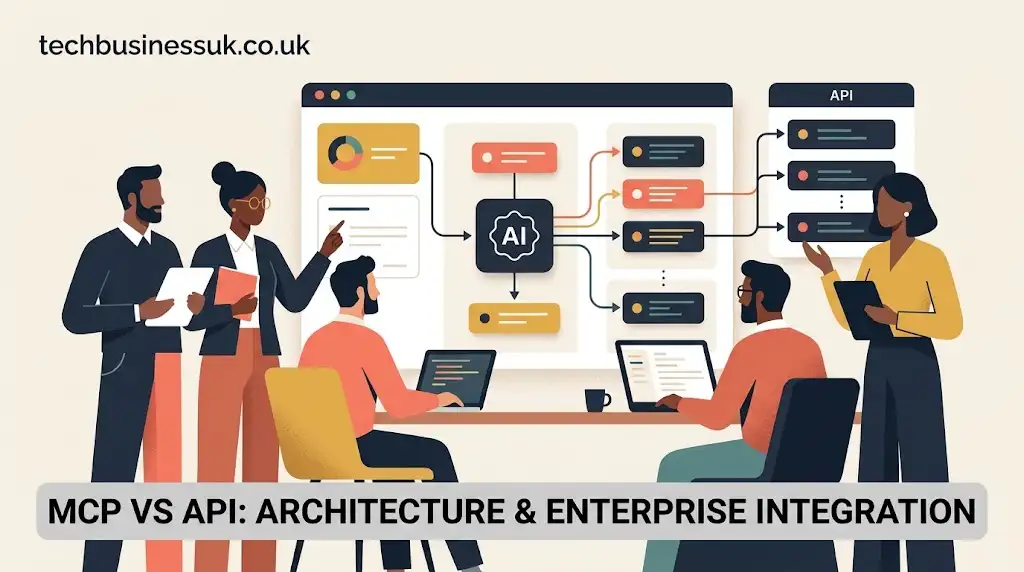
The widespread adoption of autonomous Large Language Model (LLM) agents and multi-agent workflows has exposed structural limitations in classic software integrations and Understanding the trade-offs between MCP vs API integration is becoming a foundational requirement for software architects. For decades, Application Programming Interfaces (APIs)—particularly REST, GraphQL, and gRPC—have provided the backbone of digital interconnectivity. They were built on a core premise: deterministic execution orchestrated by human developers who write explicit, hardcoded integrations.
However, AI agents do not operate deterministically. They interpret natural language, navigate ambient context, dynamically select tools, and execute multi-step reasoning loops at runtime. Forcing an autonomous agent to interact with dozens of disparate REST endpoints creates exponential integration debt—the classic M x N integration bottleneck.
Enter the Model Context Protocol (MCP), an open standard originally introduced by Anthropic and governed under the Linux Foundation’s Agentic AI Foundation (AAIF). MCP redefines how AI hosts interface with external data sources and execution engines.
This comprehensive guide breaks down MCP vs API: their structural architectures, underlying protocol mechanics, security profiles, and enterprise integration patterns.
1. Foundational Definitions: What Are We Comparing?
To evaluate MCP against traditional APIs, we must first clarify the domain each technology was built to solve.
┌─────────────────────────────────────────────────────────┐
│                      AI Host / Agent                    │
└────────────────────────────┬────────────────────────────┘
                             │
                  JSON-RPC 2.0 (MCP Layer)
                             │
                             ▼
┌─────────────────────────────────────────────────────────┐
│                       MCP Server                        │
└────────────────────────────┬────────────────────────────┘
                             │
                HTTP / gRPC / SQL (Native API)
                             │
                             ▼
┌─────────────────────────────────────────────────────────┐
│                   Enterprise Backend                    │
└─────────────────────────────────────────────────────────┘
What is a Traditional API?
A traditional API (Application Programming Interface) is a set of defined rules, schemas, and protocols that allow separate software applications to communicate.
- Primary Consumer: Human developers writing deterministic code.
- Execution Model: Static, point-to-point, and procedural.
- Protocols: REST (HTTP/JSON), GraphQL, gRPC, SOAP.
APIs require developers to read static documentation (like OpenAPI/Swagger specs), understand the parameters, manage authentication headers, and write custom integration logic to parse structured responses.
What is the Model Context Protocol (MCP)?
MCP is an open application-layer standard designed specifically for connecting AI models, IDEs, and autonomous agents to data sources, local filesystems, and operational tools. Inspired by the Language Server Protocol (LSP) used in code editors, MCP standardizes how context, capabilities, and prompts are exposed to an AI host.
- Primary Consumer: AI Hosts, LLM Reasoning Engines, and Autonomous Agents.
- Execution Model: Dynamic runtime tool discovery, stateful session negotiation, and natural language context routing.
- Protocol: Built on JSON-RPC 2.0 over stateful transports (Standard I/O or Server-Sent Events / HTTP).
The Core Misconception: MCP does not replace your backend APIs. Instead, MCP acts as an AI-native abstraction layer that wraps around existing APIs, database queries, and tools—translating them into a unified language an LLM can understand, discover, and safely execute at runtime.
2. Deep-Dive Architectural Differences
While both APIs and MCP facilitate data transfer between systems, their underlying mechanisms diverge across four critical architectural dimensions:
1. Consumer Intent: Human-Coded vs. Model-Discovered
When integrating a traditional API, an engineer inspects an OpenAPI/Swagger specification
at design time, writes hardcoded client calls (e.g., fetch('/api/v1/users')), and compiles the code. If an endpoint payload changes, the application breaks until a developer patches it.
In contrast, an MCP client connects to an MCP server at runtime. The agent issues a standardization command (tools/list). The MCP server responds with a dynamic manifest of available tools, complete with natural language descriptions and JSON Schema parameter specifications. The LLM reads these descriptions, reasons about whether a tool matches the user’s intent, and constructs the tool-call invocation autonomously.
2. State Management: Stateless Requests vs. Contextual Sessions
Standard REST APIs are intentionally stateless. Every HTTP request must carry its own authorization tokens, context, and query state. If an agent requires three sequential API calls to solve a multi-step task, it must manually extract data from response #1 and inject it into request #2.
MCP utilizes persistent, stateful sessions using JSON-RPC 2.0. Through its Client-Host-Server architecture, an MCP connection negotiates capabilities upon handshaking. The MCP host maintains session context across interaction turns, drastically reducing latency and token overhead when handling multi-step reasoning loops.
3. Solving the M x N Integration Bottleneck
Consider an enterprise with 5 distinct AI tools (e.g., Cursor IDE, Claude Desktop, enterprise chat agents) and 10 internal databases or SaaS applications.
- With Traditional APIs: Building custom integrations between every agent and every service requires 5 × 10 = 50 unique point-to-point software connectors.
- With MCP: Each tool or application builds one standardized MCP server, and each AI platform builds one MCP client. The integration footprint drops from M × N to M + N (5 + 10 = 15 implementations).
4. Payload Structure: Data Sets vs. Primitives (Tools, Resources, Prompts)
A REST API returns raw, domain-specific JSON data structures (e.g., user objects, array records). MCP organizes capabilities into three standardized protocol primitives:
- Resources: Read-only data sources (file contents, database records, application state) attached to unique URIs that provide context to the LLM.
- Tools: Executable functions (e.g.,
execute_sql,send_slack_message) that allow the model to produce side effects in external systems. - Prompts: Pre-engineered templates and contextual workflows exposed by the server to guide the LLM’s task execution.
3. MCP vs API: Architectural & Security Comparison
| Architectural Dimension | Traditional REST / GraphQL API | Model Context Protocol (MCP) |
|---|---|---|
| Primary Target User | Human Developers & Application Code | Autonomous LLMs, AI Agents & Hosts |
| Communication Protocol | HTTP/1.1, HTTP/2, WebSocket (REST/GraphQL) | JSON-RPC 2.0 over Stdio or SSE (HTTP) |
| Capability Discovery | Static OpenAPI / Swagger specs at design time | Dynamic tools/list runtime negotiation |
| State Management | Stateless (Isolated Request / Response) | Stateful bidirectional sessions |
| Interface Primitives | Endpoints (GET, POST, DELETE) |
Resources, Tools, and Prompts |
| Error Handling | HTTP Status Codes (404, 500, 401) |
Structured JSON-RPC error frames & LLM retries |
| Integration Footprint | M × N point-to-point bespoke connectors | M + N universal host/server standard |
4. Security & Threat Modeling: API Security vs. MCP Guardrails
Transitioning from deterministic APIs to agent-driven MCP tool execution shifts the attack surface. Security teams must account for risks unique to non-deterministic execution paths.
                                    ┌────────────────────────┐
                                    │ Direct / Indirect      │
                                    │ Prompt Injection       │
                                    └───────────┬────────────┘
                                                │
                                                ▼
┌────────────────┐     User Token      ┌─────────────────┐     OAuth 2.0      ┌────────────────┐
│   User Input   ├────────────────────►│   MCP Gateway   ├───────────────────►│ Existing APIs  │
└────────────────┘ (Scoped Identity)   └────────┬────────┘ (Zero Trust Tokens) └────────────────┘
                                                │
                                                ▼
                                    ┌────────────────────────┐
                                    │ Human-in-the-Loop Gate │
                                    └────────────────────────┘
The Security Challenge of MCP
In standard API architectures, input fields are strictly parsed. However, MCP exposes tool interfaces directly to LLM context windows. This introduces critical AI-specific vulnerabilities:
- Indirect Prompt Injection: An attacker places malicious instructions inside a document or web page retrieved via an MCP Resource. When the LLM parses the resource, the hidden text hijacks the model’s reasoning loop, instructing it to call a destructive MCP Tool (e.g.,
delete_database_record). - The Confused Deputy Problem: An AI agent operating with broad administrative credentials might be tricked into performing actions the end-user does not have permission to execute directly.
Enterprise Defense Architecture
Securing an enterprise deployment of MCP servers requires marrying traditional API perimeter controls with AI-native guardrails:
- User-Scoped Authorization Delegation: Never run an MCP server using static, full-privilege API keys. Tool handlers inside the MCP server must forward the end-user’s verified identity token to downstream services, maintaining standard API authentication methods.
- Infrastructure-Level Guardrails: Pre-flight scanning layers must evaluate incoming prompts and retrieved context for injection attempts. Implementing robust Prompt Injection Prevention controls at the gateway level protects both the host application and underlying tools.
- Human-in-the-Loop (HITL) Execution Gates: For state-changing operations (e.g., financial transfers, data deletion), the MCP client host must enforce an explicit user confirmation prompt before sending the JSON-RPC execution signal to the server.
- Perimeter API Management: Centralized platforms handle incoming rate-limiting, schema parsing, and token inspection before payloads hit internal handlers—a critical function provided by modern API Security Tools.
5. Real-World Use Cases: When to Use Which
Deciding between a direct API integration and building an MCP server comes down to who (or what) is consuming the interface.
                 Who is the primary system consumer?
                                │
          ┌─────────────────────┴─────────────────────┐
          ▼                                           ▼
   Human Developer /                           AI Agent / LLM
  Deterministic System                         Reasoning Engine
          │                                           │
          ▼                                           ▼
 ┌─────────────────┐                        ┌───────────────────┐
 │ Standard API    │                        │    MCP Server     │
 │ (REST / gRPC)   │                        │ (JSON-RPC Layer)  │
 └─────────────────┘                        └─────────┬─────────┘
                                                      │
                                                      ▼
                                            Wraps existing backend
                                            APIs & Databases
Choose Traditional REST/GraphQL APIs When:
- The workflow is deterministic: You are building web apps, mobile backends, microservices, or B2B SaaS integrations where input parameters and expected outputs follow strict business logic.
- Low-latency throughput is paramount: Microservice-to-microservice communication within a CI/CD pipeline architecture requires raw speed (gRPC/HTTP) without the tokenization overhead of an LLM loop.
- Public Developer Ecosystems: Exposing public developer documentation where third-party engineers manually write integration code.
Choose Model Context Protocol (MCP) When:
- Building for AI-Native Clients: You want your application’s data or capabilities accessible to platforms like Claude Desktop, Cursor IDE, ChatGPT, or custom internal agent frameworks.
- Handling Dynamic Multi-Step Workflows: Tasks require an agent to discover tools dynamically, chain actions, evaluate intermediate outputs, and self-correct.
- Unifying Disparate Data Sources: You need to expose fragmented databases, local filesystems, and cloud tools to AI models through a single, write-once adapter.
The Recommended Hybrid Pattern: MCP as an AI Wrapper
In enterprise software environments, the most effective strategy is not choosing one over the other. Instead, organizations deploy traditional backend microservices behind a robust enterprise gateway—understanding precisely what is API Gateway architecture—and then construct thin, lightweight MCP servers on top of those existing REST APIs.
Python
# Example: Building an MCP Tool Server wrapping a REST API using FastAPI patterns
from mcp.server.fastmcp import FastMCP
import httpx

mcp = FastMCP("Enterprise Inventory Manager")

@mcp.tool()
async def check_item_stock(sku: str) -> str:
    """Queries internal ERP REST API to fetch real-time warehouse inventory for a given SKU."""
    async with httpx.AsyncClient() as client:
        # Calls the underlying, secure REST API
        response = await client.get(f"https://api.enterprise.internal/v1/stock/{sku}")
        data = response.json()
        return f"SKU {sku} currently has {data['quantity']} units in stock at {data['warehouse_location']}."
By leveraging modern Python frameworks—such as reviewing performance choices between FastAPI vs Flask—developers can spin up production-ready MCP servers that expose clean REST microservices to AI agents in minutes.
6. Summary: The Shift to AI-First Integration
In summary, the choice between MCP vs API comes down to whether your primary consumer is a human coder or an autonomous agent. MCP does not render traditional APIs obsolete. Instead, it solves the fundamental impedance mismatch between human-coded software requirements and non-deterministic AI agent execution.
While APIs remain the foundational pipeline through which raw data travels, MCP serves as the intelligence wrapper—enabling autonomous agents to discover capabilities at runtime, maintain contextual sessions, and interact safely with enterprise software.
Frequently Asked Questions (FAQs)
Q1: In the choice of MCP vs API, does the Model Context Protocol completely replace REST endpoints?
No. MCP sits on top of your existing API infrastructure. Your REST, GraphQL, or gRPC endpoints continue to execute core business logic, database queries, and transactional tasks. The MCP server provides a standardized interface so AI agents can dynamically discover and invoke those underlying APIs without custom glue code.
Q2: What transport protocols does MCP use?
MCP relies on JSON-RPC 2.0 as its core messaging format. For local process communication (e.g., an IDE connecting to a local file analyzer), it uses Standard I/O (stdio). For distributed or remote cloud connections, MCP utilizes Server-Sent Events (SSE) over HTTP.
Q3: How does MCP handle authentication compared to standard APIs?
Traditional APIs authenticate via bearer tokens, API keys, or basic auth headers directly in the client request. MCP handles authorization at both the transport and host levels. Remote MCP connections use standard OAuth 2.0 / OAuth 2.1 token flows during session establishment, ensuring tool calls carry user-scoped identity down to the enterprise backend.
Q4: What is the main efficiency advantage when comparing MCP vs API for AI agents?
While OpenAPI specs provide a static list of endpoints, they were designed for human developers to read at build time. MCP provides runtime capability negotiation (tools/list), persistent stateful sessions, and unified primitives (Tools, Resources, Prompts). This drastically cuts down token consumption and eliminates integration breakages when backend tools update.
About the Author

2 thoughts on “MCP vs API: Which One Powers the Future of Enterprise AI?”