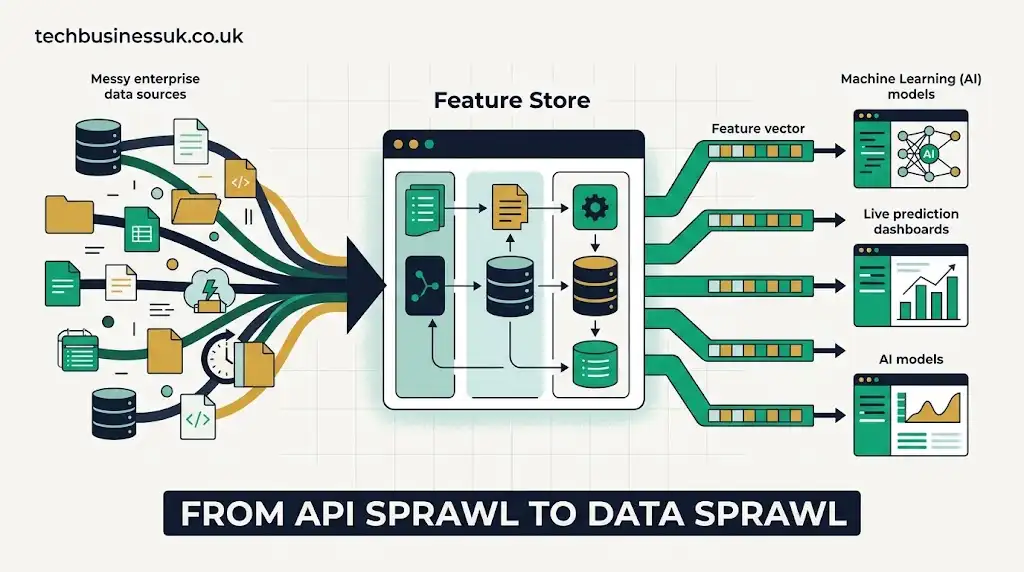
The rapid evolution of enterprise software architecture has reached a critical tipping point. Over the past decade, engineering teams aggressively dismantled monolithic systems in favor of microservices, distributed cloud backends, and lightweight REST endpoints. However, as documented in modern engineering coverage across platforms like BetterThisTechs and BetterThisWorld, this architectural shift introduced a severe operational tax: API sprawl. Organizations found themselves managing thousands of unmapped, redundant, and unsecured endpoints without unified governance.
Today, enterprise technology is undergoing an even larger transformation: the shift from deterministic software to autonomous artificial intelligence, Large Language Models (LLMs), and predictive machine learning (ML) systems.
Yet, as development teams rush to build RAG (Retrieval-Augmented Generation) pipelines, train custom neural networks, and integrate vector databases, they are repeating the exact same architectural mistake. They are moving directly from API sprawl to data sprawl.
While API sprawl fragments your application communication layer, data sprawl silently corrupts your data science workflows, corrupts machine learning model performance, and introduces massive compliance vulnerabilities.
This comprehensive guide breaks down the transition from API sprawl to data sprawl, explores why legacy databases fail to manage non-deterministic AI pipelines, and demonstrates how implementing a modern Feature Store architecture provides the ultimate governance layer for enterprise Data Science and MLOps.
1. Understanding the Crisis: What is Data Sprawl in AI?
To solve data sprawl, we must first define how it manifests inside modern data science and software engineering teams.
┌─────────────────────────────────────────────────────────┐
│                    API SPRAWL (Past)                    │
│   Ungoverned Endpoints ──► Shadow APIs ──► Security Risks│
└────────────────────────────┬────────────────────────────┘
                             │ Evolution to AI
                             ▼
┌─────────────────────────────────────────────────────────┐
│                   DATA SPRAWL (Present)                 │
│  Duplicated CSVs ──► Shadow Vector DBs ──► Model Drift  │
└─────────────────────────────────────────────────────────┘
Data sprawl is the exponential fragmentation, uncontrolled replication, and unmanaged distribution of raw datasets, feature engineering scripts, vector embeddings, and training tables across an enterprise.
In traditional software development, data flowed along predictable paths: a user submitted a form, an API endpoint validated the payload, and a relational database executed a transaction.
In modern machine learning and data science workflows, data is non-deterministic, multi-modal, and constantly shifting. A single prediction pipeline might pull structured customer metrics from a cloud warehouse, unstructured text from an S3 bucket, and real-time streaming events from Apache Kafka.
The 4 Drivers of Enterprise Data Sprawl
- Isolated Data Science Environments: Data scientists extract raw SQL dumps into local Jupyter Notebooks or Google Colab instances, generating hundreds of ad-hoc, unversioned
.csvand.parquetfiles. - Shadow Vector Databases: Engineering squads independently spin up isolated ChromaDB, FAISS, or Pinecone instances to power micro-RAG applications without central schema enforcement.
- Redundant Feature Transformation: Five different teams build five separate Python scripts (using Pandas or PySpark) to calculate the exact same metric (e.g., 30-day average user spend).
- Unregulated Ingestion Pipelines: ETL pipelines multiply without lineage tracking, creating “dark data” that enterprise security teams cannot audit.
If left unchecked, data sprawl creates immense technical debt that halts AI scaling initiatives. As highlighted in recent BetterThisTechs system design analysis, managing this debt requires looking at the failure modes of unmanaged data.
2. The Hidden Cost of Data Sprawl in Machine Learning & Analytics
While unmanaged APIs result in broken endpoints or security leaks, data sprawl directly attacks the integrity of your artificial intelligence models.
1. The Deadly Training-Serving Skew
In machine learning, training-serving skew occurs when the data mathematical distribution or feature calculation used during offline model training differs from what is computed in online real-time inference.
- In Training: A data scientist cleans a historical dataset in Pandas, applying standard scaling (
StandardScaler()) across 500,000 static rows. - In Production: A backend engineer writes a custom C++ or FastAPI endpoint to calculate the same feature on incoming single JSON payloads.
Because the logic was re-written across two different environments without shared governance, tiny discrepancies in timestamp handling, null value imputation, or floating-point rounding accumulate. The model receives feature vectors in production that look subtly different from what it memorized during training, causing prediction degradation.
3. The Architectural Solution: Feature Stores as the AI Gateway
Just as enterprises deployed API management implementation strategies to centralize web traffic during the API sprawl era, modern MLOps architectures deploy Feature Stores to centralize, serve, and govern data pipelines.
┌────────────────────────────────────────────────────────────────────────┐
│                          FEATURE STORE ARCHITECTURE                   │
│                                                                        │
│   Raw Data Sources          Offline Storage (Batch)                    │
│   [SQL / Kafka / S3] ──► [Snowflake / Delta Lake / S3] ──┐              │
│                                                          │              │
│                                                    Central Feature     │
│                                                       Registry         │
│                                                          │              │
│   Real-Time Streams         Online Storage (Low Latency) │              │
│   [Flink / Spark]    ──►     [Redis / DynamoDB]  ────────┘              │
└──────────────────────────────────────────────────────────┬─────────────┘
                                                           │
                                                           ▼
                                            ┌────────────────────────────┐
                                            │ ML Inference / RAG Gateway │
                                            └────────────────────────────┘
What is a Feature Store?
A Feature Store is a specialized data management layer designed specifically for machine learning features. It provides a central repository where features are defined, computed, stored, and served for both offline batch training and online low-latency inference.
A production-grade Feature Store (such as Feast, Hopsworks, or Databricks Feature Store) consists of three core architectural components:
1. The Central Feature Registry
A single declarative catalog (typically managed via GitOps and YAML/Python definitions) that records feature definitions, data types, ownership metadata, and lineage. Instead of writing custom transformations inside raw scripts, data scientists register features centrally.
2. Dual Storage Engine (Online vs. Offline)
To eliminate training-serving skew, a Feature Store abstracts the underlying database engine using a dual-storage strategy:
- The Offline Store: High-throughput batch storage optimized for querying large historical datasets to build ML training sets.
- The Online Store: Ultra-low latency database optimized for retrieving feature values in <10 milliseconds during live inference calls.
When an engineer requests a feature vector, the Feature Store guarantees that the exact same transformation logic populated both storage engines.
4. Data Contracts & Validation for Machine Learning Pipelines
In backend microservices, developers prevent integration breakages by implementing consumer driven contract testing. In the transition from API sprawl to data sprawl, data engineering teams must adopt the same principle by enforcing Data Contracts.
┌─────────────────┐       Data Contract Validation       ┌─────────────────┐
│ Raw Data Source ├─────────────────────────────────────►│  Feature Store  │
└─────────────────┘  (Pydantic / Great Expectations)     └────────┬────────┘
                                                                  │
                                                                  ▼
                                                         ┌─────────────────┐
                                                         │ ML Prediction   │
                                                         └─────────────────┘
A Data Contract is a formal, executable agreement between data producers (source systems, telemetry pipelines) and data consumers (data scientists, MLOps models) that defines schema expectations, acceptable null-value thresholds, and distribution limits.
Enforcing Input Validation with Pydantic and Great Expectations
Before features enter the online storage engine or hit an active Deep Learning inference API, they must pass automated validation checks.
For example, when using modern Python backends, integrating lightweight schema validation using Pydantic protects downstream models from invalid data types. Additionally, tools like Great Expectations allow data teams to assert statistical properties on batch datasets, catching data drift before model evaluation.
By enforcing data contracts, software engineers ensure that upstream database alterations—such as a DBA renaming a column or an API consumer mutating an input payload—trigger immediate pipeline alerts rather than silently corrupting machine learning predictions.
5. Step-by-Step Implementation: Building a Managed Data & AI Pipeline
To transition your system from chaotic data sprawl to a unified Feature Store architecture, follow this four-stage implementation blueprint.
┌────────────────────────┐
│  1. EDA & PREPROCESS   │ ──► Clean raw data with Pandas / NumPy
└───────────┬────────────┘
            │
            ▼
┌────────────────────────┐
│  2. FEATURE REGISTRATION│ ──► Define features in Feature Store (Feast)
└───────────┬────────────┘
            │
            ▼
┌────────────────────────┐
│  3. LOW-LATENCY SERVING│ ──► Expose features via FastAPI REST API
└───────────┬────────────┘
            │
            ▼
┌────────────────────────┐
│  4. SECURE AI GATEWAY  │ ──► Apply Zero-Trust & Prompt Injection Rules
└────────────────────────┘
Step 1: Exploratory Data Analysis (EDA) & Clean Ingestion
Begin by processing raw, noisy datasets using standard data science workflows in Python. Use Pandas to handle missing values, scale numerical distributions, and eliminate outliers.
Step 2: Registering Features in the Central Store
Push cleaned transformations to your Feature Store registry. This decouples feature calculation from model training and prediction.
Step 3: Exposing Feature Vectors via High-Performance Microservices
Once features are synchronized into low-latency online stores, serve them directly to real-time machine learning models.
When choosing your microservice backend, evaluating performance characteristics—such as comparing execution speed and async routing in FastAPI vs Flask—is essential for keeping model inference latency under 20 milliseconds.
Python
from fastapi import FastAPI, HTTPException
from feast import FeatureStore
import numpy as np

app = FastAPI(title="Real-Time AI Feature Serving API")
store = FeatureStore(repo_path=".")

@app.get("/predict/{user_id}")
async def get_prediction(user_id: int):
    # Fetch real-time online features from Redis via Feast
    feature_vector = store.get_online_features(
        features=[
            "user_activity_stats:avg_transaction_amount_30d",
            "user_activity_stats:failed_login_attempts_24h",
        ],
        entity_rows=[{"user_id": user_id}]
    ).to_dict()

    if not feature_vector:
        raise HTTPException(status_code=404, detail="User feature vector not found")

    # Pass features to loaded ML / Deep Learning model
    # prediction = model.predict(np.array(...))
    return {"user_id": user_id, "features": feature_vector}
Step 4: Securing the Data-to-Model Perimeter
Finally, apply perimeter security policies across your AI endpoint interfaces. Whether you are exposing predictive models or RAG vector search indices, securing incoming requests requires deploying comprehensive API security risks analysis and enforcing prompt injection prevention mechanisms at the gateway level.
7. Summary & Actionable Roadmap
Moving from API sprawl to data sprawl is a natural side effect of the enterprise AI revolution. However, leaving data sprawl unmanaged severely threatens model performance, inflates cloud compute budgets, and exposes organizations to critical regulatory compliance risks.
By wrapping robust data governance around your AI development lifecycle today, software engineering teams can eliminate data fragmentation and build scalable, secure, and production-ready machine learning systems.
Frequently Asked Questions (FAQs)
Q1: How does data sprawl differ from traditional API sprawl?
API sprawl involves the uncontrolled proliferation of unmonitored web endpoints (REST, GraphQL). Data sprawl is the uncontrolled fragmentation of raw datasets, feature engineering scripts, vector embeddings, and training tables across cloud buckets, data lakes, and local data science notebooks.
Q2: Does a Feature Store replace my existing Data Warehouse (Snowflake / BigQuery)?
No. A Feature Store sits on top of your existing data warehouse or data lakehouse. It uses your warehouse (like Snowflake or Databricks) as its offline store for batch feature processing, while synchronizing real-time feature values to a low-latency online store (like Redis or DynamoDB) for instant model inference.
Q3: What is training-serving skew, and how does a Feature Store prevent it?
Training-serving skew occurs when offline feature transformations written in Python/Pandas differ from online feature calculations executed during real-time API inference. A Feature Store eliminates this by maintaining a single, centralized transformation definition that automatically populates both offline historical training stores and online real-time inference stores.
Q4: How do Data Contracts prevent pipeline breakages in machine learning?
Data Contracts define strict schema expectations, data type validations, and acceptable distribution ranges for incoming dataset features before they enter the training pipeline or prediction engine. Using validation libraries like Pydantic or Great Expectations ensures that upstream schema changes trigger immediate system alerts rather than causing silent model prediction failures.
About the Author




2 thoughts on “Fixing Data Sprawl: 7 Ways Feature Stores Rescue AI”