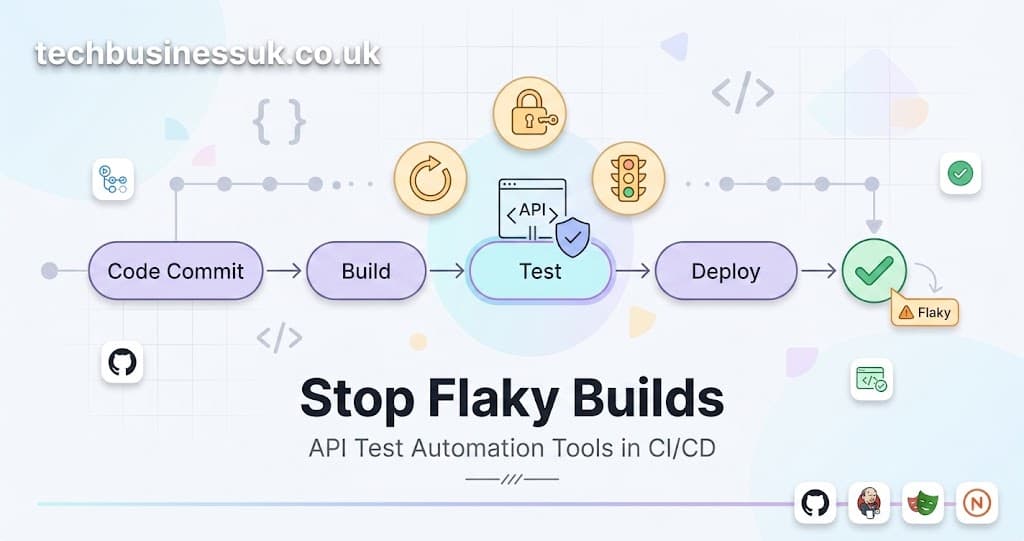
Building an automated API test suite on a local developer machine is only a fraction of the software quality engineering lifecycle. A suite of unit and integration tests that passes cleanly on localhost often crumbles the moment it runs inside a headless, shared continuous integration runner. Transient network jitter, containerized executor limits, noisy neighbors in staging environments, and strict API gateway throttles frequently transform clean, deterministic test suites into flaky nightmares that derail release schedules.
To make modern api test automation tools truly enterprise-ready, they must execute as automated gating mechanisms inside continuous deployment workflows while seamlessly handling real-world distributed resilience patterns—including exponential backoff retries, idempotent POST request validations, circuit breaker states, and HTTP 429 rate limit responses.
This guide provides a comprehensive architectural blueprint for embedding api test automation tools directly into continuous integration and continuous deployment (CI/CD) pipelines. It includes production-grade workflows for GitHub Actions and Jenkins, robust TypeScript/Playwright resilience logic, dynamic test data scaffolding patterns, and actionable reporting systems.
Moving Beyond 200 OK Assertions in CI/CD
Traditional API automation suites often rely on naive assertions: an endpoint returns an HTTP 200 OK status code, the response payload validates against a static JSON schema, and a target database record updates instantly. While these assertions suffice for static unit tests or isolated local mocks, modern microservice architectures operating in dynamic staging environments behave far less predictably.
When scaling api test automation tools across continuous integration runners, pipeline stages frequently fail not because feature code contains genuine regressions, but because the test execution harness lacks network resilience and ambient error handling.
Achieving a seamless CI CD pipeline api test integration requires moving beyond simple happy-path assertions to validate how your distributed services react under network pressure, load throttling, and intermittent infrastructure failures:
+-----------------------------------------------------------------------------------+
|                            TRADITIONAL API TESTING                                |
|                                                                                   |
|  [Test Runner] -----(Static HTTP POST)-----> [API Gateway] -----> [200 OK]        |
|  * Assumes perfect network connection                                             |
|  * Fails instantly on 429 or transient 503 errors                                 |
+-----------------------------------------------------------------------------------+

+-----------------------------------------------------------------------------------+
|                        RESILIENT ENTERPRISE API TESTING                           |
|                                                                                   |
|  [Test Runner] --(X-Idempotency-Key)--> [API Gateway] --(Throttled)--> [429]     |
|         │                                                                  │      |
|         └───[Exponential Backoff + Jitter] <─── Parse Retry-After Header ──┘      |
|         │                                                                         |
|         └───(Retry Request) ───────────────────────────────────────> [200 OK]     |
+-----------------------------------------------------------------------------------+
1. Transient Failure Isolation
In a distributed cloud topology, microservices communicate over dynamic network routes. Brief packet loss, DNS lookup latency, or brief pod restarts during rolling staging deployments cause transient network blips. Modern api test automation tools must distinguish between genuine software regressions and transient infrastructure glitches by wrapping network calls in intelligent, configurable retry loops.
2. Header-Driven Flow Control
Enterprise APIs rely heavily on specialized HTTP headers to manage state and control traffic flow across distributed clients. Comprehensive ci cd api testing harnesses must validate that endpoints properly process and emit headers such as X-Idempotency-Key, Retry-After, X-Correlation-ID, and RateLimit-Reset.
3. Ephemeral Resource Cleanup
Automated tests executing inside parallel containerized runners must maintain absolute database hygiene. Tests that fail midway through execution must not leave orphaned records, dirty state, or uncommitted transactions in shared staging datastores that could corrupt subsequent test runs.
Core Architecture of Pipeline API Test Integration
To block breaking API contract changes before code merges into production branches, execution must trigger on pull requests (PRs) and push deterministic diagnostic signals back to developers.
The testing lifecycle within an enterprise software delivery pipeline typically consists of four distinct evaluation tiers:
| Testing Tier | Execution Trigger | Primary Objective | Average SLA Target |
|---|---|---|---|
| Contract Testing | Pre-merge Pull Request | Validate OpenAPI/Swagger specs and breaking schema changes | $< 2$ Minutes |
| Functional E2E Suite | Post-merge / Nightly | Validate multi-step business logic across integrated services | $< 10$ Minutes |
| Resilience & Chaos | Scheduled / Staging | Evaluate rate limiting, idempotency handling, and timeouts | $< 15$ Minutes |
| Synthetic Monitoring | Post-deployment Gate | Continuously poll live endpoints to verify production health | Ongoing ($1-5$ min intervals) |
Continuous Integration Implementations: GitHub Actions & Jenkins
Integrating automated API testing frameworks into CI/CD platforms requires configuring explicit environment dependencies, authentication secrets, parallel execution threads, and immutable test report artifacts.
1. GitHub Actions Automated API Testing Workflow
Below is an enterprise-grade .github/workflows/api-tests.yml configuration executing a headless Newman/Postman test collection and Playwright API suite. This complete github actions automated api testing workflow incorporates dependency caching, environment secret injection via OpenID Connect (OIDC), matrix strategy sharding, and automated HTML report archiving:
name: Enterprise API Automation Pipeline

on:
  push:
    branches: [ main, release/* ]
  pull_request:
    branches: [ main, develop ]
  workflow_dispatch:
    inputs:
      environment:
        description: 'Target Execution Environment'
        required: true
        default: 'staging'
        type: choice
        options:
          - dev
          - staging
          - sandbox

permissions:
  id-token: write
  contents: read
  checks: write
  pull-requests: write

jobs:
  validate-environment:
    runs-on: ubuntu-latest
    outputs:
      target-env: ${{ steps.set-env.outputs.env }}
    steps:
      - id: set-env
        run: |
          if [ "${{ github.event_name }}" == "workflow_dispatch" ]; then
            echo "env=${{ github.event.inputs.environment }}" >> $GITHUB_OUTPUT
          elif [ "${{ github.base_ref }}" == "main" ]; then
            echo "env=staging" >> $GITHUB_OUTPUT
          else
            echo "env=dev" >> $GITHUB_OUTPUT
          fi

  api-contract-and-resilience:
    needs: validate-environment
    runs-on: ubuntu-latest
    timeout-minutes: 15
    strategy:
      fail-fast: false
      matrix:
        shard: [1/3, 2/3, 3/3]

    steps:
      - name: Checkout Source Code
        uses: actions/checkout@v4

      - name: Setup Node.js Runtime Environment
        uses: actions/setup-node@v4
        with:
          node-version: '20.x'
          cache: 'npm'

      - name: Install Project Dependencies
        run: |
          npm ci
          npm install -g newman newman-reporter-htmlextra

      - name: Configure AWS Credentials via OIDC
        uses: aws-actions/configure-aws-credentials@v4
        with:
          role-to-assume: arn:aws:iam::123456789012:role/GitHubActionsApiTestRole
          aws-region: us-east-1

      - name: Retrieve Short-Lived API Test Credentials
        id: secrets
        run: |
          SECRET_JSON=$(aws secretsmanager get-secret-value --secret-id ${{ needs.validate-environment.outputs.target-env }}/api-test-keys --query SecretString --output text)
          echo "API_BEARER_TOKEN=$(echo $SECRET_JSON | jq -r .auth_token)" >> $GITHUB_ENV
          echo "BASE_URL=$(echo $SECRET_JSON | jq -r .base_url)" >> $GITHUB_ENV

      - name: Execute Automated Newman Collection Tests
        run: |
          mkdir -p reports/newman
          newman run ./tests/collections/core-api-suite.json \
            -e ./tests/environments/${{ needs.validate-environment.outputs.target-env }}.json \
            --env-var "bearerToken=${{ env.API_BEARER_TOKEN }}" \
            --env-var "baseUrl=${{ env.BASE_URL }}" \
            --reporters cli,htmlextra,junit \
            --reporter-htmlextra-export ./reports/newman/summary-shard-${{ strategy.job-index }}.html \
            --reporter-junit-export ./reports/newman/junit-shard-${{ strategy.job-index }}.xml \
            --bail false

      - name: Execute Playwright API Resilience Suite (Sharded)
        run: |
          npx playwright test --config=playwright.api.config.ts --shard=${{ matrix.shard }}
        env:
          TEST_ENV: ${{ needs.validate-environment.outputs.target-env }}
          API_TOKEN: ${{ env.API_BEARER_TOKEN }}

      - name: Archive HTML & JUnit Test Artifacts
        if: always()
        uses: actions/upload-artifact@v4
        with:
          name: api-test-results-shard-${{ strategy.job-index }}
          path: |
            ./reports/
            ./playwright-report/
          retention-days: 14

  publish-test-summary:
    needs: api-contract-and-resilience
    if: always()
    runs-on: ubuntu-latest
    steps:
      - name: Download All Execution Artifacts
        uses: actions/download-artifact@v4
        with:
          path: ./all-reports

      - name: Process & Publish PR Annotations
        uses: mikepenz/action-junit-report@v4
        with:
          report_paths: './all-reports/**/junit-*.xml'
          check_name: 'API Regression Test Results'
          github_token: ${{ secrets.GITHUB_TOKEN }}
2. Jenkins API Automation Pipeline Script
For enterprise ecosystems hosted on private cloud infrastructure or legacy Jenkins controllers, this production jenkins api automation pipeline script leverages declarative Groovy syntax, Docker container isolation, parallel stage execution, and integrated notification hooks:
pipeline {
    agent {
        docker {
            image 'mcr.microsoft.com/playwright:v1.45.0-jammy'
            args '-u root:root --network=host'
        }
    }

    options {
        timeout(time: 30, unit: 'MINUTES')
        buildDiscarder(logRotator(numToKeepStr: '30'))
        disableConcurrentBuilds()
        ansiColor('xterm')
    }

    environment {
        STAGING_CREDENTIALS_ID = 'staging-api-jwt-token'
        BASE_URL               = 'https://staging-gateway.internal.company.com'
        RETRY_ATTEMPTS         = '3'
    }

    stages {
        stage('Checkout & Setup') {
            steps {
                checkout scm
                sh '''
                    echo "Initializing Execution Agent Environment..."
                    node --version
                    npm --version
                    npm ci
                '''
            }
        }

        stage('Parallel API Test Execution') {
            parallel {
                stage('Contract & Schema Verification') {
                    steps {
                        withCredentials([string(credentialsId: env.STAGING_CREDENTIALS_ID, variable: 'API_TOKEN')]) {
                            sh '''
                                echo "Running Contract Validation Suite..."
                                npx playwright test tests/contract/ --config=playwright.api.config.ts
                            '''
                        }
                    }
                }

                stage('Edge Case & Resilience Testing') {
                    steps {
                        withCredentials([string(credentialsId: env.STAGING_CREDENTIALS_ID, variable: 'API_TOKEN')]) {
                            sh '''
                                echo "Executing Idempotency and Rate Limiting Resilience Suite..."
                                npx playwright test tests/resilience/ --config=playwright.api.config.ts
                            '''
                        }
                    }
                }
            }
        }
    }

    post {
        always {
            junit allowEmptyResults: true, testResultsPattern: 'results/*.xml'

            publishHTML([
                allowMissing: false,
                alwaysLinkToLastBuild: true,
                reportDir: 'playwright-report',
                reportFiles: 'index.html',
                reportName: 'API Automation Execution Report',
                keepAll: true
            ])

            cleanWs deleteDirs: true, notFailBuild: true
        }

        failure {
            script {
                def failureMessage = "🚨 *API Test Suite Execution Failed on Jenkins*\n" +
                                     "*Job Name:* ${env.JOB_NAME}\n" +
                                     "*Build Number:* #${env.BUILD_NUMBER}\n" +
                                     "*Build URL:* ${env.BUILD_URL}"

                // Invoke Slack webhook alert helper
                sh """
                    curl -X POST -H 'Content-type: application/json' \
                    --data '{"text":"${failureMessage}"}' \
                    ${env.SLACK_WEBHOOK_URL}
                """
            }
        }
    }
}
Testing Edge Cases & Network Resilience
Running api test automation tools effectively inside continuous integration pipelines requires writing custom test logic that evaluates how backend services behave when network connections drop, API gateways throttle traffic (see our comprehensive guide to API rate limiting), or client applications resend duplicate transactions.
                               ┌────────────────────────┐
                               │  Client Initiates Request│
                               └───────────┬────────────┘
                                           │
                                  [Attach X-Correlation-ID]
                                  [Attach X-Idempotency-Key]
                                           │
                                           ▼
                               ┌────────────────────────┐
                               │   API Gateway Checks   │
                               │   Rate Limits (429)    │
                               └───────────┬────────────┘
                                           │
                    ┌──────────────────────┴──────────────────────┐
            [Within Limits]                                [Limit Exceeded]
                    │                                             │
                    ▼                                             ▼
       ┌────────────────────────┐                    ┌────────────────────────┐
       │ Process Request (201)  │                    │ Return HTTP Status 429 │
       │ Cache Response Payload │                    │  Header: Retry-After   │
       └────────────────────────┘                    └────────────┬───────────┘
                                                                  │
                                                     [Execute Exponential Backoff]
                                                                  │
                                                     [Retry Request with Same Key]
                                                                  │
                                                                  ▼
                                                     ┌────────────────────────┐
                                                     │ Server Returns Cached  │
                                                     │ Payload (200 OK)       │
                                                     └────────────────────────┘
1. Testing Idempotent API POST Endpoints
In distributed web applications, dynamic network connections can drop mid-flight after a backend server processes a request but before the HTTP response reaches the caller. If client applications retry non-idempotent HTTP POST requests without safeguards, backend systems risk creating duplicate database records, charging customer credit cards twice, or generating redundant downstream events.
When testing idempotent api POST endpoints, your test suite must issue intentional, rapid, concurrent duplicate POST requests carrying identical X-Idempotency-Key headers. The test validates that the first attempt succeeds with an HTTP 201 Created status code, while subsequent duplicate attempts return cached responses (typically HTTP 200 OK) carrying identical payload identifiers without duplicating database state:
import { test, expect } from '@playwright/test';
import { randomUUID } from 'crypto';

test.describe('Idempotent API Processing Validation', () => {
  const targetEndpoint = '/api/v1/orders';

  test('Verify POST payment endpoint honors X-Idempotency-Key header', async ({ request }) => {
    const idempotencyKey = randomUUID();
    const orderPayload = {
      customerId: 'CUST-88392',
      sku: 'PROD-WIRELESS-MOUSE',
      quantity: 1,
      unitPrice: 49.99,
      currency: 'USD'
    };

    // First POST Attempt: Expected to process and return HTTP 201 Created
    const initialResponse = await request.post(targetEndpoint, {
      headers: {
        'Authorization': `Bearer ${process.env.API_TOKEN}`,
        'X-Idempotency-Key': idempotencyKey,
        'Content-Type': 'application/json'
      },
      data: orderPayload
    });

    expect(initialResponse.status(), 'Initial request must succeed with 201 Created').toBe(201);
    const initialData = await initialResponse.json();
    expect(initialData).toHaveProperty('orderId');
    expect(initialData.status).toBe('PROCESSED');

    // Sequential Duplicate POST Attempt with exact same Idempotency Key
    const retryResponse = await request.post(targetEndpoint, {
      headers: {
        'Authorization': `Bearer ${process.env.API_TOKEN}`,
        'X-Idempotency-Key': idempotencyKey,
        'Content-Type': 'application/json'
      },
      data: orderPayload
    });

    // Server should return HTTP 200 OK with the cached payload, NOT create a second order (201)
    expect(retryResponse.status(), 'Duplicate idempotency request must return 200 OK').toBe(200);
    const retryData = await retryResponse.json();

    // Verify structural equality and exact transaction ID match
    expect(retryData.orderId, 'Order IDs must be identical across idempotent calls').toBe(initialData.orderId);
    expect(retryData.createdAt, 'Timestamp must match original creation time').toBe(initialData.createdAt);
  });

  test('Verify concurrent duplicate requests with identical idempotency keys do not produce race conditions', async ({ request }) => {
    const idempotencyKey = randomUUID();
    const orderPayload = {
      customerId: 'CUST-99104',
      sku: 'PROD-MECHANICAL-KEYBOARD',
      quantity: 1,
      unitPrice: 129.99,
      currency: 'USD'
    };

    // Dispatch 5 concurrent asynchronous requests simultaneously
    const concurrentRequests = Array.from({ length: 5 }).map(() =>
      request.post(targetEndpoint, {
        headers: {
          'Authorization': `Bearer ${process.env.API_TOKEN}`,
          'X-Idempotency-Key': idempotencyKey,
          'Content-Type': 'application/json'
        },
        data: orderPayload
      })
    );

    const responses = await Promise.all(concurrentRequests);
    const statusCodes = responses.map(res => res.status());

    // Exactly one request must create the resource (201), others must return cached/conflict status (200 or 409)
    const createdCount = statusCodes.filter(code => code === 201).length;
    const okCount = statusCodes.filter(code => code === 200).length;

    expect(createdCount, 'Exactly one concurrent request must issue a 201 Created status').toBe(1);
    expect(okCount, 'Remaining concurrent requests must resolve to 200 OK').toBe(4);
  });
});
2. Testing Rate Limit 429 Status Response & Automated Retry Logic
When multi-threaded test suites execute across dynamic parallel workers inside cloud runners, they can generate hundreds of requests per second, triggering API Gateway throttles.
Executing rigorous testing rate limit 429 status response scenarios requires verifying that your backend service correctly emits standard rate limit headers (such as Retry-After, X-RateLimit-Limit, and X-RateLimit-Remaining).
Conversely, embedding automated retry logic api testing wrappers within your test helper utilities ensures that temporary API gateway throttling does not cause false-positive pipeline failures.
Mathematical Foundation for Exponential Backoff with Decorrelated Jitter
To prevent retrying clients from hammering a recovering API simultaneously (a phenomenon known as the thundering herd problem), retry logic must calculate delays using exponential backoff supplemented by randomized jitter:$$t_{\text{wait}} = \min\left(t_{\text{max}}, t_{\text{base}} \times 2^{\text{attempt}}\right) + \text{random}(0, J)$$
Where:
- $t_{\text{wait}}$ is the calculated delay before initiating the next retry attempt (in seconds).
- $t_{\text{base}}$ represents the initial base delay duration (e.g., $1.0$ second).
- $t_{\text{max}}$ represents the absolute upper ceiling cap for backoff waits (e.g., $32.0$ seconds).
- $\text{attempt}$ is the current zero-indexed attempt count.
- $J$ is the maximum randomized jitter factor applied to scatter concurrent client traffic.
Below is a production-grade TypeScript utility module implementing decorrelated exponential backoff retries for Playwright API testing:
import { APIRequestContext, APIResponse } from '@playwright/test';

export interface RetryOptions {
  maxRetries?: number;
  baseDelayMs?: number;
  maxDelayMs?: number;
  jitterMs?: number;
}

/**
 * Executes an HTTP API request with automated exponential backoff retries
 * upon encountering HTTP 429 Rate Limit or 503 Service Unavailable responses.
 */
export async function executeWithBackoffRetry(
  requestContext: APIRequestContext,
  method: 'GET' | 'POST' | 'PUT' | 'DELETE',
  url: string,
  requestConfig: Record<string, any> = {},
  options: RetryOptions = {}
): Promise<APIResponse> {
  const maxRetries = options.maxRetries ?? 4;
  const baseDelayMs = options.baseDelayMs ?? 1000;
  const maxDelayMs = options.maxDelayMs ?? 16000;
  const jitterMs = options.jitterMs ?? 500;

  let attempt = 0;

  while (attempt <= maxRetries) {
    const response = await requestContext.fetch(url, {
      method,
      ...requestConfig
    });

    const status = response.status();

    // Pass through successful or non-transient status codes immediately
    if (status !== 429 && status !== 503) {
      return response;
    }

    if (attempt === maxRetries) {
      console.error(`[Max Retries Exceeded] Failed after ${maxRetries} attempts on ${method} ${url}. Final Status: ${status}`);
      return response;
    }

    // Inspect server-provided Retry-After header (supports integer seconds or HTTP-Date)
    const retryAfterHeader = response.headers()['retry-after'];
    let calculatedWaitMs = 0;

    if (retryAfterHeader) {
      const parsedSeconds = parseInt(retryAfterHeader, 10);
      if (!isNaN(parsedSeconds)) {
        calculatedWaitMs = parsedSeconds * 1000;
      } else {
        const parsedDate = Date.parse(retryAfterHeader);
        if (!isNaN(parsedDate)) {
          calculatedWaitMs = Math.max(0, parsedDate - Date.now());
        }
      }
    }

    // Fallback to exponential backoff calculation if header is missing or unparseable
    if (calculatedWaitMs <= 0) {
      const exponentialFactor = Math.pow(2, attempt);
      const rawDelay = baseDelayMs * exponentialFactor;
      const randomizedJitter = Math.floor(Math.random() * jitterMs);
      calculatedWaitMs = Math.min(maxDelayMs, rawDelay + randomizedJitter);
    }

    console.warn(
      `[HTTP ${status}] Throttled on ${method} ${url}. ` +
      `Attempt ${attempt + 1} of ${maxRetries}. Retrying in ${calculatedWaitMs}ms...`
    );

    await new Promise((resolve) => setTimeout(resolve, calculatedWaitMs));
    attempt++;
  }

  throw new Error(`Exceeded maximum retries (${maxRetries}) during backoff execution on ${url}`);
}
Synthetic Data Scaffolding & Database Cleanup
A primary cause of test flakiness in ci cd api testing environments is data collision. When multiple parallel pipeline runners share a persistent staging database, static test records (such as hardcoded user email addresses or product SKUs) conflict, causing false-positive unique constraint errors.
To eliminate data collisions, enterprise api test automation tools must dynamically generate unique, isolated test data using dynamic UUID generation, execute tests within unique contexts, and trigger cleanup routines upon test completion.
import { test as base, expect } from '@playwright/test';
import { randomUUID } from 'crypto';

// Custom Fixture Type Definition
type ApiDataFixtures = {
  ephemeralUser: { id: string; email: string; token: string };
};

// Extend base test to include dynamic lifecycle setup and teardown hooks
export const test = base.extend<ApiDataFixtures>({
  ephemeralUser: async ({ request }, use) => {
    // SETUP: Provision dynamic, isolated test entity before test execution
    const uniqueId = randomUUID().substring(0, 8);
    const userPayload = {
      email: `ci-test-${uniqueId}@automation-test.internal`,
      name: `Automated Test User ${uniqueId}`,
      role: `TEST_RUNNER`
    };

    const createResponse = await request.post('/api/v1/users', {
      headers: { 'Authorization': `Bearer ${process.env.API_TOKEN}` },
      data: userPayload
    });

    expect(createResponse.status()).toBe(201);
    const userData = await createResponse.json();

    // Pass the created entity to the test execution context
    await use({
      id: userData.id,
      email: userData.email,
      token: userData.authToken
    });

    // TEARDOWN: Guarantee cleanup of test entity after test completes
    const cleanupResponse = await request.delete(`/api/v1/users/${userData.id}`, {
      headers: { 'Authorization': `Bearer ${process.env.API_TOKEN}` }
    });

    if (cleanupResponse.status() !== 200 && cleanupResponse.status() !== 204) {
      console.warn(`[Teardown Warning] Failed to delete ephemeral test user ${userData.id}`);
    }
  }
});

test('Verify isolated user profile updates successfully', async ({ request, ephemeralUser }) => {
  const updateResponse = await request.patch(`/api/v1/users/${ephemeralUser.id}`, {
    headers: { 'Authorization': `Bearer ${ephemeralUser.token}` },
    data: { name: 'Updated Profile Name' }
  });

  expect(updateResponse.status()).toBe(200);
  const updatedData = await updateResponse.json();
  expect(updatedData.name).toBe('Updated Profile Name');
});
Reporting, Observability, and Flaky Test Governance
Having clear, structured visibility into API execution logs, failing request/response pairs, and trend metrics prevents developer downtime.
1. Publishing Dashboards with Automated API Test Reporting Dashboards
Standardize all pipeline runners to emit standard JUnit XML, JSON, and HTML artifacts. Integrating automated api test reporting dashboards (such as Allure, Newman HTMLExtra, or Playwright HTML Reports) provides engineering leads with actionable insights regarding execution latency, endpoint failure rates, and contract degradation over time.
2. Immediate Failure Alerts: Slack Webhook Notification API Test Failure
When a scheduled nightly regression suite or pull request deployment gate fails, pushing immediate diagnostic alerts to team communication channels accelerates issue resolution.
Despatching a structured Slack webhook notification api test failure payload provides immediate diagnostic details, failing endpoint URLs, HTTP status codes, and execution logs directly to engineers:
const axios = require('axios');

/**
 * Pushes a structured Slack card payload when an API automation run fails in CI.
 */
async function sendSlackFailureAlert(summaryData) {
  const webhookUrl = process.env.SLACK_WEBHOOK_URL;

  if (!webhookUrl) {
    console.warn('[Alerting Warning] SLACK_WEBHOOK_URL environment variable is not defined.');
    return;
  }

  const payload = {
    text: "🚨 *API Test Automation Failure Detected in CI/CD*",
    blocks: [
      {
        type: "header",
        text: {
          type: "plain_text",
          text: "API Test Suite Execution Failed ❌",
          emoji: true
        }
      },
      {
        type: "section",
        fields: [
          { type: "mrkdwn", text: `*Environment:* \`${summaryData.environment}\`` },
          { type: "mrkdwn", text: `*Branch:* \`${summaryData.branch}\`` },
          { type: "mrkdwn", text: `*Failed Endpoints:* ${summaryData.failedCount} / ${summaryData.totalCount}` },
          { type: "mrkdwn", text: `*Execution Time:* ${summaryData.durationSeconds}s` }
        ]
      },
      {
        type: "section",
        text: {
          type: "mrkdwn",
          text: `*Primary Failing Endpoint:* \`${summaryData.firstFailureMethod} ${summaryData.firstFailureUrl}\`\n*HTTP Status Received:* \`${summaryData.firstFailureStatus}\``
        }
      },
      {
        type: "actions",
        elements: [
          {
            type: "button",
            text: { type: "plain_text", text: "View Pipeline Execution Logs" },
            url: summaryData.buildUrl,
            style: "danger"
          },
          {
            type: "button",
            text: { type: "plain_text", text: "Download HTML Report" },
            url: summaryData.reportArtifactUrl
          }
        ]
      }
    ]
  };

  try {
    await axios.post(webhookUrl, payload, { headers: { 'Content-Type': 'application/json' } });
    console.log('[Alerting System] Successfully posted Slack failure notification.');
  } catch (error) {
    console.error('[Alerting Error] Failed to post alert to Slack webhook:', error.message);
  }
}

module.exports = { sendSlackFailureAlert };
Quarantine & Flaky Test Triage Strategy
A flaky test—one that exhibits both passing and failing results on the exact same commit hash—undermines developer trust in CI/CD pipelines. Flaky tests should be systematically managed using a structured quarantine workflow:
                      ┌────────────────────────────────────────┐
                      │    CI/CD Runner Detects Test Failure   │
                      └───────────────────┬────────────────────┘
                                          │
                                 [Automatic Re-run]
                                          │
                  ┌───────────────────────┴───────────────────────┐
          [Fails Consistently]                            [Passes on Re-run]
                  │                                               │
                  ▼                                               ▼
     ┌────────────────────────┐                      ┌────────────────────────┐
     │ Genuine Regression     │                      │  FLAKY TEST DETECTED   │
     │ Block Merge Pipeline   │                      └────────────┬───────────┘
     └────────────────────────┘                                   │
                                                        [Move to @quarantine]
                                                                  │
                                                        [Open Auto-Jira Ticket]
                                                                  │
                                                        [Fix & Restore in 48 hrs]
- Automated Re-runs: Configure test runners to automatically re-try failing tests up to two times before flagging the build as failed.
- Quarantine Tagging: If a test passes on retry, automatically mark the execution as unstable, apply a
@quarantinetag, and isolate it from blocking the main pull request merge queue. - Automated Defect Filing: Configure pipeline hooks to auto-generate a high-priority bug ticket assigned to the owning engineering squad when a test enters quarantine.
- 48-Hour SLA: Impose a strict engineering team SLA: quarantined tests must be resolved, refactored, or permanently deleted within 48 hours to maintain test suite integrity.
Pipeline Integration Checklist
Before declaring your continuous deployment API test automation workflow ready for production, verify that your implementation satisfies this structural checklist:
- [ ] Secret Hygiene: All API credentials, JWT tokens, and private keys are injected dynamically via short-lived cloud OIDC roles—never hardcoded or committed to git repositories.
- [ ] Data Isolation: Test suites generate unique dynamic test data (using UUIDs or dynamic prefixes) and clean up ephemeral entities upon completion.
- [ ] Rate Limiting Resilience: All HTTP request helpers gracefully parse
Retry-Afterresponse headers and implement exponential backoff with jitter. - [ ] Idempotency Assertions: Critical state-changing endpoints (such as POST payments or orders) are tested using concurrent requests carrying identical
X-Idempotency-Keyheaders. - [ ] Parallel Execution Sharding: Test collections are sharded across parallel container workers to maintain PR pipeline execution times under 5 minutes.
- [ ] Observability & Alerting: Pipelines post structured XML/HTML test reports and dispatch real-time Slack alerts upon unexpected failures.
- [ ] Quarantine Process: Unstable or flaky tests are automatically isolated within 24 hours to prevent blocking valid code merges.
Frequently Asked Questions (FAQs)
What are the best API test automation tools for CI/CD pipelines?
The leading api test automation tools for continuous integration include Playwright (API context) for modern JavaScript/TypeScript and Python stacks, Newman (the Postman CLI runner) for collection-based testing, REST Assured for Java ecosystems, and Pytest with Requests for Python pipelines. Choosing the right tool depends on your team’s primary language, execution speed requirements, and network mocking needs.
How do you handle authentication tokens securely in CI/CD API testing?
Never hardcode authentication tokens or API keys in repository source files. Instead, use cloud OpenID Connect (OIDC) identity federation (such as AWS IAM OIDC for GitHub Actions) to request short-lived credentials at runtime. Inject these credentials into pipeline runners as transient environment variables that are masked in job logs.
What is the difference between functional API testing and API contract testing?
Contract testing validates that an API’s requests and responses adhere strictly to a predefined schema structure (such as an OpenAPI specification) without verifying deep underlying business logic. Functional API testing validates end-to-end execution workflows, database mutations, state transitions, and business rule enforcement across integrated microservices.
How do exponential backoff retries prevent flaky build failures in CI pipelines?
Exponential backoff progressively increases the wait duration between successive request retries following a transient failure (e.g., waiting 1s, then 2s, 4s, 8s). Adding randomized jitter scatters retry attempts from parallel CI workers, preventing synchronized traffic spikes that overload recovering API gateways or staging databases.
How should idempotent POST endpoints be validated in automated tests?
To validate an idempotent POST endpoint, send an initial request carrying a unique X-Idempotency-Key header and assert a successful creation response (such as HTTP 201 Created). Immediately follow with a second request using the exact same key and payload, asserting that the server returns a cached response (HTTP 200 OK) and does not duplicate backend database records or generate duplicate transaction IDs.
How do you prevent test data collision when running API tests in parallel?
Prevent collisions by creating isolated test data for each test run using dynamically generated identifiers (such as UUIDs). Avoid relying on static, shared database records. Implement setup and teardown fixtures that dynamically seed unique entities before test execution and clean them up immediately after.
How do you handle HTTP 429 Rate Limit responses during test runs?
When an API test runner receives an HTTP status 429 Too Many Requests, it should inspect the response’s Retry-After header to identify how long to pause before retrying. Test helper functions should automatically wait for the specified duration—or fall back to exponential backoff—rather than failing the test run immediately.
What steps should be taken when an API test becomes flaky in CI/CD?
When an API test exhibits flakiness, isolate it immediately by applying a @quarantine tag so it no longer blocks pull request merge queues. Automatically log a defect ticket for the owning engineering squad, inspect trace logs and network payloads to diagnose the root cause (such as missing wait conditions or race conditions), fix the underlying instability, and verify its consistency before returning it to the primary build pipeline.
About the Author






2 thoughts on “API Test Automation Tools in CI/CD: Retries, Idempotency, and Rate Limiting”