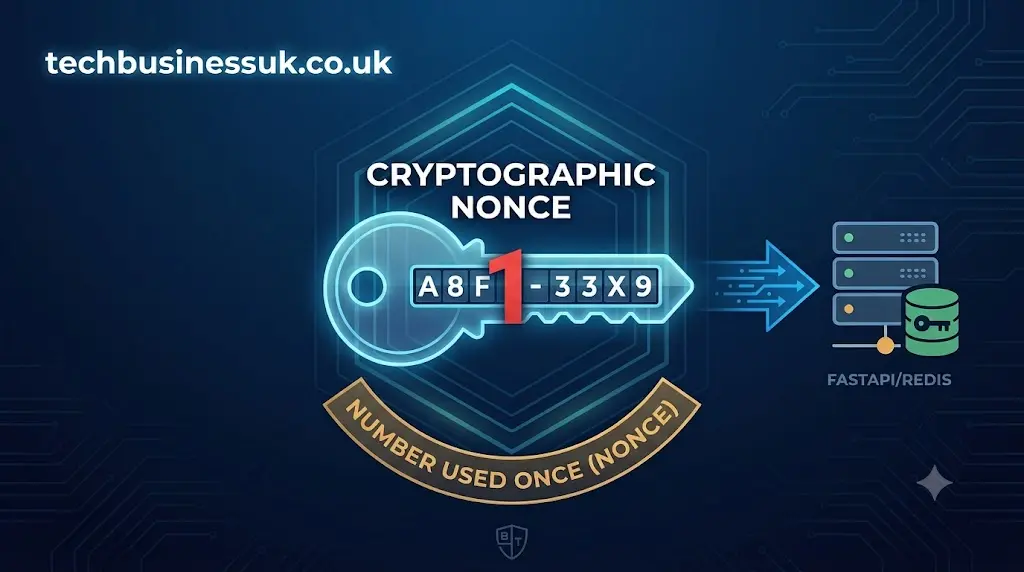
Imagine sending a $1,000 transfer over a secure backend API. What happens if a malicious actor intercepts that network packet and re-transmits it five times? Without proper safeguards, your server might process the transaction repeatedly.
This is where a nonce comes in.
If you are wondering what does nonce mean in software engineering, it refers to a “Number Used ONCE”—a unique cryptographic value designed to prevent request tampering. Understanding this concept is fundamental for backend engineers, security researchers, and system architects building resilient web infrastructure. Whether you are safeguarding REST endpoints, securing WebSocket handshakes, or configuring Web Application Firewalls (WAFs), nonces serve as your first line of defense against replay attacks.
What Does Nonce Mean in Computer Science?
In software engineering and cryptography, nonce stands for “Number Used ONCE”.
It is an arbitrary, unique, and often random string or counter generated for a single cryptographic operation or communication session. Once a given nonce has been validated by a server, it is permanently discarded or marked as used—rendering any subsequent attempt to re-send that exact payload useless.
Etymology & Origin: Where Does the Word “Nonce” Come From?
If you are exploring nonce etymology or wondering where does the word nonce come from, its roots trace back to 12th-century Middle English.
The phrase originated as “for then anes”, which evolved over centuries into “for the nonce”—meaning an action performed for a single, specific occasion. Early computer scientists and cryptographers adapted this historical linguistic phrase in the 20th century to describe a value generated exclusively for a single transaction.
🇬🇧 A Brief Note for UK Readers:
If you arrived here searching for the British slang term, it is worth clarifying early: in computer science, a nonce has zero association with UK street or prison vernacular. In cybersecurity, it strictly refers to a cryptographic single-use value designed to secure network requests.
How Cryptographic Nonces Prevent Replay Attacks in Web APIs
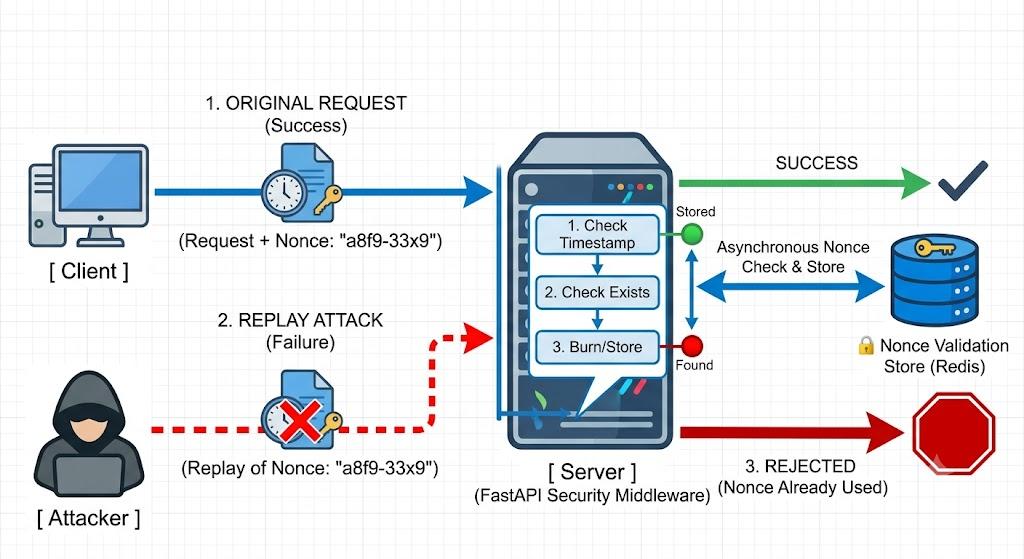
A replay attack occurs when an attacker eavesdrops on an encrypted network communication, intercepts the payload, and retransmits it to trick the server into executing an unauthorized action twice.
Standard transport-layer security (like HTTPS) encrypts data in transit. However, HTTPS alone does not prevent an authenticated user—or a compromised intermediary client—from duplicating valid requests. To truly grasp what does nonce mean in production security, you have to look at how it neutralizes replay attacks during network requests.
The 4-Step Lifecycle of an API Nonce
- Generation: The client (or server) generates a cryptographically secure random string combined with a timestamp.
- Transmission: The client attaches this value to the request header (e.g., X-Request-Nonce).
- Verification: The server checks whether the timestamp is within an acceptable drift window and verifies that the unique identifier has never been processed before.
- Invalidation: The server writes the nonce into a fast key-value store (like Redis) with a Time-To-Live (TTL). Future requests carrying that same string are instantly blocked.
When building high-throughput services, handling nonces asynchronously ensures that memory checks do not block the event loop. If you are choosing between frameworks like FastAPI or Flask to build these pipelines, explore our comparison of Python Async vs Sync Systems Architecture to see how non-blocking I/O keeps verification fast under heavy load.
What Does Nonce Mean in Practice? (CSP to Web3 Use Cases)
Nonces are used across nearly every domain of modern digital security.
1. Nonces in Web Application Firewalls & CSP Headers
Cross-Site Scripting (XSS) remains a dominant web threat. Web developers use CSP Nonces to restrict which inline JavaScript scripts can execute in the browser.
The server generates a random string per HTTP response and includes it in the header:
Content-Security-Policy: script-src 'nonce-rAnd0m12345'Only inline HTML <script> tags containing the exact matching nonce=”rAnd0m12345″ attribute will execute. Any script injected by a malicious third party is blocked automatically by the browser.
According to the MDN Web Docs CSP Guide, using a cryptographic nonce is the recommended approach for restricting inline script execution and preventing XSS.
2. Real-Time Systems & WebSockets
State verification during handshake initiation is critical when maintaining persistent bi-directional channels. For an in-depth look at managing persistent connections safely, check out our guide on FastAPI WebSocket Architecture & Security.
3. What Does Nonce Mean in Crypto & Blockchain Mining?
In Web3 and decentralized networks, the term takes on two distinct roles:
- Proof-of-Work (PoW): In Bitcoin mining, a nonce is a 32-bit arbitrary number that miners continuously increment to alter the block header hash until it meets the target difficulty.
- Account Nonces (Ethereum): In EVM-compatible chains, a transaction nonce is a sequential counter tracking the total number of transactions sent from a specific wallet address. This guarantees that transactions process strictly in order and prevents double-spending.
Nonce vs. Salt vs. Security Token: Architectural Differences
Developers frequently confuse nonces with salts, hashes, and authorization tokens. While all four play key roles in identity and data integrity, their cryptographic objectives differ significantly.
| Cryptographic Concept | Primary Purpose | Scope / Lifetime | Is It Secret? |
|---|---|---|---|
| Nonce | Prevents replay attacks & request duplication. | Single Request (Used once, then burned). | No (Sent in open headers). |
| Salt | Prevents rainbow table attacks in password hashing. | Per User Account (Stored with hash). | No (Not a secret key). |
| Security Token | Maintains session identity & grants permissions. | Session-Based (Minutes to Days). | Yes (Must be kept secure). |
| Network Security Key | Encrypts wireless traffic between device & router (WPA2/WPA3). | Persistent (Until Wi-Fi password changes). | Yes (Shared network secret). |
| Initialization Vector (IV) | Ensures unique output for identical encrypted plaintexts. | Per Encryption Cipher Block. | No (Prepended to ciphertext). |
When developers evaluate what is a nonce in security versus a cryptographic salt, the key distinction comes down to single-request lifespans versus permanent storage.
If you are evaluating authentication mechanisms for your enterprise stack, understanding what is salting in security versus what constitutes a security token ensures you do not misuse anti-replay tools for long-term identity storage. To audit your stack’s defenses, explore our overview of top API Security Tools.
Code Example: Implementing a Cryptographic Nonce in Python / FastAPI
Below is a production-grade Python implementation using FastAPI and Redis. It generates cryptographically secure nonces and validates them asynchronously without creating bottlenecks.
import secrets
import time

from fastapi import FastAPI, Header, HTTPException, status
import redis.asyncio as redis

app = FastAPI(title="Nonce-Protected API")

# Initialize async Redis connection pool
redis_client = redis.from_url("redis://localhost:6379", decode_responses=True)

NONCE_EXPIRATION_SECONDS = 300  # 5 minutes drift window

def generate_secure_nonce() -> str:
    """Generates a cryptographically secure 256-bit hex nonce."""
    return secrets.token_hex(32)

@app.post("/api/v1/secure-transfer")

async def process_transaction(
    payload: dict,
    x_nonce: str = Header(..., description="Unique single-use request nonce"),
    x_timestamp: float = Header(..., description="UNIX timestamp of request creation")
):

    current_time = time.time()

    # 1. Validate Time Drift (Prevents stale request replays)
    if abs(current_time - x_timestamp) > NONCE_EXPIRATION_SECONDS:
        raise HTTPException(
            status_code=status.HTTP_400_BAD_REQUEST,
            detail="Request timestamp expired or clock drift too large."
        )

    # 2. Check if Nonce Exists in Redis
    redis_key = f"nonce:{x_nonce}"
    is_already_used = await redis_client.exists(redis_key)

    if is_already_used:
        raise HTTPException(
            status_code=status.HTTP_403_FORBIDDEN,
            detail="Replay Attack Detected: Nonce has already been processed."
        )

    # 3. Mark Nonce as Used with an Automatic TTL Expiration
    await redis_client.setex(redis_key, NONCE_EXPIRATION_SECONDS, "USED")

    # 4. Proceed with Business Logic
    return {
        "status": "success",
        "message": "Transaction executed securely.",
        "processed_nonce": x_nonce
    }
⚠️ Security Warning on AI-Generated Code:
When asking Large Language Models (LLMs) to write cryptographic logic, AI engines frequently fall back to deterministic pseudorandom generators like Python’s default random module instead of secrets. Always review code for underlying vulnerabilities—read more about AI-Generated Code Security Risks before pushing AI-written ciphers to production.
Conclusion: Securing Modern Backend Architectures
By pairing unique nonces with short time-to-live (TTL) validation stores like Redis, you can completely neutralize replay attacks, secure inline web scripts via CSP headers, and guarantee order execution across decentralized ledgers. Implementing proper single-use validation ensures your backend APIs remain tamper-proof against unauthorized request execution.
Now that you know what does nonce mean across API headers, CSP policies, and blockchains, pairing these single-use values with short time-to-live stores like Redis will make your backend tamper-proof.
Frequently Asked Questions
What does nonce mean in plain English?
In simple terms, a nonce means a one-time single-use code or token. In computing, it guarantees that a specific instruction or network request cannot be repeated or reused by an unauthorized third party.
What does nonce stand for?
Nonce stands for “Number Used ONCE”. It refers to a unique string or number generated exclusively for a single cryptographic session or API request to ensure uniqueness.
Is a nonce secret?
No. Unlike private keys or passwords, a nonce does not need to remain secret. It is typically sent in plain text within HTTP request headers or open payload metadata. Its security value comes entirely from its uniqueness and single-use lifespan, not from secrecy.
What does nonce mean in Web3 and Ethereum?
In Ethereum and EVM blockchains, an account nonce is a sequential counter that tracks the total number of transactions sent from a specific wallet address. It ensures that transactions execute strictly in order and prevents double-spending.
Why does “nonce” have a different meaning in UK slang or prison context?
In British English slang, “nonce” is a derogatory term used within the UK prison system. However, this colloquial usage is entirely unrelated to computer science. In technology, the term originated independently from the Middle English phrase “for the nonce” (meaning “for a single occasion”).
What is the difference between a nonce and a hash?
A hash is a fixed-length string produced by running data through a one-way algorithm (like SHA-256) to verify data integrity or store passwords safely. A nonce is a single-use random value added to a payload (or hashed alongside data) to ensure that every transaction or communication session remains completely unique.
About the Author