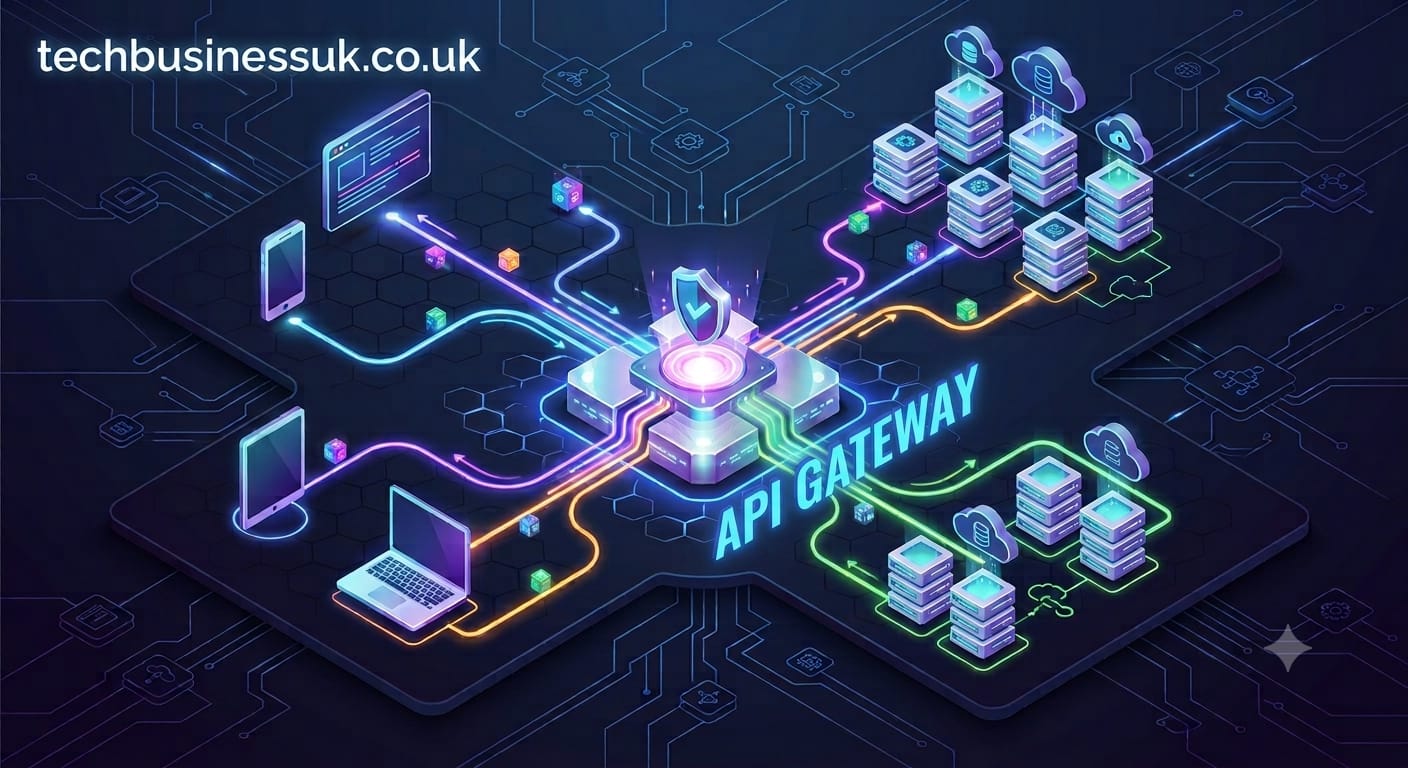
What is API gateway? An API gateway is a centralized software layer that acts as a single entry point for clients to access, manage, route, and secure traffic to multiple backend microservices.
Introduction
Imagine standing in front of a sprawling, multi-story hotel. Instead of a centralized front desk, imagine having to wander through endless hallways searching for the specific housekeeper, chef, or maintenance technician yourself. Sounds chaotic, right?
That is precisely what happens when modern web applications break free from rigid monolithic structures and embrace microservices. Having dozens of microservices is fantastic for engineering velocity, but it leaves client applications juggling dozens of unique endpoints, security checks, and network protocols.
Enter the API gateway.
Whether you are refactoring legacy infrastructure or architecting a cloud-native platform from scratch, understanding what is API gateway—and how it orchestrates backend services—is essential for building fast, resilient, and secure applications.
How Does an API Gateway Work?
To understand how an API gateway fits into modern system architecture, let’s look at what happens under the hood during a typical request/response lifecycle.
The Core Mechanism
When an application makes an API request:
- Client Call: The client sends an HTTP request to [https://api.yourdomain.com/v1/orders](https://api.yourdomain.com/v1/orders).
- Gateway Reception: The gateway accepts the call, inspects the headers, checks authentication credentials, and looks up its internal routing table.
- Internal Forwarding: The gateway routes the request downstream to the specific microservice (e.g., http://internal-order-service:8080/orders).
- Response Delivery: The microservice responds to the gateway, which processes, formats, and relays the payload back to the client.
The Reverse Proxy Role
Underneath its feature set, an API gateway operates fundamentally as an advanced reverse proxy. By sitting in front of internal infrastructure, it hides backend IP addresses, internal port numbers, and service topographies from the public internet. This abstraction layer prevents malicious actors from directly probing or attacking your database wrappers and internal microservices.
Key Tasks Performed During Request Handling
1. Request Routing & Orchestration
The gateway reads the incoming URI path, HTTP method, and headers to route incoming traffic dynamically to the correct downstream destination.
2. Protocol Translation
Front-end clients usually communicate using standard RESTful HTTP or WebSockets. However, backend microservices often rely on high-performance binary protocols like gRPC or messaging queues like RabbitMQ. An API gateway seamlessly translates external HTTP calls into internal gRPC or GraphQL requests on the fly.
3. Response Aggregation
Imagine rendering an e-commerce product page. The client needs product details, user reviews, stock inventory, and delivery estimates. Without an API gateway, the mobile app makes four separate HTTP calls. With an API gateway, the client makes one call; the gateway queries all four microservices concurrently, stitches the responses together, and returns a single JSON object
Key Features & Functions of an API Gateway
Modern API gateways do far more than just route traffic; they serve as a centralized control plane for your infrastructure.
1. Centralized Security & Authentication
Instead of writing authentication and authorization logic into every microservice codebase, the gateway handles it centrally. It validates API keys, checks OAuth 2.0 scopes, verifies bearer tokens (such as JWTs), and manages SSL/TLS termination at the network perimeter.
2. Traffic Management & Rate Limiting
To prevent DDoS attacks, web scraping, or accidental API overload from runaway client scripts, gateways enforce rate limiting and throttling. You can restrict clients to, say, $100$ requests per minute based on IP address or API key.
3. Load Balancing & Circuit Breaking
Gateways distribute traffic evenly across multiple healthy instances of a microservice. If an internal instance goes down or becomes slow, the gateway’s built-in circuit breaker pattern kicks in—failing gracefully or rerouting traffic away from the failing service to maintain overall system uptime.
4. Monitoring, Logging, & Analytics
By funneling all traffic through a single pipeline, gateways deliver full system observability. They collect latency metrics, error frequencies, and access logs, streaming them directly to tools like Prometheus, Datadog, or ELK Stack.
5. Caching
Why stress backend databases for static or frequently accessed data? API gateways can cache endpoint responses at the network edge, responding instantly to repeated requests for popular product pages or public reference data.
Why Do You Need an API Gateway? (The Benefits)
- Simplified Client Code: Client applications maintain clean, lightweight code bases because they only need to configure connections to a single base URL.
- Centralized Governance & Policy: Security policies, CORS rules, rate limits, and compliance checks are applied consistently in one place rather than duplicated across dozens of microservice codebases.
- Improved Performance & Reduced Latency: Response aggregation and edge caching minimize unnecessary network round-trips over mobile networks.
- Decoupling Frontend & Backend: Engineers can refactor, rename, split, or migrate backend microservices without breaking public-facing clients or forcing mobile app updates.
Potential Drawbacks & Challenges
While API gateways solve significant microservice challenges, they are not a silver bullet and introduce trade-offs:
- Single Point of Failure (SPOF): If your API gateway crashes, your entire application becomes unreachable. Gateways must be deployed in redundant, highly available multi-region configurations.
- Added Latency Overhead: Introducing an extra network hop between the client and backend adds milliseconds to request times if the gateway is poorly optimized or over-configured.
- Configuration Complexity: Managing extensive routing rules, rate-limiting policies, and security headers across large engineering teams can quickly lead to configuration bloat if left unmonitored.
Popular API Gateway Tools & Platforms
Choosing the right gateway depends on your cloud environment, stack preference, and performance demands:
| Gateway Tool | Best Suited For | Key Feature |
|---|---|---|
| Kong | Microservices & Cloud-Native | Open-source, plugin-rich architecture, built on NGINX |
| AWS API Gateway | Serverless / Cloud (AWS) | Seamless native integration with AWS Lambda, DynamoDB, and IAM |
| Apigee (Google Cloud) | Enterprise API Management | Advanced analytics, developer portal management, and API monetization |
| KrakenD / Tyk | High-Performance REST APIs | Ultra-fast execution with Go-based, stateless architectures |
When Should You Use an API Gateway?
You don’t always need an API gateway for simple projects. However, implementing one becomes essential when:
- Transitioning Monoliths to Microservices: You need a strangle-pattern approach to migrate routes gradually without disturbing clients.
- Building Cross-Platform Clients: You are managing separate web, mobile, and wearable frontends that consume shared backend resources.
- Exposing Public APIs: You are providing third-party developers access to your data platform and need automated developer onboarding, API key provisioning, and rate limiting.
Read this to: What is a Bearer Token: The Ultimate Definition, Header Examples & Trusted Security
Frequently Asked Questions (FAQs)
What is the difference between an API Gateway and a Load Balancer?
A load balancer distributes incoming network traffic across multiple servers hosting the same application. An API gateway goes much further: it inspects request content, routes calls to different microservices based on paths, translates protocols, handles authentication, and aggregates responses.
Is an API Gateway the same as a Service Mesh?
No, though they complement each other. An API gateway manages north-south traffic (traffic flowing from external clients into your data center). A service mesh (like Istio or Linkerd) manages east-west traffic (communication between internal microservices behind the gateway).
Can an API gateway replace my Web Application Firewall (WAF)?
While an API gateway provides authentication and rate limiting, it is not a complete WAF substitute. Many architectures run a WAF (such as Cloudflare or AWS WAF, as detailed in the AWS API Gateway Developer Documentation) in front of the API gateway to filter malicious HTTP payloads before traffic reaches downstream microservices.
Conclusion & Next Steps
Modern cloud application design demands flexibility, but splitting applications into microservices should not come at the cost of network complexity or security risks. An API gateway provides the essential abstraction layer that keeps frontend clients fast while leaving backend engineers free to scale and refactor microservices independently.
While configuring a gateway introduces an initial learning curve and operational overhead, the rewards in security, centralized governance, and system performance make it an indispensable foundation for scalable web architectures.
Have questions about selecting or configuring the right API gateway for your tech stack? Drop a comment below or share this article with your dev team!
About the Author




5 thoughts on “What is API Gateway? A Complete Guide for Developers & Architects”