
An in-depth guide on how a modern service mesh network manages Microservices and LLM workloads in enterprise environments.
Key Takeaways
- Decoupled Architecture: A service mesh offloads critical networking tasks—such as mTLS encryption, traffic routing, and telemetry—away from application code and into dedicated sidecar proxies.
- East-West Focus: While API gateways handle external North-South traffic entry, a service mesh secures and manages internal East-West communication between distributed microservices and AI model endpoints.
- Granular AI Traffic Control: Enterprise meshes enable fine-grained model routing, prompt retries, timeout management, and rate limiting essential for high-latency LLM workloads.
- Zero-Trust Security: Automatic mutual TLS (mTLS) enforcement and identity-based access policies secure data transit without requiring custom application logic.
- Phased Adoption: Successful enterprise deployment requires early traffic discovery, progressive proxy injection, and rigorous resource allocation monitoring.
What Is Service Mesh Architecture in Modern Cloud-Native Infrastructure?
A service mesh is a dedicated, configurable infrastructure layer that manages fast, reliable, and secure service-to-service communication across distributed cloud-native applications. As enterprises transition from monolithic codebases to microservice architectures—and increasingly integrate large language model (LLM) endpoints—the sheer volume of internal network traffic grows exponentially.
In basic microservice networking, developer teams embedded communication logic directly into every service. Codebases became bloated with custom retries, circuit breaking, authentication wrappers, and logging frameworks. When networking policies changed or libraries needed security patches, developers had to update, recompile, and redeploy every single microservice across the enterprise.
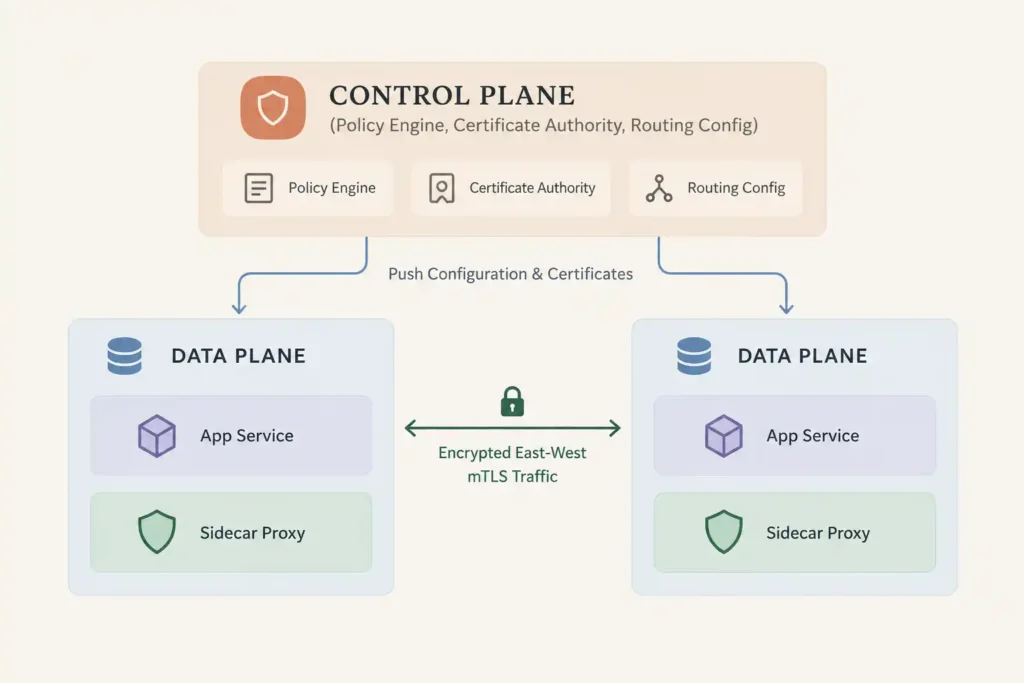
A service mesh solves this problem by moving network management into a transparent sidecar proxy running alongside each application instance. These proxies intercept all network calls passing into and out of a service container. By decoupling application logic from network operations, teams gain central control over security policy, traffic management, and system-wide visibility without altering application code.
What Is Istio Service Mesh and How It Works
The istio service mesh stands out as a graduated project under the Cloud Native Computing Foundation (CNCF) and an industry-standard platform for orchestrating service mesh networks. Istio relies on the high-performance Envoy proxy running as a data plane sidecar beside every microservice container.
When a microservice initiates a call, the Envoy proxy intercepts the request, evaluates routing rules, handles mutual TLS handshakes, and logs telemetry before forwarding traffic to its destination. Istio’s centralized control plane reads high-level configuration manifest files and translates them into actionable Envoy configuration rules, automatically pushing those updates across thousands of proxies in real time.
Core Components: Control Plane vs. Data Plane
Understanding a modern service mesh requires distinguishing between the control plane vs data plane. Although these components collaborate continuously, they perform distinct, complementary roles across the network:
- The Data Plane: Composed of high-performance network proxies built on technologies like the Envoy proxy framework or Linkerd-proxy, deployed alongside application code. The data plane touches every data packet, executing network rules locally. It handles:
- Service discovery and health checks.
- Dynamic load balancing and circuit breaking.
- Request routing and protocol translation (HTTP, gRPC, TCP).
- Mutual TLS encryption and authentication.
- Telemetry gathering (metrics, logs, traces).
- The Control Plane: The administrative intelligence of the service mesh. It does not touch live request packets directly. Instead, it provides:
- Central Configuration: Converts human-readable declarative rules into proxy instructions.
- Certificate Management: Acts as an internal Certificate Authority (CA) to issue and rotate short-lived X.509 certificates for zero-trust security.
- Policy Enforcement: Translates access control policies into concrete rules enforced at the proxy level.
Enterprise Service Mesh vs API Gateway: Key Differences & Use Cases
Architects frequently struggle to draw clear lines when evaluating an enterprise service mesh vs api gateway. While both technologies manage network proxies and route HTTP or gRPC traffic, they serve distinct architectural domains across enterprise infrastructure.
               [ External Clients / Internet ]
                              |
                              | North-South Traffic
                              v
                   +---------------------+
                   |     API Gateway     |
                   +---------------------+
                              |
                              | Ingress Boundary
  - - - - - - - - - - - - - - - - - - - - - - - - - - - - - - -
  ENTERPRISE SERVICE MESH (Internal Cluster Boundary)
                              |
        +---------------------+---------------------+
        | East-West Traffic                         | East-West Traffic
        v                                           v
+---------------+                           +---------------+
|  Service A    |  ==== Mutual TLS (mTLS) ===>  |  Service B    |
| (Sidecar)     |                           | (Sidecar)     |
+---------------+                           +---------------+
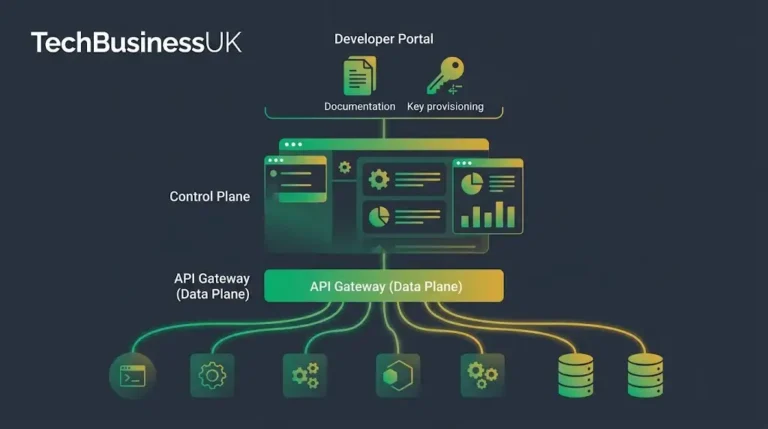
An API gateway operates at the edge of your network infrastructure. Its primary duty is managing North-South traffic—communication flowing from external clients, mobile apps, or third-party APIs into internal backend environments. API gateways excel at public edge requirements: client authentication (OAuth2, API keys), billing, request transformation, public rate limiting, and domain routing.
Conversely, a service mesh manages internal East-West traffic—communication passing between microservices inside your Kubernetes clusters, cloud environments, or data centers. Instead of protecting edge entry points, the service mesh protects internal microservices from each other, applying granular access controls, internal load balancing, and automated encryption.
Comparing Ingress Control and East-West Network Traffic
| Feature / Responsibility | Ingress API Gateway | Enterprise Service Mesh |
|---|---|---|
| Traffic Direction | North-South (Client to Backend) | East-West (Service to Service) |
| Primary Scope | Network Edge / Public Boundary | Internal Data Center / Cluster |
| Authentication Focus | User/Client (OAuth2, OpenID, API Keys) | Service Identity (mTLS, SPIFFE/SPIRE) |
| Proxy Architecture | Centralized Gateway Cluster | Distributed Sidecar / Node Proxy |
| Protocol Support | HTTP/S, WebSockets, REST, GraphQL | gRPC, HTTP/1.1-2, TCP, Custom RPC |
| Rate Limiting Scope | Public IP, User ID, Client Tier | Per-service Endpoint, Internal Quota |
| Configuration Model | API Product Catalog, Developer Portal | Declarative Infrastructure-as-Code |
When to Use an API Gateway, a Service Mesh, or Both
Most mature enterprise environments require both technologies working in tandem.
- Use an API Gateway alone if you manage a small set of monolithic services, require a public-facing developer API portal, or need edge-level rate limiting and payment monetization.
- Use a Service Mesh alone if you manage purely internal microservice workloads across large Kubernetes deployment clusters with strict security standards requiring mTLS and deep telemetry.
- Combine Both when scaling enterprise applications. Deploying an API gateway at the edge validates client credentials, strips unauthorized headers, and routes traffic into the cluster. From there, the service mesh takes ownership, encrypting traffic between downstream microservices and dynamically routing calls to LLM model instances.
Key Capabilities of an Enterprise Service Mesh Network
Modern enterprise applications demand operational features that keep distributed systems secure, fault-tolerant, and easy to inspect. A service mesh provides these built-in capabilities across every application endpoint.
Dynamic Traffic Management and Model Routing
A primary advantage of a service mesh network is its ability to manipulate traffic at Layer 7 without restarting pods or altering application code. Control planes allow operators to define complex routing rules declaratively.
- Canary and Blue-Green Deployments: Route 5% of traffic to a new service version while observing error rates, gradually ramping up traffic as confidence grows.
- LLM Model Fallbacks: Route requests away from an unresponsive AI model inference server to a secondary fallback endpoint automatically if latency thresholds exceed targets.
- Circuit Breaking: Prevent cascading system failures by isolating unhealthy services. If an upstream service starts returning 500-series errors, the local proxy breaks the circuit, immediately returning a local failure rather than overloading the downstream dependency.
- Fault Injection: Test system resilience by introducing synthetic latency or HTTP error codes directly into live canary traffic paths.
Zero-Trust Security: Mutual TLS and Policy Enforcement
Enterprise security frameworks increasingly rely on zero trust architecture principles: no network connection inside the enterprise boundary is implicitly trusted. A service mesh operationalizes zero-trust through automated Mutual TLS (mTLS).
+-------------------------------------------------------------------+
|                           SERVICE A                               |
|  +-------------------+              +--------------------------+  |
|  | Application Code  | - Cleartext ->|   Envoy Sidecar Proxy    |  |
|  +-------------------+  (Localhost) +--------------------------+  |
+---------------------------------------------------|---------------+
                                                    |
                                      Encrypted mTLS Tunnel
                                      (X.509 Identity SAN)
                                                    |
+---------------------------------------------------|---------------+
|                           SERVICE B               v               |
|  +-------------------+              +--------------------------+  |
|  | Application Code  | <- Cleartext -|   Envoy Sidecar Proxy    |  |
|  +-------------------+  (Localhost) +--------------------------+  |
+-------------------------------------------------------------------+
When Service A calls Service B through a service mesh, the sidecar proxies negotiate an encrypted mTLS tunnel transparently. The proxies authenticate both sides using X.509 digital certificates provided by the mesh control plane. Application code continues sending plain HTTP or gRPC over localhost, while the wire traffic across nodes remains fully encrypted and authenticated.
Furthermore, declarative access control authorization rules allow teams to enforce least-privilege security policies (e.g., “Only Service A may call HTTP POST on /v1/inference on Service B”).
Full-Stack Observability and Telemetry
Without centralized telemetry, debugging issues in a distributed system with dozens of microservices becomes a nightmare. Because sidecar proxies sit directly on every network hop, a service mesh automatically captures standardized operational metrics without requiring developers to instrument their applications manually.
- Golden Signals: Automated reporting on request volume, error rates, request duration (latency distribution), and saturation across every microservice.
- Distributed Tracing: Proxies propagate tracing headers (such as B3 or W3C Trace Context) across microservice boundaries, enabling platforms like Jaeger or Zipkin to construct end-to-end request timeline graphs.
- Visual Topology Maps: Tools like Kiali assemble proxy metrics into live, real-time visual dependency diagrams showing traffic velocity, directional flows, and localized network errors.
Enterprise Service Mesh Implementation Strategy
Adopting a service mesh across an enterprise requires careful planning. Rolling out network proxies indiscriminately across thousands of production workloads introduces operational risk and unexpected friction. Following a structured service mesh implementation strategy mitigates deployment risks.
+-------------------------------------------------------------------+
| PHASE 1: Traffic Discovery & Network Architecture Planning        |
| - Audit current topologies & protocols                           |
| - Calculate latency budgets & sidecar resource overhead          |
| - Define baseline security rules in Permissive mTLS mode          |
+-------------------------------------------------------------------+
                                  |
                                  v
+-------------------------------------------------------------------+
| PHASE 2: Progressive Proxy Injection & Canary Deployment           |
| - Inject sidecars into non-critical namespaces                    |
| - Validate traffic patterns under simulated production load        |
| - Enable canary routing rules & shadow traffic verification       |
+-------------------------------------------------------------------+
                                  |
                                  v
+-------------------------------------------------------------------+
| PHASE 3: Scaling Security, Governance, and Multi-Cluster Meshes   |
| - Enforce Strict mTLS across all namespaces                       |
| - Extend mesh across multi-cloud and hybrid environments          |
| - Automate policy governance via CI/CD GitOps pipelines           |
+-------------------------------------------------------------------+
Phase 1: Traffic Discovery and Network Architecture Planning
Before injecting sidecars, audit your system architecture thoroughly. Map out existing service topologies, communication protocols, and port configurations.
Identify services running legacy non-HTTP protocols, as these may require special TCP routing rules. Calculate your network latency budgets and compute overhead allocations (CPU and RAM) needed for the sidecars. Crucially, set up your control plane in Permissive mTLS mode. This configuration allows proxies to accept both plain text and mTLS traffic, preventing system outages as you begin onboarding workloads gradually.
Phase 2: Progressive Proxy Injection and Canary Deployment
Begin injecting sidecars into non-critical staging environments first, using automated CI/CD deployment pipelines or Kubernetes namespace labels.
Monitor application latency, CPU overhead, and memory usage metrics closely under synthetic load. Once staging validates clean performance, roll out proxy injection across production namespaces incrementally. Use canary rollout deployment strategies for the mesh configuration itself, verifying that traffic routes smoothly before transitioning high-volume microservices and AI model inference pools.
Phase 3: Scaling Security, Governance, and Multi-Cluster Meshes
Once all microservices run sidecar proxies, lock down network boundaries.
Switch mTLS configuration from Permissive to Strict mode, immediately rejecting unencrypted calls across the cluster. Establish clear authorization policies to restrict inter-service communication to verified dependencies. Finally, extend your control plane architecture across multiple Kubernetes clusters and hybrid cloud boundaries, unifying identity management, telemetry collection, and traffic routing rules into a single management pane.
Common Mistakes in Service Mesh Deployments
While a service mesh provides remarkable infrastructure capabilities, improper adoption creates unnecessary complexity. Avoid these common enterprise pitfalls.
Over-Engineering Network Topology for Simple Architectures
Deploying a feature-rich service mesh on a small application with only three or four microservices adds significant operational burden without proportional benefit. Control planes require maintenance, operational expertise, upgrade management, and troubleshooting when configurations conflict. If your architecture does not demand complex canary routing, strict internal mTLS, or deep distributed tracing, simpler ingress controllers or native Kubernetes networking constructs may serve your needs better.
Ignoring Latency Overhead and Resource Allocations
Sidecar proxies intercept every network request, parsing protocol headers and applying policy checks in real time. While individual proxy latency overhead is minimal—typically 1 to 3 milliseconds per hop—complex call graphs with five to ten microservice hops accumulate measurable delay.
Client Request
      |
      v
[ Sidecar Proxy ] ---> (adds +1.5ms processing)
      |
      v
[ Service A Code ]
      |
      v
[ Sidecar Proxy ] ---> (adds +1.5ms processing)
      |  (mTLS Wire Traffic)
      v
[ Sidecar Proxy ] ---> (adds +1.5ms processing)
      |
      v
[ Service B Code ]
Additionally, sidecar proxies consume memory and CPU resources on every pod instance. Teams that ignore sidecar resource requests risk running out of memory (OOM) under heavy traffic spikes. Always benchmark sidecar resource consumption and allocate explicit CPU and RAM requests in your pod specs.
Decision Matrix: Choosing the Right Service Mesh Solution
Selecting the optimal service mesh framework depends heavily on team expertise, infrastructure scale, security standards, and performance requirements.
| Feature / Criteria | Istio | Linkerd | Consul Service Mesh |
|---|---|---|---|
| Primary Focus | Maximum feature depth, enterprise policy | Simplicity, ultra-fast performance, light footprint | Multi-cloud, hybrid VM and Kubernetes integration |
| Data Plane Proxy | Envoy (C++) | Linkerd2-proxy (Rust) | Envoy (C++) |
| Resource Footprint | Moderate to High | Extremely Low | Moderate |
| Configuration Complexity | High (Extensive CRD ecosystem) | Minimal (Opinionated defaults) | Moderate |
| mTLS Setup | Automated (Permissive / Strict) | Automated out of the box | Automated via Consul CA / Vault |
| Multi-Cluster Support | Advanced (Multi-primary / Primary-remote) | Moderate (Multi-cluster mirror) | Advanced (WAN Federation) |
| Ideal Enterprise Use Case | Large-scale multi-team microservices & AI platforms | Performance-critical Kubernetes-only clusters | Mixed infrastructure bridging VMs and Kubernetes |
Frequently Asked Questions About Service Mesh
What is service mesh and why do enterprise microservices need it?
A service mesh is a dedicated infrastructure layer that manages internal service-to-service network communication through sidecar proxies. Enterprise microservices need it to offload complex networking tasks—such as Mutual TLS encryption, traffic routing, retries, and telemetry—away from application code into a centralized control framework.
How does a service mesh network differ from standard ingress load balancers?
Ingress load balancers manage North-South traffic flowing into the cluster from external clients at the network perimeter. A service mesh network manages East-West traffic passing between internal microservices inside the cluster. It provides granular service identification, mTLS security, and traffic control across every internal hop.
What is Istio service mesh and when should an enterprise choose it over Linkerd?
Istio is a feature-rich, open-source service mesh backed by an Envoy proxy data plane and comprehensive control plane APIs. An enterprise should choose Istio over Linkerd when it requires advanced traffic management, multi-cluster federation, extensive policy customization, or complex AI model routing rules. Linkerd is preferable when lightweight resource consumption and minimal operational complexity are top priorities.
What are the main challenges during a service mesh implementation?
The main challenges include managing sidecar CPU and RAM resource consumption, handling latency overhead across deep microservice call paths, and navigating a steep initial learning curve for control plane configurations. Additionally, migrating existing microservices without disrupting live production traffic requires careful traffic discovery and phased rollout plans.
How does a service mesh support LLM infrastructure and Applied AI workloads?
A service mesh supports LLM workloads by providing dynamic traffic routing across model inference pools, enforcing automatic retries and fallback endpoints during token generation timeouts, and applying zero-trust mTLS to secure sensitive prompt payloads across internal AI microservices.
About the Author



1 thought on “Service Mesh for AI: Enterprise Service Mesh Architecture & Implementation Guide”