A marketing campaign goes live. Traffic to your API spikes tenfold in sixty seconds. Your database, built to handle steady, predictable load, gets hit with a burst it was never designed for — and the whole system slows to a crawl for every user, not just the ones driving the spike.
This is exactly the problem rate limiting exists to solve. And among the handful of algorithms built for it, the leaky bucket algorithm is one of the oldest, simplest, and still most widely used — precisely because it does one thing extremely well: it smooths bursty traffic into a steady, predictable flow, instead of letting spikes hit your backend at full force.
This guide breaks down exactly how the leaky bucket algorithm works, how it compares to token bucket and window-based rate limiting, how to actually implement it, and where it fits — and doesn’t — in a real production API.
TL;DR: Leaky Bucket Algorithm
- The leaky bucket algorithm processes requests at a fixed, steady rate, no matter how bursty the incoming traffic is.
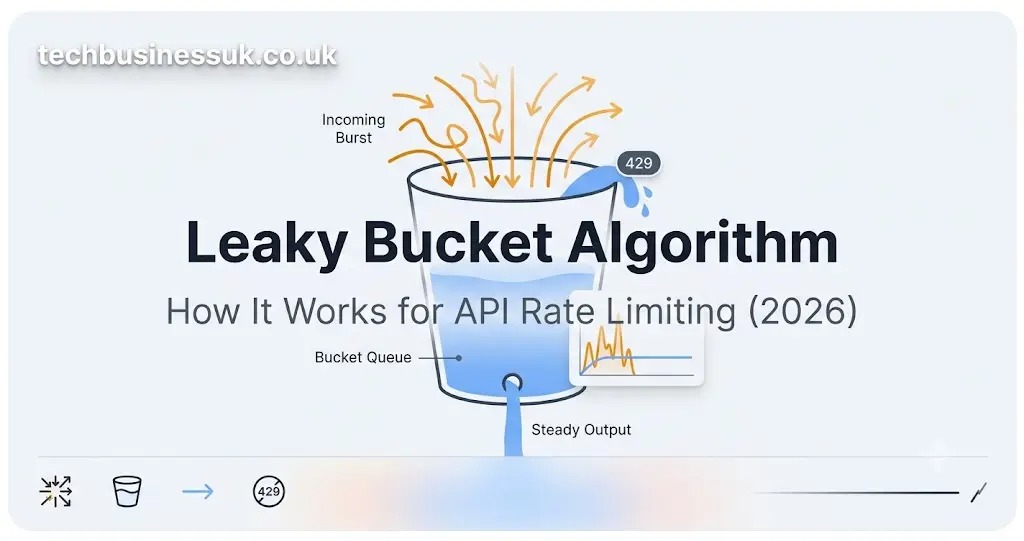
- Requests fill a “bucket” (queue); the bucket “leaks” at a constant rate; if the bucket overflows, excess requests get dropped or rejected.
- It’s ideal for smoothing traffic — protecting downstream systems from sudden spikes.
- Token bucket is the closest alternative, but it allows short bursts through; leaky bucket does not.
- Most production API gateways (Cloudflare, Kong, Envoy) implement some variant of this pattern at the edge.
- Test it under both sustained and burst load — the two failure modes look very different.
What Is the Leaky Bucket Algorithm?
The leaky bucket algorithm is a rate-limiting technique that controls the rate at which requests are processed by modeling incoming traffic as water poured into a bucket with a small hole in the bottom.
Picture an actual bucket. Water — your incoming requests — pours in at whatever rate the client sends it, which might be a slow trickle or a sudden flood. But the bucket has a fixed-size hole at the bottom, and water only ever leaks out through that hole at a constant, steady rate, no matter how fast it’s pouring in at the top.
If water comes in faster than it leaks out, the bucket starts to fill. If it fills up completely, any additional water poured in simply overflows — those requests get dropped or rejected. If water comes in slower than the leak rate, the bucket never fills, and every request just passes through.
This concept didn’t originate in software. It comes from network traffic shaping in telecommunications, where engineers needed a way to smooth variable data rates into consistent, predictable output for network hardware that could only handle steady throughput. APIs inherited the same problem decades later, and the same solution turned out to fit remarkably well.
How the Leaky Bucket Algorithm Works
Breaking the mechanics down into concrete steps:
- A request arrives. It gets added to a queue — the “bucket” — if there’s room.
- The bucket has a fixed capacity. This defines the maximum number of requests that can be queued at once.
- Requests “leak” out of the bucket at a constant rate. This is the processing rate — say, 10 requests per second, regardless of how many requests are currently waiting.
- If the bucket is full when a new request arrives, that request is rejected — typically with an HTTP 429 Too Many Requests response, closely tied to the resource-consumption protections covered in our guide on API error handling.
- The output rate never exceeds the leak rate, even during the biggest possible traffic spike. This is the entire point of the algorithm — it guarantees a smooth, predictable output regardless of how chaotic the input is.
The key detail that separates leaky bucket from other approaches: it doesn’t care how bursty the input is. A hundred requests arriving in one millisecond and a hundred requests spread evenly across ten seconds get treated identically — both get smoothed down to the same constant leak rate on the way out.
Leaky Bucket vs Token Bucket Algorithm
This is the comparison almost everyone researching the leaky bucket algorithm actually wants answered, so it deserves real depth.
Token bucket works almost in reverse. Instead of requests filling a bucket that drains at a fixed rate, tokens are added to a bucket at a fixed rate, and each incoming request consumes one token to proceed. If tokens are available, the request goes through immediately — even if several requests arrive in a sudden burst, as long as enough tokens have accumulated. If no tokens are available, the request is rejected.
The critical difference: token bucket allows bursts — if the bucket has accumulated a surplus of tokens from a quiet period, a sudden spike of requests can be processed all at once, up to the bucket’s capacity. Leaky bucket never allows this — output is always smoothed to the constant leak rate, no matter how many requests are queued or how long the system was idle beforehand.
Which one you want depends entirely on your system’s tolerance for bursts. If your backend can comfortably absorb occasional short bursts as long as the average rate stays controlled, token bucket is more forgiving and often provides a better user experience. If your backend genuinely cannot handle any burst — a downstream system with hard, fixed throughput limits — leaky bucket’s strict smoothing is the safer choice.
Leaky Bucket vs Fixed Window and Sliding Window Rate Limiting
Two other common approaches are worth understanding for contrast.
Fixed window counts requests within a set time window (e.g., 100 requests per minute) and resets the counter at the start of each new window. It’s simple to implement, but has a well-known flaw: a client can send 100 requests in the last second of one window and another 100 in the first second of the next, effectively getting 200 requests through in a two-second span — a burst the fixed window never actually prevents.
Sliding window fixes that flaw by evaluating a continuously moving time window rather than resetting at fixed boundaries, giving a more accurate real-time rate — at the cost of being more computationally expensive to track.
Leaky bucket doesn’t share fixed window’s boundary flaw at all, since there’s no reset point to exploit — the leak rate is constant, continuously, with no boundaries. This is one of its genuine structural advantages over naive fixed-window implementations.
Implementing the Leaky Bucket Algorithm
A basic implementation typically involves a queue and a background process (or timer) that dequeues and processes requests at the fixed leak rate. Conceptually, in pseudocode:
“`bucket = Queue(max_size = CAPACITY)
on_request_received(request):
if bucket.is_full():
reject(request, status=429)
else:
bucket.enqueue(request)
on_leak_tick(): // runs every 1/LEAK_RATE seconds
if not bucket.is_empty():
request = bucket.dequeue()
process(request)
The critical detail to get right is the leak tick interval — this is what actually enforces your rate limit. If your leak rate is 10 requests per second, the tick fires every 100 milliseconds, dequeuing and processing exactly one request each time, regardless of how many requests are currently waiting in the bucket.
Most production systems don’t implement this from scratch — they rely on rate-limiting middleware, a service mesh sidecar, or the rate-limiting features built into their API gateway, rather than hand-rolling bucket logic in application code.
Leaky Bucket Algorithm Comparison Table
| Algorithm | Allows Bursts | Smoothness of Output | Implementation Complexity | Best For |
| Leaky Bucket | No | Perfectly constant | Moderate (needs a queue + timer) | Protecting fragile downstream systems |
| Token Bucket | Yes, up to bucket capacity | Variable, bursty | Moderate | APIs that tolerate short bursts |
| Fixed Window | Yes, at window boundaries | Uneven, exploitable | Low | Simple, low-stakes rate limiting |
| Sliding Window | Limited | Smooth, accurate | High | High-precision rate limiting needs |
When to Use the Leaky Bucket Algorithm
Protecting fragile downstream systems. If your API sits in front of a legacy system, a third-party service with strict rate limits of its own, or any component that genuinely cannot handle bursty load, leaky bucket’s guaranteed constant output rate is exactly what you need.
Smoothing traffic before it hits a database. Databases generally perform far better under steady, predictable query rates than under bursty ones — even if the average load is identical. Leaky bucket converts unpredictable client behavior into predictable backend load.
Network and bandwidth shaping. This is the algorithm’s original use case, and it still applies directly — anywhere you need to cap outbound bandwidth or throughput to a fixed ceiling, regardless of how the demand for it arrives.
When burst tolerance would actually cause harm, rather than just being unnecessary — this is the deciding factor against token bucket. If a burst getting through even occasionally would meaningfully hurt your system, leaky bucket’s strictness is a feature, not a limitation.
Leaky Bucket Algorithm in API Gateways and Load Balancers
In practice, most engineering teams don’t implement leaky bucket logic inside individual services — they configure it at the edge, in the API gateway or load balancer layer, so every request gets smoothed consistently before it ever reaches backend code.
This centralization matters for the same reason we’ve covered when discussing gateway architecture generally: enforcing rate limiting once, in a single well-tested layer, is far more reliable than reimplementing bucket logic separately in every microservice. Our detailed breakdown of what an API gateway does covers exactly how this centralized enforcement fits alongside authentication and routing as one of the gateway’s core responsibilities.
Envoy’s local and global rate limiting, Kong’s rate-limiting plugin, and Cloudflare’s edge rate limiting all implement variations on bucket-based smoothing, configurable per route or per client, without requiring any code changes in the services behind them. For a deeper technical reference on production rate-limiting configuration, Cloudflare’s rate limiting documentation is a solid, widely used starting point.
Common Mistakes When Implementing Leaky Bucket Rate Limiting
Setting the leak rate without load-testing the actual downstream capacity. A leak rate chosen arbitrarily, rather than based on what your backend can genuinely sustain, defeats the entire purpose — you’re either throttling more aggressively than necessary or not protecting anything at all.
Ignoring bucket capacity entirely. A bucket with unlimited capacity isn’t really rate limiting anything — it just delays the eventual overload instead of preventing it. Capacity needs to be a deliberate, bounded choice.
Returning a generic error instead of a proper 429. When a request is rejected due to a full bucket, the response should be a clear 429 Too Many Requests, ideally with a Retry-After header — not a vague error that leaves the client guessing whether to retry at all.
Applying a single global bucket to every client. Without per-client or per-API-key buckets, one aggressive client can fill the shared bucket and start rejecting requests from every other legitimate client — a form of accidental self-inflicted denial of service.
Not distinguishing between burst rejection and sustained overload in monitoring. If your alerting can’t tell the difference between “one client briefly hit the limit” and “the bucket is consistently full because sustained demand now exceeds the leak rate,” you’ll miss the signal that it’s time to actually scale the leak rate up.
Testing Rate Limiting Implementations
Rate limiting is exactly the kind of behavior that looks correct in casual manual testing and then breaks in ways you didn’t anticipate under real concurrent load — which makes deliberate, structured testing essential rather than optional.
What to test explicitly:
- Sustained load at exactly the leak rate — confirm the bucket never fills under steady-state traffic at the configured limit
- Burst load well above the leak rate — confirm excess requests are correctly rejected with 429, not silently dropped or queued indefinitely
- Recovery behavior — after a burst is rejected, confirm the bucket correctly drains and starts accepting requests again at the expected rate
- Per-client isolation — confirm one client hitting their limit doesn’t affect other clients’ available capacity
Our guide to API Testing Tools covers the load-testing and stress-testing approaches needed to validate exactly these scenarios — sustained load, burst load, and recovery behavior — before a rate limiting implementation ever reaches production, rather than discovering its actual behavior during a real traffic spike.
Real-World Example: Leaky Bucket Preventing an Outage
Consider a common scenario: an e-commerce API sits in front of an inventory management system that can only reliably handle a fixed number of stock-check queries per second — a hard constraint of the legacy system underneath it, not something that could be easily scaled.
During a flash sale, incoming traffic to the stock-check endpoint spiked to many times its normal volume within seconds, as thousands of users simultaneously refreshed product pages. With a leaky bucket rate limiter configured at the gateway — matched precisely to what the inventory system could sustain — the burst was smoothed into a steady stream of requests at the system’s safe processing rate. Excess requests beyond the bucket’s capacity received an immediate 429 response with a short Retry-After window, and client applications retried automatically a moment later.
The result: the inventory system never saw anything beyond its normal, sustainable load — completely insulated from the burst happening on the other side of the gateway. Without that smoothing layer, the same burst hitting the legacy system directly would very likely have caused it to fail entirely, taking stock-checking down for every user, not just the ones driving the spike.
Decision Matrix: Which Rate Limiting Algorithm Fits Your API?
| Scenario | Recommended Algorithm | Why |
| Protecting a fragile legacy or third-party system | Leaky Bucket | Guarantees constant output rate; never allows bursts through |
| API that should tolerate occasional short bursts | Token Bucket | Allows accumulated capacity to absorb reasonable spikes |
| Simple, low-stakes internal API | Fixed Window | Easiest to implement; acceptable when precision doesn’t matter much |
| High-precision public API rate limiting | Sliding Window | Most accurate enforcement; avoids fixed-window boundary exploits |
| Network/bandwidth-level throttling | Leaky Bucket | Matches its original design purpose directly |
Conclusion
The leaky bucket algorithm solves a specific, well-defined problem: turning unpredictable, bursty request traffic into a smooth, constant stream your backend can actually rely on. It’s not the right fit for every rate-limiting scenario — token bucket’s burst tolerance is often a better user experience when your system can genuinely absorb short spikes — but when your downstream systems have hard, fixed limits, leaky bucket’s strict smoothing is exactly the guarantee you need.
Implement it at the gateway layer rather than scattering bucket logic across individual services, size the bucket and leak rate based on real, tested downstream capacity rather than guesswork, and make sure rejected requests get a proper 429 response your clients can actually act on.
Whether you’re validating burst behavior or confirming your leak rate holds under sustained load, having the right API Testing Tools in your workflow is what turns a rate-limiting strategy from a theoretical safeguard into one you’ve actually verified will hold up under real traffic.
Frequently Asked Questions
What is the leaky bucket algorithm? The leaky bucket algorithm is a rate-limiting technique that queues incoming requests in a fixed-capacity “bucket” and processes them at a constant, steady rate, smoothing bursty traffic into predictable output.
How is the leaky bucket algorithm different from the token bucket algorithm? Leaky bucket enforces a strictly constant output rate and never allows bursts through, while token bucket allows accumulated tokens to permit short bursts of requests, up to the bucket’s capacity, as long as the average rate stays within limits.
When should I use the leaky bucket algorithm instead of token bucket? Use leaky bucket when downstream systems genuinely cannot handle any burst in traffic and require a strictly constant processing rate; use token bucket when your system can tolerate occasional short bursts as long as the average rate is controlled.
Where is the leaky bucket algorithm typically implemented in an API architecture? It’s most commonly implemented at the API gateway or load balancer layer, so rate limiting is enforced consistently before requests ever reach backend services, rather than being reimplemented separately in each service.
What happens when the leaky bucket is full? When the bucket reaches its maximum capacity, additional incoming requests are rejected, typically with an HTTP 429 Too Many Requests response, often including a Retry-After header indicating when the client should retry.
Does the leaky bucket algorithm work well for bursty traffic? It’s specifically designed to handle bursty traffic by smoothing it into a constant output rate, but it does not allow the burst itself through — any traffic exceeding the bucket’s capacity during a burst is rejected rather than processed immediately.
About the Author