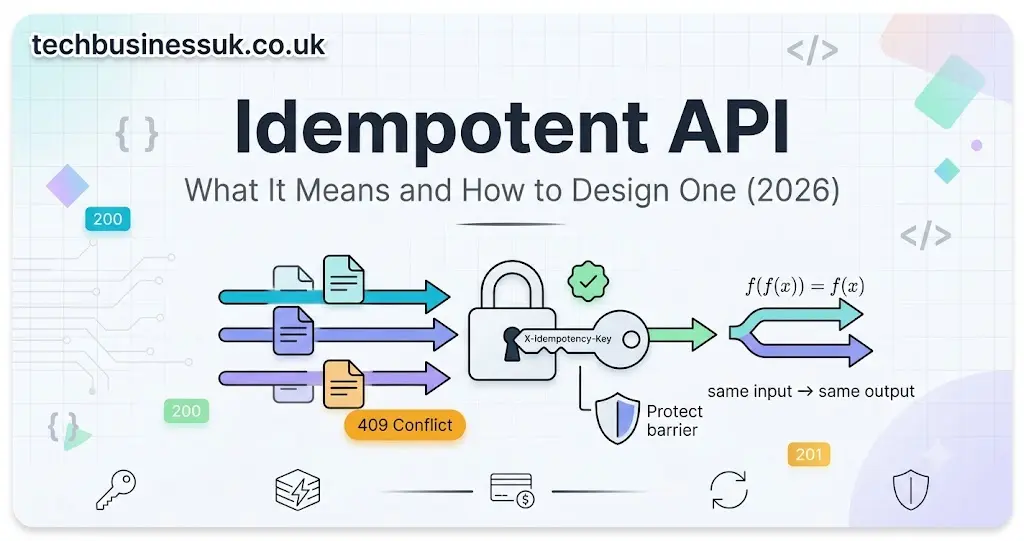
Network timeouts happen at the exact moment a customer clicks Pay Now. The client application freezes, waiting for a response that never arrives. Did the server process the payment before dropping the connection, or did the packet die silently on the wire? In a non-idempotent system, retrying the request charges the credit card twice. In an idempotent api, retrying the request a dozen times yields the exact same state change as sending it once. Designing for network unreliability is not an edge case; it is an architecture requirement for production systems.
TL;DR
- An idempotent api produces the same system outcome regardless of whether an identical request is executed once or multiple times.
- Standard HTTP methods like GET, PUT, and DELETE are inherently idempotent, whereas POST is inherently non-idempotent.
- Implementing idempotency keys (X-Idempotency-Key) guarantees that duplicate network retries do not trigger duplicate side effects such as double payments or duplicate records.
- Robust idempotency requires caching response payloads in a atomic store (like Redis) during a fixed deduplication window.
What Does Idempotent Mean in an API?
The concept of idempotency originates from linear algebra and functional programming. An operation is considered mathematical idempotence if applying it multiple times yields the same result as applying it a single time ($f(f(x)) = f(x)$).
In modern backend engineering, an idempotent api applies this exact mathematical principle to network communication and database state updates.
When a client makes a call to an API endpoint, two things happen:
- The server executes an internal process (a side effect, such as updating a database row or initiating a bank transfer).
- The server sends back a status code and payload response.
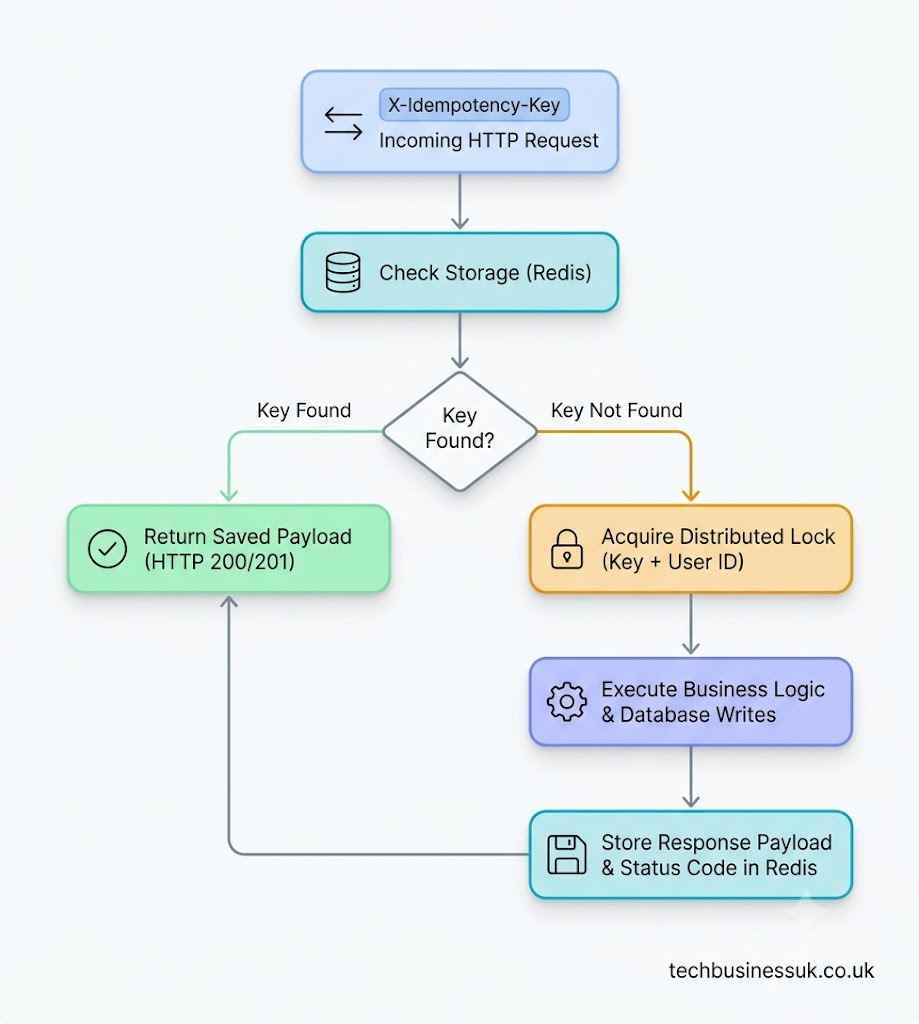
In an ideal world, network hardware never drops TCP packets. In the real world, connections break mid-transit, gateways throw 504 timeouts, and client devices switch off Wi-Fi mid-stream. If a client sends a request and the connection drops before receiving the server’s HTTP response, the client cannot know if the server executed the operation.
If the endpoint is an idempotent api, the client safely retransmits the identical request. The server recognizes that the action has already been performed, skips re-executing the logic, and returns the original cached result.
Idempotent vs Non-Idempotent HTTP Methods
The HTTP/1.1 specification explicitly classifies standard HTTP methods by two properties: Safety and Idempotency. Understanding how your HTTP verbs map to these criteria forms the core foundation of RESTful design.
Inherently Idempotent Methods
- GET: Retrieves a resource representation without modifying server state. Fetching GET /users/102 ten times returns user 102 without changing the database record. It is both safe (does not modify state) and idempotent.
- HEAD & OPTIONS: Similar to GET, these retrieve headers and communication options respectively. They carry zero side effects.
- PUT: Replaces the target resource entirely with the request payload. Executing PUT /users/102 with {“name”: “Sarah”} sets the name attribute to Sarah. Running it once or fifty times leaves the resource named Sarah.
- DELETE: Removes the target resource. Calling DELETE /users/102 the first time deletes record 102 and returns a 200 OK or 204 No Content. Subsequent calls return a 404 Not Found. While the HTTP response code changes, the final state of the database remains identical (the resource is gone).
Non-Idempotent Methods
- POST: Creates new child resources or appends data. Submitting POST /orders with order details creates a new database entry and generates a new primary key ID every single time it runs. Duplicate invocations yield duplicate records.
- PATCH: Applies partial modifications to a resource. PATCH can be either idempotent or non-idempotent depending on the payload design.
Consider these two PATCH implementations:
JSON
“`
// Idempotent PATCH: Setting an explicit state value
{ “status”: “ACTIVE” }
// Non-Idempotent PATCH: Relative mutation
{ “increment_count”: 1 }
Running the relative mutation payload three times increases the counter value by three, making it inherently non-idempotent.
Why Idempotency Matters in Modern Architectures
As applications transition from monolithic architectures to distributed cloud environments, system boundaries rely heavily on network communication. Networks are inherently unreliable.
1. Safely Handling Network Retries
When microservice A calls microservice B, a HTTP timeout error does not signify processing failure. Microservice B may have successfully committed the transaction, but the network connection failed before returning the HTTP response headers. Without an idempotent api, service A cannot automatically retry without risking data corruption.
2. Preventing Duplicate Financial Transactions
Financial integrations represent the highest-risk surface area in API design. If an e-commerce checkout page experiences network lag, a frustrated user will click the Submit Payment button multiple times. Without idempotency handling on POST /v1/charges, each user click generates a distinct charge against their credit card account.
3. Recovering from Rate Limiting
When clients hit rate boundaries on heavily traffic-throttled services, their requests fail with a status code 429 Too Many Requests. Managing these client retries safely requires proper queue handling alongside robust request deduplication. If you are building high-volume backends, balancing idempotency mechanics with rate-limiting patterns like the leaky bucket algorithm ensures your processing queues process safely without dropping critical user commands.
How to Design an Idempotent API
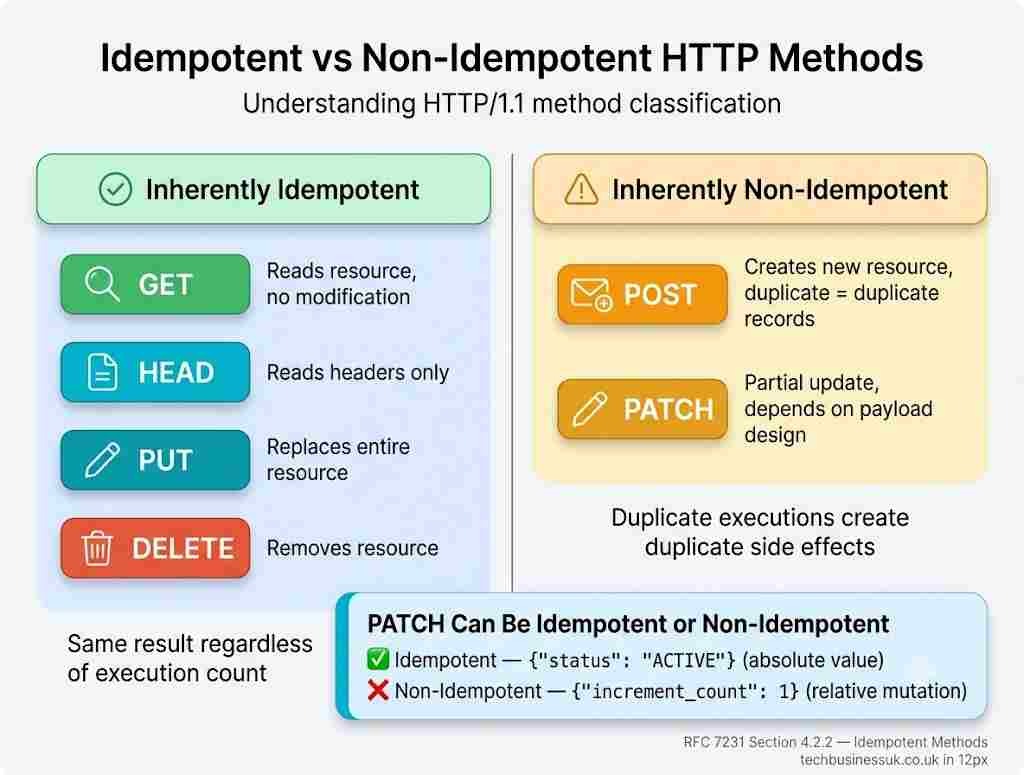
Transforming a non-idempotent verb like POST into an idempotent operation requires three structural components: an Idempotency Key, an Atomic Storage Mechanism, and a defined Deduplication Window.
1. The Idempotency Key Specification
The client generates a unique string identifier—typically a Version 4 UUID—and includes it within the HTTP request header:
X-Idempotency-Key: 9b1deb4d-3b7d-4bad-9bdd-2b0d7b3dcb6d
This key acts as a unique execution token for that specific business operation.
2. The Atomic Deduplication Lock
When the API gateway or backend controller receives the request:
- It queries a fast, in-memory store (such as Redis or Memcached) using the key format idempotency:{user_id}:{idempotency_key}.
- If the key exists with a status of PROCESSING, the server returns an HTTP 409 Conflict or queues the request to prevent concurrent duplicate execution.
- If the key exists with a status of COMPLETED, the server retrieves the saved response body and status code directly from cache, bypassing business logic and database layers entirely.
- If the key does not exist, the server writes the key with a state of PROCESSING using an atomic SETNX (Set If Not Exists) operation with a lock timeout.
3. The Deduplication Window
Idempotency keys should not linger indefinitely in cache. Define a time-to-live (TTL) window appropriate for your domain requirements—typically 24 hours. After this window expires, the server drops the cached key, freeing up storage resources.
Idempotency Keys: Implementation Walkthrough
Let us review a practical Python execution using FastAPI and Redis to demonstrate how an idempotent api processes payment retries safely.
Python
“`
import redis
from fastapi import FastAPI, Header, HTTPException, Request, Response, status
app = FastAPI()
redis_client = redis.Redis(host=’localhost’, port=6379, db=0, decode_responses=True)
DEDUPLICATION_TTL = 86400 # 24 Hours in seconds
@app.post(“/api/v1/payments”)
async def process_payment(
request: Request,
x_idempotency_key: str = Header(None)
):
if not x_idempotency_key:
raise HTTPException(
status_code=status.HTTP_400_BAD_REQUEST,
detail=”X-Idempotency-Key header is required for payment operations.”
)
cache_key = f”idempotency:{x_idempotency_key}”
# Check if the key exists in Redis
cached_response = redis_client.get(cache_key)
if cached_response:
if cached_response == “IN_PROGRESS”:
raise HTTPException(
status_code=status.HTTP_409_CONFLICT,
detail=”A request with this idempotency key is currently being processed.”
)
# Return the cached payload directly
return Response(
content=cached_response,
status_code=status.HTTP_200_OK,
media_type=”application/json”
)
# Atomically lock key execution
is_locked = redis_client.set(cache_key, “IN_PROGRESS”, nx=True, ex=60)
if not is_locked:
raise HTTPException(
status_code=status.HTTP_409_CONFLICT,
detail=”Concurrent request detected.”
)
try:
# Perform critical financial operation / business logic
payment_payload = await request.json()
transaction_result = execute_bank_transfer(payment_payload)
response_json = f'{{“status”: “SUCCESS”, “transaction_id”: “{transaction_result.id}”}}’
# Save response in Redis with 24h TTL
redis_client.set(cache_key, response_json, ex=DEDUPLICATION_TTL)
return Response(
content=response_json,
status_code=status.HTTP_201_CREATED,
media_type=”application/json”
)
except Exception as e:
# Clear lock on failure so client can fix error payload and retry
redis_client.delete(cache_key)
raise HTTPException(
status_code=status.HTTP_500_INTERNAL_SERVER_ERROR,
detail=”Payment processing failed.”
)
def execute_bank_transfer(payload):
# Simulated database and payment provider calls
class Result:
id = “tx_9988776655”
return Result()
When building production payment systems, studying real-world reference implementations is invaluable. Review the official Stripe Idempotent Requests Documentation to see how world-class engineering teams apply these headers to process millions of secure operations daily.
Idempotent API Comparison Table
Understanding how HTTP verbs interact with server state, payload safety, and cache invalidation strategies is critical when designing backend architectures:
| HTTP Method | Inherently Idempotent? | Safe (Read-Only)? | Primary Server Action | Expected Success Status | Handling Network Retries |
| GET | Yes | Yes | Reads resource representations | 200 OK | Re-issue request safely without side effects |
| HEAD | Yes | Yes | Reads headers only | 200 OK | Re-issue request safely |
| OPTIONS | Yes | Yes | Queries endpoint capabilities | 200 OK | Re-issue request safely |
| PUT | Yes | No | Replaces whole resource | 200 OK / 204 No Content | Re-issue request; overwrites with identical data |
| DELETE | Yes | No | Removes resource | 200 OK / 204 / 404 | Re-issue request; resource remains deleted |
| POST | No | No | Creates resource / executes action | 201 Created | Must require Idempotency-Key header |
| PATCH | Conditional | No | Partial update | 200 OK | Depends on payload design (relative vs absolute) |
Common Mistakes When Implementing Idempotency
Even experienced platform engineers introduce subtle bugs when implementing request deduplication logic. Avoid these common pitfalls:
1. Key Scope Pollution across Accounts
If user A submits X-Idempotency-Key: 12345 and user B coincidentally uses X-Idempotency-Key: 12345, user B might receive user A’s cached response. Always scope idempotency keys to the authenticated user or organization context:
Storage Key = tenant_id + user_id + idempotency_key
2. Ignoring Payload Hashes
What happens if a client submits an idempotency key with a $10 payment payload, and then re-uses that exact same key with a $10,000 payment payload?
If your backend only checks the header string, it will return the cached $10 response—masking a major transaction error. Generate a cryptographic hash (e.g., SHA-256) of the request body and store it alongside the key. If the key matches but the request body hash differs, immediately reject the transaction with an HTTP 400 Bad Request.
3. Caching 5xx Server Errors Permanently
If your internal database drops offline during processing, your API will return an HTTP 500 Internal Server Error. Never cache 5xx error payloads under the idempotency key. Cache only deterministic responses (200 OK, 201 Created, 400 Bad Request, 422 Unprocessable Entity). If an unhandled backend failure occurs, purge the idempotency lock so the client can safely attempt a genuine retry once internal services recover.
Designing clear fallback behaviors for unexpected server failures relies heavily on consistent API architecture. For a comprehensive look at standardizing exception formats across your services, refer to our detailed architectural guide on API error handling.
Idempotency in Microservices and Distributed Systems
Handling idempotency across a single monolithic service with a single relational database is straightforward. Enforcing idempotency across five distinct microservices communicating asynchronously over Kafka or RabbitMQ is significantly harder.
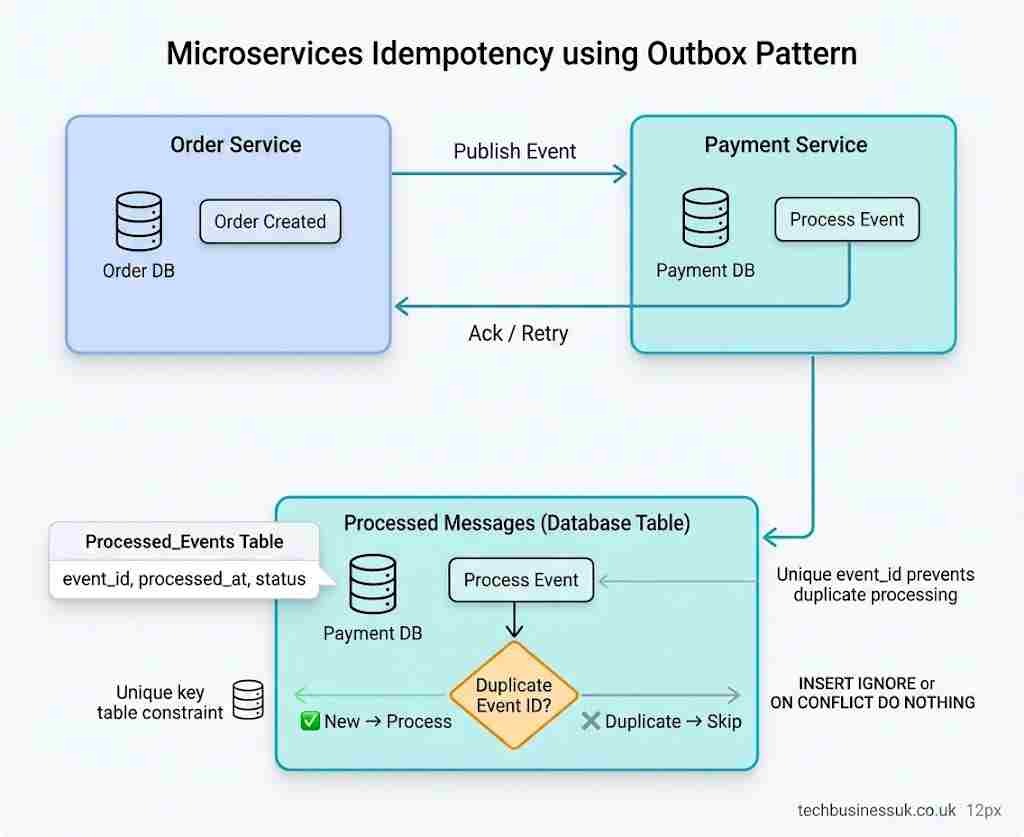
The Outbox Pattern and Transactional Messaging
When an event producer broadcasts messages to a queue, network blips can cause duplicate deliveries. Consumers in a distributed microservices network must be written as idempotent message handlers.
To achieve this:
- Every event message carries a unique event_id.
- The consuming microservice processes the payload within an explicit database transaction.
- The consumer inserts the event_id into a dedicated processed_events table within that exact same database transaction.
- If a duplicate event arrives, the database unique key constraint blocks the duplicate insertion, rolling back the execution before any secondary side effects occur.
Connecting Idempotency to the Saga Pattern
When conducting distributed sagas across services (e.g., reserving inventory, processing payment, dispatching shipping), compensation steps must also be idempotent. Executing a CancelOrder compensating action three times in a row due to messaging retries must yield the exact same cancelled state without throwing uncaught exceptions.
Testing Idempotent API Behavior
Validating an idempotent api requires specialized test cases that intentionally mimic network unreliability and race conditions. Standard unit tests passing single payloads are insufficient.
1. Concurrent Request Race Condition Testing
Send two identical requests carrying the exact same X-Idempotency-Key at the exact same millisecond using asynchronous threads or worker pools.
- Expected Outcome: One request completes with 201 Created. The parallel request returns 409 Conflict or waits and yields the cached 201 Created response payload.
2. Post-Execution Cache Validation
- Send a initial POST request containing X-Idempotency-Key: Alpha. Verify side effects (e.g., database entry added, email notification queued).
- Immediately send an identical POST request with X-Idempotency-Key: Alpha.
- Expected Outcome: Verify response status code, headers, and body match the first run exactly. Inspect database counts to confirm zero secondary records were created.
3. Functional vs Non-Functional Requirements Verification
Understanding where idempotency fits within your system architecture documentation is important. System uptime, sub-second API performance, and network fault tolerance represent non-functional requirements, whereas the actual execution of a payment transaction represents a functional requirement.
To review how to properly define these constraints during technical discovery phases, read our breakdown of functional vs non-functional requirements.
Furthermore, incorporating automated idempotency checks directly into your CI/CD test automation suites guarantees regression protection. To evaluate tools that simplify mocking duplicate network calls, explore our core benchmark guide on API testing tools.
Real-World Failure: When a Non-Idempotent Endpoint Caused Double-Billing
To understand the real-world cost of omitting idempotency, consider a real case study from a fast-growing subscription SaaS platform.
The Context
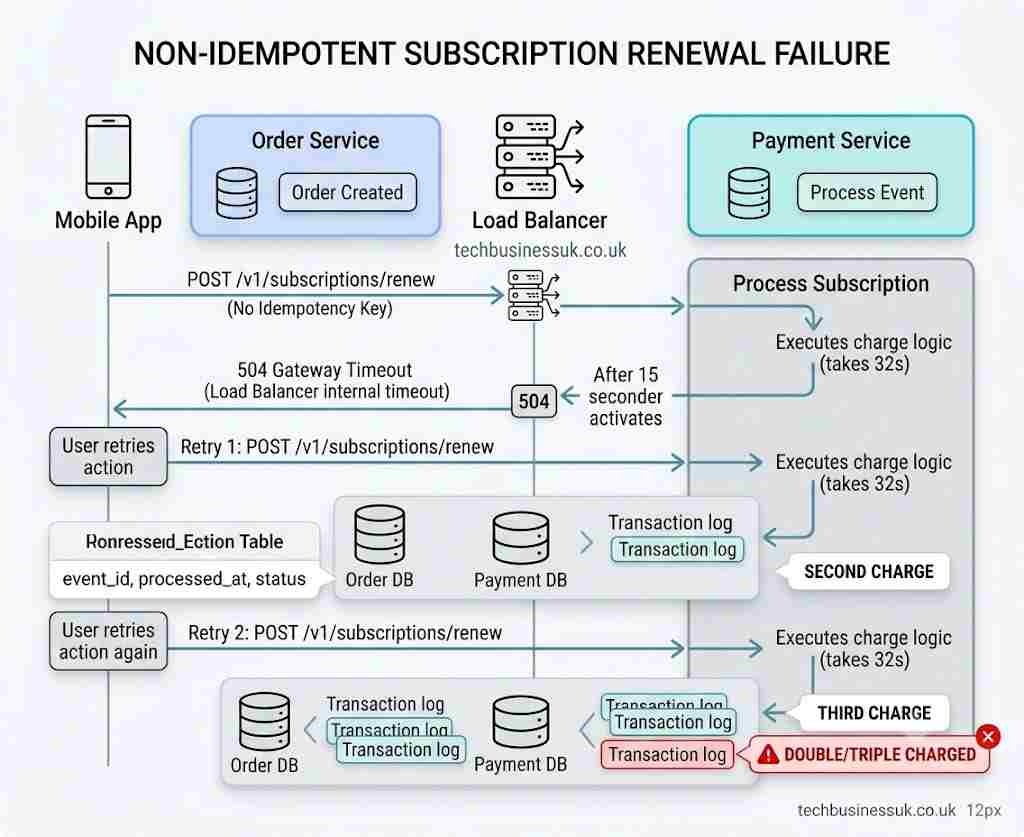
The company operated a subscription renewal endpoint: POST /v1/subscriptions/renew. The mobile client app issued this call when users tapped Renew Yearly Plan ($299).
The Incident
During a major marketing push, thousands of users attempted to renew simultaneously. Internal service latency increased, causing cloud load balancers to timeout at 30 seconds and return 504 Gateway Timeout to mobile clients.
The mobile app was programmed with an aggressive retry policy: upon receiving any network error or 5xx timeout, it immediately retried the POST request up to 3 times.
The Impact
Because the endpoint lacked idempotency key deduplication, the server processed all three retries as distinct transactions. Over 1,200 users were billed twice, and 400 users were billed three times within a single minute.
- Financial Cost: $480,000 in accidental charges.
- Operational Cost: $42,000 paid in payment processor dispute and chargeback fees.
- Reputational Cost: Severe brand damage, negative app store reviews, and hundreds of support tickets.
The Remediation
Engineering halted the API, introduced mandatory X-Idempotency-Key headers on all financial endpoints, implemented atomic Redis locks, and added automated duplicate-request tests to their deployment pipeline.
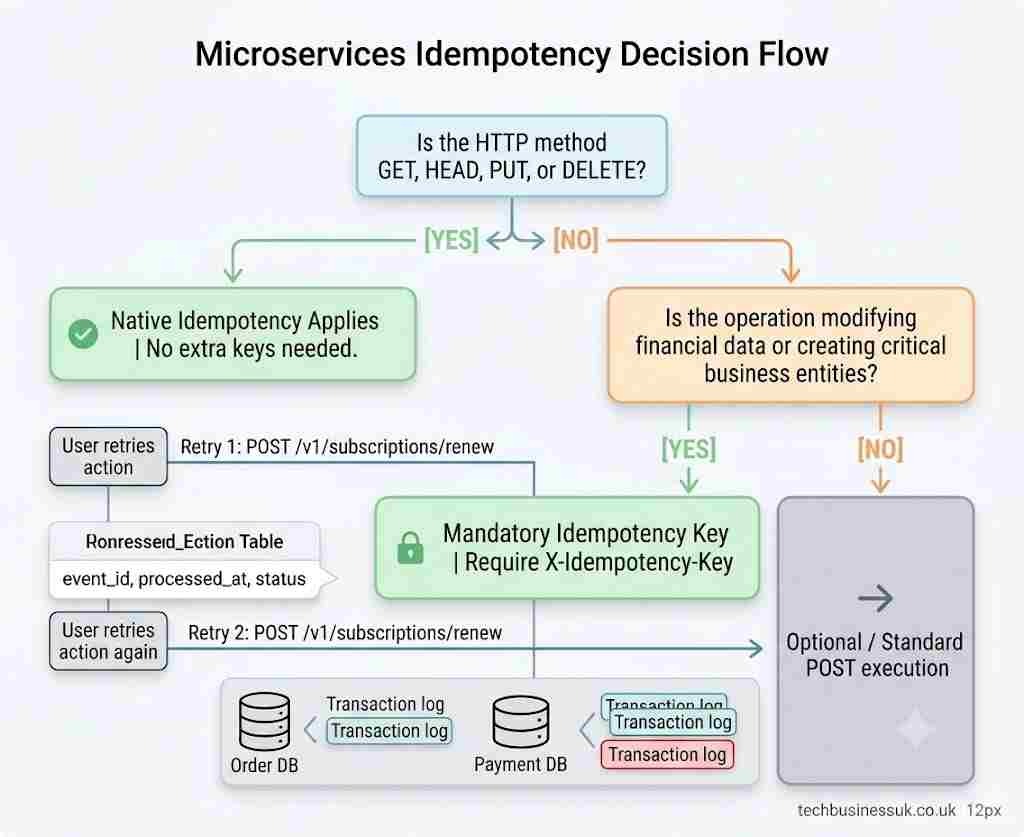
Decision Matrix: Does This Endpoint Need Idempotency?
Use this decision matrix when designing new backend endpoints or reviewing legacy API schemas:
Conclusion
Designing an idempotent api is the single most effective step you can take to make your backend resilient against network timeouts, microservice retry storms, and accidental user re-submissions.
By standardizing on clear HTTP verb semantics, enforcing X-Idempotency-Key headers on state-modifying operations, locking incoming requests with fast key-value stores like Redis, and verifying edge cases through automated testing, you guarantee system consistency under real-world network failure conditions.
Frequently Asked Questions
What is the difference between safe and idempotent HTTP methods?
A safe HTTP method does not modify any server resources (read-only operations like GET and HEAD). An idempotent method may modify server state, but calling it multiple times with the same parameters leaves the server in the exact same state as calling it once (e.g., PUT and DELETE). All safe methods are inherently idempotent, but not all idempotent methods are safe.
Should I return a 200 OK or 201 Created for a cached idempotent request?
Returning the exact same HTTP status code and response payload that was generated on the original successful run is recommended. If the original execution returned 201 Created, the cached retry response should also return 201 Created along with the identical body payload so that client-side abstractions process the result seamlessly.
How long should an idempotency key be stored?
A standard retention window (TTL) for idempotency keys is 24 hours. This provides ample time for client retry mechanisms to resolve network interruptions while preventing storage bloat in your cache systems.
What HTTP status code should be returned during a concurrent duplicate request?
When a duplicate request arrives while the first request is actively processing, return an HTTP 409 Conflict or HTTP 425 Too Early. This informs the client that the action is already underway and prevents race conditions.
About the Author