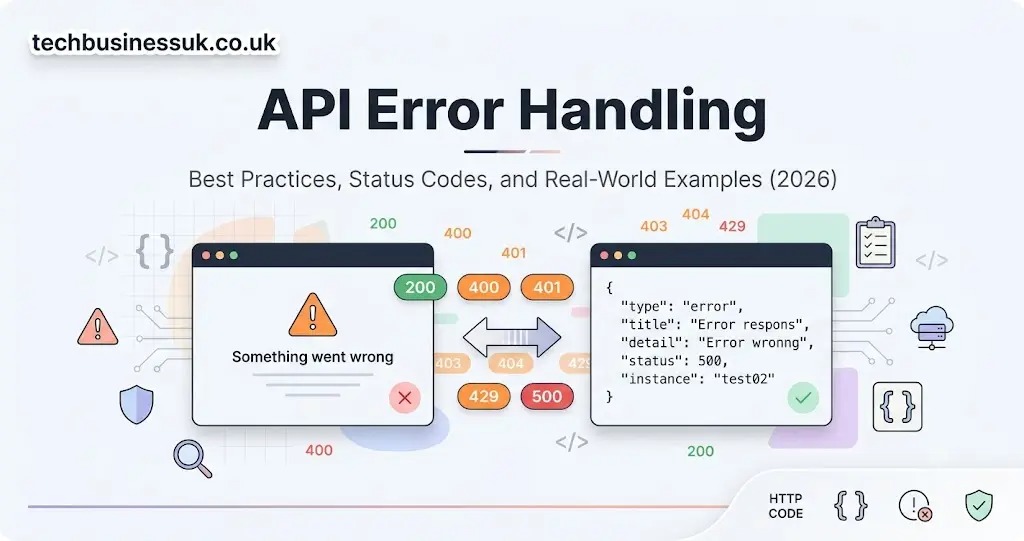
A client hits your API. Something goes wrong. What they get back is {“error”: “Something went wrong”} and a 500 status code. No detail. No code. No hint of what actually broke. Now they’re stuck — guessing, retrying blindly, and eventually opening a support ticket that could’ve been avoided with three extra lines of JSON.
This is the quiet failure mode of API design. Nobody notices bad API error handling during the demo. Every request in a demo succeeds. It’s only in production — under real traffic, with real edge cases, real malformed inputs, and real network hiccups — that error handling actually gets tested. And by then, it’s the developer integrating with your API who pays the price for every shortcut you took.
Good error handling isn’t a nice-to-have polish item you add at the end. It’s part of the contract your API makes with everyone who builds on it — closely related to how functional vs non-functional requirements work together, since an error response is simultaneously a functional output (something specific happened) and a non-functional signal (how reliable, secure, and debuggable is this system).
This guide covers how to actually do it well: the HTTP status codes to use and when, how to structure a consistent error response format, the anti-patterns that quietly sabotage developer trust, and how error handling changes once you’re operating across microservices instead of a single monolith.
TL;DR: API Error Handling
- Good API error handling turns a failure into useful information, not a dead end.
- Use HTTP status codes correctly — don’t return 200 with an error buried in the body.
- Every error response should follow a consistent, structured format — ideally close to the RFC 7807 “Problem Details” standard.
- Never leak stack traces, internal paths, or database details in a production error message.
- In microservices, propagate errors with correlation IDs so a failure can be traced across service boundaries.
- Test your error paths as rigorously as your happy paths — most teams don’t, and it shows.
What Is API Error Handling?
API error handling is the deliberate design of how your API communicates failure — what status code it returns, what information it includes in the response body, and how consistently it does this across every endpoint.
It’s easy to underestimate how much this shapes the developer experience of using your API. A well-designed error response tells the caller exactly what went wrong and, ideally, what to do about it. A poorly designed one leaves them guessing, digging through logs they don’t have access to, or filing a support ticket for something a clearer error message could have resolved in seconds.
Error handling sits at an interesting intersection: it’s triggered by functional conditions (a validation failure, a missing resource, an expired token), but the quality of how it’s communicated — consistency, clarity, security — is a non-functional concern that applies uniformly across your entire API surface.
Why API Error Handling Matters
Developer experience. An API that returns clear, actionable errors gets integrated faster and generates fewer support tickets. An API that returns vague 500s for everything creates friction at every single failure point.
Debugging speed. When something breaks in production — and it will — a well-structured error response with a specific error code and a correlation ID can turn a two-hour investigation into a two-minute lookup.
Client trust. Consistent, predictable error behavior signals a mature, well-engineered API. Inconsistent error formats across different endpoints signal the opposite, even if the underlying functionality works fine.
Security. This cuts both ways, and it’s worth taking seriously. Too little information in an error response makes debugging painful for legitimate developers. Too much information — stack traces, internal file paths, database error strings — hands an attacker a roadmap of your internal architecture. Getting this balance right is directly connected to the kind of information-leakage risks covered in our guide on API security testing, particularly around security misconfiguration and verbose error responses.
HTTP Status Codes: Using Them Correctly
HTTP status codes exist precisely so that error handling doesn’t need to be reinvented from scratch by every API. Using them correctly — rather than defaulting to 200 or 500 for everything — is the single highest-leverage thing you can do for error clarity.
For the full, authoritative list of codes and their precise meanings, MDN’s HTTP response status codes reference is the definitive source worth bookmarking.
4xx Client Errors
These signal that the client did something the server can’t process as-is — bad input, missing auth, a request for something that doesn’t exist.
- 400 Bad Request — the request is malformed or fails validation (missing required field, wrong data type)
- 401 Unauthorized — the caller isn’t authenticated at all; no valid credentials were provided. This is where your API authentication methods directly determine what “properly authenticated” even means for a given endpoint
- 403 Forbidden — the caller is authenticated, but doesn’t have permission for this specific action or resource
- 404 Not Found — the requested resource doesn’t exist, or the caller shouldn’t know whether it exists (a deliberate security choice in some APIs)
- 409 Conflict — the request conflicts with the current state of the resource (e.g., a duplicate creation attempt)
- 422 Unprocessable Entity — the request is well-formed, but semantically invalid (valid JSON, invalid business rule)
- 429 Too Many Requests — the caller has exceeded a rate limit; should include a Retry-After header
5xx Server Errors
These signal that your system failed to handle a request it should have been able to handle.
- 500 Internal Server Error — a generic, unhandled failure; the least helpful code and the one most APIs overuse
- 502 Bad Gateway — an upstream service returned an invalid response
- 503 Service Unavailable — the server is temporarily unable to handle the request (overload, maintenance)
- 504 Gateway Timeout — an upstream service took too long to respond
The Common Mistake: Returning 200 with an Error Body
This deserves its own callout because it’s so widespread. Some APIs return a 200 OK status even when the request actually failed, burying an “error”: true flag somewhere in the JSON body instead. This breaks everything that depends on standard HTTP semantics — caching layers, monitoring tools, client libraries that check status codes before parsing bodies. If a request failed, the status code should say so. Full stop.
Structuring a Consistent Error Response Format
Status codes tell you the category of failure. The response body should tell you the specifics. Every error response across your entire API should follow the same shape, so client code can parse errors generically instead of writing custom logic per endpoint.
A solid structure typically includes:
- type — a machine-readable error category or code (validation_error, resource_not_found)
- title — a short, human-readable summary
- detail — a more specific explanation of what went wrong in this particular instance
- status — the HTTP status code, duplicated in the body for convenience
- instance — optionally, a reference or correlation ID for this specific occurrence
This structure closely mirrors RFC 7807 (Problem Details for HTTP APIs), an IETF standard specifically designed to give error responses a consistent, predictable shape across different APIs and tooling. Adopting it — or something close to it — means developers integrating with your API can write one error-parsing function instead of one per endpoint.
A field-level validation error is a good test case. Instead of a flat “error”: “Invalid input”, a well-structured response identifies exactly which field failed and why — {“type”: “validation_error”, “title”: “Invalid input”, “detail”: “Field ’email’ must be a valid email address”, “status”: 400} — giving the client everything needed to fix the request without a support ticket.
API Error Handling Comparison Table
| Approach | Use Case | Tradeoff |
| Flat error string (“error”: “…”) | Quick internal tools, prototypes | Not scalable; no structure for client-side handling |
| HTTP status code only, no body | Simple internal APIs | Loses specificity; hard to debug without logs |
| RFC 7807 Problem Details | Public APIs, production systems | Slightly more implementation effort; excellent long-term consistency |
| Custom error code + status code | Large APIs needing internal error taxonomy | Requires maintaining an error code registry, but very precise |
Common API Error Handling Anti-Patterns
Swallowing errors silently. Catching an exception and returning a generic success response, or simply doing nothing, hides real problems until they surface somewhere far more damaging.
Generic 500s for everything. If every failure — a validation issue, a missing resource, an actual server crash — returns the same 500 Internal Server Error, the client has no way to distinguish “you did something wrong” from “we did something wrong.”
Leaking stack traces and internal details. A production error response should never include a raw stack trace, a database connection string, or an internal file path. This is exactly the kind of security misconfiguration risk that shows up repeatedly in API security testing audits — verbose errors are a gift to attackers, not a debugging aid for legitimate users.
Inconsistent formats across endpoints. If one endpoint returns {“error”: “…”} and another returns {“message”: “…”, “code”: “…”}, client developers can’t write generic error-handling logic — they have to special-case every single endpoint.
Ignoring localization and clarity for human-facing errors. If your API’s errors are ever displayed directly to end users (not just developers), overly technical language creates a poor experience on the other end of that integration too.
API Error Handling in Microservices
Error handling gets meaningfully harder once a single request might touch five or ten different services before a response comes back.
Error propagation. When Service A calls Service B, and Service B fails, Service A needs to decide: does it pass the original error straight through, wrap it in its own context, or translate it into something more meaningful for its own caller? Blindly forwarding raw internal errors from a downstream service can leak implementation details the calling client has no business seeing.
Correlation IDs. In a distributed system, a single user-facing request might touch multiple services, each generating its own logs. Without a shared correlation ID attached to every request as it moves through the system, tracing a failure back to its root cause becomes close to impossible. Every error response — and every internal log line generated while handling that request — should carry the same correlation ID.
Avoiding cascading failure. If Service A calls Service B and Service B is failing, Service A needs a defined behavior — a timeout, a circuit breaker, a fallback response — rather than hanging indefinitely or crashing itself in sympathy with Service B’s failure. Unhandled errors in one service becoming cascading failures across an entire system is one of the most common causes of major outages in distributed architectures.
Versioned error contracts. As your API changes over time, so do its error responses — a new error code, a changed detail format. This needs the same discipline as any other part of your interface, which is exactly why error handling and API versioning best practices need to be considered together rather than treated as separate concerns. A breaking change to your error format is still a breaking change, even if the “happy path” response looks identical.
Best Practices for API Error Handling
1. Use HTTP status codes as intended — don’t default to 200 or 500 for everything; pick the code that actually matches what happened.
2. Adopt a consistent, structured error format across every single endpoint — ideally aligned with RFC 7807.
3. Include a machine-readable error code, separate from the human-readable message, so client code can branch on logic rather than string-matching error text.
4. Never expose internal implementation details — no stack traces, no raw database errors, no internal file paths in production responses.
5. Attach correlation IDs to every request and error so failures can be traced end-to-end, especially in a microservices architecture.
6. Document every error your API can return, not just the happy path — a complete API reference includes failure modes, not only success responses.
7. Test error paths as rigorously as success paths. This is exactly where solid tooling matters: our guide to API Testing Tools covers how to build test suites that deliberately trigger and validate error conditions, not just confirm the happy path works.
8. Provide actionable detail, not just a category. “Invalid input” tells a developer nothing. “Field ’email’ must be a valid email address” tells them exactly what to fix.
Real-World Failure: When Poor Error Handling Caused an Outage
Consider a common pattern: a fintech company’s payment API began returning generic 500 Internal Server Error responses for a wide range of underlying issues — expired cards, insufficient funds, and genuine system failures, all wrapped in the exact same status code and message.
Client-side integrations, unable to distinguish between “the customer’s card expired” and “our payment processor is down,” implemented blanket retry logic for every 500 response. When the payment processor experienced a genuine, temporary outage, every client application began aggressively retrying failed requests — including the ones that had failed for completely unrelated, non-retryable reasons like insufficient funds.
The result: a moderate processor outage was amplified into a full-scale traffic spike, as thousands of client integrations simultaneously retried requests that were never going to succeed regardless of how many times they were resent. The underlying processor outage lasted twenty minutes. The retry storm it triggered took down the API gateway for several hours afterward.
The lesson: error handling isn’t just about communicating failure clearly to a human reading logs — it directly shapes automated client behavior. Vague, undifferentiated errors don’t just frustrate developers; they can actively make a bad situation measurably worse.
Decision Matrix: Choosing the Right Error Response for a Scenario
| Scenario | Status Code | Response Approach |
| Missing or invalid input field | 400 Bad Request | RFC 7807-style body naming the specific field and issue |
| No valid authentication provided | 401 Unauthorized | Generic message; avoid confirming account existence |
| Authenticated but lacking permission | 403 Forbidden | Clear denial; avoid leaking what the resource actually is |
| Resource doesn’t exist | 404 Not Found | Consistent whether resource is missing or access is denied, if hiding existence matters |
| Rate limit exceeded | 429 Too Many Requests | Include Retry-After header with wait time |
| Unhandled internal exception | 500 Internal Server Error | Generic message to client; full detail only in internal logs with correlation ID |
| Upstream service failure | 502/504 | Indicate upstream failure without exposing which internal service failed |
Conclusion
API error handling is one of those disciplines that costs almost nothing to do well and costs an enormous amount to get wrong. The difference between a vague 500 and a clear, structured, actionable error response is often just a handful of extra fields — but it’s the difference between a developer fixing their integration in minutes and one abandoning your platform in frustration.
Treat error responses as a first-class part of your API’s contract, not an afterthought bolted on after the happy path is done. Use status codes correctly, structure your error bodies consistently, keep sensitive internals out of production responses, and test your failure paths with the same rigor you’d apply to success paths.
Speaking of testing — validating both your success responses and your full range of error scenarios is exactly where the right API Testing Tools make the difference between an error-handling strategy that exists on paper and one that’s actually verified in your CI/CD pipeline.
Frequently Asked Questions
What is API error handling? API error handling is the deliberate design of how an API communicates failure to its callers — including which HTTP status code it returns and what structured information it includes in the response body.
Why is consistent error handling important in API design? Consistent error handling lets client applications parse and react to failures generically, rather than writing custom handling logic for every individual endpoint, which speeds up integration and reduces bugs on both sides.
What HTTP status code should an API return for a validation error? A validation error should typically return 400 Bad Request (malformed request) or 422 Unprocessable Entity (well-formed but semantically invalid), along with a response body identifying the specific field and issue.
Should API error messages include stack traces? No. Production error responses should never expose stack traces, internal file paths, or database details, since this information can be used by attackers to map out internal system architecture.
What is RFC 7807 and how does it relate to API error handling? RFC 7807, “Problem Details for HTTP APIs,” is an IETF standard that defines a consistent JSON structure for error responses, including fields like type, title, detail, and status, making error handling predictable across different APIs and tools.
How does error handling change in a microservices architecture? In microservices, error handling must account for propagation across service boundaries, use correlation IDs to trace failures across multiple services, and avoid unhandled errors in one service cascading into failures in others.
About the Author