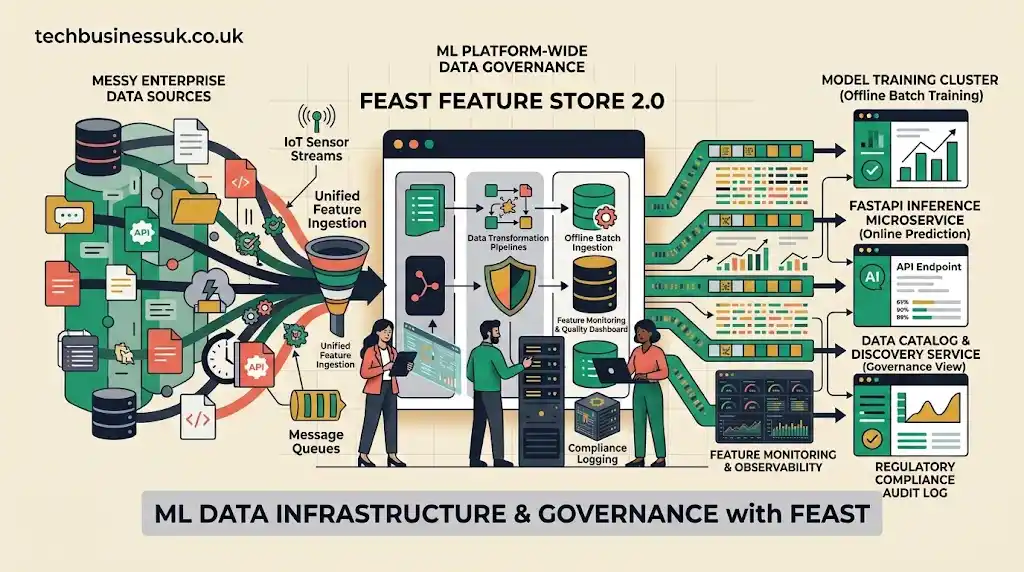
Did You Know ? Machine learning infrastructure fails in production for a single reoccurring reason: training-serving skew.
It happens every day: Data science teams craft predictive features in Python or SQL using historical batch data stored in warehouses like BigQuery or Snowflake. Meanwhile, software engineering teams rewrite that exact same feature transformation logic in C++, Java, or Go to serve predictions inside real-time microservices.
The moment those two versions drift out of sync, your model accuracy plummets due to unmanaged data sprawl.
The Feast feature store is the open-source industry standard designed to eradicate this architectural anti-pattern (refer to the official Feast documentation for deployment specs). By acting as a unified metadata registry and data abstraction layer, Feast bridges the gap between historical offline data warehouses and ultra-low-latency online key-value stores.
This guide explores the internal architecture of the open-source Feast feature store, how it eliminates data sprawl across machine learning pipelines, and how to rigorously test feature API endpoints in production.
What is a Feature Store in Machine Learning?
A feature store is a specialized data management layer that sits between raw data infrastructure (event streams, transactional databases, data lakes) and machine learning models.
[ Raw Data Sources ]
 (Kafka / Snowflake)
         │
         ▼
 ┌─────────────────────────────────────────────────────────┐
 │                   FEAST FEATURE STORE                   │
 │                                                         │
 │   ┌─────────────────────────────────────────────────┐   │
 │   │            Declarative Registry (Code)         │   │
 │   └────────────────────────┬────────────────────────┘   │
 │                            │                            │
 │            ┌───────────────┴───────────────┐            │
 │            ▼                               ▼            │
 │   ┌─────────────────┐             ┌─────────────────┐   │
 │   │  Offline Store  │             │  Online Store   │   │
 │   │ (Point-In-Time) │             │ (Low-Latency)   │   │
 │   └────────┬────────┘             └────────┬────────┘   │
 └────────────┼───────────────────────────────┼────────────┘
              │                               │
              ▼                               ▼
       [ Model Training ]            [ Real-Time Inference ]
Without a feature store, data scientists and software engineers maintain completely separate feature engineering pipelines.
                  ┌──► SQL/Spark Pipeline ──► Offline Store ──► Model Training
[ Raw Data ] ─────┤
                  └──► Microservice API   ──► Redis Cache   ──► Inference API
This split infrastructure causes critical production challenges:
- Training-Serving Skew: Minor discrepancies in how features are calculated between batch training and real-time inference degrade model accuracy.
- Data Sprawl: Multiple engineering teams re-compute identical features (e.g.,
user_30_day_avg_spend), duplicating storage costs and computing overhead. - Data Leakage: Historical joins inadvertently pull “future” feature states into training sets, leading to deceptively high validation metrics that fail in production.
Feast solves this by acting as a single, declarative source of truth. Features are defined once in code, materialized automatically across offline and online storage backends, and retrieved via standardized Python, gRPC, or REST APIs.
Addressing the root cause of unmanaged data pipelines requires unifying raw telemetry ingestion before API sprawl and feature sprawl degrade upstream model quality.
Core Architecture of the Feast Feature Store
Feast employs a pluggable, cloud-agnostic architecture. Rather than replacing your existing databases, Feast orchestrates storage and compute layers already operating within your infrastructure.
┌───────────────────────────────────────────────────────────────────┐
│                       FEAST ARCHITECTURE                          │
├───────────────────────────────────────────────────────────────────┤
│                                                                   │
│   ┌───────────────────────────────────────────────────────────┐   │
│   │               Declarative Feature Registry                │   │
│   │                 (Git-backed YAML / Code)                  │   │
│   └─────────────────────────────┬─────────────────────────────┘   │
│                                 │                                 │
│        ┌────────────────────────┴────────────────────────┐        │
│        ▼                                                 ▼        │
│ ┌──────────────┐                                  ┌─────────────┐ │
│ │ Offline      │                                  │ Online      │ │
│ │ Storage      │                                  │ Storage     │ │
│ │ (BigQuery,   │ ──────── Materialization ──────► │ (Redis,     │ │
│ │  Snowflake,  │         (Point-in-Time Sync)     │  DynamoDB,  │ │
│ │  PostgreSQL) │                                  │  SQLite)    │ │
│ └──────┬───────┘                                  └──────┬──────┘ │
│        │                                                 │        │
│        ▼                                                 ▼        │
│ ┌──────────────┐                                  ┌─────────────┐ │
│ │ Historical   │                                  │ Real-time   │ │
│ │ Feature      │                                  │ Feature     │ │
│ │ Retrieval    │                                  │ Retrieval   │ │
│ └──────────────┘                                  └─────────────┘ │
│                                                                   │
└───────────────────────────────────────────────────────────────────┘
1. The Declarative Registry
The central nervous system of Feast is its registry. Defined entirely in Python code and managed via Git, the registry tracks entities, feature views, schemas, and data sources.
2. The Offline Store (Batch Training)
Designed for high-throughput batch reads. The offline store holds historical data across months or years and executes point-in-time correct joins (“time-travel joins”) to produce leakage-free dataset arrays for model training. Common backends include Snowflake, BigQuery, AWS Redshift, and Spark/Parquet.
3. The Online Store (Real-Time Inference)
Optimized for low-latency, single-digit millisecond key-value lookups. The online store only contains the latest feature vector for every entity. Common backends include Redis, DynamoDB, PostgreSQL, and Cassandra.
4. The Materialization Engine
Materialization is the process of loading feature values from the offline store (or streaming sources) into the online store. Feast provides incremental materialization to keep online feature vectors fresh while keeping database write costs minimal.
Feast Feature Store vs. Commercial Alternatives
Evaluating feature store solutions requires balancing operational overhead against feature transformation capabilities and cloud vendor lock-in.
| Feature / Capability | Feast (Open-Source) | Databricks Feature Store | AWS SageMaker Feature Store | Tecton |
|---|---|---|---|---|
| License / Deployment | Open-Source / Self-Hosted | Managed SaaS (Databricks) | Managed Cloud (AWS) | Managed Enterprise SaaS |
| Primary Online Store | Redis, DynamoDB, PostgreSQL | DynamoDB, Cosmos DB | Amazon DynamoDB | Redis, DynamoDB |
| Primary Offline Store | Snowflake, BigQuery, Delta | Delta Lake / Spark | Amazon S3 | Snowflake, Databricks |
| Training-Serving Skew Guarantee | Native via unified SDK | Native within Spark ecosystem | Manual configuration required | Native end-to-end framework |
| Vendor Lock-In | None (Fully Cloud-Agnostic) | High (Requires Databricks) | High (Requires AWS) | Low (Multi-Cloud SaaS) |
| Operational Overhead | High (Self-managed Infra) | Low (Fully Managed) | Low (Fully Managed) | Low (Fully Managed) |
Hands-On Implementation: Setting Up Feast with FastAPI
Here is a practical workflow showing how to define features in Feast, materialize them into an online store (Redis/SQLite), and query them inside a production FastAPI FastAPI inference endpoint (for a deeper framework comparison, see FastAPI vs Flask)
Step 1: Environment Setup & Directory Structure
First, install Feast and FastAPI:
Bash
pip install "feast[redis]" fastapi uvicorn pandas
Initialize a Feast repository structure:
Plaintext
my_feature_repo/
├── feature_store.yaml
├── features.py
└── main.py
Step 2: Define Infrastructure in feature_store.yaml
Configure Feast to use a local SQLite store for offline historical data and Redis online store for serving low-latency features:
YAML
project: fraud_detection_system
registry: data/registry.pb
provider: local
online_store:
  type: redis
  connection_string: "localhost:6379"
offline_store:
  type: file
Step 3: Declarative Feature Definitions in features.py
Define your entity keys, data sources, and feature schemas in Python:
Python
from datetime import timedelta
from feast import (
    Entity,
    Field,
    FeatureView,
    FileSource,
)
from feast.types import Float32, Int64

# 1. Define the Primary Entity
user_entity = Entity(
    name="user_id",
    join_keys=["user_id"],
    description="Unique identifier for the transaction account holder",
)

# 2. Define Historical Data Source
file_source = FileSource(
    name="user_transaction_source",
    path="data/user_stats.parquet",
    timestamp_field="event_timestamp",
    created_timestamp_column="created",
)

# 3. Define the Feature View
user_transaction_feature_view = FeatureView(
    name="user_transaction_features",
    entities=[user_entity],
    ttl=timedelta(days=30),
    schema=[
        Field(name="transaction_count_30d", dtype=Int64),
        Field(name="avg_transaction_amount_30d", dtype=Float32),
        Field(name="failed_login_attempts_24h", dtype=Int64),
    ],
    online=True,
    source=file_source,
    tags={"team": "fraud_prevention"},
)
Apply the definitions to sync the Feast registry:
Bash
feast apply
To sync feature values into Redis for real-time lookups, run Feast’s materialization command:
Bash
feast materialize 2026-01-01T00:00:00 2026-09-06T00:00:00
Step 4: Exposing Feast via a FastAPI Inference Service
Expose Feast features directly inside a Python FastAPI microservice allows:
Python
from fastapi import FastAPI, HTTPException
from pydantic import BaseModel
from feast import FeatureStore
import pandas as pd

app = FastAPI(title="Real-Time Fraud Detection Microservice")

# Initialize Feast Feature Store Client
store = FeatureStore(repo_path=".")

class PredictionRequest(BaseModel):
    user_id: int
    current_transaction_amount: float

class PredictionResponse(BaseModel):
    user_id: int
    fraud_probability: float
    risk_level: str

@app.post("/predict", response_model=PredictionResponse)
async def predict_fraud(request: PredictionRequest):
    try:
        # Fetch low-latency online features from Redis via Feast
        feature_vector = store.get_online_features(
            features=[
                "user_transaction_features:transaction_count_30d",
                "user_transaction_features:avg_transaction_amount_30d",
                "user_transaction_features:failed_login_attempts_24h",
            ],
            entity_rows=[{"user_id": request.user_id}],
        ).to_dict()

        # Extract features (handling potential missing/null values)
        avg_amt = feature_vector["avg_transaction_amount_30d"][0] or 0.0
        failed_logins = feature_vector["failed_login_attempts_24h"][0] or 0

        # Heuristic/Model Scoring Logic
        suspicion_score = 0.0
        if request.current_transaction_amount > (avg_amt * 3):
            suspicion_score += 0.5
        if failed_logins > 3:
            suspicion_score += 0.4

        risk = "HIGH" if suspicion_score >= 0.7 else "LOW"

        return PredictionResponse(
            user_id=request.user_id,
            fraud_probability=min(suspicion_score, 1.0),
            risk_level=risk,
        )

    except Exception as e:
        raise HTTPException(status_code=500, detail=f"Feature retrieval failed: {str(e)}")
API Governance: Testing Feast Feature Endpoints
Exposing real-time feature stores through FastAPI or gRPC creates critical integration points that require continuous validation. If the online feature store responds with corrupted schemas, stale values, or high tail latencies, downstream machine learning models fail instantly.
Testing feature retrieval endpoints requires specialized API testing tools and robust contract testing frameworks to maintain sub-50ms inference SLAs.
1. Schema Drift & Contract Testing
Feature types must match across the entire MLOps lifecycle. If a data engineer alters transaction_count_30d from an Int64 to a Float32 in the offline warehouse, consumer endpoints will fail during parsing.
Contract tests enforce schema constraints and Pydantic schema validation before deployment:
Python
# Example contract test using pytest and pydantic
def test_feast_online_feature_schema():
    store = FeatureStore(repo_path=".")
    response = store.get_online_features(
        features=["user_transaction_features:transaction_count_30d"],
        entity_rows=[{"user_id": 1001}]
    ).to_dict()

    val = response["transaction_count_30d"][0]
    assert isinstance(val, int), f"Expected int schema, got {type(val)}"
2. Low-Latency Load Testing
Because online feature stores sit directly in the critical path of user-facing web applications, latency spikes directly degrade user experience. Load testing tools like Locust or k6 should be configured to stress-test online feature retrieval endpoints under concurrent traffic spikes, ensuring that upstream API Gateway Security policies do not introduce latency bottlenecks
3. Null Vector Assertion Checks
When an unknown entity key (e.g., a brand new user) queries the feature store, Feast returns None for un-materialized vectors. Your API tier must safely handle missing values via default fallbacks or imputation logic before passing vectors to the model framework.
Conclusion & Architectural Summary
The Feast feature store acts as a foundational component in modern MLOps architectures. By decoupling feature engineering logic from microservices and centralizing metadata into a git-backed registry, Feast eliminates the data sprawl and training-serving skew that plague production machine learning systems.
Building a resilient, production-ready AI infrastructure requires pairing an open-source feature store like Feast with rigorous automated testing. Validating feature schemas, monitoring online key-value latency, and executing end-to-end contract tests ensures your machine learning APIs perform reliably under real-world traffic loads.
1. What is a feature store in machine learning?
A feature store is a centralized operational data platform that manages, processes, and serves input variables (features) to machine learning models. It acts as a single source of truth across the MLOps lifecycle, bridging the gap between raw data warehouses and production prediction services.
2. Why do data science teams actually need a feature store?
Without a centralized store, teams suffer from training-serving skew—a common issue where feature processing code written in batch SQL for model training differs from real-time Python/C++ microservices, degrading model performance in production. A feature store guarantees consistency, reusability, and point-in-time correctness across all pipelines.
3. How does a dual-store architecture work under the hood?
A feature store maintains two complimentary storage engines:
- The Offline Store (e.g., BigQuery, Snowflake, Delta Lake) handles high-throughput historical queries for batch training and backtesting.
- The Online Store (e.g., Redis, DynamoDB) stores only the latest feature vectors for ultra-low-latency (sub-50ms) real-time inference.
4. What makes the Feast feature store distinct from managed alternatives?
Feast is the leading open-source, cloud-agnostic feature store. Unlike proprietary vendor solutions like Databricks Feature Store or AWS SageMaker Feature Store, Feast allows engineers to manage feature definitions using declarative Python code versioned directly in Git, avoiding vendor lock-in.
5. How does a feature store prevent data leakage?
A feature store implements point-in-time correct joins (often called time-travel joins). When assembling a training dataset, it retrieves feature states as they existed at the precise timestamp of the historical event, preventing future feature values from accidentally leaking into past training samples.
6. Is a feature store just another type of database?
No. While a feature store relies on underlying databases, standard databases only manage raw records. A feature store manages transformed data logic, enforces schema contracts, automates batch-to-online materialization, and exposes dedicated gRPC/REST APIs (or agentic protocols like MCP vs API) tailored specifically for ML model consumption.
7. How do software engineers test feature API endpoints in production?
Because online feature stores feed production APIs, they require rigorous testing using specialized API testing tools and contract frameworks (like Pydantic or Great Expectations). Automated integration tests check for schema drift, null value injection, and latency SLAs to ensure real-time model stability.
About the Author




3 thoughts on “Feast Feature Store Open Source Guide: Solving Data Sprawl in Machine Learning”