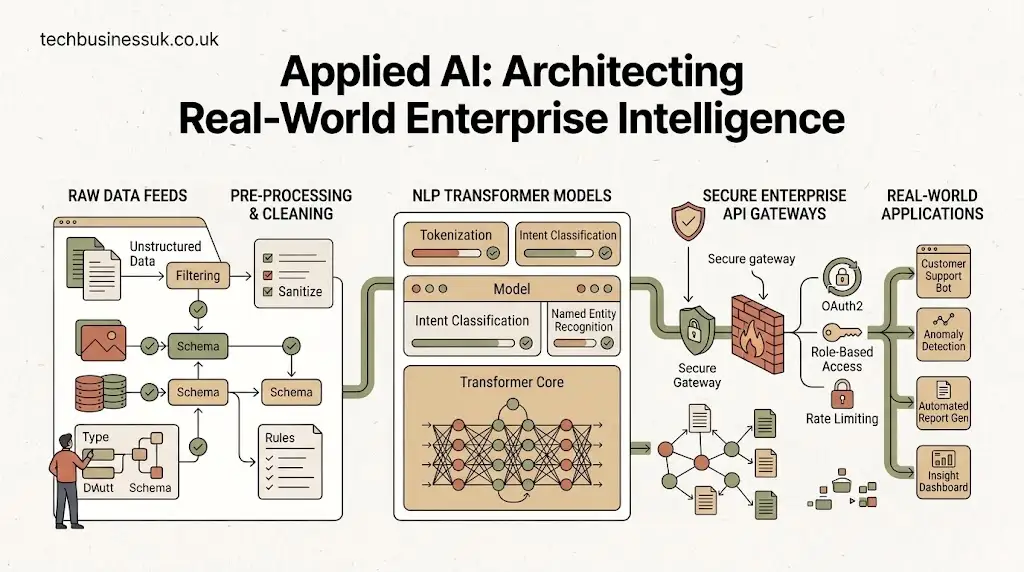
Modern enterprises no longer evaluate artificial intelligence purely through academic benchmarks, parameter counts, or white-paper breakthroughs. The era of raw experimentation has officially yielded to a pragmatic, business-first imperative: operationalizing intelligent systems to drive measurable bottom-line value.
Engineering teams, product leaders, and executive boards must navigate the complex shift from isolated probabilistic models to robust, production-grade architectures. Succeeding in this space requires moving beyond raw foundational models to establish robust infrastructure, deterministic safety rails, continuous monitoring systems, and scalable data pipelines.
1. What is Applied AI? (Definition & Core Concept)
Defining Applied AI vs. Theoretical & Research AI
Applied AI is the engineering discipline of taking artificial intelligence algorithms—such as machine learning, computer vision, and natural language processing—and integrating them into production environments, business software, and industrial workflows to solve specific operational challenges, automate decisions, and generate tangible ROI.
While Theoretical and Research AI centers on discovering new neural network architectures, optimizing loss functions, and pushing the boundaries of artificial general intelligence (AGI) using controlled benchmark datasets, Applied AI concentrates entirely on execution. It deals with real-world noise, messy data distributions, strict latency budgets, cloud compute costs, edge deployment constraints, and seamless integration with existing software stacks.
+-----------------------------------------------------------------------+
|                         RESEARCH & THEORETICAL AI                     |
| Focus: Algorithmic Innovation | Benchmark Metrics | Novel Architectures |
+-----------------------------------------------------------------------+
                                    |
                                    v  (Translational Engineering & MLOps)
+-----------------------------------------------------------------------+
|                              APPLIED AI                               |
| Focus: Real-World Telemetry | Business Logic | SLA & Latency | Security |
+-----------------------------------------------------------------------+
The Shift from Experimental Models to Production Workflows
Moving an AI system out of a Jupyter notebook and into enterprise production is notoriously difficult. A standalone model is merely an inference engine; an Applied AI system encompasses the entire operational framework built around that engine.
This systemic transition requires moving from static validation toward dynamic, continuous software lifecycles:
- Static Datasets → Streaming Telemetry: Shifting from curated, pre-cleaned CSV training sets to handling real-time, unstructured data feeds containing missing fields, schema shifts, and noise.
- Accuracy Metrics → Business Outcomes: Transitioning from evaluating models purely on F1-score or perplexity to tracking transaction throughput, cost-per-inference, processing time reduction, and user retention.
- Isolated Scripts → Robust API Microservices: Encapsulating models behind reliable protocol layers, such as a secure LLM API, to support containerized autoscaling, circuit breaking, and failover routing.
Core Capabilities: Machine Learning, Computer Vision, and Natural Language Processing (NLP)
Applied AI brings together three primary computational disciplines to address enterprise challenges:
- Machine Learning (ML) & Deep Learning: Predictive modeling, anomaly detection, structured tabular analytics, time-series forecasting, and reinforcement learning for dynamic decision-making.
- Computer Vision (CV): Visual inspection, automated spatial analysis, optical character recognition (OCR), video processing, and edge detection in manufacturing, logistics, and healthcare.
- Natural Language Processing (NLP): Understanding, processing, and generating human language, bridging unstructured textual data with structured enterprise databases.
2. The Role of Natural Language Processing (NLP) in Applied AI
How NLP Bridges Human Communication and Machine Intelligence
Unstructured textual and verbal communication makes up the vast majority of enterprise data assets—from customer emails, support tickets, and legal contracts to clinical records and audio recordings. Natural Language Processing (NLP) serves as the translational layer within Applied AI systems, parsing unstructured natural language and turning it into structured, machine-actionable data payloads.
By converting contextual nuances, intent, and semantic relationships into vector embeddings, NLP enables software systems to process human intent natively, bypassing the rigid constraints of traditional keyword-matching scripts.
Core NLP Applications in Enterprise Systems
Intent Classification & Sentiment Analysis
Modern intent engines process incoming customer communications in real time, routing queries dynamically based on urgency, emotional sentiment, and subject matter. Advanced systems utilize fine-tuned transformer encoders to categorize multi-turn conversations, trigger automated mitigation paths, or escalate priority items directly to human operations agents.
Automated Text Summarization & Entity Extraction (NER)
Enterprise workflows frequently stall due to document processing bottlenecks. Named Entity Recognition (NER) systems parse unstructured documents (such as invoices, medical records, or regulatory filings) to extract key parameters—including dates, financial figures, party names, and account numbers. Paired with abstractive summarization, these tools condense lengthy technical dossiers into actionable operational briefs.
Conversational AI, Chatbots, and Voice Agents
Moving far beyond legacy decision-tree scripts, modern conversational interfaces rely on generative architectures and voice-synthesis pipelines. These interfaces execute multi-step transactions, query backend databases, and contextually adjust responses during live customer interactions.
[User Input] --> [NLP Pipeline / Embeddings] --> [Intent & NER Extraction]
                                                          |
                                                          v
[Database / ERP] <-- [Function Call / API Trigger] <-- [Context Resolver]
Modern NLP Architectures: From Transformers to Large Language Models (LLMs) and RAG
The transition from early recurrent architectures (RNNs and LSTMs) to self-attention Transformers revolutionized applied natural language processing. Today’s enterprise deployments lean heavily on Large Language Models (LLMs) and Retrieval-Augmented Generation (RAG) to achieve domain-specific precision without requiring fully custom foundation model training.
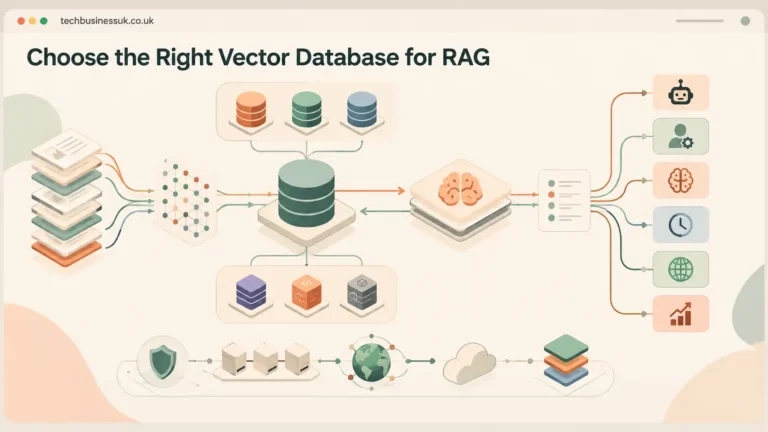
To keep LLMs grounded in enterprise truth, RAG architectures pair generative language models with external vector databases (such as Pinecone, Qdrant, or ChromaDB). When a user issues a prompt, the system queries a curated knowledge base, extracts relevant contextual chunks, and injects them directly into the model’s inference context window.
YAML
# Conceptual RAG Context Injection Payload
System Prompt: "You are a secure corporate policy agent. Answer strictly using the context below."
Retrieved Context:
  - Chunk ID 8492: "Enterprise travel reimbursement requests over £500 require director approval."
User Query: "What is the approval threshold for a £650 flight request?"
This pattern drastically reduces hallucinations, eliminates the immense cost of pre-training models from scratch, and ensures enterprise access control policies remain enforced at the data retrieval boundary.
3. Key Differences: Applied AI vs. Other Paradigms
Understanding where Applied AI fits within your technology organization requires comparing it against theoretical research and traditional, rule-based software engineering.
While traditional software relies on explicit if/then conditions, Applied AI leverages probabilistic models capable of generalizing across unseen inputs. However, that probabilistic nature requires wrapping AI models in deterministic software constraints—such as strict runtime input/output validation engines—to ensure enterprise predictable safety.
4. Real-World Applications of Applied AI Across Industries
Applied AI is reshaping production environments across every major vertical sector by automating complex, high-volume tasks.
           +-------------------------------------------------------+
           |               ENTERPRISE APPLIED AI                   |
           +-------------------------------------------------------+
                                       |
     +-----------------+---------------+---------------+-----------------+
     |                 |                               |                 |
     v                 v                               v                 v
[FINANCE]         [HEALTHCARE]                    [RETAIL]          [OPERATIONS]
* Fraud Detection * Clinical NLP                  * Recommendations * Document Processing
* Algorithmic Trade* Medical Imaging               * Dynamic Pricing * Autonomous Routing
Finance & Banking
- Real-Time Fraud Detection: Analyzing millions of streaming transactions per second using gradient-boosted trees and deep neural networks to isolate fraudulent behavior anomalies in under 50 milliseconds.
- Automated Credit & Loan Underwriting: Blending traditional credit scoring with unstructured data analysis (tax returns, employment history documents) via OCR and NLP to accelerate approval workflows safely.
- Algorithmic Trading & Risk Modeling: Employing quantitative reinforcement learning models to assess real-time market risk exposures and execute optimized trade routes.
Healthcare & Life Sciences
- Medical Imaging Analysis: Utilizing convolutional neural networks (CNNs) and vision transformers to assist radiologists in detecting early-stage oncology anomalies, fractures, and vascular abnormalities in MRI and CT scans.
- Clinical NLP & EHR Processing: Extracting structured clinical diagnoses, dosage history, and patient comorbidities from unstructured physician notes to streamline billing and clinical trial matching.
- Predictive Patient Analytics: Forecasting patient readmission risks and intensive care unit (ICU) capacity demands to optimize hospital staff allocation.
E-Commerce & Retail
- Personalized Recommendation Engines: Utilizing collaborative filtering and deep retrieval models to construct real-time, highly personalized product feeds based on active user clickstreams.
- Dynamic Pricing Algorithms: Adjusting product pricing dynamically using real-time supply chain signals, competitor pricing variations, and local demand trends.
- Intelligent Visual Search: Allowing consumers to upload mobile photos to identify matching or aesthetically similar products across inventory catalogs.
Customer Support & Enterprise Operations
- Intelligent Document Processing (IDP): Transforming unstructured receipts, bills of lading, and shipping manifests into validated JSON records ready for direct ERP injection.
- Autonomous Support Routing: Deploying generative conversational frameworks to resolve primary support queries while automatically escalating high-impact cases to specialist teams.
5. How to Build an Enterprise Applied AI Pipeline
Successfully moving an Applied AI initiative from concept to cloud infrastructure requires a disciplined, multi-stage engineering roadmap.
+-------------------+      +-------------------+      +-------------------+      +-------------------+
|  1. DATA READINESS| ---> |2. MODEL SELECTION | ---> | 3. ARCHITECTURE   | ---> | 4. MLOPS & SAFETY |
|  & SANITIZATION   |      |  & FINE-TUNING    |      |  & RAG INTEGRATION|      |  MONITORING       |
+-------------------+      +-------------------+      +-------------------+      +-------------------+
Step 1: Problem Definition & Data Readiness
Before writing code or provisioning GPU clusters, engineering teams must clearly isolate the business problem and establish baseline benchmarks:
- Define Success Metrics: Establish precise operational Target Level Objectives (e.g., “Reduce invoice processing time from 4 minutes to under 15 seconds while maintaining 99% extraction precision”).
- Audit Data Pipelines: Ensure historical training and validation data is clean, properly labeled, and stored in accessible formats.
- Address Data Privacy & Lineage: Scrub personally identifiable information (PII) at ingest using pseudonymization scripts to maintain strict regulatory compliance.
Step 2: Model Selection & Fine-Tuning (Proprietary vs. Open-Source Models)
Choosing the right base model involves evaluating performance requirements, latency constraints, data privacy policies, and ongoing operational costs:
                  MODEL SELECTION ARCHITECTURE TREE
                                  |
               Is Data Privacy / On-Prem Required?
                                  |
                 +----------------+----------------+
                 |                                 |
               [YES]                             [NO]
                 |                                 |
    Use Open-Source Base             Evaluate Proprietary APIs
    (e.g., Llama, Mistral)           (e.g., OpenAI, Anthropic)
                 |                                 |
      Do you need specific             Do you need specific
     formatting / domains?            formatting / domains?
                 |                                 |
          +------+------+                   +------+------+
          |             |                   |             |
        [YES]          [NO]               [YES]          [NO]
          |             |                   |             |
     Fine-Tune     Use Base Model      Fine-Tune      Use Base
     w/ QLoRA      Out-of-Box          via API        Out-of-Box
- Proprietary Frontier APIs (e.g., OpenAI, Anthropic): Ideal for rapid prototyping, complex multi-step reasoning, and generalized tasks where third-party cloud data transmission is approved.
- Open-Source Base Models (e.g., Llama, Mistral): Essential when enterprise data sovereignty demands on-premise or private VPC hosting, strict latency optimization, or custom low-rank adaptation (QLoRA) fine-tuning.
Step 3: Architecture & Context Integration (Vector Databases, RAG, and APIs)
Once the base inference engine is selected, developers wrap it in an enterprise system architecture:
- Vector Database Provisioning: Indexing corporate knowledge bases using high-performance vector indexes (HNSW) to enable sub-100ms semantic retrieval.
- Context Assembly Layers: Constructing middleware that intercepts incoming user queries, pulls relevant context chunks from storage, and hydrates the final system prompt.
- Security & Guardrail Interceptors: Implementing deterministic security middleware, such as active AI Guardrails, directly before and after model invocation. This ensures input prompts and generated responses are continuously audited for toxic output, data leakage, or injection attempts.
[User Query]
     |
     v
[Input Guardrails] --(Blocked?)--> [400 Error / Fallback]
     |
  (Passed)
     v
[Vector DB Context Retrieval]
     |
     v
[Model Inference API]
     |
     v
[Output Guardrails] --(Violation?)--> [Sanitized Fallback Response]
     |
  (Passed)
     v
[Client Application]
Step 4: MLOps, Continuous Evaluation, & Monitoring
A production deployment marks the beginning of an Applied AI application’s lifecycle, not its end. Robust enterprise systems depend on continuous operational oversight:
- Active Drift Monitoring: Tracking distribution shifts in user inputs (data drift) and degradation in model response quality over time (concept drift).
- Inference Observability: Deploying specialized tracing tools, such as end-to-end LLM Observability platforms, to log token consumption, pipeline latency, context relevance, and execution costs per transaction.
- Automated Fallback Routes: Configuring circuit breakers that route traffic to smaller models, cached responses, or human agents when primary inference services experience elevated latency or errors.
6. Challenges in Deploying Applied AI (And How to Solve Them)
Deploying non-deterministic models into deterministic enterprise software environments introduces distinct operational challenges.
Data Quality, Drift, and Hallucinations in LLMs
Generative language models operate probabilistically, predicting the next mathematically likely token rather than retrieving absolute ground truths. This leads to hallucinations—statistically coherent text that is factually incorrect.
                    HALLUCINATION MITIGATION STACK
+-------------------------------------------------------------------+
| 1. GROUNDING: Enforce strict RAG context limits (No external knowledge)
+-------------------------------------------------------------------+
                                  |
                                  v
+-------------------------------------------------------------------+
| 2. TEMPERATURE: Set decoding temperature to 0.0 for deterministic output
+-------------------------------------------------------------------+
                                  |
                                  v
+-------------------------------------------------------------------+
| 3. VALIDATION: Pass outputs through JSON Schema / Pydantic validators
+-------------------------------------------------------------------+
To control these risks:
- Force generative models to supply exact source attribution quotes alongside generated facts.
- Validate generated outputs programmatically using structured schemas (such as Pydantic in Python) before returning payloads to downstream services.
- Enforce deterministic temperature settings (0.0) on technical extraction operations.
Scalability, Latency, and Compute Costs
Running deep neural networks at enterprise scale introduces significant compute infrastructure expenses. Unoptimized API requests can quickly balloon cloud hosting bills while breaching target latency SLAs.
Engineering Mitigations:
- Semantic Caching: Utilizing specialized memory stores (such as Redis or GPTCache) to cache semantic query embeddings, serving identical or near-identical prompts instantly without triggering new model inferences.
- Model Quantization: Converting weights from FP16 precision down to INT8 or INT4 formats, dramatically reducing GPU memory usage while preserving output accuracy.
- Speculative Decoding: Pairing smaller, faster draft models with larger validation models to accelerate overall token generation speeds.
AI Governance, Compliance, and Data Privacy
Enterprise Applied AI platforms must strictly align with global data security frameworks, including the EU AI Act, GDPR, HIPAA, and SOC2 standards.
                      ENTERPRISE AI SECURITY BOUNDARY
                                     |
    +--------------------------------+--------------------------------+
    |                                                                 |
    v                                                                 v
[OFFENSIVE TESTING]                                         [DEFENSIVE CONTROLS]
Proactively stress-test systems via                          Implement runtime context filtering
adversarial attack vectors like                              and payload sanitization using
[AI Red Teaming]                                             [Prompt Injection Prevention]
To protect enterprise perimeters:
- Conduct adversarial security stress testing, deploying structured AI Red Teaming protocols to discover vulnerabilities, jailbreaks, and authorization bypasses before public release.
- Implement robust sanitization layers targeting direct and indirect prompt attacks, embedding dedicated Prompt Injection Prevention techniques across all application ingress boundaries.
- Maintain complete audit trails mapping every prompt, retrieved context chunk, model response, and system decision to simplify legal review and regulatory reporting.
7. Frequently Asked Questions (FAQ)
What is the main benefit of Applied AI?
The core benefit of Applied AI is its focus on practical operational impact. Unlike academic AI research, Applied AI integrates probabilistic intelligence directly into commercial workflows—reducing operational overhead, automating unstructured document handling, and accelerating complex enterprise decisions at scale.
Is Natural Language Processing (NLP) considered part of Applied AI?
Yes. NLP is a foundational domain within Applied AI. It provides the algorithms, text embeddings, and language models necessary for software systems to read, interpret, summarize, and generate human language inside operational production environments.
What technical skills are required to become an Applied AI Engineer?
An Applied AI Engineer bridges traditional software engineering and data science. Core skills include:
- Advanced Python / Systems Engineering: Building scalable microservices, async APIs, and distributed data pipelines.
- Framework Mastery: Proficiency with PyTorch, Hugging Face, LangChain, LlamaIndex, and vector search stores.
- MLOps & Infrastructure: Experience containerizing workloads (Docker, Kubernetes), managing cloud compute, and configuring CI/CD pipelines.
- System Evaluation & Security: Implementing model evaluation frameworks, LLM observability tools, guardrails, and secure API patterns.
How does Applied AI differ from Generative AI?
Applied AI is an overarching engineering category focused on solving real-world business challenges using any practical artificial intelligence technology—including computer vision, predictive tabular analytics, time-series forecasting, classical machine learning, and generative models. Generative AI is a specific subset of modern AI models (such as LLMs and diffusion networks) designed explicitly to generate new text, code, image, or audio content. Generative models represent one of many available tools within an Applied AI practitioner’s toolkit.
About the Author

9 thoughts on “Applied AI: Architecting Practical Artificial Intelligence for Enterprise Scale”