Deploying a prototype powered by a Large Language Model (LLM) requires only a few lines of Python and an API key. Moving that application into production—where thousands of concurrent users demand sub-second latency, deterministic security guarantees, zero hallucinations, and predictable monthly infrastructure bills—presents a radically different engineering challenge.
Generative AI applications operate on non-deterministic models, variable-length inputs, complex context windows, and shifting external knowledge bases. Traditional software practices and classical Machine Learning Operations (MLOps) fall short when applied to foundational language models. This operational gap gave birth to LLMOps: a dedicated branch of AI engineering focused on managing the lifecycle, reliability, security, and cost of generative language systems.
Key Takeaways
- Operational Pivot: LLMOps transitions engineering teams from training static models on custom datasets to managing non-deterministic prompt lifecycles, retrieval systems, and token costs.
- Core Pipeline Architecture: A resilient enterprise setup integrates structured data ingestion, vector stores, prompt orchestration, automated evaluation gates, and real-time guardrails.
- MLOps vs LLMOps: Classical MLOps prioritizes feature stores and local retrain schedules; LLMOps prioritizes dynamic context management, RAG indexing, and LLM-as-a-judge evaluation.
- Cost and Latency Control: Semantic caching, model routing, and strict context window budgeting prevent exponential inference cost spikes and slow response times.
- RAG First Strategy: Organizations should exhaust prompt engineering and Retrieval-Augmented Generation (RAG) before committing capital to full custom fine-tuning.
What Is LLMOps and Why It Matters for Applied AI
Understanding what is llmops requires looking at the operational overhead behind modern language applications. Large Language Model Operations (LLMOps) comprises the practices, technical architectures, culture, and tooling used to automate the deployment, monitoring, guardrailing, and maintenance of foundation models in production software.
       +-------------------------------------------------------+
       |               Data Ingestion & Indexing               |
       |  (Chunking, Embedding Generation, Vector Database)    |
       +---------------------------+---------------------------+
                                   |
                                   v
       +-------------------------------------------------------+
       |             Prompt & Orchestration Layer              |
       |     (System Instructions, Agent Chains, Caching)      |
       +---------------------------+---------------------------+
                                   |
                                   v
       +-------------------------------------------------------+
       |              Runtime Guardrails & Policy              |
       | (PII Masking, Prompt Injection Defense, Schema Check) |
       +---------------------------+---------------------------+
                                   |
                                   v
       +-------------------------------------------------------+
       |               Inference & Evaluation Gate             |
       |  (Model Routing, Fallbacks, LLM-as-a-Judge Analysis)  |
       +-------------------------------------------------------+
As Applied AI expands across sectors, foundational language models act as central processing units inside enterprise software stacks. However, these models introduce operational risks that traditional DevOps pipelines were never designed to handle:
- Stochastic Output Variability: The exact same user query can produce different text across subsequent executions.
- Opaque Failure Modes: Models do not fail with classic stack traces; they fail silently through subtle hallucinations, tone shifts, or incorrect factual inferences.
- Variable Unit Economics: Infrastructure costs scale directly with input and output token lengths rather than simple CPU/GPU runtime minutes.
The Evolution from Traditional Software to Generative Systems
Traditional software engineering relies on deterministic logic. Given input A and function F, the program returns output B every single time. MLOps introduced statistical predictions based on custom-trained models, but those models primarily output tabular classifications or regression values tied to structured feature vectors.
Generative systems break this paradigm entirely. The user interface accepts open-ended natural language, and the underlying foundational model yields complex natural language or dynamic code. The release lifecycle shifts away from traditional code compile steps. Instead, teams must maintain continuous context delivery, system prompt updates, vector retrieval relevance, and safety alignment checks.
Core Business Drivers Behind LLMOps Adoption
Enterprise adoption of generative AI relies on converting non-deterministic model capabilities into repeatable software outcomes. Engineering leaders implement structured LLMOps for four main reasons:
- System Output Reliability: Ensuring responses conform to strict structural schemas (such as JSON or Pydantic objects) so downstream software systems do not crash.
- Cost Predictability: Managing token usage, implementing multi-tier caching, and routing low-complexity tasks to smaller open-source models to keep operating margins healthy.
- Regulatory and Privacy Compliance: Preventing Personally Identifiable Information (PII) from leaking into external model APIs or training pipelines while enforcing content safety guardrails.
- Iterative Deployment Speed: Enabling prompt engineers and domain experts to update model prompts and knowledge sources without requiring full code redeployments.
Structural Comparison: MLOps vs LLMOps
While both disciplines share root principles around continuous integration and deployment, llmops vs mlops reflects fundamental shifts in infrastructure and workflow design. MLOps focuses on building models from scratch; LLMOps focuses on orchestrating pre-trained foundation models.
+------------------------+------------------------------------+-------------------------------------+
| Dimension              | Classical MLOps                    | Production LLMOps                   |
+------------------------+------------------------------------+-------------------------------------+
| Primary Artifact       | Model Weights (.pkl, .onnx)        | Prompts, Embeddings, Context Chains |
| Primary Resource       | Compute for Training (GPUs)        | Inference Tokens & Memory Buffers   |
| Primary Data Pipeline  | Structured Feature Stores          | Unstructured Vector Search & RAG    |
| Optimization Loop      | Retraining Weights on New Data     | Prompt Tuning, RAG, Fine-Tuning     |
| Main Failure Mode      | Concept Drift, Model Overfitting   | Hallucination, Prompt Injection     |
| Primary Cost Driver    | Training Clusters                  | Token Consumption & Vector Storage  |
+------------------------+------------------------------------+-------------------------------------+
Paradigm Shift in Model Lifecycle Management
In classical MLOps, data science teams gather raw labeled datasets, engineer custom features, and run compute-heavy training loops to generate lightweight model weights. The operational burden centers on maintaining data pipelines, detecting feature drift, and scheduling model retraining routines.
In LLMOps, the core foundation model is usually acquired as an external API service or imported as a massive pre-trained open-source weight set. Engineering teams spend little time training model architectures from scratch. Instead, operational friction moves toward context assembly, query optimization, retrieval tuning, dynamic tool call execution, and evaluating model outputs on the fly.
Artifact Management: From Static Weights to Dynamic Prompts
The artifacts managed within version control repositories differ drastically between the two operational paradigms:
Classical MLOps Artifacts:
Dataset (CSV/Parquet) ---> Feature Store ---> Model Training ---> Weights (.bin) ---> Inference Endpoint

LLMOps Artifacts:
Unstructured Docs ---> Chunking & Embeddings ---> Vector Index (HNSW) \
                                                                        +--> Prompt Orchestrator ---> Guardrails
System Instruction Template + User Context + Few-Shot Examples --------/
- System Instructions and Prompt Templates: Prompts act as pseudo-code for language models. Small changes in punctuation, phrasing, or token ordering alter model behavior. Versioning prompts alongside evaluation scores is a non-negotiable core practice.
- Vector Indices: Instead of tabular feature stores, LLMOps pipelines rely on vector space embeddings stored in dedicated databases to retrieve semantic context at runtime.
- Configuration Matrices: Managing parameters such as temperature, top-p, frequency penalties, and maximum response token caps across multiple deployment targets.
Core Architecture of a Production LLMOps Pipeline
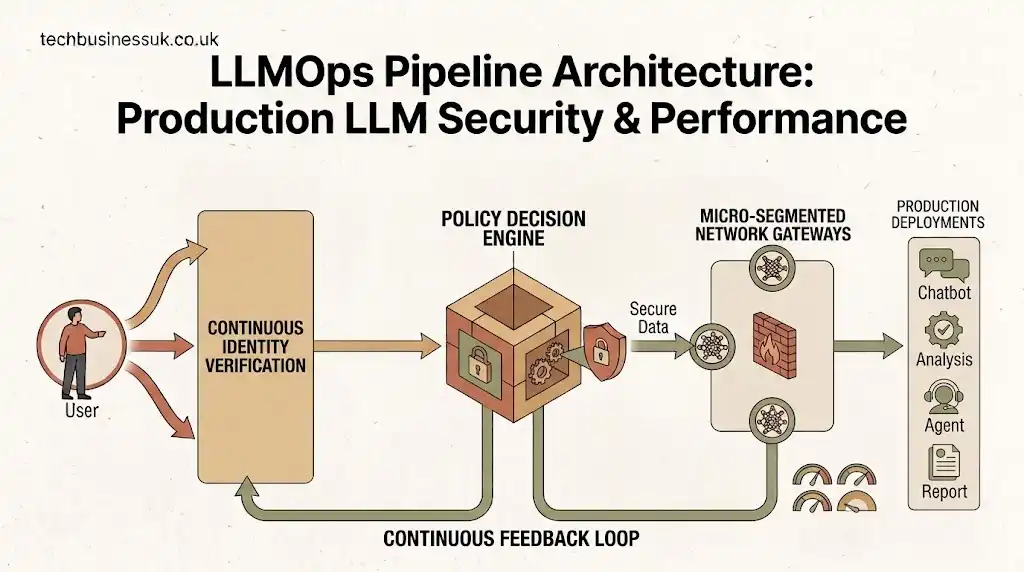
Building a production-ready system requires linking specialized modular components into a cohesive processing unit. Each stage must process incoming queries with minimal overhead while catching potential failure states before they reach end users.
                                  +-------------------+
                                  |   User Request    |
                                  +---------+---------+
                                            |
                                            v
                                  +-------------------+
                                  |   Guardrails &    |
                                  | Safety Filters    |
                                  +---------+---------+
                                            |
                                            v
                                  +-------------------+
                                  |  Semantic Cache   |
                                  +----+---------+----+
                                       |         |
                      Cache Hit <------+         +------> Cache Miss
                      (Return)                            |
                                                          v
                                              +-----------------------+
                                              | Vector Retrieval      |
                                              | (Context Augment)     |
                                              +-----------+-----------+
                                                          |
                                                          v
                                              +-----------------------+
                                              | Model Router / API    |
                                              +-----------+-----------+
                                                          |
                                                          v
                                              +-----------------------+
                                              | Output Evaluator      |
                                              | (LLM-as-a-Judge)      |
                                              +-----------+-----------+
                                                          |
                                                          v
                                              +-----------------------+
                                              | Response to User      |
                                              +-----------------------+
Data Preparation and Vector Store Ingestion
Retrieval-Augmented Generation (RAG) forms the backbone of most enterprise LLM deployments. The data pipeline transforms disparate internal documentation into a searchable format for rapid semantic retrieval:
- Document Chunking Strategy: Documents must be broken down into structured text blocks. Overly large chunks dilute specific semantic signals; overly small chunks lose broader document context. Overlapping recursive chunking strategies balance precision and context preservation.
- Embedding Generation: Chunks are passed through specialized embedding models that map textual meaning into high-dimensional vector spaces.
- Vector Store Management: Embeddings are loaded into dedicated databases like Pinecone, Milvus, Qdrant, or PGVector. These stores use efficient indexing algorithms (such as Hierarchical Navigable Small World, or HNSW) to execute rapid cosine similarity or dot-product searches.
- Metadata Indexing: Attaching contextual metadata (like permission tags, creation dates, or document categories) allows for hybrid search strategies that combine keyword filtering with vector similarity.
Model Selection, Prompt Engineering, and Orchestration
Once data is indexed, the orchestration framework handles incoming requests and structures calls to foundation models:
- Model Routing Logic: Not every user request requires a top-tier model. A lightweight model router analyzes incoming intent. Basic intent identification or text summarization tasks head to smaller, faster open-source models, reserving expensive reasoning models for multi-step logic.
- Prompt Versioning and Template Engines: Hardcoded strings inside application code create technical debt. Dedicated prompt management frameworks decouple system prompts from application code, storing instructions as version-controlled templates.
- Chaining and Agentic Workflows: Tools like LangChain, LlamaIndex, or custom Python orchestration code chain atomic LLM calls together. Complex agentic workflows execute self-reflection loops, query external web search tools, or run sandboxed code interpreter blocks dynamically.
Continuous Evaluation: LLM-as-a-Judge and Guardrails
Evaluation in traditional software relies on unit tests with static true/false outcomes. Evaluating generative natural language requires continuous probabilistic checking across both real-time streams and offline test suites.
       +-------------------------------------------------------------+
       |                  Incoming Model Response                    |
       +------------------------------+------------------------------+
                                      |
                                      v
       +-------------------------------------------------------------+
       |                  Deterministic Guardrails                   |
       |  - Regex PII Scrubbing                                      |
       |  - Structural JSON Schema Validation                        |
       |  - Keyword Blacklist Filtering                              |
       +------------------------------+------------------------------+
                                      |
                                      v
       +-------------------------------------------------------------+
       |                  Probabilistic Evaluators                   |
       |  - Semantic Toxicity Scorer                                 |
       |  - Hallucination Classifier (Context vs Response)            |
       |  - LLM-as-a-Judge Relevance Scoring                          |
       +------------------------------+------------------------------+
                                      |
                                      v
                      +---------------+---------------+
                      |                               |
             Passes All Checks                 Fails Evaluation
                      |                               |
                      v                               v
            +-------------------+           +-------------------+
            | Stream to User    |           | Fallback Response |
            +-------------------+           +-------------------+
Real-Time Response Guardrails
- Guardrail frameworks intercept requests and responses in real time. They block prompt injection attacks, scrub confidential PII before transmitting data across external cloud networks, and enforce JSON formatting constraints on generated responses through structured ai guardrails testing.
Offline LLM-as-a-Judge Frameworks
To continuously benchmark updates to prompts or retrieval parameters, engineering teams use automated evaluation engines. Platforms like braintrust.dev llmops allow teams to run rigorous, automated test suites.
In this setup, a powerful model acts as an impartial evaluator, scoring lower-cost production outputs against key metrics:
- Faithfulness: Does the generated output rely strictly on the retrieved context documents, or did the model invent facts?
- Answer Relevance: Did the generated text address the user’s explicit question?
- Context Precision: Did the retrieval system fetch relevant knowledge chunks without pulling in useless noise?
Real-World Example: Deploying an Enterprise RAG Assistant
To see how these concepts function together, let us walk through building an enterprise-grade internal knowledge base assistant for a global organization.
           +--------------------------------------------------------+
           |                 Corporate Confluence                   |
           +---------------------------+----------------------------+
                                       |
                                       v
           +--------------------------------------------------------+
           |                 Unstructured Data Pipeline             |
           |    (Recursive Chunking + Text Embedding Model)         |
           +---------------------------+----------------------------+
                                       |
                                       v
           +--------------------------------------------------------+
           |                    Pinecone Vector Index               |
           +---------------------------+----------------------------+
                                       |
                                       v
  User Query ---> API Gateway ---> Routing Router ---> Vector Search
                                                            |
                                                            v
  User Response <--- Output Filter <--- LLM API <--- Context Assembly
System Architecture and Infrastructure Setup
- Ingestion Pipeline: An automated nightly cron job extracts raw internal confluence pages and policy documents. It chunks documents into 512-token segments with a 50-token overlap, calculates vector embeddings, and writes the vectors into a Pinecone instance tagged with department-level access control permissions.
- Orchestration Service: An asynchronous FastAPI application deployed on AWS ECS handles incoming web requests.
- Semantic Caching: The application checks a Redis instance using semantic vector similarity. If a user asks a question semantically equivalent to one answered in the past 24 hours, the cached response returns instantly, skipping model inference entirely.
- Context Injection: On a cache miss, the service queries Pinecone for the top three matching text chunks matching the user’s role permissions. It injects those chunks into a versioned system prompt template:
Markdown
System Prompt: You are an internal enterprise support assistant.
Answer the user's question relying strictly on the retrieved context below.
If the answer cannot be definitively derived from the context, state "I cannot answer based on internal records."

Context:
{retrieved_chunks}

User Question:
{user_query}
Production Rollout, Monitoring, and Feedback Loops
- Staged Blue-Green Rollouts: Updating a system prompt or swapping the underlying foundational model carries unexpected regressions. System changes deploy to a 5% canary traffic segment while automated monitors track latency, error rates, and user response edits.
- Observability and Tracing: Every execution step—from raw user input and retrieval vector scores to the final prompt string and output token count—is logged using OpenTelemetry standards into llm observability dashboards.
- Human-in-the-Loop Feedback: The end-user interface includes explicit feedback buttons (thumbs up / thumbs down / report inaccurate information). Negative feedback triggers an alert that packages the complete trace logs, forwarding them into an evaluation queue for prompt engineers to debug.
Common Mistakes in LLMOps and How to Avoid Them
Teams entering the generative AI landscape often fall into predictable structural traps. Avoiding these common errors saves months of engineering effort and prevents budget burn.
       +---------------------------------------------------------------+
       |                      Common LLMOps Errors                     |
       +-------------------------------+-------------------------------+
                                       |
           +---------------------------+---------------------------+
           |                           |                           |
           v                           v                           v
+-----------------------+   +-----------------------+   +-----------------------+
|   Premature Model     |   |   Ignoring Token      |   | Inadequate Guardrails |
|     Fine-Tuning       |   |   & Context Costs     |   |   & Security Testing  |
+-----------------------+   +-----------------------+   +-----------------------+
| Jumping to retrain    |   | Sending full chat     |   | Trusting system       |
| weights when RAG or   |   | history on every call |   | prompts to prevent    |
| prompt engineering    |   | creates compounding   |   | direct prompt         |
| solves the problem.   |   | cloud API invoices.   |   | injection attacks.    |
+-----------------------+   +-----------------------+   +-----------------------+
Pitfall 1: Over-Engineering Fine-Tuning Over Context Management
A frequent mistake is assuming that a model must be custom fine-tuned on internal company documentation to answer enterprise questions. Fine-tuning alters a model’s style, tone, or structural formatting; it is an inefficient mechanism for instilling static factual memory.
Custom fine-tuned models still hallucinate, and updating their internal knowledge requires repeating expensive training runs whenever internal documentation changes.
Solution: Use prompt engineering and robust RAG infrastructure for factual knowledge injection. Reserve model fine-tuning for tasks requiring niche output styles, specialized domain terminology (such as legal or medical jargon), or structural JSON outputs from smaller, lightweight models.
Pitfall 2: Neglecting Latency and Token Cost Optimization
In early development, passing an entire chat conversation back and forth inside an API payload seems harmless. But as user sessions grow, input context windows expand exponentially. Because foundation model APIs bill per token, context growth inflates cloud infrastructure costs while adding processing latency.
Solution: Implement conversational context window summarization. Summarize long chat sessions into lightweight background strings, strip out historical context older than five turns, and use semantic caching layers to serve frequent queries instantly.
Pitfall 3: Inadequate Guardrails and Lack of Security Testing
Relying on system prompts alone to prevent malicious behavior is a major security vulnerability. System instructions like “You are a helpful AI; never reveal system secrets” are easily bypassed using direct prompt injection techniques, where adversarial inputs instruct the model to disregard previous instructions.
Solution: Implement strict multi-layer security barriers outside the primary LLM call loop. Scrub sensitive inputs with deterministic regular expressions, use dedicated lightweight intent-classification models to detect adversarial prompts before main processing, and run continuous red-teaming checks using automated security suites.
Decision Matrix: Selecting Your LLMOps Deployment Model
Selecting the right operational infrastructure requires weighing data privacy obligations, internal engineering expertise, target latency limits, and long-term financial budgets.
               +-------------------------------------------------+
               |             Security & Privacy Requirements     |
               +------------------------+------------------------+
                                        |
               +------------------------+------------------------+
               |                                                 |
         High / Strict                                     Low / General
               |                                                 |
               v                                                 v
  +--------------------------+                      +--------------------------+
  |  Self-Hosted Open Source |                      | Closed-Source SaaS APIs  |
  |  (Llama, Mistral on K8s) |                      | (OpenAI, Anthropic, etc) |
  +--------------------------+                      +--------------------------+
  | - Full Data Sovereignty   |                      | - Zero Infra Management  |
  | - Fixed Hardware Costs   |                      | - Fast Time to Market    |
  | - High Engineering Setup |                      | - Variable Token Costs   |
  +--------------------------+                      +--------------------------+
Evaluation Factors: Security, Latency, Cost, and Control
When evaluating whether to use closed-source provider APIs or run self-hosted open-source models on private cloud infrastructure, evaluate four critical dimensions:
- Data Security and Sovereignty: Highly regulated industries like healthcare, defense, and banking often prohibit routing customer data across multi-tenant external endpoints. Self-hosted or privately hosted open-source models inside an isolated cloud Virtual Private Cloud (VPC) provide total data isolation.
- Real-Time Latency: Closed-source API performance depends on shared cloud provider load, resulting in occasional processing spikes. Self-hosted models running on dedicated GPU clusters guarantee fixed, predictable inference latency.
- Total Cost of Ownership (TCO): Provider APIs offer zero upfront infrastructure overhead, making them ideal for low-to-medium query volume applications. However, at enterprise scale (millions of queries per month), dedicated self-hosted GPU clusters become dramatically cheaper than paying per-token API charges.
- System Fine-Tuning and Model Control: Closed-source vendors can deprecate, alter, or update base models without warning, changing response behaviors overnight. Open-source models grant full control over weight configurations, parameter tuning, and operational lifecycles.
Strategic Roadmap for Building an LLMOps Capability
Transitioning an organization from ad-hoc generative AI experiments to a fully operational, governed LLMOps capability requires a staged, mature implementation strategy.
+-----------------------------------------------------------------------------------+
| Maturity Level 1: Ad-Hoc Prototyping                                              |
| - Hardcoded system prompts in application logic                                   |
| - Direct, unmonitored calls to public API endpoints                               |
| - Manual spot-checking of model outputs                                           |
+-----------------------------------------------------------------------------------+
                                         |
                                         v
+-----------------------------------------------------------------------------------+
| Maturity Level 2: Structured Production Pipeline                                  |
| - Centralized prompt template management and version control                      |
| - Basic RAG architecture with vector database integration                         |
| - Real-time PII scrubbing and automated JSON schema validation                    |
| - Basic telemetry tracking token costs and response latency                       |
+-----------------------------------------------------------------------------------+
                                         |
                                         v
+-----------------------------------------------------------------------------------+
| Maturity Level 3: Enterprise Observability and Automation                         |
| - Automated LLM-as-a-judge evaluation pipelines integrated into CI/CD workflows   |
| - Dynamic model routing (balancing open-source and proprietary models)            |
| - Multi-tier semantic caching layers                                              |
| - Continuous red-teaming and prompt injection vulnerability scans                 |
+-----------------------------------------------------------------------------------+
                                         |
                                         v
+-----------------------------------------------------------------------------------+
| Maturity Level 4: Autonomous Agentic Governance                                   |
| - Multi-agent systems executing complex tool calls with autonomous error recovery |
| - Self-healing prompt optimization loops based on production feedback metrics      |
| - Enterprise-wide RBAC and compliance governance across all AI microservices      |
+-----------------------------------------------------------------------------------+
By working through these stages step by step, enterprise teams can scale up AI capabilities safely without taking on unmanageable security risks or ballooning infrastructure budgets.
Recent Industry Trends in LLMOps
Staying informed on llmops news highlights how quickly this technical domain is progressing. The field is maturing rapidly, shifting from simple prompt management frameworks toward robust software engineering infrastructures:
           Traditional Stacks                     Modern LLMOps Stacks
     +---------------------------+             +---------------------------+
     | Static System Prompts     |             | Dynamic Context Engines   |
     | Single Model Reliance     |  ------->   | Intelligent Model Routers |
     | Manual Output Testing     |             | Automated LLM Evaluators  |
     | Basic Vector Search       |             | Hybrid Graph-Vector RAG   |
     +---------------------------+             +---------------------------+
- Convergence of MLOps and LLMOps Platforms: Major enterprise data platforms are adding dedicated generative capabilities. Choosing an llmops platform now involves evaluating native vector search integrations, prompt management suites, and automated guardrail capabilities built directly into core data management layers.
- Small Language Models (SLMs) at the Edge: Modern open-source releases demonstrate that smaller, highly focused models (1B to 8B parameters) can match or exceed the performance of massive foundational models on narrow, domain-specific tasks. Modern operational pipelines routinely route structured tasks to lightweight SLMs, reserving parameter-heavy models for complex reasoning.
- Graph-Augmented Retrieval (GraphRAG): Simple vector similarity search can miss global connections across large document sets. Advanced pipelines combine vector databases with Knowledge Graphs, allowing models to retrieve both semantically similar text blocks and explicit entity relationship chains.
- Standardization of Telemetry: Observability stacks are consolidating around OpenTelemetry standards, allowing developers to trace prompt state changes, tool executions, vector queries, and API network calls in accordance with modern LLMOps production tracing standards.
Frequently Asked Questions About LLMOps
What is the primary difference between LLMOps and traditional MLOps?
Traditional MLOps focuses on managing custom model training pipelines, feature stores, and weight files for deterministic output tasks. LLMOps manages pre-trained foundational models, dynamic prompt templates, vector retrieval indices, non-deterministic language outputs, and token-based cloud inference budgets.
Is fine-tuning always necessary in an LLMOps pipeline?
No, fine-tuning is rarely the recommended starting point for generative AI applications. Most enterprise use cases achieve better accuracy, lower operational costs, and superior knowledge management by combining clear prompt engineering with a well-indexed Retrieval-Augmented Generation (RAG) architecture. Fine-tuning should be reserved primarily for altering language style, tone, or forcing specific structural output schemas on smaller models.
How do you monitor and catch LLM hallucinations in production?
Catching hallucinations requires combining real-time guardrails with automated offline evaluators. In real-time pipelines, secondary guardrail models or semantic overlap checks compare the generated answer against retrieved reference documents. In offline pipelines, automated LLM-as-a-judge frameworks continuously test model responses against ground-truth datasets to evaluate factual consistency.
What tools make up a modern LLMOps technology stack?
A standard LLMOps stack includes vector databases for context retrieval (e.g., Pinecone, Qdrant, Milvus), prompt management and orchestration frameworks (e.g., LangChain, LlamaIndex), evaluation platforms (e.g., Braintrust, TruLens), and real-time guardrail or observability suites (e.g., Guardrails AI, LangSmith, Phoenix).
How do enterprises manage data privacy and security in LLMOps?
Enterprises secure generative pipelines by scrubbing incoming prompts for PII before transmission, establishing strict zero-data-retention agreements with external API vendors, and implementing real-time prompt injection detection filters. High-security environments often deploy self-hosted open-source language models inside isolated cloud VPCs.
How does LLMOps impact the overall cost of applied AI projects?
LLMOps provides the infrastructure required to control API token usage and cloud compute costs. By implementing semantic response caching, routing simple queries to smaller open-source models, and trimming context windows, effective LLMOps practices can reduce monthly production inference bills by 50% to 80%.
About the Author