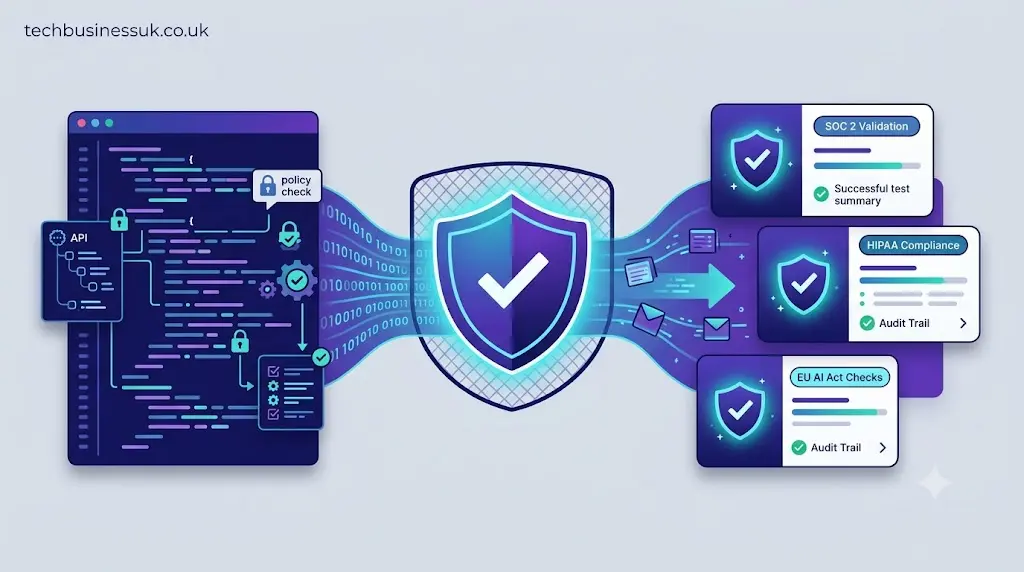
compliance testing
A single failed regulatory audit can halt product deployments, trigger massive financial penalties, and destroy corporate reputation overnight. Engineering teams routinely ship features rapidly, only to discover late in the release cycle that an unencrypted endpoint or flawed audit logging routine violates federal law. Fixing security oversights after production deployment costs exponentially more than catching them during initial development.
To maintain development velocity without introducing existential legal risk, modern software engineering teams must treat regulatory requirements as continuous, automated software assertions.
This comprehensive guide demonstrates how to build an automated compliance testing framework across your REST APIs, microservices, cloud infrastructure, and emerging AI workloads.
TL;DR: Automated Compliance Testing
- Compliance testing continuously verifies that software applications, API schemas, and data pipelines adhere strictly to legal, privacy, and industry standards.
- Shift left compliance strategies move regulatory validation directly into developer workflows using Policy-as-Code engines like Open Policy Agent (OPA).
- High-stakes frameworks—including SOC 2, ISO 27001, HIPAA, and the EU AI Act—demand automated evidence collection, deterministic access controls, and strict payload encryption.
- API endpoints are the primary audit vulnerability; modern test runners must enforce strict schema validation, token authorization, and payload sanitization to prevent catastrophic leaks.
What is Compliance Testing in Software Engineering?
Compliance testing in software engineering is the systematic, repeatable verification that an application, its underlying architecture, and its data handling practices adhere strictly to explicit regulatory, legal, and security policy standards.
Unlike conventional functional QA that evaluates whether a feature works as designed, regulatory compliance testing in software evaluates whether the system operates within legally permissible and secure boundaries.
+-----------------------------------------------------------------------+
|                    CI/CD BUILD PIPELINE                               |
+-----------------------------------------------------------------------+
|  [ Code Commit ] --> [ Policy as Code (OPA) ] --> [ API Schema Check ]|
|                                                                 |     |
|                                                                 v     |
|  [ Audit Log Generated ] <-- [ Security Scans ] <-- [ Automated Tests ]|
+-----------------------------------------------------------------------+
Integrating compliance testing in software engineering shifts regulatory checks from manual, annual spreadsheet audits into real-time code reviews. Developers receive immediate feedback on security policies every time they push a branch or open a pull request.
Regulatory vs. Industry Compliance Frameworks
Modern software applications often must comply simultaneously with two distinct categories of standards:
| Standard Type | Key Examples | Primary Focus | Enforcement Mechanisms |
|---|---|---|---|
| Regulatory (Legal) | HIPAA, GDPR, EU AI Act | Data privacy, consumer consent, system safety, bias mitigation | Government fines, operating bans, criminal liability |
| Industry (Certification) | SOC 2, ISO 27001, PCI DSS | Information security management, operational availability, access control | Loss of enterprise contracts, failed vendor audits |
Meeting these requirements requires translating abstract legal texts into deterministic test suites. Engineering leads must define regulatory boundaries alongside baseline functional vs non-functional requirements during initial system design.
Shift Left Compliance Strategies vs. Post-Deployment Audits
Traditional compliance relies on retrospective, point-in-time security audits. External auditors inspect static architecture diagrams and review sample server logs months after code has shipped to production. This reactive approach fails completely in modern cloud-native environments where teams deploy updates multiple times a day.
TRADITIONAL COMPLIANCE:
[ Code Dev ] ──> [ Deployment ] ──> [ 12 Months Pass ] ──> [ Manual Audit Failure! ]

SHIFT LEFT COMPLIANCE:
[ Code Dev ] ──> [ IDE/Pre-Commit OPA ] ──> [ CI/CD Test Gate ] ──> [ Secure Deployment ]
Adopting shift left compliance strategies embeds policy enforcement directly into IDE plugins, pre-commit hooks, and CI/CD pipelines. Catching non-compliant Terraform configurations, unencrypted S3 buckets, or permissive API endpoints at compile time guarantees continuous readiness for api security testing and formal audits.
Key Regulatory & Security Standards to Test
Every application processing sensitive user data requires specialized automated test suites tuned to its governing standard.
                            +--------------------------+
                            | Core Compliance Domains  |
                            +--------------------------+
                                         |
         +-------------------------------+-------------------------------+
         |                               |                               |
         v                               v                               v
+------------------+           +------------------+           +------------------+
|  SOC 2 Type II   |           |    ISO 27001     |           |   HIPAA Health   |
| Continuous Access|           | Cryptographic    |           | Data Encryption  |
| Control Checks   |           | Key Enforcement  |           | & PII Scrubbing  |
+------------------+           +------------------+           +------------------+
SOC 2 Compliance Testing for Software Systems
Achieving SOC 2 compliance testing for software systems requires demonstrating continuous operational control across five Trust Services Criteria: Security, Availability, Processing Integrity, Confidentiality, and Privacy.
To automate SOC 2 verification across your infrastructure:
- Access Control Checks: Assert that administrative routes require Multi-Factor Authentication (MFA) and enforce strict Role-Based Access Control (RBAC).
- Audit Logging Tests: Verify that every user authentication, database read/write, and privilege escalation fires an immutable audit log entry.
- Automated Recovery Asserts: Execute automated nightly backup scripts to prove system state can be restored without data corruption.
ISO 27001 Security Compliance Testing
ISO 27001 security compliance testing focuses on validating an organization’s Information Security Management System (ISMS). Technical safety controls must operate properly across all active microservices.
Your automated test runners must verify that data at rest uses AES-256 encryption and that network traffic enforces TLS 1.3. Aligning automated policy checks with standard NIST SP 800-53 security controls streamlines technical audits.
HIPAA Compliance Testing for Healthtech Applications
Healthtech platforms handling Protected Health Information (PHI) must adhere strictly to US federal privacy regulations. Performing HIPAA compliance testing for healthtech applications requires validating end-to-end data isolation and sanitization.
+--------------------------------------------------------------------------+
|                     HIPAA API AUTOMATED TEST FLOW                        |
+--------------------------------------------------------------------------+
|  [ API Request Payload ] --> [ PII / PHI Detector Routine ]               |
|                                       |                                  |
|                                       v                                  |
|  [ PASS ] Payload Masked <-- [ Encryption Verification ]                 |
|  [ FAIL ] Plaintext Leak --> [ Trigger Automated Audit Alert ]           |
+--------------------------------------------------------------------------+
Integration test suites must intercept outgoing payloads to confirm that PHI fields (e.g., Social Security numbers, medical record IDs, full names) are masked or encrypted before transmission.
Modern Frameworks: AI Compliance & EU Regulations
As machine learning models take over enterprise decision-making, compliance testing expands beyond network security into algorithmic transparency, dataset safety, and drift detection.
AI Compliance Testing Frameworks & Governance
Deploying predictive models or LLMs requires specialized ai compliance testing frameworks that run safety and quality assertions in parallel with traditional unit tests.
Automated pipelines feed benchmark datasets into live model endpoints to evaluate drift, hallucinations, and safety violations. Integrating a dedicated llm evaluation framework ensures model outputs remain within approved compliance and fairness parameters.
Testing Software for EU AI Act Compliance
The landmark EU Artificial Intelligence Act imposes mandatory legal requirements on high-risk AI applications. Engineering teams must start testing software for eu ai act compliance to avoid severe penalties (up to €35M or 7% of global annual turnover).
                  +--------------------------------------+
                  |   EU AI Act Risk Classification      |
                  +--------------------------------------+
                                     |
         +---------------------------+---------------------------+
         |                                                       |
         v                                                       v
+----------------------------------+           +----------------------------------+
|      High-Risk System Tier       |           |     Minimal Risk System Tier     |
+----------------------------------+           +----------------------------------+
| * Mandatory Human-in-the-Loop    |           | * Standard Data Quality Scans    |
| * Real-time Logging Verification |           | * Basic Transparency Disclosures |
| * Continuous Drift & Bias Checks |           | * Basic API Contract Validation  |
+----------------------------------+           +----------------------------------+
High-risk AI systems (e.g., automated hiring tools, credit scoring algorithms, biometric sorting) must pass rigorous automated checks:
- Human-in-the-Loop Override Verification: Test that human operators can halt AI execution loops instantly.
- Transparency Marking Checks: Assert that synthetic or generated outputs include clear, machine-readable transparency identifiers.
- Code Provenance Audits: Scan repositories to identify and remediate AI-generated code security risks before submitting technical documentation to European regulatory bodies.
How to Perform Compliance Testing in APIs
APIs represent the largest attack surface in modern enterprise architectures. A single unvalidated endpoint can expose millions of database records, breaching regulatory compliance instantly. Knowing how to perform compliance testing in apis is essential for securing distributed applications.
Schema Validation in API Compliance Testing
Enforcing strict contract specifications prevents unauthorized parameters from bypassing application validation layers. Using automated schema validation in api compliance testing blocks malformed payloads before they reach internal databases.
+---------------------------------------------------------------------------+
|                    REST API SCHEMA COMPLIANCE CHECK                       |
+---------------------------------------------------------------------------+
|  Incoming HTTP POST Payload:                                              |
|  { "user_id": 104, "role": "admin" }                                      |
|                                                                           |
|  OpenAPI 3.1 Contract Definition Validation:                              |
|  Assert "role" parameter in client POST request payload --> FAIL          |
|                                                                           |
|  Result: HTTP 422 Unprocessable Entity (Prevents Privilege Escalation)    |
+---------------------------------------------------------------------------+
API testing engines validate OpenAPI/Swagger schemas to verify that incoming payloads match strict type definitions, required headers, and key structures. Enforcing contract rules at the gateway layer strips untrusted parameters immediately.
API Security Compliance Testing Tools & Payloads
Automating security compliance requires executing aggressive penetration scripts during every build. Modern api security compliance testing tools allow engineers to run fuzzing tests, authentication checks, and payload injection scans inside staging environments.
Test runners must confirm that endpoints return explicit HTTP 401 Unauthorized responses for missing tokens and HTTP 403 Forbidden responses for insufficient user scopes. Integrating these checks into your standard suite of api testing tools prevents critical vulnerabilities like Broken Object Level Authorization (BOLA).
Policy as Code: Building an Automated Compliance Testing Framework
Manual compliance checklists create bottleneck friction and allow human error to slip into production. Building a scalable automated compliance testing framework using Policy as Code (PaC) defines security rules as version-controlled, executable code.
                      +----------------------------------+
                      |      POLICY AS CODE FLOW         |
                      +----------------------------------+
                                       |
     +---------------------------------+---------------------------------+
     |                                 |                                 |
     v                                 v                                 v
+------------------------+  +------------------------+  +------------------------+
|  Terraform Infrastructure| |  Kubernetes Manifests   | |   API Gateway Routing  |
+------------------------+  +------------------------+  +------------------------+
     |                                 |                                 |
     +---------------------------------+---------------------------------+
                                       |
                                       v
                      +----------------------------------+
                      |   Open Policy Agent (OPA Engine) |
                      |    - Evaluates Rego Policies     |
                      |    - Emits Pass / Fail Assert    |
                      +----------------------------------+
Open Policy Agent (OPA) Compliance Testing
Open Policy Agent (OPA) is an open-source, general-purpose policy engine that standardizes policy enforcement across cloud-native environments. Conducting open policy agent opa compliance testing allows teams to write declarative security assertions using the Rego query language.
Below is a complete, production-ready Rego policy that validates AWS S3 storage buckets for SOC 2 encryption and public access rules:
# Sample OPA Rego Policy for SOC 2 Encryption & Public Access Compliance
package compliance.security

default allow_deployment = false

# Allow deployment only if S3 buckets enforce AES-256 encryption and block public access
allow_deployment {
    input.resource_type == "aws_s3_bucket"
    input.attributes.server_side_encryption_configuration != null
    input.attributes.block_public_acls == true
    input.attributes.block_public_policy == true
}

# Generate audit violation log when non-compliant resources are detected
deny[msg] {
    input.resource_type == "aws_s3_bucket"
    not input.attributes.block_public_acls
    msg := sprintf("SOC 2 VIOLATION: S3 Bucket '%v' must block public ACLs.", [input.name])
}
By embedding policy as code for automated compliance testing directly into your deployment pipeline, non-compliant infrastructure changes are blocked before provisioning occurs.
Executing End-to-End Software Compliance Testing
Achieving complete regulatory coverage requires executing end to end software compliance testing across all stages of the software development lifecycle (SDLC).
SDLC COMPLIANCE PIPELINE:
[ Code Commit ] ──> [ Static Policy Scan (OPA) ] ──> [ API Schema Validation ] ──> [ Evidence Artifact Generation ]
- Pre-Commit Checks: Developers run local OPA rules to validate configuration files, Dockerfiles, and API contracts.
- CI Pipeline Testing: Automated runners execute unit tests, security scans, and schema checks against pull requests.
- Staging Environment Scans: Dynamic API security tools test endpoints for authorization bypasses and data leakage.
- Audit Evidence Generation: The build pipeline automatically exports cryptographically signed logs, storing proof of compliance for external auditors.
Configuring these stages within a robust pipeline architecture ensures seamless, hands-free audit readiness.
Compliance Testing Checklist for Enterprise Apps
Use this operational checklist to establish software compliance testing best practices across your organization:
- $$$$ Implement Policy-as-Code Engine: Deploy Open Policy Agent (OPA) or AWS CloudFormation Guard in pre-commit hooks and CI/CD pipelines.
- $$$$ Enforce API Schema Contracts: Validate incoming and outgoing REST/gRPC API payloads against strict OpenAPI 3.1 specifications.
- $$$$ Automate Access Control Audits: Verify that administrative interfaces enforce Multi-Factor Authentication (MFA) and granular Role-Based Access Control (RBAC).
- $$$$ Encrypt Data at Rest and in Transit: Assert that storage volumes use AES-256 bit encryption and network calls require TLS 1.3.
- $$$$ Sanitize Log Streams: Implement automated regex scrubbers to prevent PII, tokens, and passwords from reaching centralized log storage.
- $$$$ Establish AI Model Safety Gates: Validate machine learning model endpoints against drift, toxicity, and EU AI Act transparency rules.
- $$$$ Automate Audit Artifact Export: Generate timestamped, tamper-evident logs for every build to streamline annual compliance reviews.
Conclusion
Automated compliance testing transforms regulatory compliance from a chaotic annual audit into an ongoing engineering discipline. By combining Policy as Code, strict API schema validation, and automated evidence collection, software organizations can ship features rapidly while maintaining total audit readiness.
As regulatory frameworks like the EU AI Act expand globally, teams that embed automated policy checks directly into their build pipelines will innovate faster, eliminate legal exposure, and secure enterprise customer trust.
Frequently Asked Questions
What is compliance testing in software engineering?
Compliance testing in software engineering is the automated process of validating that an application, its system architecture, and its data management practices comply with explicit legal, privacy, and industry standards (e.g., SOC 2, HIPAA, GDPR, ISO 27001).
How does compliance testing differ from functional testing?
Functional testing checks whether software features perform their intended user tasks correctly. Compliance testing verifies whether the system adheres to regulatory, security, and data privacy constraints regardless of user functionality.
What are shift left compliance strategies?
Shift left compliance strategies move regulatory and policy validation earlier in the development lifecycle—embedding automated checks into IDEs, pull requests, and CI/CD builds rather than waiting for post-deployment security audits.
Why is schema validation important in API compliance testing?
Schema validation in api compliance testing enforces strict contract definitions on API payloads. It strips unexpected fields, prevents privilege escalation attacks, and ensures sensitive data parameters are structured securely before processing.
What is Policy as Code (PaC) in automated compliance testing?
Policy as Code expresses compliance rules, access boundaries, and security controls as version-controlled code. Tools like Open Policy Agent (OPA) evaluate these code-based policies automatically during software builds.
How do modern frameworks test software for EU AI Act compliance?
Testing software for eu ai act compliance involves running automated evaluations on AI models to measure output drift, bias, transparency identifiers, and human-in-the-loop override controls required for high-risk AI deployments.
About the Author

1 thought on “Compliance Testing in Software Engineering: Automated Security & API Standards Guide”