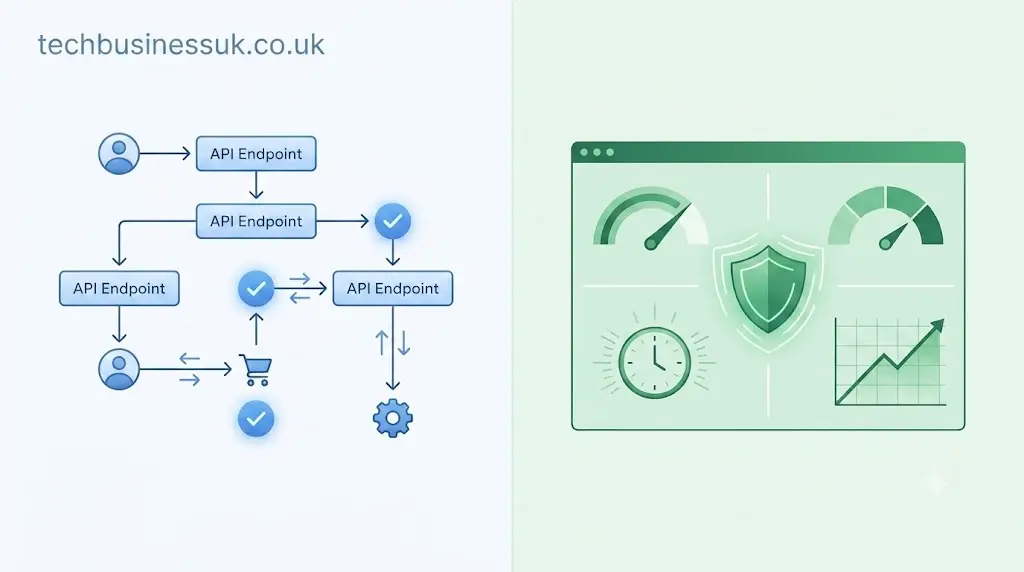
Every API architecture review eventually hits the same wall: someone asks whether a requirement is functional or non-functional, and the room goes quiet. It sounds like a simple classification exercise. It isn’t. Get it wrong, and you end up with an API that works perfectly in every demo and collapses the moment real traffic hits it.
This guide walks through functional vs non-functional requirements the way senior API architects actually think about them — not as a textbook definition, but as a lens for making better design decisions across REST, GraphQL, gRPC, and microservice architectures.
Strategy 1: Dissect Features That Straddle Both Categories (Functional Requirement vs Non-Functional Requirement)
Why This Debate Exists
Most articles on functional vs non-functional requirements oversimplify the discussion into a neat two-column list. That works for a university course. It falls apart the moment you’re designing a real distributed system, where a single feature can straddle both categories at once.
The confusion usually comes from mixing two different perspectives. A project management view asks, “what did we deliver?” An architectural view asks, “what does this component actually guarantee?” Those two questions don’t always produce the same answer — which is exactly why experienced engineers still disagree with each other during API design reviews, years into their careers.
Example: Authentication in a REST API
Take a simple login endpoint:
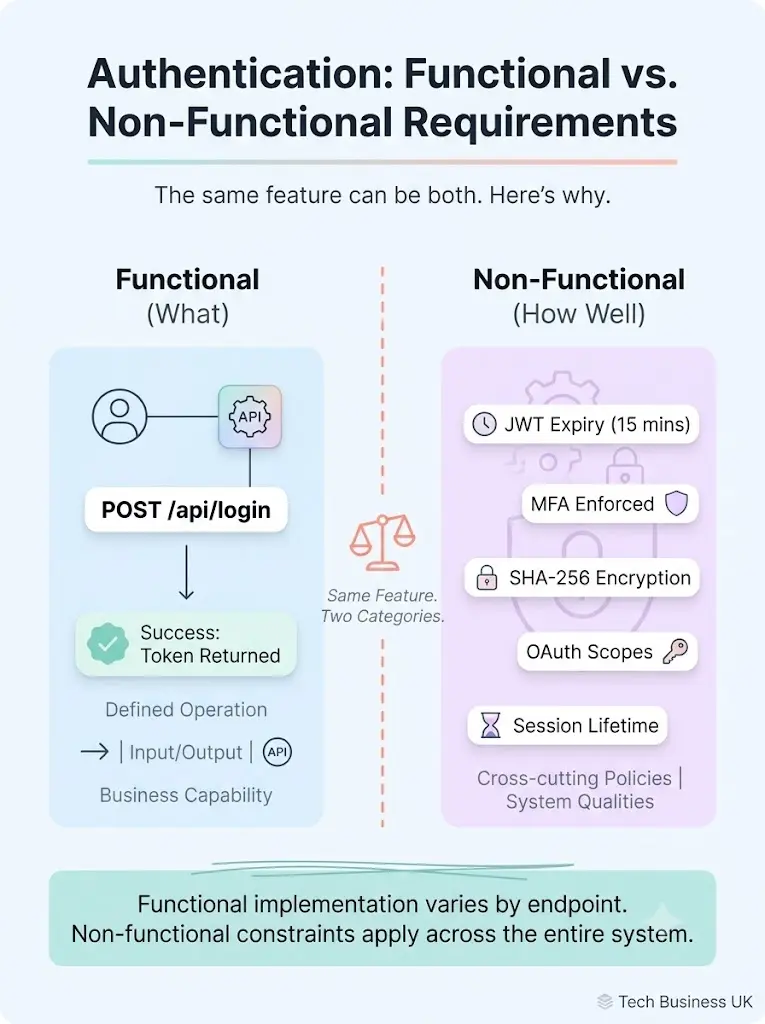
POST /api/loginThe endpoint itself — accepting credentials, returning a token — is clearly a functional capability. It’s a defined operation with a defined output.
But authentication policy is a different animal entirely. JWT expiry windows, multi-factor enforcement, OAuth scopes, session lifetime — these describe qualities of the system, not actions it performs. That’s a non-functional, security-driven constraint layered on top of a functional feature.
Authorization rules blur the line even further. “Only admins can delete a resource” sounds like business logic (functional), but it’s often implemented as a cross-cutting policy enforced platform-wide (non-functional in practice, even if functional in intent).
This confusion is a major reason why the OWASP API Security Top 10 consistently highlights issues like Broken Object Level Authorization and Broken Function Level Authorization as critical security risks. These are classic examples of requirements that are functional in implementation but carry profound non-functional security implications.
More Blurry Examples
Rate limiting. Is capping requests at 100 per minute per API key a feature, a performance safeguard, or a security control? Honestly, it’s all three depending on which team you ask — product sees it as a plan-tier feature, SRE sees it as a stability mechanism, and security sees it as abuse prevention.
GDPR compliance. A data-deletion endpoint is functional — it’s a defined operation with a defined outcome. But the underlying retention policy governing how long data can legally persist before deletion is a non-functional, compliance-driven constraint.
Encryption. Encrypting specific sensitive fields might be a functional data-handling rule. Enforcing TLS across every connection, or encrypting an entire database at rest, is a non-functional platform-wide guarantee.
Your Takeaway
The same feature frequently contains both functional and non-functional requirements layered on top of each other. This becomes far easier to untangle when you view it through an API architecture lens — endpoints, contracts, and platform guarantees — rather than a generic project management lens of “features vs quality.”
Functional vs Non-Functional Requirements in Modern API Architecture
Why “What vs How” Isn’t Enough
The textbook shorthand — functional requirements define what the system does, non-functional requirements define how well it does it — is a reasonable starting point. It breaks down quickly in distributed systems, where a single business capability might be implemented across REST endpoints, GraphQL resolvers, gRPC services, event-driven consumers, and an API gateway simultaneously, each with its own functional and non-functional considerations.
Functional Requirements Answer
Functional requirements answer concrete questions: What API endpoints exist? What operations are supported? What business logic executes, and under which conditions?
The same underlying capability often looks different depending on the protocol, even though it satisfies the same functional requirement:
-
REST:
POST /api/users— creates a user -
GraphQL:
mutation { createUser(...) } }— creates the same user through a different interface -
gRPC:
CreateUser()— performs identical business functionality over a binary protocol
Same functional requirement. Three completely different implementations.
Non-Functional Requirements Answer
Non-functional requirements ask a different kind of question entirely. Instead of “what should happen?”, they ask “how well must it happen?” That covers response time, reliability, availability, scalability, security, and observability — qualities that apply across every endpoint and protocol, not to any single one of them.
Strategy 2: Map Functional Requirements to Endpoints and Domain Logic
CRUD Operations
The clearest functional requirements map directly to standard operations:
-
POST
/users— creates a user -
GET
/users/{id}— returns user information -
PUT
/users/{id}— updates user data -
DELETE
/users/{id}— deletes a user
Business Rules
Functional requirements also capture domain-specific logic — rules that only make sense within your particular business. A few common patterns: only premium users can generate certain reports, orders above a set threshold require manager approval, and inactive users are blocked from authenticating regardless of valid credentials.
Validation Rules
Input validation is functional too — an email must be unique, a password must meet complexity requirements (uppercase, lowercase, a number, a special character). These are concrete, testable rules with a clear pass/fail outcome.
Database Requirements
Some functional requirements span multiple operations executed as a single unit. Creating a customer, for instance, might require inserting a customer record, a profile record, and an audit log entry — all inside one transaction, so a partial failure never leaves the system in an inconsistent state.
A functional requirement worth calling out on its own: idempotency. On financial transaction endpoints — POST /api/v1/payments, for example — enforcing an X-Idempotency-Key header prevents the same payment from being processed twice if a client retries a request after a timeout. It’s easy to overlook because it doesn’t show up in a happy-path demo, but it’s a functional contract with direct financial consequences if it’s missing.
Strategy 3: Define Non-Functional Requirements That Break Production
Rather than listing dry definitions, it’s more useful to look at what each non-functional requirement actually protects against in production.
Performance — a target like “95% of API requests complete within 200ms” gives engineers something concrete to design and test against, rather than a vague notion of “fast.”
Scalability — If the system needs to handle 50,000 concurrent users, you have to size the clusters upfront. The alternative is hitting an infrastructure wall the first time traffic surges.
Reliability — Meeting a 99.99% uptime target requires designing active-active redundancy and failover paths right into the service layer.
Availability — High-availability SLAs rule out single-region infrastructure. You need multi-region deployments backed by automated DNS or load-balancer failover.
Security — Functional login endpoints rely on heavy backend groundwork: OAuth protocols, JWT validation, mutual TLS, and secure secrets management.
Observability — Users never see structured logs, distributed tracing, or correlation IDs, but you can’t debug a production outage without them.
Maintainability— A clean API versioning policy and backward-compatibility rules keep your service evolving without breaking client applications.
Disaster recovery — recovery time objectives, recovery point objectives, database replication, and backup strategy define how much data loss and downtime is acceptable when something goes seriously wrong.
A pattern worth understanding at a deeper level: tail latency amplification. In a distributed system, a single slow upstream microservice can degrade the response time of an entire API gateway aggregation call — even if every other service involved is performing well. This is precisely why senior engineering teams pair non-functional requirements like circuit breakers and bulkhead isolation patterns with strict deadline propagation across service calls, rather than relying on simple timeouts alone. A timeout tells one service to give up. A deadline tells every service in the call chain how much total time budget remains.
Functional vs Non-Functional Requirements Comparison Matrix
| Attribute | Functional Requirement | Non-Functional Requirement |
|---|---|---|
| Purpose | Defines what the system does | Defines how well the system performs |
| API Example | POST /orders |
Processes 5,000 orders/minute |
| Testing Type | Unit, integration, contract testing | Load, stress, chaos, security testing |
| Success Criteria | Correct output/response | Meets performance/reliability targets |
| Failure Impact | Logic bug, incorrect data state | Outage, cascading failure |
| Primary Ownership | Product managers, domain engineers | Architects, SRE/platform teams |
Strategy 4: Align Your CI/CD and Testing Pipeline with Requirement Types
Selecting the right API Testing Tools depends heavily on which category of requirement you’re actually validating — business behavior, or system characteristics like latency, throughput, and resilience under load.
Testing Functional Requirements
Functional requirements are validated through unit tests, integration tests, API contract testing, schema validation, consumer-driven contracts, GraphQL schema tests, database assertions, and authentication flow tests. A typical example: send a request to POST /users and assert the response returns 201 Created with the expected payload shape.
Testing Non-Functional Requirements
Non-functional requirements need an entirely different testing approach: performance testing, stress testing, spike testing, scalability testing, load testing, chaos engineering, and security testing, including penetration testing. A typical benchmark: simulate 1,000 concurrent users and confirm average latency stays under 200ms.
CI/CD Pipeline Integration
Not every test belongs at every stage. Functional contract tests generally run on every pull request. Load and stress tests are often too expensive to run on every commit, so they’re scheduled nightly or reserved for release-candidate builds. Chaos experiments and full-scale resilience testing typically happen in staging environments that closely mirror production, on a scheduled cadence rather than continuously.
Why Teams Often Test Functional Requirements Better Than Non-Functional Ones
Here’s the uncomfortable pattern that shows up across the industry: most production outages happen despite every functional test passing. Functional bugs get caught because they’re easy to write assertions for — did the response match the expected shape, yes or no. Non-functional failures are harder to catch because they only appear under conditions that staging environments rarely replicate: real concurrency, real network latency, real failure combinations happening simultaneously.
Real-World Failure: When Missing Non-Functional Requirements Caused Production Outages
Consider a common scenario: an e-commerce platform launches a flash sale. Every functional test passes. Every endpoint behaves exactly as specified — create an order, apply a discount, process a payment, all functionally correct.
What wasn’t tested: what happens under real concurrent load. No load testing had been performed. No autoscaling policy was configured. No rate limiting was in place at the gateway. The moment traffic spiked, the database connection pool was exhausted by simultaneous order attempts, a cache stampede hit the product catalog service as thousands of cache entries expired at once, and the API gateway itself became overwhelmed trying to queue requests it had no mechanism to throttle.
The result: API latency exceeded 20 seconds under load, payment requests began timing out, and — worst of all — some customers were charged multiple times as retry logic on the client side resent payment requests that appeared to have failed. Revenue was lost and trust was damaged, despite the application being functionally flawless on paper.
The lesson here generalizes well beyond this one scenario: a system can be 100% functionally correct and still fail catastrophically if its non-functional requirements are undefined, untested, or simply assumed rather than verified.
Decision Matrix: Is This Requirement Functional or Non-Functional?
| Requirement | Classification | Why |
|---|---|---|
| User can reset password | Functional | Defines a capability |
| Password reset completes in under 3 seconds | Non-functional | Performance target |
| GraphQL query returns user profile | Functional | Defines behavior |
| GraphQL supports 10,000 concurrent users | Non-functional | Scalability target |
| OAuth authentication | Functional capability | Implements a feature |
| OAuth tokens expire after 15 minutes | Non-functional | Security requirement / policy |
DELETE /users permanently removes data |
Functional | Defines behavior |
| Deleted data satisfies GDPR retention policy | Non-functional | Governance / compliance constraint |
Use this as a working checklist during architecture reviews: if a requirement describes an action the system performs, it’s functional. If it describes a quality, limit, or guarantee that applies across many actions, it’s non-functional. Requirements that resist a clean answer — like authentication or rate limiting — are usually hybrid, and worth splitting explicitly into their functional and non-functional components rather than forcing a single label.
Strategy 5: Apply the Decision Matrix and SMART Criteria to Classify Ambiguous Requirements
Vague requirements are the root cause of most functional-vs-non-functional confusion. Compare these two ways of writing the same intent:
Bad: “The API should be fast.”
Good: “95% of GET requests complete within 150ms under 2,000 concurrent users.”
Bad: “The API should be secure.”
Good: “Every endpoint requires OAuth 2.0 authentication with JWT validation and role-based authorization.”
The difference isn’t stylistic — it’s measurability. A requirement you can’t test isn’t really a requirement; it’s a hope. Framing requirements as SMART criteria, backed by concrete Service Level Indicators, Service Level Objectives, and Service Level Agreements, turns vague intentions into things your test suite can actually verify.
Conclusion: Both Requirement Types Define System Quality
Functional requirements define features, business capabilities, and user interactions — the things your API is supposed to do. Non-functional requirements define reliability, performance, security, and scalability — how well your API keeps doing them under real-world conditions.
Neither category is optional, and neither is more important than the other. A modern API platform needs both designed, documented, tested, monitored, and continuously validated as the system evolves.
Whether you’re validating API behavior or benchmarking performance under load, choosing the right API Testing Tools is essential for ensuring both functional correctness and long-term system reliability.
Frequently Asked Questions
What is the difference between functional and non-functional requirements?
Functional requirements define specific actions and capabilities a system must perform — endpoints, operations, business rules. Non-functional requirements define the qualities under which those actions must be performed — speed, reliability, security, and scale.
Can authentication be both functional and non-functional?
Yes. Implementing an authentication endpoint is a functional capability. Token lifetime, encryption standards, multi-factor enforcement, and access control policies layered around that endpoint are non-functional quality attributes.
Why are non-functional requirements often missed?
They’re frequently missed due to a focus on visible feature delivery, unclear ownership between product and engineering, a lack of measurable acceptance criteria, and inadequate performance or resilience testing before launch.
How do you test non-functional requirements?
Through load testing, stress testing, scalability testing, resilience and chaos testing, security testing, and observability validation — approaches focused on system behavior under stress rather than correctness of a single response.
Which is more important: functional or non-functional requirements?
Neither. A production-ready API has to satisfy both. A feature that works correctly but collapses under load, violates a compliance policy, or exposes a security gap isn’t actually production-ready.
Are security requirements functional or non-functional?
Both, depending on which layer you’re describing. Security features — login, multi-factor authentication, role-based access control — are functional capabilities. Security properties — confidentiality, integrity, encryption standards, and resilience against attack — are non-functional requirements.
About the Author

1 thought on “Functional vs Non-Functional Requirements: 5 Proven API Architecture Strategies”