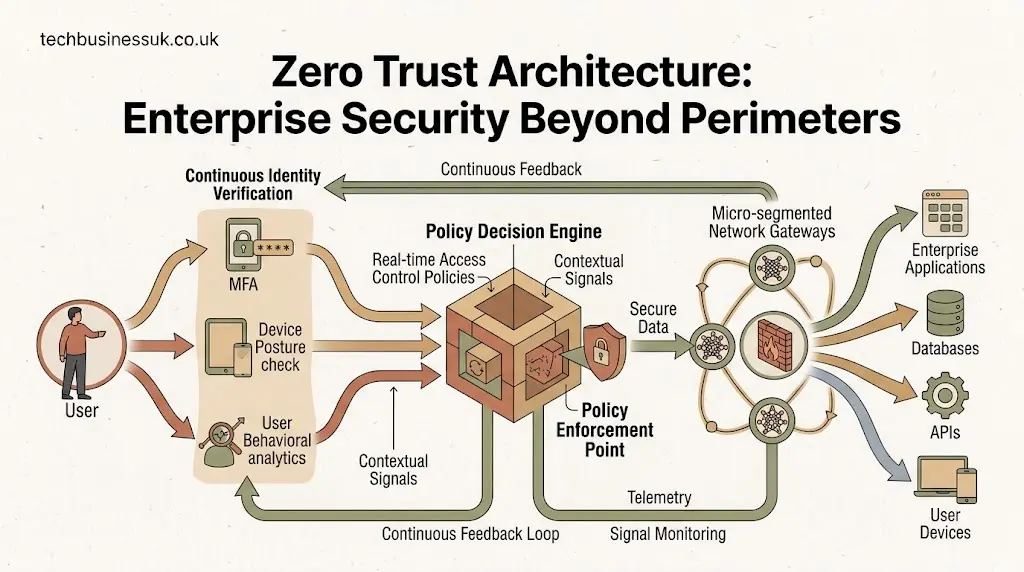
Legacy network security was built on a simple assumption: inside the perimeter is safe; outside is hostile. For decades, enterprise IT relied on castle-and-moat architectures. Organizations deployed firewalls, intrusion prevention systems, and Virtual Private Networks (VPNs) at corporate boundaries to inspect incoming traffic. Once a user or device authenticated at the outer boundary, the network granted them broad implicit trust across internal assets.
Modern software architecture has shattered that boundary. With multi-cloud infrastructure, remote workforces, microservice topologies, third-party integrations, and edge computing, there is no single physical boundary to defend. Attackers no longer break into corporate networks solely by bypassing firewalls; they walk in using stolen credentials, compromised API tokens, or supply-chain vulnerabilities.
A single compromised set of credentials inside an implicitly trusted network enables lateral movement. Attackers can scan internal subnets, discover unpatched databases, elevate permissions, and exfiltrate sensitive enterprise data unnoticed.
Zero Trust Architecture (ZTA) addresses these structural flaws. Defined by the National Institute of Standards and Technology (NIST) in Special Publication 800-207, zero trust strips away location-based trust. It shifts security enforcement from macro-network perimeters directly to individual identities, workloads, devices, and sessions. The foundational directive of zero trust is simple: never trust, always verify.
                     +---------------------------------------+
                     |    Legacy Castle-and-Moat Model       |
                     |  [ Perimeter ] ---> Wide Access Inside |
                     +---------------------------------------+
                                         |
                                         v
                     +---------------------------------------+
                     |    Zero Trust Architecture Model      |
                     |  Verify Every User, Device & Session  |
                     +---------------------------------------+
What is Zero Trust Architecture? Core Principles Explained
Transitioning from legacy infrastructure to a zero trust posture requires moving away from static network location assumptions. Security teams must deploy dynamic access policies evaluated continuously against real-time signals..
                                [ REQUEST ]
                                     |
                        +-------------------------+
                        |   Identity & Context    |
                        |      Verification       |
                        +------------+------------+
                                     |
                  +------------------+------------------+
                  |                  |                  |
                  v                  v                  v
          +---------------+  +---------------+  +---------------+
          |  Continuous   |  |     Least     |  |    Assume     |
          | Verification  |  |   Privilege   |  |    Breach     |
          +---------------+  +---------------+  +---------------+
Three foundational zero trust principles form the baseline of this strategy:
1. Verify Explicitly
Always authenticate and authorize based on all available context signals. System access decisions must never rely solely on an IP address or internal network location. Every access request requires explicit verification of user identity, active device compliance, software patch levels, geographical location, threat intelligence telemetry, and data sensitivity.
2. Use Least-Privilege Access
Limit entity access using Just-In-Time (JIT) and Just-Enough-Access (JEA) models. Never grant standing administrative rights or open-ended network access. Granular, policy-driven rules isolate users, workloads, and services so they can access only the specific resources needed to execute a single task.
3. Assume Breach
Operate under the premise that internal systems are already compromised. Minimize the “blast radius” of potential incidents by micro-segmenting networks, isolating application components, encrypting all internal communications end-to-end, and using real-time security analytics to catch anomalies.
Managing zero trust identity is the operational anchor of this model. Every human user, service account, microservice, and IoT endpoint must establish identity proofing continuously. When evaluating automated components or third-party service pipelines, using specialized api testing tools helps maintain underlying code integrity and validates authentication endpoints before deploying to production.
The NIST SP 800-207 Zero Trust Architecture Standard
To standardize enterprise deployments, federal agencies and technology leaders look to the nist sp 800-207 zero trust architecture official reference model published by NIST. This framework establishes standard terminology, structural control planes, and core logical components needed for zero trust.
The Seven Tenets of Zero Trust
NIST SP 800-207 outlines seven core tenets governing system design:
- All data sources and computing services are resources: Whether an asset is a local server, cloud database, SaaS application, or edge device, it must be treated as a discrete resource.
- All communication is secured regardless of network location: Internal transit paths receive the same cryptographic protections (such as mutual TLS) as untrusted public networks.
- Access to resources is granted on a per-session basis: Authorization granted for one session does not automatically extend to future sessions or adjacent resources.
- Access is determined by dynamic policy: Policy engines evaluate client identity, device state, behavioral telemetry, and environmental attributes before granting resource access.
- Asset integrity and security posture are continuously monitored: Owned and associated endpoints must undergo real-time health checks, patch checks, and endpoint detection monitoring.
- Authentication and authorization are dynamic and strictly enforced: Credentials and permissions are evaluated continuously throughout active connections, not just at initial login.
- Collect telemetry to improve security posture: Enterprises must aggregate logs, traffic data, and access metrics across their entire infrastructure to refine policy rules dynamically.
Architectural Breakdown: Control Plane vs. Data Plane
NIST SP 800-207 enforces a strict functional separation between the Control Plane (where policy access decisions are made) and the Data Plane (where application payload traffic flows).
+------------------------------------------------------------------+
|                          CONTROL PLANE                           |
|                                                                  |
|   +-------------------+              +-----------------------+   |
|   |   Policy Engine   |<------------>| Policy Administrator  |   |
|   +---------+---------+              +-----------+-----------+   |
|             ^                                    |               |
|             | Telemetry Signals                  | Control       |
|             v                                    v Signals       |
|   +-------------------+                                          |
|   | Trust Data Sources|                                          |
|   | (IdP, EDR, PKI)   |                                          |
|   +-------------------+                                          |
+------------------------------------------------------------------+
                                                   |
===================================================|================
                                                   v
+------------------------------------------------------------------+
|                            DATA PLANE                            |
|                                                                  |
|   +------------------+     mTLS Tunnel     +-----------------+   |
|   | Subject / Device |====================>| Policy          |   |
|   |                  |  (Encrypted Data)   | Enforcement Pt. |   |
|   +------------------+                     +--------+--------+   |
|                                                     |            |
|                                                     v            |
|                                            +-----------------+   |
|                                            | Enterprise Asset|   |
|                                            +-----------------+   |
+------------------------------------------------------------------+
1. Policy Decision Point (PDP)
The Policy Decision Point operates exclusively within the Control Plane. It acts as the brain of a Zero Trust Architecture and comprises two core logical modules:
- Policy Engine (PE): The decision-making module. It ingests enterprise security policies along with real-time telemetry from Trust Data Sources to evaluate access requests. The PE yields an absolute boolean verdict: Grant or Deny.
- Policy Administrator (PA): The execution module. Once the Policy Engine renders a decision, the PA issues control commands to configure the Policy Enforcement Point (PEP). It can generate short-lived cryptographic tokens, provision session keys, or command the PEP to open or terminate communication channels.
2. Policy Enforcement Point (PEP)
The Policy Enforcement Point operates directly within the Data Plane. The PEP intercepts, inspects, and proxies all communication between requesting endpoints and enterprise resources.
The PEP never makes policy decisions independently. Instead, it enforces commands received from the Policy Administrator. Examples of Policy Enforcement Points include Identity-Aware Proxies (IAP), API gateways, service mesh sidecar proxies (such as Envoy or Istio), and next-generation firewall agents.
3. Trust Data Sources
The Policy Engine relies on continuous context feeds from external systems to make informed decisions:
- Identity Providers (IdP): User directories, SAML/OIDC identity assertion services, and central access stores.
- Endpoint Detection and Response (EDR): Systems that report device health, operating system versions, disk encryption states, and malware indicators.
- Security Information and Event Management (SIEM): Real-time threat analytics, behavioral anomaly scores, and threat intelligence feeds.
- Public Key Infrastructure (PKI): Digital certificate management systems that issue and validate mutual TLS (mTLS) identities.
When connecting enterprise APIs to automated policy decision points, securing the control boundary is critical. To dive deeper into modern edge protections, review our detailed guide on API Gateway Security to explore token validation, payload sanitization, and OAuth integration patterns.
What to Use for Zero Trust Access Control?
Implementing robust zero trust access control requires choosing tools that evaluate identity, inspect endpoint posture, and isolate network traffic dynamically.
Organizations moving toward zero trust frequently migrate away from legacy Virtual Private Networks (VPNs) to Zero Trust Network Access (ZTNA) solutions.
Comparing VPNs vs. Zero Trust Network Access (ZTNA)
[ Legacy VPN Model ]
User ---> [ VPN Gateway ] ---> ( Complete Unsegmented Access to Internal Subnet )

[ ZTNA Model ]
User ---> [ Identity Proxy ] ---> ( Micro-Tunnel restricted strictly to App A )
                                  [ App B & Subnets Completely Hidden ]
| Security Feature | Legacy VPN | Zero Trust Network Access (ZTNA) |
| Trust Boundary | Network-level (Perimeter) | Application-level (Micro-segmented) |
| Network Visibility | Exposes full internal IP subnets upon authentication | Hides all internal networks; applications remain invisible |
| Authentication Timing | Validated once at initial connection | Evaluated continuously throughout active sessions |
| Lateral Movement | High risk; compromised credentials unlock adjacent systems | Minimal risk; users access explicitly authorized apps only |
| Device Context | Minimal or static posture checks | Continuous monitoring of endpoint compliance and health |
Key Modules for Zero Trust Access Control
- Phishing-Resistant Identity Providers (IdP): Implement hardware-backed FIDO2/WebAuthn security keys alongside Single Sign-On (SSO) to mitigate credential theft.
- Software-Defined Perimeters (SDP): Deploy lightweight client agents or browser-based proxies that establish outbound-only tunnels to ZTNA gateways. This keeps backend applications completely invisible to public internet scans.
- Micro-segmentation Platforms: Divide internal workloads, cloud containers, and virtual machines into isolated logical zones. Micro-segmentation prevents an adversary from moving laterally across internal subnets if an endpoint is compromised.
- Machine-to-Machine Authentication (mTLS & SPIFFE): Enforce cryptographic identity verification for internal API calls, microservices, and background scripts.
To examine how attackers target automated API endpoints—and how modern zero trust controls prevent exploitation—read our comprehensive guide on API Security Risks.
For formal specifications, review official publications from the NIST CSRC SP 800-207 Specification and the federal guidance outlined in the CISA Zero Trust Maturity Model.
5-Phase Zero Trust Implementation Roadmap
Transitioning an organization to Zero Trust Architecture is a multi-year strategic effort. Attempting to overhaul an entire enterprise footprint overnight creates friction and risks service disruptions.
Following a structured 5-phase migration roadmap helps security teams build maturity systematically:
+-------------------------------------------------------------------+
|               5-PHASE ZERO TRUST IMPLEMENTATION ROADMAP           |
+-------------------------------------------------------------------+
| Phase 1: Asset Identification & Data Mapping                      |
| Phase 2: Identity Hardening & Phishing-Resistant MFA              |
| Phase 3: ZTNA Pilot & VPN Decommissioning                         |
| Phase 4: Workload Micro-Segmentation & mTLS Deployment            |
| Phase 5: Continuous Monitoring & Policy Automation                |
+-------------------------------------------------------------------+
Phase 1: Asset Identification & Data Flow Mapping
You cannot protect what you cannot see. Begin by building a complete inventory of every enterprise asset, including managed endpoints, cloud workloads, SaaS tools, shadow infrastructure, and API endpoints. Map data interaction flows to pinpoint where sensitive enterprise assets reside and how internal applications communicate.
Phase 2: Identity Hardening & Phishing-Resistant MFA
Consolidate identity management across hybrid environments into a central Identity Provider (IdP). Mandate phishing-resistant Multi-Factor Authentication (MFA) using FIDO2 hardware keys or passkeys. Eliminate static passwords, remove hardcoded service account secrets, and adopt Role-Based (RBAC) and Attribute-Based Access Control (ABAC).
Phase 3: ZTNA Deployment & VPN Migration
Identify high-risk remote access paths and critical web applications. Deploy a Zero Trust Network Access (ZTNA) solution to proxy incoming access requests. Gradually migrate remote teams off legacy VPNs to direct application-level ZTNA tunnels, reducing your exposed public attack surface.
Phase 4: Workload Micro-Segmentation & Service Mesh Integration
Apply micro-segmentation across cloud instances, on-premises datacenters, and container clusters. Deploy service meshes (such as Istio or Linkerd) across microservice deployments to enforce cryptographic mutual TLS (mTLS) for all East-West internal network traffic.
Phase 5: Continuous Telemetry Automation & Adaptive Security
Connect Policy Enforcement Points to central SIEM and XDR automation platforms. Build automated policy rules that adjust user permissions dynamically based on real-time risk scores, anomalous login behavior, or detected threat signals.
Technical Deep-Dive: Micro-Segmentation Strategies
Micro-segmentation is a core requirement of Zero Trust Architecture. While traditional network segmentation divides a network into broad subnets using physical hardware firewalls, micro-segmentation creates granular, software-defined perimeters around individual workloads, containers, or applications.
Traditional Subnet Model (Flat):
[ Subnet A: Web Server | DB Server | App Server ]  <-- Unrestricted lateral movement

Micro-Segmented Model (Software-Defined):
[ Web Server ] <--- Isolated Tunnel ---> [ App Server ] <--- Isolated Tunnel ---> [ DB Server ]
1. Network-Based Micro-Segmentation
Network-based micro-segmentation uses Software-Defined Networking (SDN) overlays to inspect traffic at Layers 3 and 4. Network controllers apply virtual firewalls directly to virtual machine network interfaces (vNICs) or cloud security groups. This prevents workloads on the same physical host or subnet from communicating unless an explicit rule permits it.
2. Host-Based Micro-Segmentation
Host-based micro-segmentation relies on lightweight agents installed directly on host operating systems. These agents manage internal kernel-level firewalls (such as iptables or Windows Filtering Platform). Host-based enforcement provides visibility into process-level execution, ensuring that only approved binary processes can initiate network connections to backend resources.
3. Application / Service Mesh Micro-Segmentation
In modern cloud-native architectures running on Kubernetes, micro-segmentation operates at Layer 7 using a Service Mesh. Sidecar proxies process every inbound and outbound HTTP/gRPC request. Access decisions evaluate cryptographically verified workload identities (via SPIFFE/SPIRE standards) and explicit HTTP request parameters, preventing unauthorized inter-service calls.
Measuring Zero Trust Maturity & Operational KPIs
Transitioning to Zero Trust Architecture requires clear tracking metrics to evaluate security progress and measure risk reduction over time.
Tracking key performance metrics helps demonstrate the value of zero trust implementations to executive stakeholders:
| Zero Trust KPI | Metric Description | Target Outcome |
| Phishing-Resistant MFA Coverage | Percentage of user accounts secured with WebAuthn/FIDO2 hardware keys. | 100% across all workforce identity categories. |
| Exposed Public Endpoints | Total count of internal systems directly accessible via public IP addresses. | Near zero; all assets behind ZTNA proxies. |
| Mean Time to Detect (MTTD) | Average time required to spot unauthorized credential access or policy anomalies. | Reduced from days to minutes via continuous logging. |
| Mean Time to Contain (MTTC) | Average time required to isolate a compromised endpoint or revoke session tokens. | Automated containment executed within seconds. |
| Lateral Movement Radius | Total number of accessible subnets or services reachable from a single compromised node. | Restricted strictly to explicit application dependencies. |
Common Implementation Challenges & How to Overcome Them
Adopting Zero Trust Architecture introduces organizational, architectural, and operational hurdles. Understanding these challenges early helps security teams avoid common migration traps:
1. Legacy System Compatibility
Challenge: Legacy mainframes, industrial control systems, or proprietary software often cannot run modern endpoint agents or support SAML/OIDC authentication protocols.
Solution: Wrap legacy applications behind Identity-Aware Proxies (IAP) or network access control gateways. The proxy handles modern identity checks, device health evaluations, and mTLS session termination on behalf of the legacy asset.
2. User Experience Friction
Challenge: Overly aggressive security checks or frequent re-authentication prompts can slow down employee workflows, leading users to seek workarounds.
Solution: Leverage context-aware signals and risk-based adaptive authentication. If a user’s location, device compliance state, and behavior metrics remain stable, access continues seamlessly without unnecessary prompts.
3. Policy Complexity & Sprawl
Challenge: Writing thousands of micro-segmentation and access control rules across cloud and on-premises environments can quickly lead to management bloat and configuration errors.
Solution: Adopt Policy-as-Code (PaC) frameworks (such as Open Policy Agent). Centralize access rules in version-controlled repositories, automate testing in CI/CD pipelines, and deploy policy updates systematically across enforcement gateways.
Frequently Asked Questions About Zero Trust Architecture
Is Zero Trust a single software product or tool?
No. Zero Trust Architecture is a strategic cybersecurity framework, not a standalone software product. Achieving zero trust requires integrating multiple systems—including Identity Providers, Endpoint Detection software, Policy Engines, and ZTNA proxies—into an aligned operational workflow.
Does Zero Trust eliminate the need for firewalls?
No. Firewalls remain useful for boundary filtering, blocking malicious traffic, and managing micro-segmentation boundaries. However, zero trust changes how firewalls are used: they operate as secondary enforcement points rather than the primary border defending implicitly trusted networks.
How does Zero Trust protect against insider threats?
By enforcing least-privilege access, explicit verification, and continuous monitoring across all sessions. Even if a legitimate internal user or service account is compromised, micro-segmentation limits access to authorized resources only, stopping lateral movement and exfiltration attempts.
What is the difference between SASE and Zero Trust?
Zero Trust Architecture (ZTA) is the overarching security strategy. Secure Access Service Edge (SASE) is an enterprise cloud deployment architecture defined by Gartner that combines networking (SD-WAN) and cloud-native security services—including ZTNA, Cloud Access Security Brokers (CASB), and Secure Web Gateways (SWG)—into a single unified cloud platform.
Next Steps for Enterprise Security Teams
Zero Trust Architecture replaces brittle perimeter defenses with continuous, context-aware security enforcement. By verifying every user and device, enforcing least-privilege access, and isolating workloads, enterprise environments become far more resilient against modern threat vectors.
To start implementing zero trust across your organization:
- Audit your identity systems and deploy phishing-resistant Multi-Factor Authentication.
- Identify high-risk remote access paths and launch a Zero Trust Network Access (ZTNA) pilot.
- Apply micro-segmentation across critical database workloads and cloud application tiers.
- Align your system design with the core guidelines established in the NIST SP 800-207 specification.
Deconstructing the NIST SP 800-207 Standard
This video provides a deep technical breakdown of the NIST SP 800-207 framework, explaining how the Control Plane, Policy Engine, and Policy Enforcement Points interact to replace legacy perimeter security.
About the Author

1 thought on “What is Zero Trust Architecture? A Complete Technical Guide”