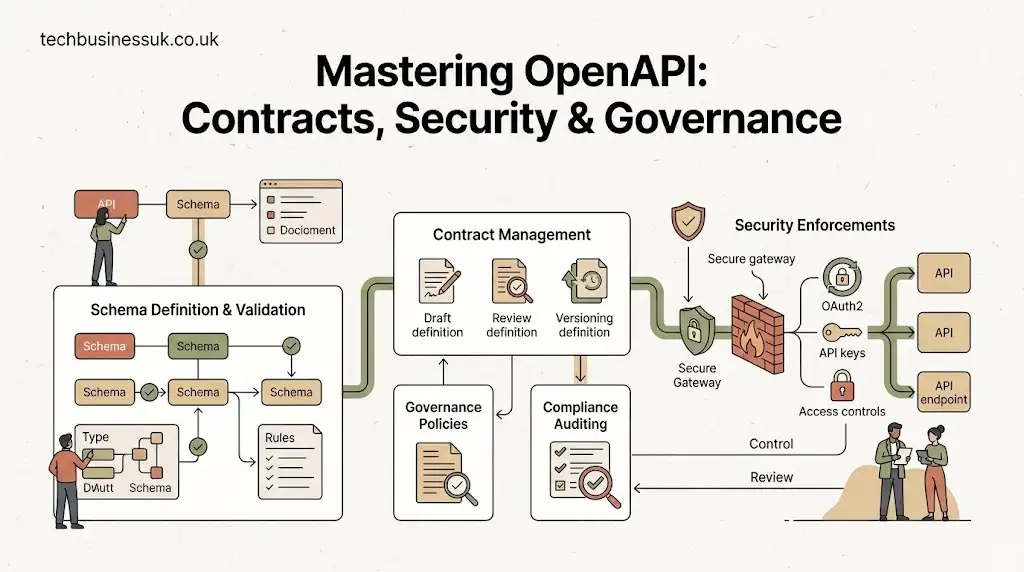
The industry-wide shift toward API-first architecture and contract-driven microservices has fundamentally altered how modern software is built. In distributed systems, engineering teams cannot afford to let backend implementations dictate API contracts after code is shipped.
The OpenAPI Specification serves as the universal Interface Definition Language (IDL) for RESTful APIs. By establishing an explicit, machine-readable contract before writing business logic, organizations answer a critical question: what is openapi specification? At its core, it is a vendor-neutral standard managed by the Linux Foundation that standardizes how RESTful endpoints, request/response schemas, parameter bindings, and authentication mechanisms are described in YAML or JSON.
Adopting a formal spec eliminates common enterprise failure modes:
- Documentation Drift: Keeping interactive docs, client SDKs, and backend behavior aligned automatically.
- API Sprawl: Preventing undocumented or hidden endpoints from quietly entering production environments.
- Broken Client Integrations: Catching breaking schema changes in CI/CD pipelines before they impact downstream consumers.
OpenAPI Specification Fundamentals: Syntax, Core Components, and Structure
Understanding the structure of an OpenAPI Specification requires inspecting its top-level nodes. An OpenAPI 3.x document organizes endpoints, reusable schemas, and security parameters into distinct, declarative sections.
Understanding the Core Sections (components, paths, and security)
An OpenAPI document relies on three structural anchors:
paths: Maps individual endpoint URIs to their supported HTTP operations (GET,POST,PUT,DELETE).components: The central repository for reusable objects. The openapi spec components section houses shared data schemas, parameter groupings, request bodies, and error structures.security: Applies globally enforced or operation-specific authentication rules.
YAML
openapi: 3.1.0
info:
  title: Enterprise Data Service
  version: 1.0.0
paths:
  /users/{userId}:
    get:
      summary: Retrieve user profile
      parameters:
        - name: userId
          in: path
          required: true
          schema:
            type: string
            format: uuid
        - name: includeMetrics
          in: query
          required: false
          schema:
            type: boolean
      responses:
        '200':
          description: User profile payload
          content:
            application/json:
              schema:
                $ref: '#/components/schemas/UserProfile'
components:
  schemas:
    UserProfile:
      type: object
      properties:
        id:
          type: string
        username:
          type: string
When modeling parameters, developers must distinguish openapi path parameters vs query parameters. Path parameters (in: path) identify specific resources within a URI path hierarchy (e.g., /users/{userId}) and are always mandatory. Query parameters (in: query) filter, sort, or paginate broader resource collections (e.g., /users?role=admin) and should remain optional by default.
To keep specifications DRY (Don’t Repeat Yourself), leveraging openapi reference objects ref (e.g., $ref: '#/components/schemas/UserProfile') links paths back to central schema definitions, eliminating duplicate code definitions across endpoints.
File Formats and Structural Schema Types
Developers can author specifications using an openapi specification yaml example or standard JSON syntax. YAML is generally preferred for human readability and git diff reviews, whereas JSON is useful for programmatic compilation.
Underneath, request and response structures rely on openapi json schema rules. For complex data models, OpenAPI supports object polymorphism through specific schema composition keys:
allOf: Combines multiple schemas, requiring the data to conform to all sub-schemas (used for schema inheritance).oneOf: Validates data against exactly one of the sub-schemas.anyOf: Validates data against one or more sub-schemas.
YAML
components:
  schemas:
    Pet:
      type: object
      required: [petType]
      properties:
        petType:
          type: string
    Cat:
      allOf:
        - $ref: '#/components/schemas/Pet'
        - type: object
          properties:
            huntingSkill:
              type: string
For file ingest endpoints, specifications model openapi file upload multipart formdata payloads using specialized media types and content encoding declarations:
YAML
requestBody:
  content:
    multipart/form-data:
      schema:
        type: object
        properties:
          file:
            type: string
            contentMediaType: application/pdf
OpenAPI 3.0 vs 3.1 and Swagger Evolution
A common source of confusion in enterprise architecture stems from legacy terminology.
OpenAPI Specification vs Swagger: Key Distinctions
“Swagger” is not the specification itself; it is the commercial and open-source toolset (Swagger UI, Swagger Editor, Swagger Codegen) originally created by Wordnik and later acquired by SmartBear.
In 2015, the specification format was donated to the Linux Foundation and rebranded as the OpenAPI Specification (OAS). Examining openapi specification vs swagger reveals a clean boundary:
- OpenAPI Specification: The open-source, vendor-neutral standard spec for describing REST APIs.
- Swagger: The tooling ecosystem used to view, edit, and render OpenAPI definitions.
Transitioning to OpenAPI 3.1
The release of OpenAPI 3.1 resolved the largest structural divergence between OAS and the broader web standard: full alignment with JSON Schema Draft 2020-12.
| Feature / Modifier | OpenAPI 3.0.x | OpenAPI 3.1.x |
|---|---|---|
| JSON Schema Dialect | Extended subset of Draft 4 | Full JSON Schema Draft 2020-12 |
| Nullable Fields | type: string + nullable: true |
type: ["string", "null"] (Type arrays) |
| File Uploads | type: string + format: binary |
contentMediaType / contentEncoding |
| Out-of-Band Calls | Primitive callbacks only | Top-level webhooks object |
Updating schema configurations to openapi 3.0 vs 3.1 standards unlocks native conditional logic inside schemas (if/then/else), multi-type arrays, and modernized openapi securityschema oauth2 authorization flows.
Design-First API Development and Governance
When engineering teams build microservices, they face a strategic decision: Code-First vs Design-First.
Adopting a Contract-First Strategy
In Code-First development, engineers write backend routes in Python, Java, or Go first, and then generate the specification file second. This frequently leads to accidental breaking changes, unvetted schema modifications, and tight coupling.
Applying a design first openapi specification strategy reverses this cycle:
+-------------------------------------------------------+
|  1. Author OpenAPI Contract (YAML) & Review Specs     |
+-------------------------------------------------------+
                            |
                            v
+-------------------------------------------------------+
|  2. Lint Specification & Verify Security Constraints  |
+-------------------------------------------------------+
                            |
        +-------------------+-------------------+
        |                                       |
        v                                       v
+-----------------------+               +-----------------------+
| 3a. Generate Client   |               | 3b. Generate Server   |
|     SDKs & Mocks      |               |     Stubs & Tests     |
+-----------------------+               +-----------------------+
A contract first api development approach establishes the specification as the explicit openapi spec single source of truth. Frontend and mobile teams can run automated mock servers against the spec in parallel while backend developers build implementation services to match the exact schema contract.
Linting, Quality Control, and Versioning
Specifications must be governed automatically inside continuous integration (CI) pipelines. Relying on manual code reviews to enforce schema conventions is inefficient and error-prone.
Using automated tools like openapi spec linting spectral, teams enforce strict organizational design rules (e.g., requiring camelCase properties, mandatory operation descriptions, and standardized error responses) on every git push:
YAML
# .spectral.yaml
extends: ["spectral:oas"]
rules:
  paths-kebab-case:
    description: "All path segments must use kebab-case."
    message: "{{property}} must be kebab-case"
    given: "$.paths[*]~"
    then:
      function: pattern
      functionOptions:
        match: "^(/[a-z0-9---_]+)+$"
Establishing openapi specification best practices requires automating openapi breaking changes detection during pull request reviews. CI tools analyze diffs between the primary branch and working commits, flagging dropped properties, altered data types, or newly required parameters before breaking changes ship to production.
Securing APIs with OpenAPI Specifications
An API contract must define not only how data moves, but how data access is protected.
Defining Authentication and Authorization Models
Under the components/securitySchemes block, engineers configure robust openapi security definitions across supported authorization schemes:
YAML
components:
  securitySchemes:
    OAuth2Auth:
      type: oauth2
      description: Enterprise OAuth2 Authorization Code Flow
      flows:
        authorizationCode:
          authorizationUrl: https://auth.company.com/oauth/authorize
          tokenUrl: https://auth.company.com/oauth/token
          scopes:
            read:users: Read user records
            write:users: Modify user records
    BearerAuth:
      type: http
      scheme: bearer
      bearerFormat: JWT
To enforce fine-grained access control, map openapi role based access control rbac scopes directly at the path level:
YAML
paths:
  /admin/system-logs:
    get:
      summary: Download system audit logs
      security:
        - OAuth2Auth:
            - write:users
Enterprise API Perimeter Protection & Shadow API Detection
OpenAPI specs play a decisive role in enforcing perimeter defense. Rather than configuring security policies manually on API Gateways, modern infrastructure engines ingest specification files directly to enforce schema validation at the edge.
                          INGRESS TRAFFIC
                                 |
                                 v
                +---------------------------------+
                |   Enterprise API Gateway        |
                |   (Validates against OpenAPI)   |
                +---------------------------------+
                                 |
                 +---------------+---------------+
                 |                               |
        [Valid Payload]                  [Invalid Payload]
                 |                               |
                 v                               v
    +-------------------------+     +-------------------------+
    | Internal Microservice   |     | Blocked at Ingress (400)|
    +-------------------------+     +-------------------------+
This deployment architecture drives comprehensive enterprise api governance openapi enforcement:
- Blocking Malformed Attacks: The gateway automatically drops incoming requests that contain non-conforming types, unlisted query parameters, or unexpected payloads, neutralizing injection vectors before they reach inner application boundaries.
- Eliminating Shadow APIs: By comparing live wire traffic against published specs, security tooling isolates unmapped endpoints (shadow api detection via openapi), preventing rogue developer deployments from running exposed in production.
For deeper architectural breakdowns on securing ingress boundaries and evaluating API threat models, see our guides on API Gateway Security
, and Enterprise API Governance
.
The OpenAPI Ecosystem: Code Generation, Testing, and Gateway Integration
A specification file unlocks value across the entire software development lifecycle when integrated with modern developer tools.
Documentation and Interactive Portals
Knowing how to document REST APIs with openapi transforms raw YAML contracts into developer portals. Using tools via swagger ui openapi integration or Redoc, teams render interactive documentation where developers can test live requests directly from their web browsers.
Furthermore, running openapi mock server generation tools (such as Prism or Microcks) converts OpenAPI definitions into functional, fake HTTP servers instantly, outputting mock payloads defined directly within the spec’s examples block.
Automating Client Libraries and Framework Integrations
Instead of manually writing API client SDKs across multiple programming languages, an openapi client code generator reads the specification to generate fully typed client libraries for TypeScript, Python, Java, and Go automatically.
Modern backend frameworks provide bidirectional integration:
- FastAPI: Python’s native typing automatically yields a live specification via fastapi auto generate openapi spec.
- Spring Boot: Developers leverage
springdoc-openapifor spring boot openapi 3 integration, automatically inspecting Java annotations to build specifications dynamically.
Legacy ecosystems can extract schema models directly using generate openapi spec from code plugins, or utilize a postman to openapi spec converter to upgrade manual Postman collections into structured, machine-readable specifications.
Architectural Comparisons & Edge Cases
While OpenAPI is the dominant standard for RESTful architectures, modern enterprise applications often combine multiple architectural styles.
OpenAPI vs AsyncAPI vs GraphQL
| Architectural Dimension | OpenAPI Specification | AsyncAPI | GraphQL Schema |
|---|---|---|---|
| Primary Target | Request-Response REST APIs | Event-Driven & WebSockets | Single-Endpoint Graph Queries |
| Transport Protocol | HTTP / HTTP/2 | Kafka, AMQP, WebSockets, MQTT | HTTP (typically POST) |
| Data Payload Model | JSON Schema / YAML | JSON Schema / Avro | GraphQL Schema Definition Language |
Evaluating openapi vs asyncapi for event driven architecture highlights distinct operational roles: OpenAPI governs synchronous, request-response transactions over HTTP, whereas AsyncAPI handles asynchronous message brokers (e.g., Kafka streams, RabbitMQ, WebSockets).
Conversely, analyzing openapi vs graphql schema compares fixed, server-defined REST endpoints against a flexible, client-defined graph query engine.
Standardizing Responses and Gateways
To enforce consistency across microservice response contracts, specify uniform error schemas adhering to RFC 7807 (Problem Details for HTTP APIs):
YAML
components:
  schemas:
    ProblemDetails:
      type: object
      properties:
        type:
          type: string
          format: uri
        title:
          type: string
        status:
          type: integer
        detail:
          type: string
Adhering to openapi spec response status codes best practices ensures every HTTP response code (200, 201, 400, 401, 403, 404, 500) defines an explicit schema inside the specification file.
Finally, importing specification files directly via api gateway openapi spec import simplifies ingress configurations across enterprise cloud platforms like AWS API Gateway, Kong, Apigee, and Azure API Management.
Step-by-Step Tutorial: How to Write an OpenAPI Specification from Scratch
Follow this step-by-step walkthrough demonstrating how to write openapi specification from scratch:
YAML
# Step 1: Define Metadata and Server Boundaries
openapi: 3.1.0
info:
  title: Order Processing Service
  description: Core microservice handling customer order lifecycles.
  version: 1.0.0
servers:
  - url: https://api.production.company.com/v1
    description: Production Cluster
  - url: https://api.staging.company.com/v1
    description: Staging Environment

# Step 2: Set Global Security Requirements
security:
  - BearerAuth: []

# Step 3: Define Endpoint Paths and HTTP Methods
paths:
  /orders:
    post:
      summary: Submit a new order
      operationId: createOrder
      requestBody:
        required: true
        content:
          application/json:
            schema:
              $ref: '#/components/schemas/OrderInput'
      responses:
        '201':
          description: Order created successfully
          content:
            application/json:
              schema:
                $ref: '#/components/schemas/OrderOutput'
        '400':
          description: Invalid request payload
          content:
            application/json:
              schema:
                $ref: '#/components/schemas/ErrorResponse'

# Step 4: Define Reusable Schemas and Security Specifications
components:
  securitySchemes:
    BearerAuth:
      type: http
      scheme: bearer
      bearerFormat: JWT

  schemas:
    OrderInput:
      type: object
      required: [customerId, itemIds, totalAmount]
      properties:
        customerId:
          type: string
          format: uuid
        itemIds:
          type: array
          items:
            type: string
        totalAmount:
          type: number
          minimum: 0.01

    OrderOutput:
      type: object
      properties:
        orderId:
          type: string
          format: uuid
        status:
          type: string
          enum: [PENDING, PROCESSING, SHIPPED]
        createdAt:
          type: string
          format: date-time

    ErrorResponse:
      type: object
      properties:
        code:
          type: string
        message:
          type: string
Conclusion & Next Steps
The OpenAPI Specification forms the cornerstone of modern, enterprise-grade API architectures. By shifting away from loosely defined contracts and manual documentation toward an automated, contract-first pipeline, engineering organizations eliminate drift, improve API perimeter security, and streamline cross-team development.
To extend your API security and DevSecOps engineering practices, explore our detailed guides on:
- API Gateway Security
- API Penetration Testing
- SAST vs DAST in AI-Era Security
- Enterprise API Governance Frameworks
About the Author






1 thought on “The Definitive Guide to OpenAPI Specification: Architecture, Security, and Governance”