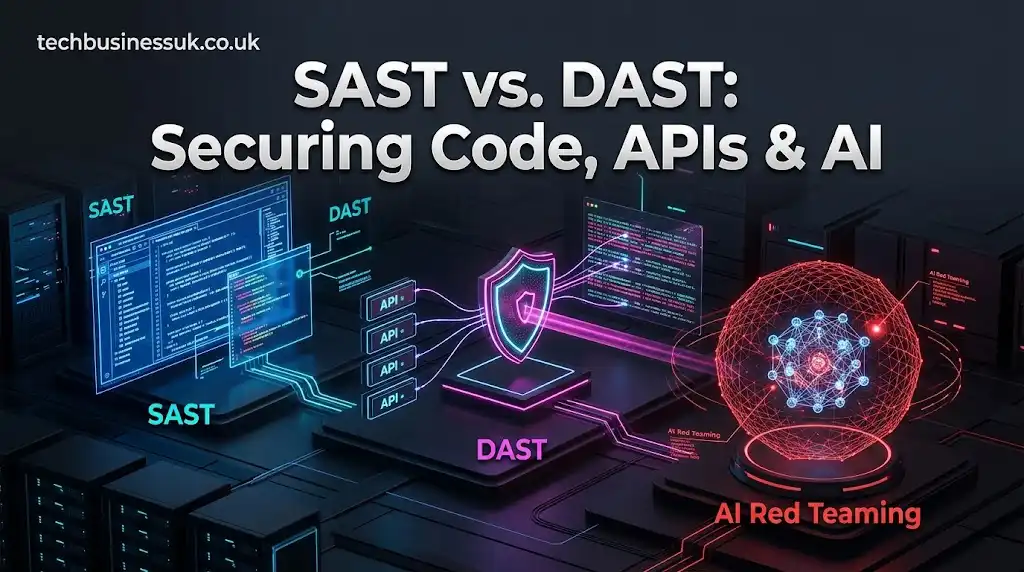
For years, enterprise Application Security (AppSec) relied on a simple dual-engine consensus: SAST (Static Application Security Testing) scans your source code at rest to catch vulnerabilities early in the software development lifecycle, while DAST (Dynamic Application Security Testing) probes live, running environments to uncover exploitable runtime flaws from an attacker’s perspective.
Together, they formed the backbone of secure continuous integration and delivery (CI/CD) pipelines—one looking inside-out at static syntax, the other looking outside-in at running behavior.
Yet as enterprises rapidly integrate Large Language Models (LLMs), autonomous agents, and RAG pipelines into production stacks, a dangerous security gap has emerged. Traditional SAST tools expect deterministic code branches; they cannot evaluate whether a natural-language system prompt can be subverted via prompt injection. Standard DAST tools fire structured HTTP payloads; they cannot execute multi-turn jailbreaks or simulate probabilistic token leaks.
Navigating modern AppSec no longer means choosing between static code analysis and dynamic testing—it requires deploying both effectively while recognizing where traditional scanners stop and Generative AI Red Teaming begins.
What is SAST? (Static Application Security Testing)
Static Application Security Testing (SAST) is a white-box testing methodology that analyzes application source code, byte code, or compiled binaries without executing the program.
By evaluating an application from the inside out, SAST tools build a visual AST (Abstract Syntax Tree) to trace data flows from inputs (sources) to execution functions (sinks). This allows security teams to identify vulnerabilities directly in the IDE or during pull-request checks in the CI/CD pipeline—a core pillar of the “Shift Left” movement.
How SAST Works & Key Vulnerabilities Caught
SAST scanners operate by matching code patterns against predefined rule sets and analyzing execution logic for unsafe coding practices. Typical flaws identified include:
- Hardcoded Credentials & Secrets: API keys, database passwords, and private SSH keys checked into git repositories.
- SQL Injection (SQLi) & Command Injection: Unsanitized string concatenations inside database queries or system shell executions.
- Buffer Overflows & Memory Leaks: Insecure memory management in languages like C/C++.
- Known Dependency CVEs: Vulnerable open-source packages imported into the code manifest (Software Composition Analysis).
Advantages and Limitations of SAST
- Pro: Line-of-Code Precision. SAST pinpoints the exact file and line number where a flaw exists, making remediation fast for developers.
- Pro: Early SDLC Detection. Catches flaws before code is ever built, compiled, or deployed to staging.
- Con: High False-Positive Rate. Without runtime context, SAST tools frequently flag benign code paths, creating triage fatigue for security teams.
- Con: Language Dependence. Scanners must be explicitly built to parse specific programming languages and frameworks.
What is DAST? (Dynamic Application Security Testing)
Dynamic Application Security Testing (DAST) is a black-box testing methodology that evaluates a running application from the outside in. DAST tools do not possess knowledge of the underlying source code, framework, or internal architecture; instead, they interact with the application’s exposed interfaces (web frontends, REST APIs, GraphQL endpoints) just as an external threat actor would.
How DAST Works & Key Vulnerabilities Caught
DAST tools execute real-time HTTP requests, submitting malicious or edge-case payloads to active endpoints and parsing the application’s HTTP responses for anomalous behavior, error codes, or leaked data. Key vulnerabilities caught include:
- Cross-Site Scripting (XSS): Reflected or stored script injections executed in client browser sessions.
- Authentication & Authorization Bypasses: Broken access control, parameter tampering, and session management flaws.
- Server-Side Request Forgery (SSRF): Forging requests from the application server to internal microservices.
- Infrastructure & Server Misconfigurations: Exposed directory listings, missing security headers (CORS, CSP), and weak SSL/TLS suites.
Advantages and Limitations of DAST
- Pro: High Fidelity (Zero False Positives on Confirmed Exploits). If DAST successfully executes an exploit, the vulnerability is unquestionably real.
- Pro: Language Agnostic. DAST tests over standard network protocols (HTTP/HTTPS/WebSockets) regardless of backend language stacks.
- Con: Late SDLC Execution. Testing requires a running build (Staging/QA), meaning fixing bugs discovered here is significantly more expensive than in development.
- Con: Lack of Code Visibility. DAST demonstrates that an endpoint is vulnerable, but cannot inform developers which line of code caused the issue.
SAST vs. DAST: Direct Comparison
While SAST inspects static code at rest during early development, DAST validates application security in motion prior to release. Understanding how they contrast across critical engineering metrics helps determine optimal pipeline placement:
| Feature / Dimension | Traditional SAST | Traditional DAST | Generative AI Red Teaming |
|---|---|---|---|
| Testing Approach | White-box: Scans raw source code, binaries, or build artifacts without execution. | Black-box: Probes running application endpoints from the outside via HTTP/APIs. | Grey/Black-box: Probes model endpoints, system prompts, retrieval layers, and tool APIs. |
| Target Execution Path | Deterministic code logic (explicit branches, functions, parameters). | Deterministic runtime routes, web servers, and database queries. | Probabilistic token generation, natural language boundaries, and prompt logic. |
| Primary Input / Payloads | Static files, repository commits, and environment configs. | Structured technical payloads (JSON, SQL strings, XSS scripts, headers). | Unstructured natural language prompts, multi-turn contexts, and multimodal inputs. |
| Primary Vulnerabilities | Buffer overflows, hardcoded secrets, unsafe dependencies, SQLi syntax. | Cross-Site Scripting (XSS), Auth bypass, SSRF, CORS misconfigurations. | Prompt injection (LLM01), jailbreaks, RAG exfiltration, unauthorized tool calls. |
| SDLC Phase | Development / Commit phase (Shift-Left inside IDE or pull request). | Staging / Pre-Production (Live execution before public release). | Staging & Post-Deployment (Pre-launch validation + continuous CI regression). |
| Pinpointing Accuracy | High line-of-code accuracy, but prone to false positives without runtime context. | Proves real exploitability, but cannot pinpoint the exact line of underlying code. | Identifies non-compliant model behavior, failing guardrails, and context leak vectors. |
The Blind Spot: Why SAST and DAST Fall Short in AI Security
Traditional AppSec mechanisms operate on a core assumption: code paths are deterministic. A standard application routes static inputs through explicit, conditional code paths (if/else logic) to execute precise database or web functions.
Generative AI models break this paradigm completely. Natural language serves simultaneously as both data and control code.
┌────────────────────────────────────────────────────────────────────────┐
│                        TRADITIONAL APPSEC                              │
│  User Input (Data) ───► Sanitize ───► Code Interpreter (Logic)         │
│  *Boundaries between data and instructions are explicit.*              │
└────────────────────────────────────────────────────────────────────────┘

┌────────────────────────────────────────────────────────────────────────┐
│                        GENERATIVE AI APPSEC                            │
│  User Input + System Prompt (Data & Instructions Combined)             │
│       ───► Probabilistic Neural Inference Window                       │
│  *Boundaries vanish: Natural language dictates execution.*             │
└────────────────────────────────────────────────────────────────────────┘
Because of this collapse of boundaries, conventional security tools encounter fundamental blind spots:
- Where SAST Fails on LLMs: A SAST tool can scan a Python script and verify that an API key isn’t exposed or that a database call uses parametrized queries. However, SAST cannot parse system metaprompts or evaluate whether an underlying model will collapse when presented with adversarial roleplay, base64-encoded jailbreaks, or indirect prompt injections inside retrieved RAG documents.
- Where DAST Fails on LLMs: A DAST scanner fires deterministic SQL payload lists (
' OR 1=1 --) or XSS tags (<script>). It expects binary, HTTP-level status code indicators or page reflection. DAST cannot evaluate multi-turn conversational manipulation, measure semantic model drift, or verify whether an autonomous agent will hijack its own tool integration functions when fed untrusted text.
Generative AI Red Teaming: The Next Evolution of DAST
To address the non-deterministic nature of AI workloads, security teams are deploying Generative AI Red Teaming—an advanced, AI-native form of dynamic security evaluation.
Where traditional DAST tests network and web interfaces against standard exploit lists, AI Red Teaming targets the entire probabilistic LLM pipeline: system metaprompts, model weights, RAG vector stores, and downstream agentic tool APIs.
                  ┌────────────────────────┐
                  │   AI RED TEAMING       │
                  │   ADVERSARIAL SUITE    │
                  └───────────┬────────────┘
                              │
         ┌────────────────────┼────────────────────┐
         ▼                    ▼                    ▼
┌─────────────────┐  ┌─────────────────┐  ┌─────────────────┐
│ System Prompts  │  │ RAG & Vector    │  │ Agentic Tools   │
│ & Metaprompts   │  │ Context Layers  │  │ & Function APIs │
└─────────────────┘  └─────────────────┘  └─────────────────┘
AI Red Teaming maps directly to critical threats defined in the OWASP Top 10 for LLMs:
- Direct & Indirect Prompt Injection (
LLM01): Simulating adversarial inputs designed to override safety instructions or exfiltrate hidden system prompts. - Sensitive Information Disclosure (
LLM06): Probing the RAG pipeline to ensure unauthorized users cannot pull confidential enterprise data out of vector databases via semantic manipulation. - Excessive Agency (
LLM08): Testing autonomous agents to verify that an injected prompt cannot force the model into invoking unauthorized API functions or database mutations.
Rather than replacing traditional scanners, AI Red Teaming operates alongside SAST and DAST within a modern Defense-in-Depth architecture.
Rather than replacing traditional scanners, AI Red Teaming operates alongside SAST and DAST—complemented by a continuous LLM observability strategy—within a modern Defense-in-Depth architecture.
Building a Complete AppSec Strategy
A mature enterprise security strategy cannot rely on a single testing layer. Securing modern applications requires aligning your testing methodology with the nature of the target components:
- Deploy SAST inside the IDE and CI/CD pull requests in alignment with the NIST Secure Software Development Framework (SSDF) to catch hardcoded secrets, syntax errors, and vulnerable code dependencies before code is committed.
- Execute DAST against staging builds to validate web app boundaries, server configurations, and traditional API endpoints prior to release.
- Integrate AI Red Teaming across LLM pipelines to evaluate system prompt resilience, prevent data leaks, and enforce strict boundaries over autonomous agents.
By bridging traditional AppSec scanners with dynamic AI red teaming, organizations can confidently ship next-generation AI features without exposing production data or underlying backend infrastructure.
Frequently Asked Questions (FAQ)
Can SAST replace DAST entirely in a modern pipeline?
No. SAST only checks code at rest and misses runtime environment flaws, access control misconfigurations, and authentication bypasses. DAST is strictly required to validate live exploitability before deployment.
Is AI Red Teaming just automated dynamic fuzzing?
No. While AI red teaming utilizes automated programmatic fuzzing for regression coverage, it also incorporates multi-turn contextual reasoning, adaptive payload generation, and manual expert testing to break complex business logic and agentic workflows.
At what SDLC phase should security teams introduce DAST and AI Red Teaming?
DAST and AI Red Teaming should be executed in staging environments prior to production releases. Additionally, automated AI red teaming suites should run continuously inside CI/CD pipelines to catch regression gaps caused by provider-side model updates or system prompt tweaks.
About the Author

1 thought on “SAST vs. DAST: Key Differences, Use Cases & The Rise of AI Red Teaming”