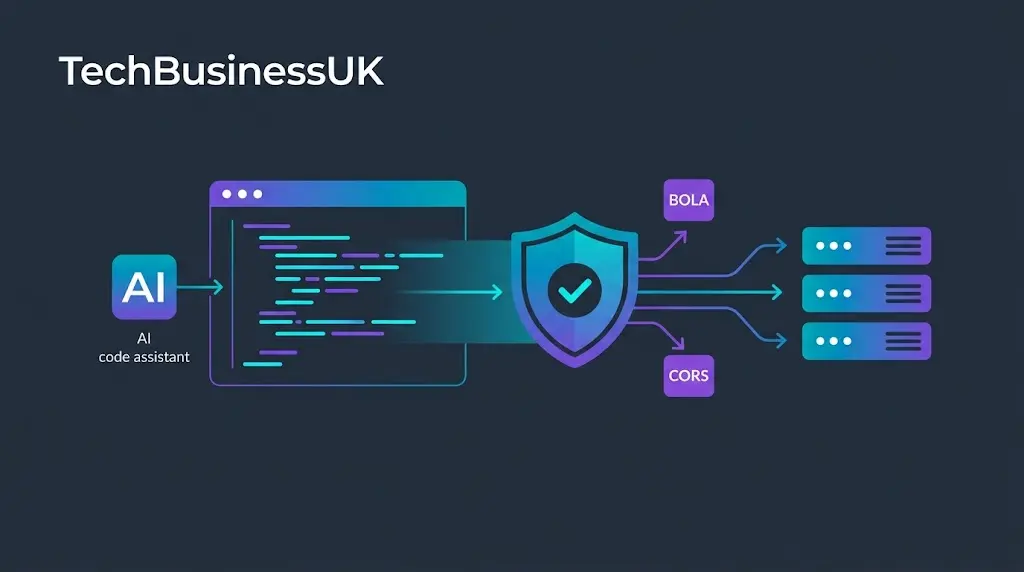
A software engineer prompts an AI coding assistant to create a Node.js user management service. Within five seconds, the model emits a clean, syntax-valid Express router featuring working database queries and JWT extraction. All automated unit tests pass, and the pull request gets merged. Two weeks later, an external audit reveals that every user account on the staging server is accessible without authorization.
The AI assistant wrote syntactically flawless code, but it omitted critical ownership checks inside the controller logic. Evaluating API security risks introduced by AI code generators is no longer a theoretical exercise for engineering leads—it is an urgent operational requirement.
====================================================================================================
TL;DR: AI code assistants accelerate development but routinely generate insecure API patterns,
including Broken Object Level Authorization (BOLA), over-permissive CORS, and mass assignment
vulnerabilities. Mitigating these flaws requires a defense-in-depth model combining static code
analysis, schema enforcement, runtime gateway defense, and continuous penetration testing.
====================================================================================================
Why LLM Assistants Produce Insecure API Code
Large Language Models (LLMs) used in developer tools like GitHub Copilot and ChatGPT excel at autocomplete patterns, but they lack contextual understanding of security boundaries.
Training Data Bias and Pattern Mimicry
LLMs predict the most statistically probable token sequence rather than verifying security logic. Public repositories contain millions of open-source projects, quick-start code tutorials, and legacy codebases that omit error handling, input sanitization, and authentication middleware for brevity.
When generating code, the AI mimics these unsafe patterns because they represent common syntax. Research into Copilot generated API vulnerabilities consistently demonstrates that AI assistants reproduce vulnerable coding habits found across public code repositories unless explicitly constrained by system prompts and static analysis rules.
The Context Window Limitation in Business Logic
Effective AI code security in REST APIs relies on context-aware authorization: verifying whether User A has explicit permission to modify Resource B.
AI assistants operate within local context windows, usually looking only at the active file or function signature. They cannot infer global Role-Based Access Control (RBAC) or Attribute-Based Access Control (ABAC) middleware policies enforced elsewhere in your microservices architecture. Consequently, generated controller functions execute direct database operations without validating tenant boundaries or resource ownership.
Top 4 API Vulnerabilities Introduced by AI Code
The OWASP Top 10 API Security Risks project documents the primary breakdown points in modern web applications. AI-generated code frequently introduces four specific failure modes.
| Failure Mode | Technical Cause | Security Impact |
|---|---|---|
| BOLA / IDOR | Omitted ownership checks in URI | Unsanitized data access |
| Over-Permissive CORS | Wildcard headers generated | Cross-site data exfiltration |
| Mass Assignment | Direct payload-to-model mapping | Privilege escalation |
| Hallucinated Package Imports | Model invents non-existent packages | Typosquatting risk |
1. Broken Object Level Authorization (BOLA) and IDOR Flaws
BOLA remains the most severe risk in modern API development. AI models frequently write database query controllers that look like this:
// Typical AI-generated endpoint pattern
app.get('/api/v1/invoices/:id', async (req, res) => {
  const invoice = await Invoice.findByPk(req.params.id);
  if (!invoice) return res.status(404).send('Not found');
  res.json(invoice);
});
The syntax is clean, but the logic is fundamentally broken. The endpoint retrieves records based solely on the incoming path parameter without checking if req.user.id === invoice.userId. Any authenticated user can enumerate invoice IDs and exfiltrate sensitive tenant data. Implementing automated BOLA detection in AI code is critical to catching these flaws early.
2. Over-Permissive CORS and Insecure Defaults
To make generated code run without execution errors during local testing, AI assistants regularly include permissive CORS headers:
app.use(cors({ origin: '*' }));
When pushed to production environments, wildcard origins expose internal API endpoints to cross-site data exfiltration from browser-based malicious scripts.
3. Missing Schema Validation and Mass Assignment
AI assistants typically bind HTTP request bodies directly to object relational mappers (ORMs):
# Insecure Django/FastAPI pattern generated by LLMs
@app.post("/users/update")
def update_user(user_data: UserUpdateSchema, current_user: User = Depends(get_current_user)):
    db.query(User).filter(User.id == current_user.id).update(user_data.dict())
    db.commit()
If the payload contains undocumented fields (such as is_admin: true or role: "superuser"), the ORM persists those changes automatically. The AI fails to restrict payload fields to an explicit allowlist.
4. Hallucinated Packages and Supply Chain Risks
LLMs occasionally invent package names, function calls, or dependency signatures that do not exist in official package managers (such as npm or PyPI). Threat actors monitor these common hallucinated package names and publish malicious code under those exact identifiers, triggering typosquatting attacks when developers run npm install on AI-generated configurations.
How to Detect AI-Generated API Flaws Before Production
Mitigating insecure code requires layered detection across pre-commit hooks, continuous integration (CI) runners, and live testing environments.
Static Application Security Testing (SAST) Custom Rules
Generic SAST scanners check for standard injection flaws, but catching AI-specific code mistakes requires custom rules. Engineering teams should configure scanners like Semgrep or SonarQube to flag:
- Route definitions that bypass central authorization middleware.
- Wildcard CORS headers inside production configurations.
- Direct ORM model updates lacking explicit field filtering.
Combining Automated Scans with Manual Penetration Testing
Automated static scanners inspect syntax, but they cannot evaluate contextual business logic boundaries. Catching subtle authorization gaps and privilege escalation paths requires integrating automated tool outputs with thorough manual API penetration testing methodologies. Manual adversarial analysis validates whether AI-generated controllers correctly enforce authorization logic under real-world attack scenarios.
5 Engineering Fixes to Mitigate API Security Risks in AI Code
Addressing AI code vulnerabilities requires establishing security guardrails that catch flaws before deployment and enforce security rules during runtime.
                  +-------------------------------------------------------+
                  |               DEVELOPER PROMPT / CODE                 |
                  +-------------------------------------------------------+
                                              │
                                              ▼
                  +-------------------------------------------------------+
                  |           1. Policy-as-Code Middleware                |
                  +-------------------------------------------------------+
                                              │
                                              ▼
                  +-------------------------------------------------------+
                  |         2. OpenAPI Strict Schema Validation           |
                  +-------------------------------------------------------+
                                              │
                                              ▼
                  +-------------------------------------------------------+
                  |        3. Ingress Gateway Runtime Defense             |
                  +-------------------------------------------------------+
                                              │
                                              ▼
                  +-------------------------------------------------------+
                  |         4. CI/CD Automated Security Runners           |
                  +-------------------------------------------------------+
                                              │
                                              ▼
                  +-------------------------------------------------------+
                  |        5. Human Code Review & Threat Auditing         |
                  +-------------------------------------------------------+
Fix 1: Enforce Policy-as-Code Middleware
Decouple authorization logic from developer-written (or AI-written) controller code entirely. By moving access control rules into centralized policy engines like Open Policy Agent (OPA), security teams can enforce consistent RBAC and ABAC checks regardless of how the underlying application code was generated.
# OPA authorization check example
default allow = false

allow {
    input.method == "GET"
    input.path = ["api", "v1", "invoices", invoice_id]
    input.user.id == data.invoices[invoice_id].userId
}
Fix 2: Mandate Strict OpenAPI Schema Enforcement
Never allow incoming client payloads to reach AI-generated application controllers without prior validation. Define strict OpenAPI (Swagger) specifications that restrict data types, string patterns, maximum array lengths, and allowed JSON keys. Reject malformed or unauthorized parameters at the ingress boundary to prevent mass assignment exploits.
Fix 3: Implement Runtime Perimeter Defenses
Application-level code fixes must be backed up by runtime infrastructure protections. Deploying robust inline API gateway security controls ensures that even if an unpatched BOLA vulnerability or over-permissive CORS header slips into production, the edge proxy enforces token authentication, mutual TLS (mTLS), and contextual rate limiting before requests reach internal microservices.
Fix 4: Integrate Security Scans into Developer CI/CD Pipelines
Security checks must be automated inside continuous integration pipelines. Integrating dedicated API testing tools into your deployment runners allows teams to execute dynamic security scans, schema checks, and fuzz tests against staging environments automatically before code merges to main branches.
Fix 5: Establish AI Coding Guidelines and Mandatory Human Code Reviews
Software engineering management should publish clear secure API coding guidelines regarding AI assistant usage:
- Mandatory Human Approval: Never allow AI-generated code to auto-merge into production without review by a senior engineer.
- Explicit Prompting Rules: Instruct engineers to include explicit security constraints in AI prompts (e.g., “Generate an Express route with input sanitization and OPA middleware authorization checks”).
- Compliance Standards Alignment: Align AI development workflows with established security frameworks, such as the UK National Cyber Security Centre (NCSC) guidance for secure software design and the US National Institute of Standards and Technology (NIST) Secure Software Development Framework (SSDF).
Future-Proofing API Security in the Age of Autonomous AI Agents
As engineering teams transition from human-driven AI assistants to autonomous AI agents that generate, test, and deploy code independently, static security controls become insufficient. Autonomous agents execute complex multi-step API operations, requiring dynamic identity management, machine-to-machine mutual TLS authentication, and tight payload inspection.
Establishing a defense-in-depth architecture—combining static code analysis, policy-as-code enforcement, perimeter gateway protection, and continuous vulnerability assessment—ensures your organization leverages AI productivity gains while maintaining absolute control over your API security risks.
Frequently Asked Questions (FAQs)
1. Why do AI coding assistants frequently produce BOLA vulnerabilities?
AI assistants predict code based on probability patterns learned from public codebases. Because simple tutorials and open-source examples often omit explicit object ownership checks for brevity, AI models mimic these incomplete snippets, resulting in controller logic that retrieves records by ID without validating whether the requesting user owns the object.
2. Can automated SAST tools detect security flaws in AI-generated code?
Standard SAST tools catch syntax-level flaws like SQL injection, but they often miss contextual logic errors like BOLA or missing middleware checks. Engineering teams must write custom rules (e.g., in Semgrep) to enforce that every route includes required authorization middleware and strict field filtering.
3. What is package hallucination in AI code assistants, and how do you prevent it?
Package hallucination occurs when an LLM invents non-existent library dependencies or package names. Attackers register these fake names on public registries like npm or PyPI to execute typosquatting attacks. Prevention requires lockfile verification, private registry proxies, and CI dependency scanning.
4. How does an API gateway protect against AI-introduced code vulnerabilities?
An API gateway serves as a runtime perimeter guardrail. Even if an AI-generated microservice contains an unpatched BOLA vulnerability or insecure CORS setting, the gateway enforces centralized token authentication, rate limits, schema validation, and mTLS at the edge before traffic reaches internal logic.
5. What is the role of Policy-as-Code in mitigating AI security risks?
Policy-as-Code (such as Open Policy Agent) decouples access control rules from application code. By enforcing authorization logic in a central policy layer, security rules remain consistent across all services regardless of whether developer code was written by a human or generated by an AI assistant.
About the Author

2 thoughts on “API Security Risks in AI Code: 5 Fixes for Engineers”