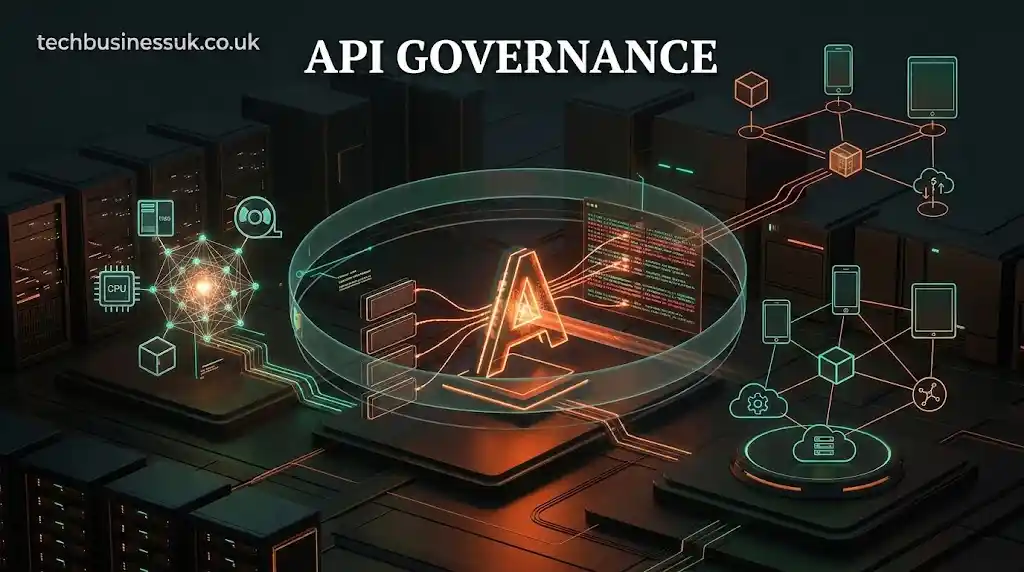
As enterprise architectures pivot away from monolithic stacks toward microservices, cloud-native deployments, multi-cloud platforms, and distributed ecosystem integrations, APIs have effectively become the modern enterprise’s digital nervous system. Today, large organizations manage anywhere from hundreds to tens of thousands of internal, partner-facing, and public endpoints. However, rapid, uncoordinated growth creates a critical operational bottleneck. When separate engineering teams invent their own naming conventions, authentication mechanisms, pagination models, and error schemas, organizations face severe architectural drift, regulatory non-compliance, escalating maintenance overhead, and runaway shadow API risks.
Traditional Governance, Risk, and Compliance (GRC) strategies fail in modern software delivery because they rely on static PDF guidelines, periodic architecture review boards (ARBs), and manual approval gates that developers bypass during fast-paced sprint cycles. Modern Enterprise API Governance Frameworks bridge the gap between high-level architectural policy and day-to-day engineering workflows. By embedding automated linting, security guardrails, schema validation, and contract tests directly into the software development lifecycle (SDLC), technical leaders transform API governance from a bureaucratic roadblock into an automated enabler of scale.
This comprehensive operational blueprint provides engineering directors, Chief Information Security Officers (CISOs), and Principal Enterprise Architects with the framework needed to establish an enterprise API governance program that unifies design standardization, zero-trust security, lifecycle management, and discovery across heterogeneous technical ecosystems.
1. The Core Pillars of an Enterprise API Governance Framework
A resilient enterprise API governance model must address four foundational pillars across the entire API lifecycle. Omitting any single pillar creates systemic blind spots that lead to security vulnerabilities or fragmented developer experiences.
┌──────────────────────────────────────────┐
│       Enterprise API Governance          │
└────────────────────┬─────────────────────┘
│
┌──────────────────┬─┴─────────────┬──────────────────┐
▼                  ▼               ▼                  ▼
┌─────────┐       ┌───────────┐   ┌───────────┐      ┌───────────┐
│ Design  │       │  Security │   │ Lifecycle │      │ Discovery │
│ & Style │       │ & Compliance  │ Management│      │ & Catalog │
└─────────┘       └───────────┘   └───────────┘      └───────────┘
Pillar 1: Design & Style Standardization
Consistency across endpoints reduces developer cognitive load, accelerates internal integration velocity, and improves external developer portal adoption. Key standardization domains include:
- Resource Naming & URI Formatting: Mandating consistent path conventions (e.g., kebab-case for URIs, plural nouns for resources, strict HTTP verb semantics like
GET,POST,PUT,PATCH,DELETE). - Error Payload Specification: Standardizing application-level error responses using recognized standards such as RFC 7807 Problem Details. This ensures frontend applications and client SDKs handle errors predictably across microservices.
- Data Schemas & Types: Enforcing uniform ISO 8601 timestamps, standard currency formats, consistent string sanitization flags, and strict schema definitions for request body parameters.
- Multi-Protocol Guidelines: Defining explicit rules for RESTful HTTP APIs, GraphQL queries/mutations, gRPC Protocol Buffers, and event-driven architectures (AsyncAPI/Kafka).
Pillar 2: Security & Regulatory Compliance
APIs represent the primary attack surface for external threat actors targeting enterprise data stores. Security governance must enforce zero-trust principles systematically rather than ad-hoc per service:
- Authentication & Identity Propagation: Enforcing centralized identity provider (IdP) integration via OAuth 2.0 and OpenID Connect (OIDC), paired with mutual TLS (mTLS) for inter-service mesh communication.
- Authorization Controls: Mandating granular Role-Based Access Control (RBAC) or Attribute-Based Access Control (ABAC) claims within JWT tokens to mitigate broken object-level authorization (BOLA) risks.
- Threat Mitigation Baselines: Aligning all endpoint definitions with established security benchmarks, including NIST SP 800-228 (Guidelines for API Protection for Cloud-Native Systems) and the OWASP API Security Top 10.
- Data Privacy Guardrails: Mapping data schemas against global regulatory requirements (GDPR, HIPAA, CCPA, PCI-DSS) to flag personally identifiable information (PII) field exposures during design.
Pillar 3: Lifecycle Management & Versioning Strategies
Without strict lifecycle state management, enterprise ecosystems accumulate legacy endpoints that consume runtime infrastructure and introduce unpatched vulnerabilities:
- State Transition Rules: Defining explicit gate conditions for state transitions (Draft $\rightarrow$ Active $\rightarrow$ Deprecated $\rightarrow$ Retired).
- Breaking Change Policies: Establishing clear definitions of what constitutes a breaking change (e.g., deleting a field, altering a data type, changing error response codes) and requiring semantic versioning (
v1.2.0vs.v2.0.0). - Sunsetting Frameworks: Enforcing standardized HTTP headers (such as the
DeprecationandSunsetresponse headers specified in RFC 8594) alongside contractual notification windows (e.g., mandatory 180-day deprecation notices for public APIs).
Pillar 4: Centralized Discovery, Cataloging & Developer Portals
A governance framework is ineffective if developers cannot find existing APIs, leading to redundant work and duplicate service construction:
- Dynamic Catalog Synchronization: Automatically registering every deployed API endpoint into a centralized internal catalog (such as Backstage, Kong Developer Portal, or Apigee) upon CI/CD deployment.
- Elimination of Shadow APIs: Continuous cross-referencing between runtime API gateway logs and the centralized catalog to detect, flag, and quarantine unauthorized endpoints (shadow APIs) or abandoned legacy endpoints (zombie APIs).
- Machine-Readable Metadata: Requiring complete metadata attached to every service registry entry, including service ownership (Team/Slack channel), SLAs, data classification level, and repository source code URLs.
2. Comparing Strategic API Governance Models
Enterprise governance can be structured in three main ways. Choosing the right framework depends on organizational velocity requirements, engineering maturity, regulatory scrutiny, and team distribution.
| Governance Dimension | Centralized Governance (API Center of Excellence) | Federated Governance (Guild / Chapter Model) | Automated “Governance-as-Code” (Platform Model) |
|---|---|---|---|
| Primary Mechanism | Dedicated Architecture Review Board (ARB) manually reviews and approves all API specifications. | Cross-functional working groups define shared guidelines; individual product teams perform peer reviews. | Central platform team writes automated linters, policy-as-code engines, and CI/CD gate checks. |
| Development Velocity | Low. Creates major delivery bottlenecks and delays deployment schedules by weeks. | Medium. Depends heavily on team discipline, workload, and individual reviewer engagement. | High. Provides instantaneous real-time feedback inside IDEs and pull requests. |
| Consistency Enforcement | High compliance, but scales poorly as engineering headcounts increase. | Moderate. Standards drift over time as different product teams interpret guidelines loosely. | Strict & Deterministic. Rules are enforced programmatic and identically across all teams. |
| Cultural Impact | High developer friction; encourages teams to work around processes or create unmanaged APIs. | High developer buy-in, but requires continuous effort to maintain interest and alignment. | Empowering. Gamifies quality via inline feedback while maintaining safety rails. |
| Best Suited For | Highly regulated monolithic legacy environments with infrequent release cycles. | Mid-sized product engineering organizations with strong collaborative engineering cultures. | Hyper-scale enterprises, multi-cloud platforms, and cloud-native DevSecOps organizations. |
| Primary Tooling | Word/PDF style guides, manual tickets, architecture approval meetings. | Wiki pages, shared design templates, code review checklists. | Spectral, Vacuum, Open Policy Agent (OPA), Git pre-commit hooks, API Gateways. |
3. Operationalizing Policy: Shifting Left with Governance-as-Code
To eliminate manual review bottlenecks, progressive enterprises adopt a Contract-First (OpenAPI-First) development methodology powered by automated policy-as-code engines. Instead of writing backend controller code and generating documentation after the fact, developers define machine-readable OpenAPI Specifications (OAS 3.x or AsyncAPI) first.
┌─────────────────────┐     ┌──────────────────────┐     ┌──────────────────────┐
│  Design Spec    │───► │   Spectral Linting  │───► │   Security Scans     │───► │ Deployment & Gateway │
│ (OpenAPI / OAS) │     │ (Style & Structure) │     │ (SAST/DAST & OWASP)  │     │ (Policy Enforcement) │
└─────────────────┘     └─────────────────────┘     └──────────────────────┘     └──────────────────────┘
By decoupling specification from implementation, security teams, technical writers, and frontend engineers can collaborate on contracts before code implementation begins.
Step 1: Standardizing Specifications with Custom Spectral Rulesets
Using open-source linters like Spectral or Vacuum, platform engineering teams can write and enforce enterprise-wide linting rulesets across all Git repositories. The following enterprise Spectral ruleset demonstrates how to enforce standardized RFC 7807 error formatting, snake_case query parameters, and mandatory security scopes:
# enterprise-api-ruleset.yaml
extends: ["spectral:oas"]

functionsDir: "./custom-functions"

rules:
  # Enforce RFC 7807 Problem Details for all HTTP error codes (4xx and 5xx)
  rfc7807-error-response-schema:
    description: "All HTTP 4xx and 5xx error responses must reference the standard RFC 7807 error schema."
    message: "Error response for status code {{property}} must use content.application/json.schema featuring RFC 7807 definitions."
    severity: error
    given: "$.paths..responses[?(@property >= 400)]"
    then:
      field: "content.application/problem+json.schema.$ref"
      function: defined

  # Enforce snake_case naming conventions for all query parameters
  query-parameters-snake-case:
    description: "All API query parameters must use snake_case formatting."
    message: "Query parameter '{{value}}' must be snake_case."
    severity: warning
    given: "$.paths..parameters[?(@.in === 'query')]"
    then:
      field: "name"
      function: pattern
      functionOptions:
        match: "^[a-z0-9_]+$"

  # Enforce mandatory tags on every operation for catalog grouping
  operation-tags-required:
    description: "Every API operation must specify at least one tag for developer portal navigation."
    severity: error
    given: "$.paths..[get,post,put,delete,patch]"
    then:
      field: "tags"
      function: truthy

  # Enforce global or operation-level OAuth 2.0 security declarations
  explicit-oauth2-security-requirement:
    description: "Every endpoint must explicitly declare OAuth2 security schemes."
    severity: error
    given: "$.paths..[get,post,put,delete,patch]"
    then:
      field: "security"
      function: defined
Step 2: Policy Enforcement at the Infrastructure Layer via Open Policy Agent (OPA)
While Spectral lints design specifications, Open Policy Agent (OPA) evaluates structural infrastructure configurations and deployment metadata against declarative Rego policies. This prevents non-compliant API deployment files (Kubernetes manifests, Terraform scripts, or Gateway CRDs) from applying to staging or production clusters.
The Rego policy below verifies that every API Gateway ingress route defines an approved authentication plugin and enforceable rate-limiting policy:
Code snippet
# enterprise_gateway_policy.rego
package enterprise.api.governance

default allow = false

# Allow deployment only if security and rate-limiting controls are verified
allow {
    has_valid_auth_plugin
    has_enforceable_rate_limit
}

# Rule: Verify OAuth2 or JWT plugin is attached to the Gateway ingress route
has_valid_auth_plugin {
    input.kind == "GatewayRoute"
    input.spec.plugins[_].name == "oauth2-jwt-validator"
    input.spec.plugins[_].enabled == true
}

# Rule: Verify rate limiting plugin is explicitly configured
has_enforceable_rate_limit {
    input.kind == "GatewayRoute"
    rate_limit := input.spec.plugins[_]
    rate_limit.name == "rate-limiting"
    rate_limit.config.minute_limit <= 1000
}
Step 3: Mapping Controls to Security Frameworks (NIST SP 800-228 & OWASP)
Automated Governance-as-Code must directly validate architectural compliance against recognized cybersecurity control matrices:
- Access Control (NIST AC-2 / OWASP API1:2023 – Broken Object Level Authorization): Contract linters enforce that path parameters (e.g.,
/users/{user_id}/orders/{order_id}) map directly to mandatory authorization scope declarations in the spec, forcing developers to implement context-aware authorization logic in backend code. - Input Validation & Injection Defense (NIST SC-18 / OWASP API8:2023 – Security Misconfiguration): OpenAPI contracts are validated to ensure every parameter defines explicit data types, minimum/maximum lengths, regex patterns, and string restrictions. API Gateways ingest these specifications to perform automated payload validation at the edge, rejecting malicious inputs before they reach internal application servers.
- Audit & End-to-End Telemetry (NIST AU-2 / OWASP API9:2023 – Improper Inventory Management): Governance rules mandate that every API contract requires standard correlation headers (such as
X-Correlation-IDandX-Request-Source) in every request/response specification, enabling distributed tracing across complex microservice graphs.
4. Gating the Lifecycle in CI/CD Pipelines
Security testing tools must be chained together within the deployment pipeline to validate API policies before code reaches production. We must pair pre-deployment testing with robust API security guidelines to detect real-time drift.
┌─────────────────┐     ┌─────────────────────┐     ┌──────────────────────┐     ┌──────────────────────┐
│ Git Commit Hook │───► │ Spectral Lint Check │───► │ SAST & DAST Testing  │───► │ Gateway Sync & Register│
│ (Developer IDE) │     │ (Build Automation)  │     │ (Staging / QA Env)   │     │ (Production Cluster) │
└─────────────────┘     └─────────────────────┘     └──────────────────────┘     └──────────────────────┘
A complete enterprise governance pipeline splits policy evaluation into distinct execution stages:
- Stage 1: Pre-Commit (Local Developer Environment): Git hooks trigger fast linter passes (Spectral/Vacuum) inside VS Code or JetBrains IDEs. If an OpenAPI document violates core naming rules or omits error definitions, the local commit is blocked immediately, providing instantaneous feedback.
- Stage 2: Build & Pull Request Gate (CI Automation): The CI runner executes full linting suites, breaking change detection checks (comparing the PR branch spec against the main branch spec), and Static Application Security Testing (SAST). If a breaking change is detected without a corresponding major version bump, the pull request merge is blocked automatically.
- Stage 3: Staging & Dynamic Validation (Pre-Production): The application is deployed to a staging environment where Dynamic Application Security Testing (DAST) tools and API vulnerability scanners fire automated attack vectors (BOLA, SQLi, Auth bypass, SSRF) against running endpoints.
- Stage 4: Production Deployment & Gateway Synchronization: Once all checks pass, the finalized OpenAPI contract is published to the centralized developer catalog, and gateway routes are updated automatically via GitOps controllers.
Automated GitHub Actions Governance Pipeline
The following production-ready GitHub Actions workflow demonstrates how to operationalize automated contract linting, breaking change detection, and API schema validation:
YAML
name: Enterprise API Governance Gatekeeper

on:
  pull_request:
    branches: [ "main" ]
    paths:
      - 'schemas/openapi/**'

jobs:
  api-governance-validation:
    runs-on: ubuntu-latest
    steps:
      - name: Checkout Source Repository
        uses: actions/checkout@v4
        with:
          fetch-depth: 0 # Full history required for breaking change checks

      - name: Setup Node.js Environment
        uses: actions/setup-node@v4
        with:
          node-version: '20'

      - name: Install Spectral & OpenAPI Diff Tooling
        run: |
          npm install -g @stoplight/spectral-cli
          npm install -g oasdiff

      - name: Execute Spectral Governance Linting
        run: |
          echo "==> Running Enterprise Spectral Ruleset Rules..."
          spectral lint schemas/openapi/api-spec.yaml --ruleset .spectral.yaml --fail-severity=error

      - name: Check for Unintentional Breaking Changes
        run: |
          echo "==> Comparing Pull Request Specification against Main Branch..."
          git show origin/main:schemas/openapi/api-spec.yaml > main-spec.yaml
          oasdiff breaking main-spec.yaml schemas/openapi/api-spec.yaml --fail-on-ERR

      - name: Validate OpenAPI Spec Parsing Compliance
        run: |
          echo "==> Validating OpenAPI 3.1 Structural Integrity..."
          npx @redocly/cli lint schemas/openapi/api-spec.yaml --extends=recommended
5. Eliminating Shadow APIs, Zombie APIs, and Architectural Drift
Unmanaged endpoints are a primary vector for modern corporate data breaches. Organizations cannot secure endpoints they do not know exist. API Governance must address two critical inventory risks:
- Shadow APIs: Unregistered endpoints deployed by engineering teams outside official deployment pipelines or cloud accounts, lacking gateway authentication, rate limiting, and security monitoring.
- Zombie APIs: Abandoned, deprecated endpoints that remain running on backend servers after newer versions are released. These endpoints often lack security patches, rely on old authorization models, and process real database entities.
┌────────────────────────────────────────────────────────────────────────┐
│                        RUNTIME DRIFT DETECTION                         │
│                                                                        │
│  Live Network Traffic ───► eBPF Sniffer / Gateway Logs                 │
│                                    │                                   │
│                                    ▼                                   │
│                        Discovered Endpoints                            │
│                                    │                                   │
│                                    ▼                                   │
│                    Diff Engine vs. Central Catalog                     │
│                                    │                                   │
│            ┌───────────────────────┴───────────────────────┐           │
│            ▼                                               ▼           │
│   [ MATCH: Authorized ]                           [ MISMATCH: Drift ]  │
│   Traffic Allowed                                 Flag Shadow / Zombie │
│                                                   Trigger Alert / Block│
└────────────────────────────────────────────────────────────────────────┘
Active & Passive Discovery Strategies
To eliminate shadow and zombie APIs, enterprise governance frameworks deploy automated discovery mechanisms across the infrastructure stack:
- eBPF (Extended Berkeley Packet Filter) Traffic Inspection: Deploying light-weight eBPF agents directly at the Linux kernel level on Kubernetes worker nodes. eBPF monitors all incoming and outgoing HTTP/gRPC network calls in real time, identifying active endpoints without requiring code modification or sidecar proxies.
- API Gateway Log Parsing: Continuously feeding API gateway access logs into SIEM or observability engines (Splunk, Datadog) to parse URI routes and match runtime traffic against published catalog specs.
- Automated Remediation Playbooks: When an undocumented route receives traffic, automated policy controllers can immediately enforce security isolation rules:
- Flag: Raise an automated High-Severity Security Ticket assigned to the infrastructure team.
- Throttle: Apply strict rate limits (e.g., maximum 5 requests/minute) to mitigate potential exfiltration risks.
- Quarantine: Require mandatory OpenAPI contract submission before removing traffic restrictions on the route.
6. Frequently Asked Questions (FAQ)
What is the difference between API Management and API Governance?
API Management focuses on the operational, runtime execution of APIs (gateway routing, developer portal hosting, rate-limiting, key management, and runtime analytics). API Governance establishes the overarching organizational strategy, security compliance boundaries, design standardization standards, and automated rules that dictate how APIs are created, secured, versioned, and retired across the SDLC. API Governance defines the policies; API Management enforces them at runtime.
Why is an OpenAPI-First approach critical for API Governance?
An OpenAPI-First approach treats the API contract as the single source of truth prior to writing application code. This allows linting tools, mock servers, automated security scanners, and client SDK generators to run during the design phase, catching structural flaws and security oversights early in the development cycle when remediation costs are lowest.
How does API Governance mitigate shadow APIs?
Enterprise API governance mandates continuous API discovery and automatic catalog registration through CI/CD pipeline integration and gateway log monitoring. If an undocumented endpoint is deployed outside the official pipeline, governance policy engines automatically flag or block its traffic at the API Gateway layer.
How often should enterprise API linting rulesets be updated?
API style guidelines and linting rulesets should be reviewed quarterly by a federated API Guild or Platform Engineering team. Adjustments should occur whenever corporate security policies update, new regulatory requirements emerge (such as updated PCI-DSS mandates), or new communication protocols (like GraphQL or gRPC) are introduced into the enterprise technology stack.
How can platform teams enforce API governance without slowing down developers?
The key is integrating governance checks directly into native developer environments (IDE linters, pre-commit hooks, and instant PR feedback). By providing clear automated error messages that explain why a rule failed and how to fix it alongside code autofixes, platform teams transform governance from an administrative obstacle into an automated developer enablement tool.
Executing Your Enterprise API Governance Strategy: A 90-Day Roadmap
Establishing an enterprise API governance program requires moving away from manual architectural gatekeeping toward automated policy enforcement. Technical leaders can execute this transformation using a phased 90-day implementation roadmap:
┌────────────────────────────────────────────────────────────────────────┐
│                        90-DAY IMPLEMENTATION ROADMAP                    │
├───────────────────┬──────────────────────────┬─────────────────────────┤
│ Days 1-30: Assess │ Days 31-60: Standardize  │ Days 61-90: Automate    │
│ • Inventory APIs  │ • Draft Style Guide      │ • CI/CD Pipeline Gates  │
│ • Map Traffic     │ • Build Spectral Rules   │ • Gateway Enforcement   │
│ • Identify Drift  │ • Pilot with 2 Teams     │ • Full Rollout & Catalog│
└───────────────────┴──────────────────────────┴─────────────────────────┘
- Days 1–30 (Discovery & Baseline): Deploy traffic discovery tools (eBPF or gateway log analyzers) to audit existing internal, partner, and public APIs. Catalog all active services, identify unmanaged shadow APIs, and establish a baseline metric for architectural drift across business units.
- Days 31–60 (Standardization & Tooling): Form a cross-functional API Guild to establish enterprise-wide style specifications. Convert these guidelines into machine-readable Spectral rulesets and Open Policy Agent (OPA) manifests. Roll out IDE plugins and run pilot linting automation across two key product engineering teams.
- Days 61–90 (CI/CD Integration & Full Rollout): Embed automated governance gates into central CI/CD pipeline templates. Connect Git release workflows directly to your centralized developer portal, enable runtime payload validation at the API Gateway layer, and mandate contract-first development across all software engineering groups.
Successful API governance isn’t a one-time compliance exercise; it is an ongoing automated posture that balances engineering speed with enterprise cybersecurity, structural reliability, and long-term architectural stability.
About the Author

3 thoughts on “Enterprise API Governance Frameworks: Operationalizing API Security, Compliance & Quality at Scale”