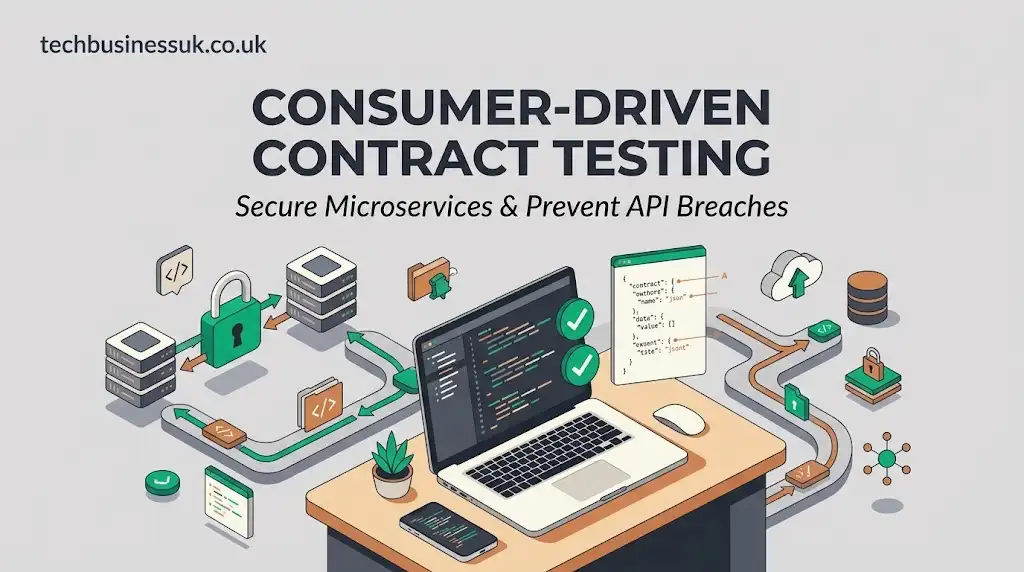
In modern software delivery, engineering teams face a persistent operational paradox. We decouple applications into distributed microservices to accelerate feature velocity, yet our quality assurance processes often remain tethered to monolithic paradigms.
As service counts scale into the tens or hundreds, traditional testing strategies begin to backfire. End-to-End (E2E) integration test suites become fragile, pipeline execution times stretch from minutes to hours, and staging environments turn into bottlenecked staging bottlenecks.
Contract testing offers an architectural alternative to this integration bottleneck. By shifting the verification of inter-service boundaries left into unit testing cycles, contract testing enables decoupled teams to ship backend changes without breaking downstream clients or relying on heavy staging infrastructure.
1. The Integration Bottleneck in Modern Microservices
1.1 The Staging Environment Trap
TTraditional integration testing relies heavily on shared staging environments—replicated deployments where all backend microservices, mobile apps, and single-page applications (SPAs) communicate over a live network.
At enterprise scale, this model exhibits several critical failure modes:
- Cascading Pipeline Failures: If Service C fails to start due to a bad configuration, integration tests for Service A and Service B fail simultaneously, blocking completely unaffected deployments.
- Test Data Pollution: Multiple parallel CI/CD runners mutating state in a shared staging database create race conditions, leading to non-deterministic, flaky test runs.
- Resource Overheads: Maintaining dedicated cloud infrastructure that mirrors production topology incurs steep compute costs and significant DevOps maintenance.
When staging environments become unreliable, engineering teams spend valuable cycles debugging environment configuration issues rather than inspecting actual application code.
1.2 The Shift-Left Testing Paradigm
Contract testing replaces heavy E2E execution with isolated, fast assertions at the network boundary. Instead of deploying Service A and Service B together in a live test environment, contract testing isolates each service, mocking the remote peer while using a machine-readable agreement to guarantee compatibility.
This paradigm shifts boundary verification from post-deployment staging runs straight into pre-commit local builds. Developers catch breaking changes before code merges into main branches.
1.3 Strategic Boundary Testing Within QA Frameworks
Contract testing is not a silver bullet designed to replace unit testing or dynamic application scanners. Instead, it occupies a specific, essential layer within modern QA architectures.
While unit tests validate internal domain logic and security scanners assess endpoint vulnerabilities, contract testing verifies boundary compatibility. Organizations leveraging modern automated API testing tools use contract verification specifically to replace slow E2E integration suites while leaving internal unit logic and security fuzzing to specialized tools.
2. Core Fundamentals – What is Contract Testing?
2.1 Core Definition & Mental Model
At its core, contract testing is a technique for testing an HTTP or message-based integration point by isolating each service and checking its interactions against a shared agreement—the contract.
Instead of verifying how a backend microservice computes a result (business logic), contract testing validates that the service accepts expected request parameters and returns expected response payloads (structural and state agreements).
Consumer-Driven Contract Flow:
1. Consumer Test ---> Generates ---> [Contract JSON (Pact File)]
2. Contract JSON ---> Replayed Against ---> Provider Controller Code (In Isolation)
2.2 Essential Terminology
Understanding contract testing requires establishing three distinct roles:
- Consumer: The client application that initiates network requests to retrieve data or trigger side effects. Examples include React frontends, iOS/Android apps, or downstream microservices.
- Provider: The upstream server service that receives requests, processes payloads, and returns HTTP responses or event messages.
- Contract (The Pact): A structured, version-controlled JSON document that defines the specific expectations of the interaction. It specifies endpoint paths, HTTP methods, headers, query parameters, expected response status codes, and structural body definitions.
2.3 How Contract Testing Compares to Unit and E2E Tests
| Testing Dimension | Unit Testing | Contract Testing | E2E Integration Testing |
|---|---|---|---|
| Scope | Single class, function, or module | Point-to-point service boundary | Complete end-to-end system flow |
| Execution Environment | In-memory / Mocked dependencies | Isolated local runner (No network) | Deployed multi-service staging |
| Execution Speed | Sub-second | Milliseconds per interaction | Minutes to hours |
| Maintenance Cost | Low | Low to Medium | High (Frequent maintenance) |
| Deterministic Output | 100% (High consistency) | 100% (Isolated state) | Low (Flaky network/environment state) |
3. Deep Dive into Consumer-Driven Contract Testing (CDCT)
3.1 Consumer-Driven vs. Provider-Driven Approaches
Traditional API design often follows a provider-driven model: the backend team authors an OpenAPI specification, builds endpoints to match, and expects frontend or downstream teams to adapt.
Consumer-Driven Contract Testing (CDCT) flips this responsibility. In CDCT, the consumer drives the specification of the API. The consumer defines precisely what data fields it needs from the provider—and no more.
This approach provides two significant architectural benefits:
- Unused Field Immunity: If a backend provider deprecates or modifies an unmapped payload field that no consumer has declared in its contract, the provider team knows instantly that the change will not break any active downstream clients.
- Lean Payload Design: It prevents backend engineers from building over-engineered responses containing fields that client applications never parse.
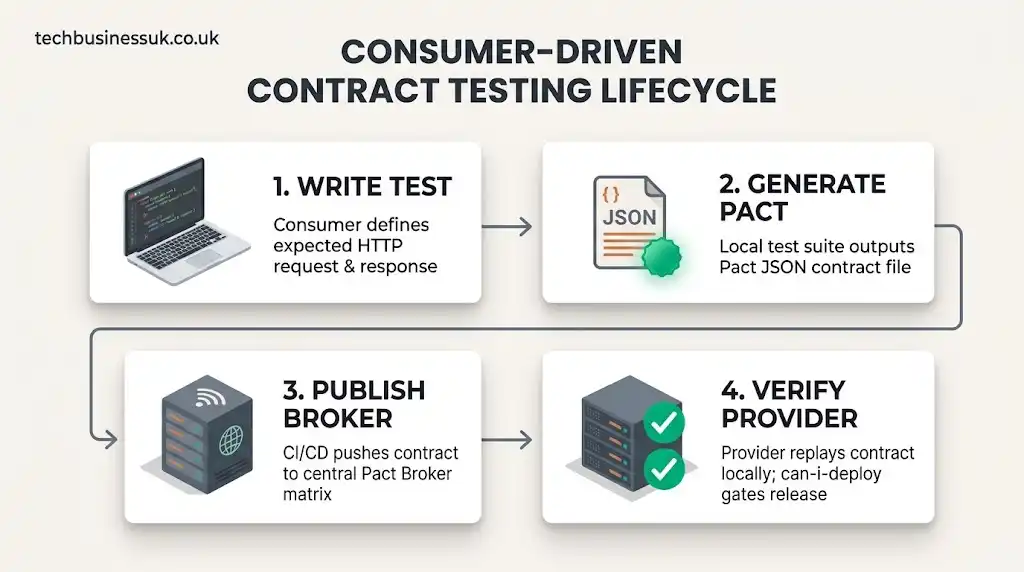
3.2 The 4-Step Lifecycle of a Contract
The life cycle of consumer-driven contract testing follows a disciplined 4-step execution flow:
▼
- Define (Consumer): The consumer author writes a unit-level test against a mock provider server, asserting how the application handles the expected HTTP response.
- Generate (Artifact): Executing the consumer test suite automatically generates a local JSON contract file (a Pact file) capturing the defined interactions.
- Publish (Broker): The CI/CD pipeline uploads the generated JSON artifact to a centralized repository known as a Pact Broker.
- Verify (Provider): The provider’s CI/CD pipeline pulls the contract from the broker and replays the captured requests directly against local provider controllers without deploying the service or running downstream databases.
3.3 Authoritative Specifications
Industry implementation of CDCT heavily relies on the formal Pact contract testing specification. The Pact specification ensures that contract files generated across disparate language stacks (such as a TypeScript frontend and a Go or Java backend) adhere to standardized structural matching rules, request definitions, and provider state hooks.
4. Architectural Comparisons – Contract Testing vs. Alternatives
4.1 Contract Testing vs. OpenAPI / Swagger Schema Validation
A common source of confusion in enterprise architecture is the distinction between schema validation (e.g., OpenAPI/Swagger) and contract testing.
While OpenAPI specifications define what an endpoint can return broadly, consumer-driven contracts define what a specific client actually expects under precise scenarios.
OpenAPI Schema (Broad structural rule):
"user_id" MUST be an integer.

Consumer Contract (Specific scenario expectation):
WHEN requesting "GET /users/42",
EXPECT status 200 AND body containing {"user_id": 42, "role": "admin"}.
OpenAPI checks validation rules statically. It cannot easily verify if a backend route handler returns correct dynamic responses based on explicit consumer states. Contract testing evaluates stateful behavior across execution boundaries.
Failing to distinguish between structural schema validation and state-based contract verification often leads to subtle release issues. Maintaining strict decoupling across changing backend services requires adhering to established API versioning best practices, ensuring schema evolution does not silently bypass consumer boundary assumptions.
4.2 Comprehensive Feature Matrix
| Feature / Dimension | Consumer-Driven Contract Testing (Pact) | Schema Validation (OpenAPI 3.1) | E2E Staging Testing |
|---|---|---|---|
| Primary Focus | Client-provider compatibility | Structural API specification | System workflow verification |
| Execution Trigger | Local pre-commit / Pull Request | Build / Compile step | Post-deployment integration step |
| Network Overhead | Zero (In-memory mock HTTP) | Low (Static evaluation) | High (Real network connections) |
| Catches Breaking Changes | Before code merge | Post-compilation / Linting | Post-deployment to staging |
| State Verification | Yes (Via Provider States) | No (Purely structural) | Yes (Live database execution) |
5. Step-by-Step Implementation with Pact (Node.js/TypeScript Example)
To illustrate consumer-driven contract testing in practice, let’s implement a complete integration workflow using @pact-foundation/pact V3 in a TypeScript environment.
5.1 Project Setup and Dependencies
Install the required dependencies for both the consumer (client application) and provider (backend API):
Bash
npm install --save-dev @pact-foundation/pact @types/jest jest ts-jest typescript axios express
5.2 Writing the Consumer Test
In this scenario, our frontend application (OrderService) consumes a backend user service (UserService) to fetch user profile details via GET /users/:id.
Create tests/consumer/userClient.pact.test.ts:
TypeScript
import { PactV3, MatchersV3 } from '@pact-foundation/pact';
import axios from 'axios';
import path from 'path';

// Initialize the Pact V3 Provider Mock
const provider = new PactV3({
  consumer: 'OrderServiceWeb',
  provider: 'UserServiceAPI',
  dir: path.resolve(process.cwd(), 'pacts'),
});

// Client code executing the actual API call
class UserClient {
  constructor(private baseUrl: string) {}

  async getUser(id: string) {
    const response = await axios.get(`${this.baseUrl}/users/${id}`, {
      headers: { Accept: 'application/json' },
    });
    return response.data;
  }
}

describe('Consumer Test: UserClient interaction with UserServiceAPI', () => {
  it('handles a valid request for an existing user profile', async () => {
    // 1. Arrange: Define expected interaction using type-safe matchers
    provider
      .given('User with ID 100 exists')
      .uponReceiving('a request for user profile 100')
      .withRequest({
        method: 'GET',
        path: '/users/100',
        headers: { Accept: 'application/json' },
      })
      .willRespondWith({
        status: 200,
        headers: { 'Content-Type': 'application/json' },
        body: {
          id: MatchersV3.like('100'),
          email: MatchersV3.regex(
            '^[a-zA-Z0-9._%+-]+@[a-zA-Z0-9.-]+\\.[a-zA-Z]{2,}$',
            'alex.dev@example.com'
          ),
          role: MatchersV3.equal('ADMIN'),
        },
      });

    // 2. Act & Assert: Execute consumer call against the local Pact mock server
    await provider.executeTest(async (mockServer) => {
      const client = new UserClient(mockServer.url);
      const user = await client.getUser('100');

      expect(user.id).toBe('100');
      expect(user.role).toBe('ADMIN');
    });
  });
});
Running this test via Jest executes the client logic against Pact’s local HTTP mock engine and generates the contract file ./pacts/OrderServiceWeb-UserServiceAPI.json.
5.3 Generated Pact JSON Contract Artifact
The automatically generated contract artifact contains structural matching rules rather than static values:
JSON
{
  "consumer": { "name": "OrderServiceWeb" },
  "provider": { "name": "UserServiceAPI" },
  "interactions": [
    {
      "description": "a request for user profile 100",
      "providerStates": [{ "name": "User with ID 100 exists" }],
      "request": {
        "method": "GET",
        "path": "/users/100",
        "headers": { "Accept": "application/json" }
      },
      "response": {
        "status": 200,
        "headers": { "Content-Type": "application/json" },
        "body": {
          "id": "100",
          "email": "alex.dev@example.com",
          "role": "ADMIN"
        },
        "matchingRules": {
          "body": {
            "$.id": { "matchers": [{ "match": "type" }] },
            "$.email": { "matchers": [{ "match": "regex", "regex": "^[a-zA-Z0-9._%+-]+@[a-zA-Z0-9.-]+\\.[a-zA-Z]{2,}$" }] },
            "$.role": { "matchers": [{ "match": "equality" }] }
          }
        }
      }
    }
  ],
  "metadata": { "pactSpecification": { "version": "3.0.0" } }
}
5.4 Writing the Provider Verification Test
The provider service reads the generated contract and replays every defined interaction against its local controllers.
Create tests/provider/userProvider.pact.test.ts:
TypeScript
import { Verifier } from '@pact-foundation/pact';
import express from 'express';
import { Server } from 'http';
import path from 'path';

// Express Application representing Provider Service
const app = express();
app.use(express.json());

// Mocked controller route handler
app.get('/users/:id', (req, res) => {
  if (req.params.id === '100') {
    return res.status(200).json({
      id: '100',
      email: 'user100@enterprise.internal',
      role: 'ADMIN',
    });
  }
  return res.status(404).end();
});

describe('Provider Verification: UserServiceAPI against OrderServiceWeb Contract', () => {
  let server: Server;

  beforeAll((done) => {
    server = app.listen(8081, () => done());
  });

  afterAll((done) => {
    server.close(() => done());
  });

  it('validates local endpoints against the consumer contract', async () => {
    const verifier = new Verifier({
      providerBaseUrl: 'http://localhost:8081',
      provider: 'UserServiceAPI',
      pactUrls: [
        path.resolve(process.cwd(), 'pacts/OrderServiceWeb-UserServiceAPI.json'),
      ],
      stateHandlers: {
        'User with ID 100 exists': async () => {
          // Setup provider state (e.g., inject mock database record)
          return Promise.resolve('Provider state initialized');
        },
      },
    });

    const output = await verifier.verifyProvider();
    console.log('Pact Verification Output:', output);
  });
});
6. Pipeline Integration & Preventing Production Downtime
6.1 The Role of Pact Broker and PactFlow
In team environments, storing contract files in version control creates cross-repository synchronization friction. A Pact Broker serves as an internal artifact registry for contracts and verification results.
The Pact Broker maps compatibility across environments using a matrix of consumer versions, provider versions, and environment tags (dev, staging, production).
6.2 Gatekeeping Deployments with can-i-deploy
The Pact CLI provides a deployment gatekeeping utility: can-i-deploy. Before any service deploys to production, the CI/CD runner queries the Pact Broker matrix to verify if the specific version build has passed verification against all active consumer contracts in that target environment.
If a backend developer introduces a breaking API change and attempts to deploy, can-i-deploy returns a non-zero exit code, immediately aborting the deployment step before live traffic is impacted.
6.3 Embedding Gateways in Automated Workflows
For teams utilizing modern release engineering practices, contract evaluation must run directly inside primary build pipelines. Integrating specialized API test automation tools in CI/CD pipelines alongside can-i-deploy assertions ensures every pull request enforces strict boundary verification before reaching target clusters.
6.4 CI/CD Pipeline Configuration Example
Below is an example workflow incorporating contract verification within GitHub Actions deployment workflows:
YAML
name: Provider Verification & Deployment Gate

on:
  push:
    branches: [ main ]

jobs:
  verify-and-gate:
    runs-on: ubuntu-latest
    steps:
      - uses: actions/checkout@v4

      - name: Setup Node.js
        uses: actions/setup-node@v4
        with:
          node-version: '20'

      - name: Install Dependencies
        run: npm ci

      - name: Run Provider Contract Verification
        run: npm run test:pact:provider
        env:
          PACT_BROKER_BASE_URL: ${{ secrets.PACT_BROKER_BASE_URL }}
          PACT_BROKER_TOKEN: ${{ secrets.PACT_BROKER_TOKEN }}

      - name: Check Deployment Matrix (can-i-deploy)
        run: |
          npx @pact-foundation/pact-node broker can-i-deploy \
            --pacticipant UserServiceAPI \
            --version ${{ github.sha }} \
            --to-environment production \
            --broker-base-url ${{ secrets.PACT_BROKER_BASE_URL }} \
            --broker-token ${{ secrets.PACT_BROKER_TOKEN }}
7. Common Pitfalls & Anti-Patterns to Avoid
7.1 Using Contract Tests for Functional Business Logic
Contract tests should never attempt to validate deep business calculations, edge-case algorithms, or complex data processing pipelines.
- Incorrect: Asserting that a discount code correctly reduces a shopping cart total from $100 to $85 across multiple complex item combinations.
- Correct: Asserting that
POST /cart/checkoutreturns a 200 status code with a numericfinal_amountpayload field.
Functional business logic belongs in dedicated backend unit and integration tests. Contract tests should remain focused on schema structures, field types, and HTTP status codes.
7.2 Hardcoding Environment State and Dynamic Identifiers
Hardcoding static database IDs, timestamps, or transient strings inside contract assertions creates brittle tests that fail on subsequent runs.
- Anti-Pattern: Asserting
created_at: "2026-09-01T20:30:00Z". - Best Practice: Utilizing Pact dynamic matchers:
MatchersV3.iso8601Timestamp().
7.3 Neglecting Asynchronous and Event-Driven Architectures
Contract testing is not restricted to synchronous HTTP REST interfaces. Modern enterprise applications rely heavily on asynchronous event streaming platforms such as Apache Kafka, RabbitMQ, and AWS SQS.
Contract testing frameworks support Message Pact, allowing teams to define payload contract structures for asynchronous published events and subscribed message queues, guaranteeing schema compatibility across message producers and consumers.
8. Strategic Conclusion & Next Steps
Consumer-driven contract testing provides a practical solution to the modern microservice integration dilemma. By replacing heavy, fragile end-to-end staging suites with fast, deterministic boundary verification, organizations can decouple development teams and ship backend features with higher confidence.
Adopting CDCT requires a shift in engineering culture—moving from reactive staging debugging to proactive, consumer-driven boundary definitions. When combined with centralized broker matrix verification and strict CI/CD gatekeeping, contract testing eliminates breaking API changes before they reach production environments.
About the Author

1 thought on “Contract Testing: How Consumer-Driven QA Prevents API Breaches”