Your API works today. Six months from now, you’ll need to change it. A field will need to move. A response shape will need to shift. A whole authentication flow might get replaced. And somewhere out there, dozens of client applications are calling your endpoints right now, built on the assumption that nothing changes underneath them.
That assumption is the problem. Breaking changes are not a possibility in API development — they’re a certainty. The only real choice you have is whether you handle that certainty deliberately, with a versioning strategy, or whether you handle it accidentally, with a support inbox full of angry developers and a production incident at 2 a.m.
Poor versioning doesn’t just cause technical bugs. It breaks trust. A client who wakes up to a failed integration because your team pushed a change silently will think twice before building on your platform again. Versioning, in this sense, isn’t a feature. It’s a non-functional requirement — a quality attribute your API must satisfy regardless of what business logic it executes, in the same way performance and security are, as covered in our guide on functional vs non-functional requirements.
This guide walks through the API versioning best practices that separate mature API programs from chaotic ones — the real strategies teams use to version APIs without breaking their consumers, how versioning gets harder (and different) in microservices, and how to sunset an old version without setting off a support fire drill.
TL;DR: API Versioning Best Practices
- API versioning lets you evolve your API without breaking existing clients — it’s a contract, not a formality.
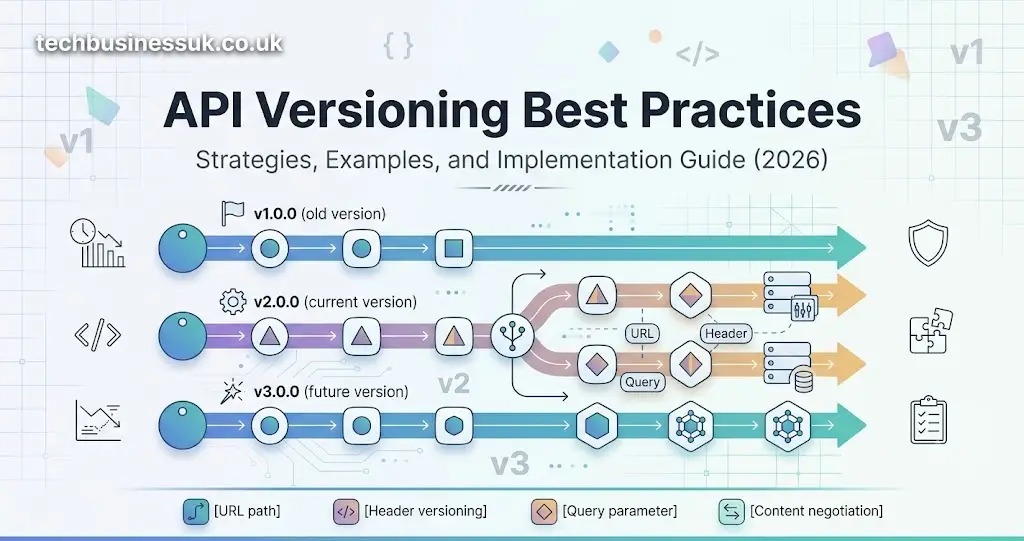
- Four main strategies exist: URL path, query parameter, header versioning, and content negotiation — each with real tradeoffs in cache-friendliness, discoverability, and complexity.
- Semantic Versioning (MAJOR.MINOR.PATCH) gives your version numbers actual meaning instead of arbitrary labels.
- The best practice isn’t picking the “perfect” strategy — it’s picking one early, documenting it clearly, and communicating deprecation well before you pull support.
- Skipping versioning doesn’t save time. It just moves the cost to a future outage.
What Is API Versioning?
API versioning is the practice of managing multiple versions of an API at the same time, so you can evolve your system without breaking the clients already depending on it.
Here’s why this matters more than it might seem: an API is a contract. When you publish an endpoint, you’re making an implicit promise to every developer who integrates with it — this is what you’ll send me, this is what I’ll send back. Versioning is how you keep that promise even while the underlying system keeps evolving.
There’s a permanent tension sitting underneath every versioning decision: innovation versus stability. You want to ship new features, fix design mistakes, and improve your API’s shape. Your existing clients want none of that to affect them. Versioning is the mechanism that lets both things happen simultaneously.
A simple example makes this concrete. Say your payments API needs a new currency_code field on every transaction object. Adding that field doesn’t break existing clients — they’ll just ignore a field they don’t recognize. But if you rename an existing field, or change its data type, every client parsing that response breaks immediately. That distinction — additive change versus breaking change — is the entire reason versioning exists.
Why API Versioning Is Essential
Backward compatibility. Breaking changes are unavoidable over the life of any real API. Versioning gives you a migration path instead of a cliff edge — clients can move to the new version on their own timeline, not yours.
Client trust. Nothing erodes developer trust faster than a silent breaking change. A well-versioned API signals professionalism: we know things change, and we’ve built a system so that change doesn’t hurt you.
Business agility. Versioning is what actually lets your team ship fast. Without it, every change carries the risk of breaking someone’s production integration — which quietly pressures teams toward never changing anything, which is its own kind of failure.
Regulatory compliance. In regulated industries — finance, healthcare, insurance — you often need a documented, auditable trail of exactly what changed, when, and why. A clear versioning scheme is half of that audit trail already built for you.
It’s worth noting that versioning discipline doesn’t stop at endpoints and payloads. Authentication mechanisms evolve too — a token format, an OAuth scope, an expiry policy can all change between versions, which is exactly the kind of detail covered in our guide on API authentication methods. Versioning and auth changes often move together, and treating them separately is a common oversight.
API Versioning Strategies
There are four dominant strategies in production use today. None of them is universally “correct” — each is a genuine tradeoff, and the right choice depends on your API’s audience, your infrastructure, and how strict you need to be about REST principles.
1. URL Path Versioning
How it works: The version number lives directly in the URL path.
GET https://api.example.com/v1/users
Pros: It’s simple. It’s explicit — anyone reading the URL instantly knows which version they’re hitting. It’s also cache-friendly, since different versions have genuinely different URLs, which plays nicely with CDNs and HTTP caching layers.
Cons: It pollutes your URL space, and technically duplicates routes across versions, which can bloat your API surface over time.
Best for: Public APIs and REST APIs where discoverability and simplicity matter more than strict REST purity.
Real-world examples: Stripe, GitHub, and Twilio all use URL path versioning as their primary or supported scheme — it’s the most common pattern you’ll see in the wild for exactly this reason.
2. Query Parameter Versioning
How it works: The version is passed as a query parameter.
GET https://api.example.com/users?version=1
Pros: Simple to implement, and it doesn’t change your core URL structure — the resource path stays clean.
Cons: It’s not cache-friendly in most setups (many caching layers ignore query strings by default), and it’s easy for clients to simply forget to include it, silently falling back to some default version.
Best for: Internal APIs and situations where you’re iterating quickly and don’t need the rigor of a full versioning scheme yet.
3. Header Versioning
How it works: The version is passed inside an HTTP header, often using a custom media type.
Accept: application/vnd.example.v1+json
Pros: Keeps URLs completely clean, and aligns more closely with REST principles — the resource identifier stays constant while the representation of that resource varies by version.
Cons: It’s less discoverable — a developer can’t just glance at a URL and know the version — and it adds complexity for API consumers, who now need to manage headers correctly rather than just changing a URL segment.
Best for: RESTful APIs and API-first companies that prioritize architectural purity over convenience.
Real-world example: Stripe supports this approach as an alternative to their URL path versioning, giving consumers a choice depending on their integration style.
4. Content Negotiation
How it works: Version information is embedded directly in the Accept header using media types, following HTTP’s native content negotiation mechanism.
Accept: application/json; version=1
Pros: This is the most RESTful approach available, following HTTP standards as closely as possible rather than layering a custom scheme on top.
Cons: It’s also the most complex to implement correctly, and requires both server and client to handle content negotiation properly — a real barrier for less sophisticated API consumers.
Best for: Strict REST APIs, typically inside organizations with strong architectural governance and a client base sophisticated enough to handle it.
API Versioning Strategies: Comparison Table
| Strategy | Example | Cache-Friendly | Discoverability | Implementation Complexity | Best For | Popular Examples |
| URL Path | /v1/users | Yes | High | Low | Public REST APIs | Stripe, GitHub, Twilio |
| Query Parameter | ?version=1 | No | Medium | Low | Internal APIs, fast iteration | — |
| Header Versioning | Accept: application/vnd.example.v1+json | Yes | Low | Medium | RESTful, API-first companies | Stripe (alt. scheme) |
| Content Negotiation | Accept: application/json; version=1 | Yes | Low | High | Strict REST APIs | — |
Semantic Versioning for APIs
Version numbers shouldn’t be arbitrary. Semantic Versioning (SemVer) gives every version number actual, predictable meaning, following a simple MAJOR.MINOR.PATCH format.
- MAJOR — incremented for breaking, incompatible changes. If a client needs to change their integration code to keep working, this number moves.
- MINOR — incremented for new, backward-compatible features. Clients don’t have to change anything, but new functionality is now available.
- PATCH — incremented for backward-compatible bug fixes. Nothing about the contract changes; something just works correctly now.
Take a version like v2.1.3. That single string tells a developer everything they need to know at a glance: this is the second major iteration of the API (meaning there have been breaking changes since v1), it has received one round of new backward-compatible features since 2.0, and three patch-level bug fixes since then.
The full specification — including edge cases like pre-release labels and build metadata — is maintained at semver.org, which is worth bookmarking as the canonical reference whenever your team debates how to bump a version number.
API Versioning Best Practices
1. Plan for versioning from day one. Retrofitting a versioning scheme onto an API that’s already live, with existing clients depending on undocumented assumptions, is significantly harder than designing it in from the start. Decide your strategy before your first public release, not after your first breaking change.
2. Choose a strategy and stick to it. Switching versioning schemes midway through an API’s life creates exactly the kind of confusion versioning is supposed to eliminate. Pick one of the four strategies above and commit.
3. Support multiple versions during transition. Never force an instant cutover. Run the old and new versions in parallel long enough for clients to migrate on a reasonable timeline.
4. Use semantic versioning. Arbitrary version labels (v2-final, v2-new) tell your consumers nothing. SemVer tells them exactly what kind of change to expect.
5. Document versioning clearly. Every version should have its own changelog, migration notes, and clear indication of what’s different from the previous one. Undocumented versioning is barely better than no versioning at all.
6. Test all active versions. Every version you support in production needs active test coverage — not just the newest one. This is exactly where a solid testing setup matters: our guide to API Testing Tools covers how to structure test suites that validate multiple concurrent API versions without duplicating your entire test codebase for each one.
7. Monitor version usage. You can’t safely deprecate a version if you don’t know who’s still using it. Track usage per version so deprecation decisions are based on real data, not guesswork.
8. Communicate deprecation early and often. Silence before a sunset date is how trust gets broken. Say it early, say it more than once, and make sure it’s genuinely hard to miss.
API Versioning in Microservices
Versioning gets meaningfully harder once you move from a single API to a distributed system with dozens of services, each owned by a different team, each on its own release cycle.
The challenge: In a monolith, one team controls the whole API surface. In microservices, versioning decisions made by one team can ripple across services they don’t own, and coordinating a breaking change across ten teams is a fundamentally different problem than coordinating it across one.
Three strategies help manage this complexity:
Consumer-Driven Contract Testing. Rather than a central team guessing what “breaking” means for every downstream consumer, each consuming service defines a contract describing exactly what it expects from the provider. Changes get tested against every registered contract before release — if a change would break any consumer’s contract, it fails the build before it ever reaches production.
API Gateway Versioning. A gateway sitting in front of your microservices can route requests to different backend versions based on the version specified in the URL or header — meaning individual services don’t each need to reinvent version-routing logic themselves. Our detailed breakdown of what an API gateway does covers exactly how this routing layer fits into the broader request lifecycle, including how it centralizes concerns like auth and rate limiting alongside version routing.
Service Versioning. Each individual microservice manages and exposes its own version independently, giving teams full autonomy over their own release cadence, at the cost of needing clear conventions so the overall system doesn’t become a tangle of inconsistent versioning schemes.
A common real-world pattern: the gateway inspects an incoming request’s version header, then routes that request to the correct backend service version — invisible to the client, who only ever talks to one stable gateway endpoint.
How to Deprecate an API Version
Deprecation is the formal process of phasing out an old API version — and doing it badly is one of the fastest ways to damage developer trust in your platform.
Announce early. Give clients real lead time — six to twelve months is the standard window for anything with meaningful adoption. Shorter timelines punish clients for integrating with you in good faith.
Communicate clearly, repeatedly, and through multiple channels. Email your registered developers. Update your documentation. Add in-band warning headers to responses from the deprecated version itself, so even developers who missed the email get a direct signal.
Provide migration guides. Don’t just announce that something is changing — show exactly how to move to the new version, with concrete before/after examples.
Monitor usage continuously. Track exactly who’s still calling the deprecated version, right up until sunset. This tells you who needs direct, personal outreach before you pull the plug.
Set a firm sunset date. A deprecation with no real end date isn’t a deprecation — it’s a suggestion. Commit to a date, publish it, and hold to it.
Consider extended support for enterprise clients. Large contractual customers sometimes need longer transition windows than your general developer base. Building in a formal extended-support tier avoids ad-hoc exceptions negotiated under pressure.
GitHub’s own deprecation process is a widely cited example of doing this well — clear advance notice, in-band warnings on deprecated endpoints, and a firm, well-communicated sunset timeline.
Real-World Failure: When API Versioning Was Missing
Here’s a scenario that plays out more often than most engineering teams would like to admit.
A fast-growing SaaS company needed to ship an urgent product change. Under deadline pressure, the team modified a core API response — restructuring a nested object that dozens of client applications depended on — and pushed it live without introducing a new version.
The consequence was immediate. Within hours, dozens of client applications integrated with that endpoint began failing. Support tickets flooded in. Client-side engineering teams scrambled to understand what had changed, since nothing in the documentation had warned them.
The outcome stretched well beyond that first day: lost client trust, direct revenue impact from broken integrations, and weeks of manual firefighting to patch client-side code and rebuild confidence with affected partners.
The lesson is simple, and it’s the same one this entire guide comes back to: versioning is not optional. It’s a fundamental responsibility that comes with publishing an API other people depend on — not an advanced feature reserved for mature platforms.
Decision Matrix: Which Versioning Strategy Should You Choose?
| Scenario | Recommended Strategy | Why |
| Public REST API | URL Path Versioning | Maximizes discoverability and cache-friendliness for a broad, less-technical developer audience |
| Internal API | Query Parameter Versioning | Fast to implement; acceptable tradeoffs for lower-stakes, internal-only consumers |
| API-First Company | Header Versioning | Keeps URLs clean and aligns with a strong REST-first architectural philosophy |
| Strict REST API | Content Negotiation | Fully adheres to HTTP standards for organizations prioritizing architectural purity |
| Microservices Architecture | API Gateway Versioning + Consumer-Driven Contracts | Centralizes routing complexity while protecting individual service teams from each other’s changes |
Conclusion
Following solid API versioning best practices is a promise to your consumers — a commitment that your API can keep evolving without pulling the ground out from under the people building on it. Done well, it builds trust, enables real innovation, and prevents the kind of outage that costs both revenue and reputation in a single afternoon.
The strategy you choose matters less than choosing one early, documenting it clearly, and communicating every change — especially deprecations — well before your clients are forced to find out the hard way.
Whether you’re validating a single version or several running in parallel, having the right API Testing Tools in place is what makes multi-version support sustainable rather than a constant source of regressions.
Frequently Asked Questions
What is API versioning? API versioning is the practice of managing multiple versions of an API simultaneously, allowing the API to evolve over time without breaking existing client integrations.
What are the main API versioning strategies? The four primary strategies are URL path versioning, query parameter versioning, header versioning, and content negotiation — each with different tradeoffs around discoverability, caching, and implementation complexity.
What is the best API versioning strategy? There’s no single best strategy — it depends on your API’s audience and architecture. URL path versioning tends to work best for public-facing REST APIs, while header versioning or content negotiation suit API-first companies with strict REST principles.
What is semantic versioning for APIs? Semantic Versioning (SemVer) is a MAJOR.MINOR.PATCH numbering scheme where each segment communicates a specific type of change: breaking, backward-compatible feature additions, or backward-compatible bug fixes.
How do you deprecate an API version? Announce the deprecation early (typically six to twelve months in advance), communicate clearly through multiple channels, provide migration guides, monitor usage, and commit to a firm sunset date.
Why is API versioning important? It preserves backward compatibility, protects client trust, enables business agility by allowing safe iteration, and — in regulated industries — supports compliance requirements around auditable change history.
About the Author



1 thought on “API Versioning Best Practices: Strategies, Examples, and Implementation Guide (2026)”