Every API architecture review eventually hits the same wall: the system passes every functional unit test, looks flawless in staging demos, and still leaks sensitive customer records the second a malicious payload hits a production route.
Application Programming Interfaces (APIs) form the invisible highways of modern enterprise software. They power microservice networks, drive mobile backends, and handle financial transactions. Because they expose direct pathways to backend databases and business logic, they have become the primary surface area for modern web attacks. API-related security incidents surging by over 400% in recent years.
A single unvalidated route, exposed parameter, or missing authorization policy can allow attackers to dump entire user tables, bypass payment workflows, or compromise internal infrastructure.
Validating an API requires verifying both functional correctness and non-functional resilience. While functional testing confirms that an endpoint returns expected outputs for valid inputs, rigorous API security testing proves that your architecture resists abuse when presented with unexpected, malicious, or out-of-order payloads.
What Is API Security Testing?
API security testing is the systematic process of analyzing, probing, and validating Application Programming Interfaces to discover vulnerabilities, implementation flaws, and logic weaknesses before malicious actors can exploit them.
Unlike generic vulnerability scanning, true API security testing evaluates how an API manages identity, enforces data access policies, sanitizes structured payloads, and maintains system availability under adversarial conditions.
The core goals of an enterprise API security testing strategy include:
- Vulnerability Identification: Locating architectural flaws such as broken access controls, weak authentication tokens, and injection vectors.
- Data Protection: Ensuring sensitive information—such as Personally Identifiable Information (PII), credentials, and financial metrics—remains encrypted in transit and isolated across multi-tenant boundaries.
- Regulatory Compliance: Satisfying statutory requirements under frameworks like GDPR, HIPAA, and PCI-DSS through verifiable security controls.
- Integrity Assurance: Preventing unauthorized payload modifications, parameter tampering, and state-machine manipulation.
- Risk Minimization: Reducing total enterprise exposure by catching security regressions inside developer delivery pipelines before release.
Why API Security Testing Is Different from Web App Testing
Traditional Web Application Security Testing (WAST) was built for the monolithic HTML era. Scanners crawled Document Object Models (DOMs), filled out visible forms, and checked rendered web pages for reflected Cross-Site Scripting (XSS).
APIs operate under an entirely different execution paradigm:
+-----------------------------------------------------------------------+
|                       Traditional Web App Scanners                    |
|  [Browser / UI] ---> Crawls HTML Form ---> Renders DOM (Reflected XSS)|
+-----------------------------------------------------------------------+
                                    vs.
+-----------------------------------------------------------------------+
|                       Modern API Security Testing                     |
|  [Raw HTTP / JSON] ---> State-Machine State ---> Direct DB / Logic    |
|  (No GUI, Stateful JWTs, BOLA/IDOR, Complex Object Trees, RPCs)       |
+-----------------------------------------------------------------------+- Absence of a User Interface: APIs have no graphical front end. Security tools cannot rely on crawling clickable buttons; they must parse structured contracts like OpenAPI/Swagger schemas, GraphQL introspection trees, or Protobuf definitions.
- Direct Exposure of Backend Logic: API endpoints interact directly with internal databases, messaging queues, and microservice orchestration layers. Bypassing client-side validation logic is trivial when a user can manipulate raw HTTP request headers and JSON payloads directly.
- Complex State Management: Modern APIs communicate statelessly using complex tokens (such as OAuth2 and JWTs). Testing must account for multi-step workflows, object-level authorization matrices, and property-level permissions rather than static page responses.
API Security Testing vs. API Penetration Testing
Engineering teams often conflate automated security testing with manual penetration testing. Both are critical components of a defense-in-depth posture, but they serve fundamentally different operational roles within the delivery lifecycle:
| Capability / Attribute | API Security Testing | API Penetration Testing |
|---|---|---|
| Execution Method | Automated, continuous, contract-driven scanning | Manual, creative human exploration and exploit crafting |
| Execution Cadence | Continuous (Every PR, nightly build, release gate) | Periodic (Quarterly, biannual, or pre-compliance audit) |
| Primary Focus | Catching known vulnerability patterns and schema drifts | Uncovering novel zero-days and multi-step business logic exploits |
| Pipeline Integration | High (Integrated into GitHub Actions, GitLab CI, Jenkins) | Low (Out-of-band external security assessment) |
| Cost & Speed | Low marginal cost per run; rapid feedback loops | High cost per engagement; multi-week evaluation windows |
Continuous Security Scanning: Ensures that API deployments remain consistently hardened against known architectural flaws and automated regressions on every code commit.
Manual Penetration Testing: Validates whether those continuous defenses hold up against determined human adversaries crafting creative, multi-step exploits.
To streamline automated execution across your delivery pipelines, choosing the right toolset is critical. Explore our dedicated breakdown of modern API Testing Tools to select runners that natively support security automation alongside your functional integration suites.
The OWASP API Security Top 10 (2023): Testing Approaches and Proof-of-Fix
The Open Web Application Security Project (OWASP) maintains a dedicated API Security Top 10 standard reflecting the most prevalent, high-impact vulnerabilities facing modern application programming interfaces.
Official Threat Specifications: Review the official OWASP API Security Top 10 Specification for complete vulnerability classifications, risk vectors, and mitigation guidelines.
Evaluating your system against these ten risk categories is essential for establishing verifiable proof-of-fix controls across both REST and GraphQL architectures.
+-------------------------------------------------------------------+
|               OWASP API SECURITY TOP 10 OVERVIEW                  |
|                                                                   |
| [API1] BOLA               [API2] Broken Auth                      |
| [API3] Property Auth      [API4] Resource Limits                  |
| [API5] Function Auth      [API6] Sensitive Business Flows         |
| [API7] SSRF               [API8] Security Misconfigurations       |
| [API9] Inventory Errors   [API10] Unsafe Third-Party Consumption   |
+-------------------------------------------------------------------+
API1:2023 – Broken Object Level Authorization (BOLA)
In modern API security testing, identifying Broken Object Level Authorization (formerly known as Insecure Direct Object References or IDOR) is the top priority, as it remains the #1 most severe and widely exploited API security vulnerability in production.
It occurs when an endpoint exposes user-controlled object identifiers (such as /api/v1/accounts/{account_id}/transactions) without verifying that the authenticated caller holds explicit authorization to access or modify that specific resource.
Real API Example
When executing API security testing for BOLA, automated scanners or security engineers simulate authorization bypass attempts. An attacker authenticates legitimately as User A (who owns account ID 101) and receives a valid Bearer token. The attacker then intercepts and tampers with the request parameter, and substitutes another user’s ID (102):
HTTP
GET /api/v1/accounts/102/transactions HTTP/1.1
Host: api.example.com
Authorization: Bearer <User_A_Token>
If the API returns transaction data for User B (account_id: 102), a critical BOLA vulnerability exists.
Testing Strategy
During API security testing, validating BOLA defenses requires an automated, multi-identity test framework. Relying on single-user test runs will completely miss authorization flaws:
- Dual-Token Matrix Assertion: Maintain dedicated API security testing suites equipped with credentials for two distinct, isolated tenants (Tenant A and Tenant B).
- Resource Identification: Automatically extract valid resource IDs owned exclusively by Tenant B.
- Cross-Tenant Replay Attacks: Replay API calls using Tenant A‘s authorization headers while targeting Tenant B‘s protected resource paths.
- Full HTTP Verb Coverage: Execute these cross-tenant matrix tests across all supported HTTP methods (
GET,PUT,PATCH,DELETE) to ensure read, update, and deletion routes are equally protected.
Token Matrix Verification Flow:
[User A Token] ---> Sends Request to /api/v1/users/User_B_ID/profile
                      |
                      +---> Returns 200 OK  [VULNERABLE: BOLA Detected]
                      +---> Returns 403/404 [SECURE: Access Control Enforced]
Proof-of-Fix Evidence
The endpoint responds with an explicit 403 Forbidden or 404 Not Found HTTP status code, accompanied by a server-side audit event logging the unauthorized cross-tenant attempt.
API2:2023 – Broken Authentication
Broken Authentication occurs when authentication mechanisms are implemented incorrectly, enabling attackers to compromise authentication tokens, exploit JWT implementation bugs, or assume unauthorized identities.
Real API Example
An API accepts a JSON Web Token (JWT) where the header signature algorithm has been intentionally modified to "alg": "none":
JSON
{
  "alg": "none",
  "typ": "JWT"
}
If the backend fails to validate signatures or strips signature checks when "alg": "none" is present, unauthenticated callers can forge arbitrary JWT claims (e.g., "sub": "admin").
Testing Strategy
- Signature Bypass Verification: Strip JWT signatures or submit tokens signed with public keys (RSA to HMAC algorithm confusion attacks).
- Expiry Verification: Submit expired tokens (
exptimestamp set in the past) and confirm immediate execution rejection. - Credential Robustness: Test password reset endpoints for brute-force rate-limiting defenses and OTP predictability.
For a deeper dive into token implementation standards, read our guide on API Authentication Methods and review our breakdown of What Is a Bearer Token.
Proof-of-Fix Evidence
The server rejects malformed or unverified tokens immediately with a 401 Unauthorized status code, producing structured authentication failure logs server-side.
API3:2023 – Broken Object Property Level Authorization
This category merges Excessive Data Exposure and Mass Assignment. It occurs when an API exposes sensitive object properties in JSON responses without filtering, or allows clients to modify protected object properties during write operations.
Real API Example
A registration endpoint accepts user creation parameters via POST /api/v1/users:
JSON
{
  "username": "john_doe",
  "email": "john@example.com",
  "is_admin": true,
  "account_balance": 1000000
}
If the backend automatically maps incoming JSON fields directly to database entities without explicit property binding (DTOs), the caller successfully escalates privileges.
Testing Strategy
- Mass Assignment Fuzzing: Inject unexpected schema properties (e.g.,
is_admin,role,verified,tenant_id) intoPOSTandPUTrequest payloads. - Response Schema Differential: Compare returned JSON structures against published OpenAPI definitions to ensure internal database fields (
password_hash,ssn) are not exposed.
Proof-of-Fix Evidence
Extra fields injected into write payloads are stripped silently or rejected with a 400 Bad Request schema validation error, and response structures strictly mirror defined public schemas.
API4:2023 – Unrestricted Resource Consumption
APIs that fail to impose constraints on request volume, execution complexity, or resource allocations leave backends vulnerable to Denial of Service (DoS) attacks and severe infrastructure cost spikes.
Real API Example
Sending an HTTP request with an unconstrained pagination limit parameter:
HTTP
GET /api/v1/logs?limit=99999999 HTTP/1.1
Host: api.example.com
This query forces the application database to load millions of records into memory, exhausting database connection pools and causing system-wide latency degradation.
Testing Strategy
- Pagination Limit Bounds: Send negative, zero, and extremely high numerical values to limit/page parameters.
- Volumetric Request Spikes: Execute high-frequency request bursts against compute-heavy endpoints to test rate-limiting buckets.
- Payload Compression Bombing: Submit gzip-compressed payloads designed to expand into gigabytes of uncompressed memory upon arrival.
Proof-of-Fix Evidence
The API enforces maximum page bounds and returns a 429 Too Many Requests status code with valid Retry-After response headers upon exceeding rate thresholds.
API5:2023 – Broken Function Level Authorization (BFLA)
Broken Function Level Authorization occurs when access control policies are applied inconsistently across different user roles or HTTP methods.
Real API Example
A standard user lacks UI access to administrative functions, but successfully calls administrative API routes directly by changing the HTTP verb or path prefix:
HTTP
DELETE /api/v1/admin/users/102 HTTP/1.1
Host: api.example.com
Authorization: Bearer <Standard_User_Token>
Testing Strategy
- Administrative Path Probing: Attempt invoking paths containing
/admin,/v2/management, or/internalusing unprivileged user credentials. - HTTP Verb Tampering: Send
PUT,POST, orDELETErequests to endpoints designed exclusively forGEToperations.
Proof-of-Fix Evidence
Unprivileged access attempts to administrative endpoints return a 403 Forbidden response across all non-administrative tokens.
API6:2023 – Unrestricted Access to Sensitive Business Flows
This flaw occurs when an API exposes business workflows—such as discount code redemptions, ticket purchases, or account registrations—without accounting for automated abuse or velocity attacks.
Real API Example
An e-commerce API allows automated scripts to execute POST /api/v1/coupons/redeem tens of thousands of times per minute, draining promotional funds before legitimate users can participate.
Testing Strategy
- Velocity Testing: Execute rapid, automated sequence loops through high-value business workflows without introducing artificial delays.
- Bot-Mitigation Verification: Probe endpoints for missing CAPTCHA enforcement, device fingerprinting, or anti-automation challenge triggers.
Proof-of-Fix Evidence
Automated flow triggers step-up authentication, CAPTCHA challenges, or temporary access restrictions when request thresholds are breached.
API7:2023 – Server-Side Request Forgery (SSRF)
Server-Side Request Forgery (SSRF) happens when an API fetches a remote resource from a client-supplied URL without validating the destination host or IP address range.
Real API Example
A webhook registration endpoint accepts client URLs:
JSON
{
  "callback_url": "http://169.254.169.254/latest/meta-data/"
}
If the backend server fetches this callback URL directly, it exposes internal cloud instance metadata credentials to the external client.
Testing Strategy
- Internal Address Probing: Inject link-local (
169.254.169.254), loopback (127.0.0.1), and internal network ranges (10.0.0.0/8,192.168.0.0/16) into parameter fields accepting URIs. - Out-of-Band (OAST) Verification: Supply unique DNS listener hostnames to capture out-of-band requests generated by backend processors.
Proof-of-Fix Evidence
Outbound requests targeting non-routable, loopback, or private internal IP addresses are dropped by network validation middleware and firewalls.
API8:2023 – Security Misconfiguration
Security misconfigurations stem from unhardened default settings, permissive Cross-Origin Resource Sharing (CORS) policies, unencrypted communications, or overly verbose error stack traces.
Real API Example
An API encounters an unhandled runtime database exception and returns a detailed 500 Internal Server Error response payload:
JSON
{
  "error": "Database error",
  "detail": "pg_connect(): Connection failed to host 10.0.2.14 user db_admin password 'SecretPass123!'"
}
Testing Strategy
- Error State Inducement: Send corrupted JSON formatting, mismatched types, and invalid headers to trigger error handlers.
- Security Header Auditing: Inspect response headers for missing security directives (
Strict-Transport-Security,Content-Type-Options). - CORS Validation: Send requests with arbitrary
Originheaders to verify that credentials are not exposed across permissive wildcards (Access-Control-Allow-Origin: *).
Proof-of-Fix Evidence
API errors return standardized error contracts containing non-sensitive error codes, while detailed stack traces are redirected to internal telemetry platforms.
API9:2023 – Improper Inventory Management
Improper Inventory Management occurs when deprecated API versions, shadow endpoints, or staging environments remain exposed to the public internet without proper maintenance.
Real API Example
While v2 of an API enforces multi-factor authentication, an unpatched /api/v0/debug/export route remains active and accessible without authentication.
Testing Strategy
- Path Version Enumeration: Fuzz API base paths for legacy version segments (
/v1/,/v0/,/beta/,/dev/). - Schema Drift Analysis: Compare active production endpoints against the official, published OpenAPI inventory specs.
Proof-of-Fix Evidence
All active routes map strictly to published OpenAPI specifications, while deprecated routes return 404 Not Found or 410 Gone HTTP responses.
API10:2023 – Unsafe Consumption of APIs
Developers routinely trust data received from third-party or upstream APIs more than raw user input, failing to sanitize incoming third-party payloads before processing.
Real API Example
An API fetches product catalog data from an external partner API and concatenates returned JSON fields directly into local SQL queries, creating a secondary SQL Injection vector.
Testing Strategy
- Dependency Mocking Payload Injection: Inject malicious strings (SQLi, Command Injection, XSS) into mock third-party API service responses.
- Validate that local processing layers sanitize third-party inputs prior to storage or query execution.
Proof-of-Fix Evidence
All data received from upstream third-party services passes through strict schema validation and parameter binding layers prior to system execution.
The Continuous API Security Testing Workflow
An enterprise API security testing workflow requires structured, repeatable phases to ensure total coverage across all endpoints:
[Phase 1: Recon & Contract Analysis]
                 |
                 v
[Phase 2: Authentication Testing]
                 |
                 v
[Phase 3: Authorization Matrix Execution]
                 |
                 v
[Phase 4: Payload Fuzzing & Input Validation]
                 |
                 v
[Phase 5: Remediation & Verification Retesting]
- Phase 1: Reconnaissance & Contract Analysis: Parsing OpenAPI/Swagger specifications, GraphQL schemas, or Protobuf definitions to generate complete endpoint route inventories.
- Phase 2: Authentication Testing: Validating JWT signatures, token revocation checks, session time-to-live settings, and login attempt rate limits.
- Phase 3: Authorization Matrix Execution: Running automated cross-tenant and role-hierarchy matrices across all state-changing routes.
- Phase 4: Payload Fuzzing & Input Validation: Injecting boundary conditions, invalid formats, and malicious strings into HTTP headers, query parameters, and JSON fields.
- Phase 5: Remediation & Verification Retesting: Documenting failure metrics, applying code fixes, and re-executing automated regression runs to confirm patch effectiveness.
Types of API Security Tests
| Test Type | Operational Mechanism | Primary Vulnerability Targets |
|---|---|---|
| Penetration Testing | Simulated adversarial attacks combining automated tooling with human manual probing | Complex multi-step business logic flaws and multi-tier exploits |
| Fuzzing Tests | Injecting malformed, unexpected, or random payloads into structured API fields | Buffer overflows, uncaught backend exceptions, memory leaks, parser crashes |
| Auth & Authz Tests | Executing dual-token cross-user validation matrices | BOLA, BFLA, Broken Authentication, Mass Assignment |
| Data Integrity Tests | Verifying encryption layers, TLS configurations, and parameter tampered inputs | Injection vulnerabilities (SQLi, NoSQLi, Command Injection) |
| Compliance Tests | Validating data retention policies, authorization logging, and PII masking controls | Violations of GDPR, PCI-DSS, and SOC2 compliance criteria |
Cross-Protocol Testing: Beyond REST
While traditional REST APIs dominate internet traffic, enterprise modern architectures heavily rely on GraphQL and gRPC for internal microservices and high-throughput web frontends. Security testing tools designed strictly for REST HTTP endpoints will miss protocol-specific vulnerabilities.
+-----------------------------------------------------------------------+
|                       CROSS-PROTOCOL THREAT MAP                      |
+------------------------------------+----------------------------------+
|           GraphQL Threats          |           gRPC Threats           |
+------------------------------------+----------------------------------+
| * Introspection Exposure           | * Active Reflection Services     |
| * Cyclic Query Depth DoS           | * Unencoded Protobuf Injection   |
| * Batch Query Rate Limit Bypass    | * Missing Interceptor Auth Checks|
+------------------------------------+----------------------------------+
GraphQL Security Testing
- Introspection Exposure: Publicly accessible introspection queries allow attackers to download your entire database schema and field definitions in a single call.
- Cyclic Query Depth Attacks: Deeply nested queries (user { friends { friends { friends } } }) can exhaust server CPU and memory, triggering DoS.
- Batch Request Abuse: Sending arrays of multiple operations within a single HTTP payload enables attackers to bypass per-request rate limits.
- Testing Tools: Use dedicated tools such as
InQLorGraphQL-Copto validate query cost caps and introspection disabling rules.
gRPC Security Testing
- Protobuf Fuzzing: Testing high-performance binary gRPC streams requires protocol-aware tools that can decode
.protoschema definitions. - Reflection Probe: Verify whether the gRPC Server Reflection Protocol is disabled in production environments to prevent schema exposure.
- Testing Tools: Utilize
ghzfor volumetric benchmarking andgrpc-curlalongside Protobuf-aware fuzzers to test RPC interceptors.
API Security Testing Tools
Executing continuous security checks requires selecting automated tooling tailored to your protocol stack and workflow. For a complete analysis of enterprise suites, explore our review of API Security Tools.
Open Source Tools
- OWASP ZAP (Zed Attack Proxy): A flexible, open-source dynamic web scanner that supports OpenAPI schema importing and scriptable API scanning.
- OWASP API Security Testing Framework (ASTF): An open-source, continuous security runner built specifically for APIs. ASTF auto-discovers API routes, executes 12 security test cases covering the entire OWASP API Top 10 2023, and natively supports GraphQL and gRPC checks. When validated against the benchmark repository [OWASP crAPI GitHub Repository], ASTF auto-discovered 832 endpoints and identified 11 distinct vulnerability classes.
- Burp Suite Community Edition: The standard proxy tool for manual endpoint inspection, payload manipulation, and authentication testing.
Commercial Tools
- Postman Enterprise: Provides team collaboration platforms alongside integrated security scanning and automated schema validation.
- apisec.ai: An automated platform focused on continuous API discovery and AI-driven business logic flaw detection.
- Beagle Security: Provides automated penetration testing platforms that integrate directly into developer pipelines.
- Bright Security: A developer-centric DAST solution providing contract-aware payload fuzzing with minimal false-positive rates.
API Security Testing in CI/CD Pipelines
A major breakdown in modern software engineering is the security execution gap: only 12% of organizations execute continuous security scans on every code commit. The majority defer security checks to pre-release testing gates, creating severe delivery bottlenecks.
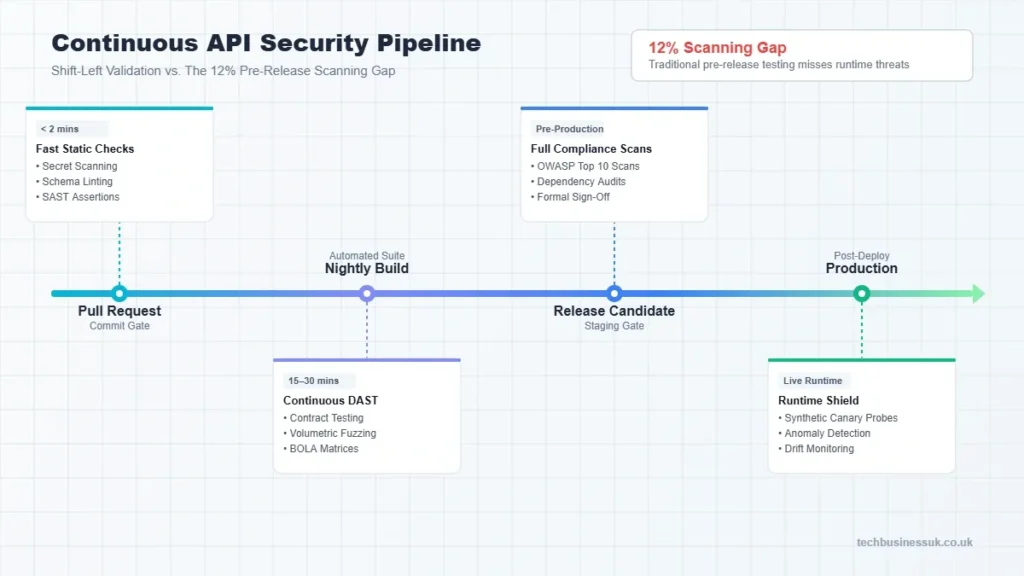
Shift-Left Pipeline Stages
To secure APIs without slowing developer velocity, security checks must be distributed logically across the delivery lifecycle:
| Pipeline Stage | Recommended Tests | Execution Target | Gate Impact |
|---|---|---|---|
| Pull Request (Commit) | Schema validation, secret scanning, static code analysis (SAST) | Execution time: < 2 mins | Block merge on high-confidence findings |
| Nightly Build | Contract-driven DAST, authorization matrix testing, volumetric fuzzing | Execution time: 15–30 mins | Flag ticket for immediate triage |
| Release Candidate | Full OWASP Top 10 regression scans, dependency vulnerability scans | Pre-production staging | Formal sign-off verification |
| Production Post-Deploy | Synthetic canary security probes, inventory drift monitoring | Live production | Real-time security alerting |
Resolving the Unauthenticated Scan Gap
A common failure pattern in automated security programs is running DAST scanners unauthenticated. Unauthenticated scanners only reach public login routes and /health endpoints, leaving 95% of your internal API surface completely unmonitored. Ensure your pipeline security runners use valid OAuth/JWT test credentials to assess authenticated routes.
Real-World Failure: What Happens When You Skip API Security Testing
To understand the real-world impact of neglecting API security testing, consider the following incident breakdown of a microservices platform breach:
                  THE EXPLOIT CHAIN BREAKDOWN

[ 1. Introspection Probe ] ---> Discovers Hidden Schema Fields
                                          |
                                          v
[ 2. JWT Claim Inspection ] ---> Extracts Target Resource UUIDs
                                          |
                                          v
[ 3. Unchecked BOLA Call ]  ---> Exfiltrates 2M Records (Unthrottled)
The Incident
A fast-growing fintech company built a microservices architecture to process user loans. The engineering team enforced high testing standards, achieving over 95% functional unit test coverage. Every API endpoint passed its unit and integration tests successfully.
The Exploit Chain
- Reconnaissance: An attacker targeted the public GraphQL gateway and discovered that introspection was left enabled in production. The attacker downloaded the full schema, revealing hidden administrative user IDs and record fields.
- Enumeration: The attacker registered a standard account and inspected their own JWT claims, discovering that resource paths relied on predictable UUID structures.
- Exploitation: By substituting another user’s ID into the loan history endpoint
(/api/v1/loans/{loan_id}), the attacker discovered a severe BOLA vulnerability. The backend verified that the Bearer token was valid, but failed to check if the token owner matched the requested loan record. - Exfiltration: Because the endpoint lacked rate-limiting controls, the attacker scripted automated requests that exfiltrated over 2 million sensitive customer records in under three hours.
The Impact
- Financial Fines: Multi-million dollar regulatory penalties for non-compliance with GDPR data protection laws.
- Development Halt: Engineering teams froze all feature development for two months to rewrite authentication and authorization middleware.
- Brand Erosion: Public disclosure led to significant loss of customer trust and enterprise partner churn.
The Key Lesson: High functional test coverage guarantees only that your API works as expected under normal conditions. It tells you nothing about how your architecture behaves when an attacker intentionally sends unexpected or unauthorized payloads.
API Security Testing Decision Matrix
Use this scenario-based matrix to determine the correct security testing strategy for your engineering pipeline:
| Trigger / Scenario | Recommended Test Framework | Execution Gate | Pass Criteria |
|---|---|---|---|
| New API Endpoint PR | SAST, Schema Linting, BOLA Authorization Checks | Pull Request Pre-Merge | 0 High/Critical findings; Spec compliance verified |
| Major Version Release | Full OWASP Top 10 Scan, Fuzzing, Third-Party Dependency Checks | Staging Release Candidate | Zero unresolved vulnerabilities; All proof-of-fix evidence passed |
| Compliance Audit (SOC2/GDPR) | OWASP Top 10 Audit Scan, Manual Penetration Test | Quarterly Gate | Documented proof-of-fix logs for all identified endpoints |
| Production Runtime Verification | Canary Synthetic Security Probes, Schema Drift Monitoring | Continuous Production | Real-time notification on unexpected status codes or shadow routes |
Best Practices for API Security Testing
- Adopt Shift-Left Security: Embed security scans into developer local environments and pull request pipelines rather than relying exclusively on pre-release gates.
- Automate Test Execution: Integrate continuous tools like the OWASP ASTF into your CI/CD pipelines to run automated scans on every build.
- Maintain Accurate API Specifications: Treat OpenAPI and GraphQL schemas as living documentation. Ensure production deployments match specs strictly to eliminate shadow endpoints.
- Implement Negative Testing: Write negative unit and integration assertions that intentionally supply invalid tokens, malformed JSON, and cross-tenant resource IDs.
- Educate Development Teams: Train backend engineers on secure coding standards, property-level authorization principles, and token validation patterns.
Conclusion: API Security Testing Is Not Optional
APIs are the core foundation of modern software systems—and attackers know it. Relying exclusively on functional unit testing leaves your platform exposed to severe authorization flaws, data breaches, and costly service interruptions.
Building a resilient API architecture requires balancing developer velocity with continuous, automated security verification. An end-to-end continuous validation strategy typically relies on three core pillars:
- Architectural Alignment: Establishing clear boundary lines through Functional vs Non-Functional Requirements.
- Execution Infrastructure: Selecting appropriate pipeline runners from modern API Testing Tools.
- Automated Vulnerability Scanning: Implementing specialized protocols and AST scanners using dedicated API Security Tools.
Embedding automated security assertions into daily developer workflows shifts security from a release-blocking gate into an active technical guardrail.
FAQs
Frequently Asked Questions
What is API security testing?
Why is API security testing important?
What are the OWASP API Security Top 10?
What tools are used for API security testing?
How often should I test API security?
What’s the difference between API security testing and penetration testing?
What is the most common API security vulnerability in production?
How can we test for BOLA automatically in CI/CD pipelines?
About the Author

2 thoughts on “API Security Testing: 7 Essential Rules for Developers”