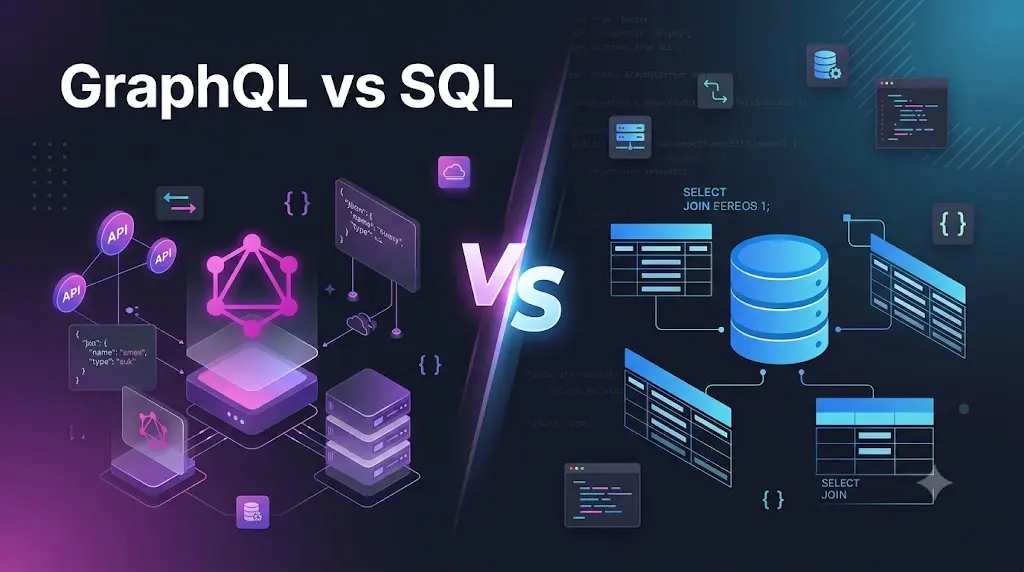
If you’ve spent any time exploring modern web development, you’ve probably come across the debate around GraphQL vs SQL. At first glance, they seem related. After all, both have “Query Language” in their names. But that’s where the similarity ends.
One of the biggest misconceptions is that GraphQL is a replacement for SQL. It isn’t. GraphQL is an API query language that helps clients request exactly the data they need. SQL, on the other hand, is the language used to interact with relational databases.
Think of it this way. SQL talks directly to a database. GraphQL talks to an API server, which may use SQL behind the scenes to fetch data.
So, GraphQL vs SQL isn’t really a battle. In many real-world applications, they work together. A GraphQL server often translates incoming requests into SQL queries before retrieving data from databases like PostgreSQL or MySQL.
In this guide, you’ll learn:
- What GraphQL is
- What SQL is
- How each one works
- Their major differences
- Performance considerations
- When to use GraphQL, SQL, or both
By the end, you’ll have a clear understanding of where each technology fits into a modern application stack.
What Is GraphQL?
GraphQL is an API query language and runtime developed by Facebook (now Meta). Like any API technology, it should be thoroughly tested before deployment. If you’re exploring ways to validate API performance, functionality, and security, check out our comprehensive guide to API Testing Tools.
Instead of forcing clients to accept a fixed response, GraphQL lets them ask for exactly the fields they need.
Imagine ordering food at a restaurant. With GraphQL, you don’t receive the entire menu when all you wanted was a burger and fries. You simply request those items, and that’s exactly what you get.
That’s the core idea behind GraphQL.
If you’d like to explore the official specification and learn more about GraphQL concepts, the GraphQL Learn documentation is an excellent starting point.
A Brief History
Facebook introduced GraphQL internally in 2012 to improve the performance of its mobile applications. The company later released it as an open-source project in 2015.
Today, GraphQL powers APIs used by startups and large enterprises alike because it provides a flexible way to fetch and organize data.
GraphQL Is Not a Database
This point deserves repeating. GraphQL is not a database. It doesn’t store information. It doesn’t replace MySQL or PostgreSQL. Instead, it sits between your client and one or more data sources.
Those data sources might include:
- PostgreSQL
- MySQL
- SQL Server
- MongoDB
- Redis
- REST APIs
- Third-party APIs
- Cloud services
GraphQL simply provides a consistent way for clients to request data, regardless of where that data comes from.
How GraphQL Works
A typical GraphQL request follows this flow:
GraphQL is only one part of an API ecosystem. In production environments, it’s common for requests to pass through an API gateway before reaching GraphQL services.
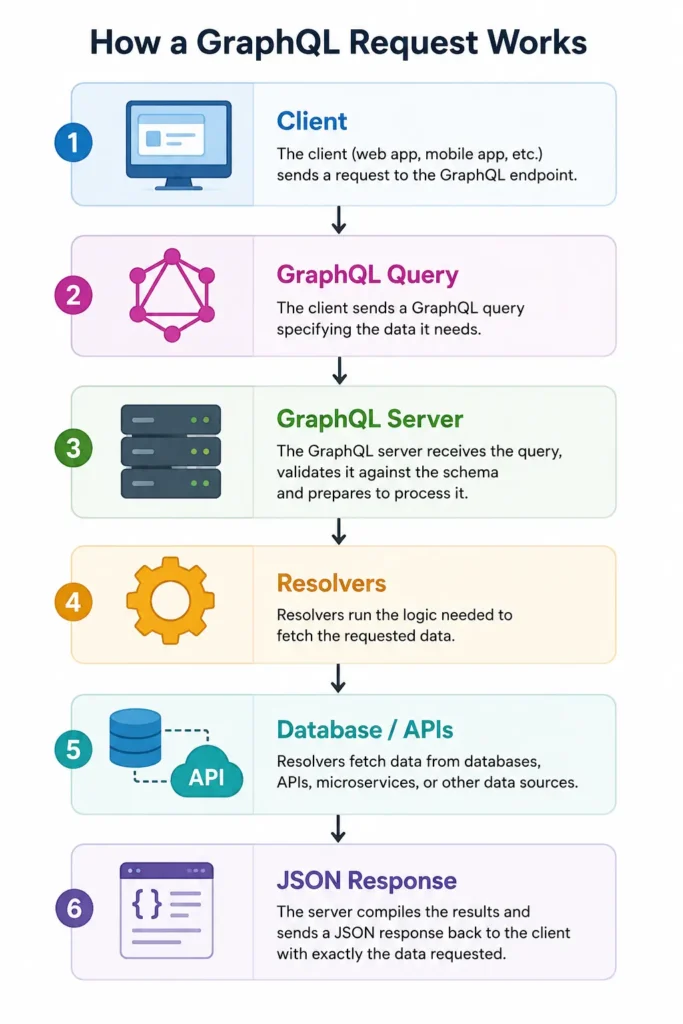
When a client sends a query, the GraphQL server doesn’t automatically know where the requested data lives.
Instead, it relies on resolvers.
Resolvers are functions responsible for fetching data from the appropriate source.
For example, one resolver might retrieve user information from PostgreSQL, while another fetches order details from a REST API.
The client never needs to know.
Core Components of GraphQL
Schema
Every GraphQL API is built around a schema.
The schema defines:
- Available data types
- Relationships
- Queries
- Mutations
- Subscriptions
It acts as a contract between the client and the server.
Queries
Queries retrieve data.
Example:
{
  user(id: 5)
 {
    name
    email
  }
}
}
Only the requested fields are returned.
Example response:
JSON
{
  "data": {
    "user": {
      "name": "Sarah",
      "email": "sarah@example.com"
    }
  }
}
Mutations
Mutations modify data.
They can:
- Create records
- Update records
- Delete records
Example:
mutation {
  createUser(name: "John") {
    id
    name
  }
}
Subscriptions
Subscriptions provide real-time updates.
They’re commonly used in:
- Chat applications
- Stock market dashboards
- Live sports scores
- Notifications
Instead of repeatedly asking the server for updates, the server pushes new data whenever something changes.
Why Developers Like GraphQL
GraphQL solves two common API problems.
Over-Fetching
Suppose a REST endpoint returns:
- Name
- Address
- Phone
- Birthdate
- Orders
- Preferences
But your application only needs the user’s name. The remaining data is unnecessary. That’s over-fetching.
Under-Fetching
Now imagine you need:
- User details
- Orders
- Reviews
A REST API may require three separate requests.
GraphQL lets you request everything in a single query.
That reduces network requests and simplifies frontend development.
Benefits of GraphQL
Some of the biggest advantages include:
- Clients request only the data they need.
- A single endpoint serves many different queries.
- Strong typing improves reliability.
- APIs become self-documenting through the schema.
- Frontend teams gain more flexibility.
- Multiple data sources can be combined behind one API.
These benefits make GraphQL especially popular for mobile apps, dashboards, and applications with multiple client platforms.
What Is SQL?
SQL stands for Structured Query Language.
Unlike GraphQL, SQL is designed specifically for relational databases.
If your data lives inside tables made up of rows and columns, SQL is the language you use to interact with it.
Whether you’re retrieving records, inserting new data, updating existing values, or deleting information, SQL is the standard tool for the job.
A Brief History
SQL dates back to the 1970s and was inspired by relational database research conducted at IBM.
Over the years, it became the industry standard for relational databases.
Today, almost every major relational database supports SQL in one form or another.
Popular examples include:
- MySQL
- PostgreSQL
- Microsoft SQL Server
- Oracle Database
- SQLite
- MariaDB
Although each database has its own extensions, the core SQL syntax remains largely the same.
Understanding Tables
Relational databases organize information into tables.
Consider a simple Users table.
| ID | Name | Age | |
|---|---|---|---|
| 1 | Sarah | sarah@example.com | 24 |
| 2 | Ali | ali@example.com | 31 |
| 3 | Emma | emma@example.com | 28 |
Each row represents a record.
Each column stores a specific type of information.
SQL allows you to retrieve, filter, sort, join, and modify this data efficiently.
Basic SQL Operations
SELECT
Retrieves data from a table.
SELECT name, email
FROM Users;
INSERT
Adds new records.
INSERT INTO Users(name, email)
VALUES ('John', 'john@example.com');
UPDATE
Modifies existing records.
UPDATE Users
SET email='john123@example.com'
WHERE id=1;
DELETE
Removes records.
DELETE FROM Users
WHERE id=1;
These four commands form the foundation of everyday database operations.
How SQL Retrieves Data
When an SQL query reaches the database, several things happen behind the scenes.
The database engine:
- Parses the query.
- Validates the syntax.
- Optimizes the execution plan.
- Uses indexes whenever possible.
- Retrieves the requested rows.
- Returns the results.
Modern database systems are highly optimized.
Even queries involving millions of records can execute quickly when indexes and schemas are designed properly.
Why SQL Is Still Essential
Despite the rise of newer technologies, SQL remains one of the most valuable skills in software development.
It’s trusted because it offers:
- ACID-compliant transactions
- Reliable data consistency
- Powerful filtering
- Complex joins
- Aggregation functions
- Mature optimization techniques
- Decades of community support
From banking systems and e-commerce platforms to healthcare applications and enterprise software, SQL continues to power many of the world’s most critical systems.
GraphQL vs SQL at a Glance
The easiest way to understand the difference is to compare their primary roles.
| Feature | GraphQL | SQL |
|---|---|---|
| Primary Purpose | Query language for APIs | Query language for relational databases |
| Works With | APIs and multiple data sources | Relational databases |
| Introduced By | Meta (Facebook) | IBM (based on relational model) |
| Main Use | Client-server communication | Data storage and retrieval |
| Data Sources | Multiple databases, APIs, services | Relational database tables |
| Response Format | JSON | Tables (rows and columns) |
| Flexibility | Clients choose requested fields | Developers write database queries |
| Endpoint | Usually a single endpoint | Direct database connection |
| Standard | GraphQL Specification | ANSI SQL Standard |
So, what’s the big difference?
GraphQL focuses on how applications request data.
SQL focuses on how databases store and retrieve data.
They’re built for different jobs, and in many applications, they complement each other rather than compete.
How GraphQL Works
Understanding GraphQL becomes much easier when you look at a typical request from start to finish.
Imagine a user opens an online shopping app… and wants to view their profile… along with their latest orders!
Instead of making several API calls, the application sends one GraphQL query requesting exactly the required fields.
Here’s what happens next:
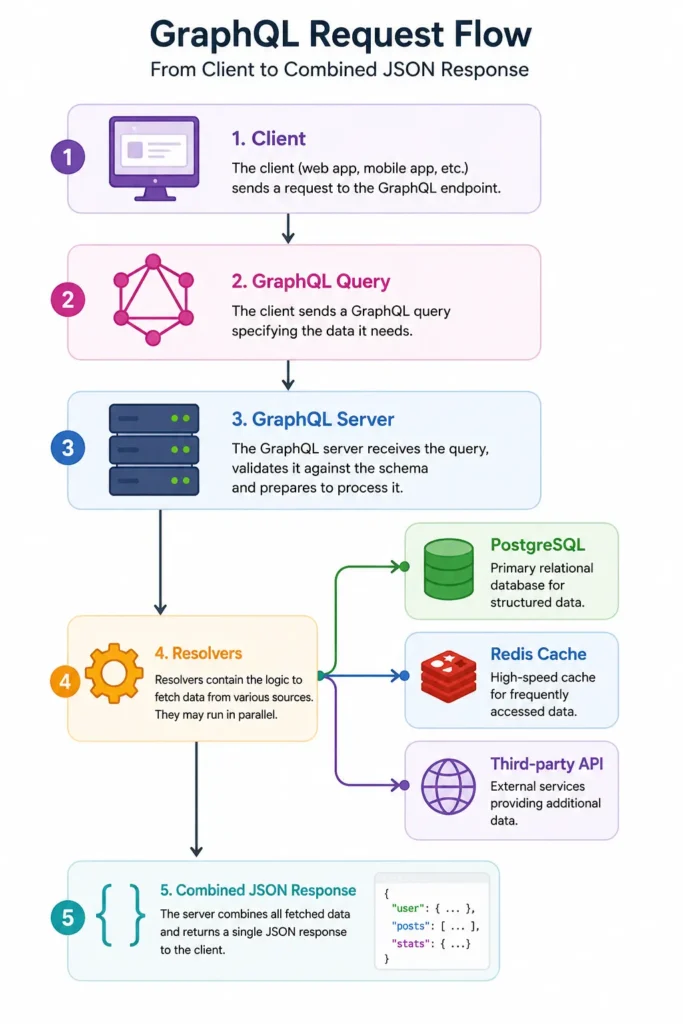
The GraphQL server receives the query and checks it against its schema. Before processing a request, most GraphQL servers also verify the client’s identity using authentication mechanisms such as API keys, OAuth, or JWT. If you’re unfamiliar with these approaches, then this guide API Authentication Methods explains how they work and when to use each.
If the request is valid, it calls the appropriate resolvers.
Each resolver fetches data from its assigned source. One may query a PostgreSQL database using SQL. Another might retrieve cached data from Redis. A third could call an external payment service.
Finally, GraphQL combines everything into a single JSON response that matches the exact structure requested by the client.
This design is one of GraphQL’s biggest strengths. It hides the complexity of multiple back-end systems behind a clean, flexible API.
Now we’ll explore how SQL works internally, compare GraphQL vs SQL feature by feature, examine performance, security, practical code examples, and help you decide which technology is the right fit for your project.
How SQL Works
Now that you’ve seen how GraphQL operates as an API layer, it’s time to look at the other side of the equation. Understanding SQL is essential if you want to fully grasp the GraphQL vs SQL discussion.
Unlike GraphQL, SQL communicates directly with a relational database. In simple terms, SQL is the language that databases understand.
It doesn’t fetch data from APIs or external services. Instead, it retrieves, updates, inserts, and deletes information stored in database tables.
The SQL Request Flow
When an application sends an SQL query, the database doesn’t immediately return the results. Several steps happen behind the scenes.
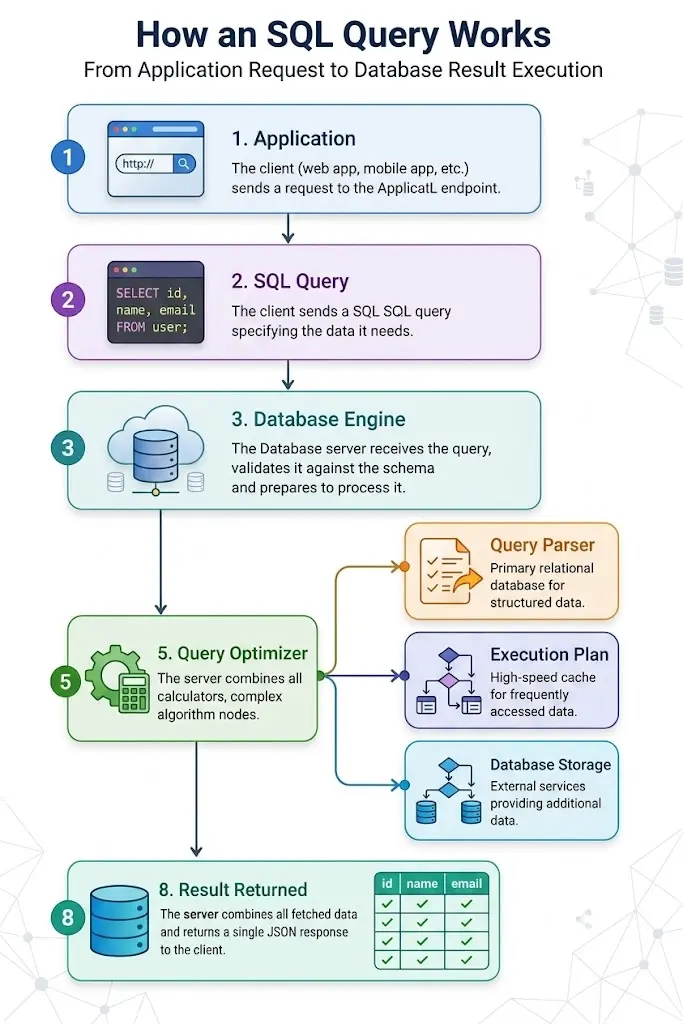
Although this process sounds complicated, modern database engines perform these steps in milliseconds.
Step 1: The Query Parser
The parser checks whether your SQL query follows the correct syntax.
For example, this query is valid:
SELECT name, email
FROM users
WHERE id = 10;
If you accidentally misspell a keyword or reference a table that doesn’t exist, the parser throws an error before the database does anything else.
Step 2: The Query Optimizer
Behind the scenes, the Query Optimizer does the heavy lifting. By acting like a GPS, the system plots multiple routes to the data and picks the fastest path rather than just running the query blindly.
The optimizer considers several factors:
- Available indexes — Can the database jump directly to matching rows?
- Table size — Larger tables require more careful optimization.
- Join order — The sequence of table joins significantly impacts performance.
- Data distribution — How data is spread across columns and partitions.
- Existing statistics — Up-to-date statistics help the optimizer make informed decisions.
Because of this optimization, two SQL queries that produce the same result may have very different execution times.
Step 3: Accessing the Data
As soon as the execution plan is ready, the database pulls the requested records.
If indexes are available, the database can jump directly to the matching rows instead of scanning the entire table.
That’s why indexing is one of the biggest factors affecting SQL performance.
Step 4: Returning the Results
Finally, the database returns the matching rows to the application.
Depending on the query, the result might contain:
- One row
- Thousands of rows
- Aggregated values
- Joined data from multiple tables
Unlike GraphQL, SQL returns data in rows and columns rather than JSON.
Why SQL Is So Fast
Developers often praise SQL databases for their speed, and for good reason.
Relational database systems have been optimized for decades. Features like indexing, caching, query optimization, and transaction management allow them to process massive datasets efficiently.
For example, retrieving a single customer record from a table containing millions of rows can take only a few milliseconds when the appropriate indexes are in place.
Of course, SQL isn’t automatically fast. Poor schema design, missing indexes, or inefficient queries can still slow things down. But when used correctly, SQL delivers exceptional performance for relational data.
Main Differences Between GraphQL and SQL
GraphQL and SQL might sound similar because both are query languages, yet their use cases rarely overlap. They address different challenges in software development. To understand how they differ, let us examine their key characteristics.
1. Purpose
The purpose of GraphQL is to help clients interact with APIs.
It defines what data the application needs.
The purpose of SQL is to interact with relational databases; it specifies how to retrieve and modify data.
Think of GraphQL as a waiter who takes your order.
SQL is the chef who prepares the order you placed, not the waiter.
Similarly, it is SQL that manages the database, not GraphQL.
2. Where They Operate
GraphQL operates at the API layer. It sits between the client and the data sources. SQL operates within the database layer. It interacts directly with tables, indexes, constraints, and transactions. In many applications, a GraphQL request ultimately translates into one or more SQL queries. This means that GraphQL does not replace SQL; rather, it relies on it.
3. Data Sources
GraphQL is highly flexible.
A single query can combine information from multiple places, including:
- PostgreSQL
- MySQL
- MongoDB
- Redis
- REST APIs
- Payment gateways
- Authentication services
The client doesn’t need to know where the data comes from.
SQL, on the other hand, works with relational databases.
It cannot directly aggregate information from several unrelated services the way GraphQL can.
4. Query Structure
One of the reasons GraphQL has become so popular is its flexibility.
The client specifies exactly which fields it wants.
For example:
{
  user(id: 1) {
    name
    email
  }
}
The response contains only those two fields.
SQL takes a different approach.
The developer writes a database query against specific tables.
SELECT name, email
FROM users
WHERE id = 1;
Both queries retrieve similar information, but they’re executed at different layers of the application.
5. Flexibility
GraphQL gives more control to the client.
Different pages in an application can request different fields without changing the server endpoint.
For example:
A profile page might request:
- Name
- Profile picture
A dashboard might request:
- Name
- Total orders
- Loyalty points
- Recent purchases
Both requests can use the same GraphQL endpoint.
With SQL, flexibility exists at the database level, but it isn’t exposed directly to end users.
Instead, backend developers decide which SQL queries should run and what information the application receives.
6. Performance
Performance is one of the hottest topics in the GraphQL vs. SQL debate.
The truth? Neither technology is universally faster because they solve performance problems at completely different layers of the stack.
How GraphQL Optimizes Performance
GraphQL improves application speed primarily by reducing network latency and payload sizes over the wire:
- Single Network Round-Trip: Instead of making three or four sequential API requests to fetch user profiles, order histories, and notification badges, a client retrieves everything it needs in a single query.
- Elimination of Over-Fetching: Mobile clients on spotty cellular connections load faster because they only download the exact fields required to render the screen, drastically lowering bandwidth and payload parse times.
The GraphQL Performance Trap: The N+1 Problem
However, GraphQL introduces performance challenges on the backend if not engineered carefully.
Because GraphQL field resolvers run independently, naive implementations frequently trigger the N+1 query problem. For example, fetching 50 posts and their respective authors can accidentally trigger 1 database query for the posts, followed by 50 individual queries for each author.
Since GraphQL resolvers perform heavy I/O-bound tasks, leveraging asynchronous execution (like Python’s async/await) along with batching utilities like DataLoader is critical to coalesce multiple nested database lookups into single, batched SQL queries.
How SQL Optimizes Performance
While GraphQL optimizes data transmission, SQL optimizes raw execution and data processing.
SQL database performance relies on database-level architecture rather than network calls:
- Schema Design & Normalization: Structuring relational tables efficiently to eliminate data redundancy.
- Indexing Strategies: Creating B-Tree or Hash indexes to ensure lookup times remain fast even as tables scale to millions of rows.
- Query Optimization & Execution Plans: The database engine’s query planner analyzes incoming SQL to determine the fastest algorithm for filtering, joining, and sorting data.
- Hardware & Memory Allocation: Utilizing dedicated RAM for buffer pools and fast NVMe storage to execute disk I/O operations in milliseconds.
A well-indexed SQL database can query and join millions of structured records in fractions of a second because modern relational engines are purpose-built for massive-scale data processing.est lifecycle.
Key Takeaway
The GraphQL vs SQL comparison isn’t about choosing one winner.
GraphQL improves the way applications request and deliver data.
SQL powers the database that stores and retrieves that data.
In most production applications, they work together. A GraphQL server receives client requests, translates them into optimized SQL queries, and returns only the data the client actually needs. This complementary architecture is one of the main reasons GraphQL has become a popular API layer while SQL remains the foundation of relational databases.
GraphQL vs SQL Example
Theory is helpful. But seeing both technologies in action makes the difference much clearer.
Let’s say you’re building an e-commerce application. A customer opens their profile page and wants to view:
- Name
- Latest three orders
With GraphQL, the client requests only those fields.
GraphQL Query
query {
  user(id: 1) {
    name
    email
    orders(limit: 3) {
      id
      total
      status
    }
  }
}
The server responds with exactly what the client requested.
{
  "data": {
    "user": {
      "name": "Sarah",
      "email": "sarah@example.com",
      "orders": [
        {
          "id": 102,
          "total": 89.99,
          "status": "Delivered"
        },
        {
          "id": 101,
          "total": 45.50,
          "status": "Shipped"
        },
        {
          "id": 100,
          "total": 29.99,
          "status": "Processing"
        }
      ]
    }
  }
}
Simple. Clean. No extra data.
Behind the scenes, though, the GraphQL server still has work to do.
A resolver might execute SQL queries similar to these:
SELECT id, name, email
FROM users
WHERE id = 1;

SELECT id, total, status
FROM orders
WHERE user_id = 1
ORDER BY created_at DESC
LIMIT 3;
The client never sees those SQL queries.
Instead, GraphQL combines the results into a single JSON response.
This is one of the biggest reasons developers often choose GraphQL for modern APIs. It creates a cleaner experience for frontend applications while SQL continues doing what it does best—retrieving data efficiently.
Advantages of GraphQL
GraphQL has gained popularity because it gives clients much more control over the data they receive.
Here are some of its biggest strengths.
1. No Over-Fetching
Clients request only the fields they need.
That means less unnecessary data travels across the network.
For mobile applications, this can noticeably improve loading times.
2. Fewer API Requests
Traditional REST APIs sometimes require multiple endpoints to build a single page.
GraphQL can retrieve related information through one request.
Fewer requests usually mean lower latency and a smoother user experience.
3. Strongly Typed Schema
Every GraphQL API has a defined schema.
Developers know exactly which queries are available and what data types they return.
That makes development more predictable.
4. Excellent Developer Experience
Modern GraphQL tools provide features like:
- Auto-completion
- Schema exploration
- Documentation generation
- Type validation
These tools make API development faster and less error-prone.
5. Multiple Data Sources
GraphQL isn’t tied to one database.
A single query can combine data from:
- PostgreSQL
- MySQL
- MongoDB
- Redis
- REST APIs
- External services
This flexibility is difficult to achieve with traditional database queries alone.
Advantages of SQL
SQL has remained the industry standard for decades for one simple reason.
It works exceptionally well.
1. Proven Reliability
Banks, hospitals, airlines, governments, and large enterprises rely on SQL databases every day.
They have been tested under demanding workloads for decades.
2. High Performance
Modern database engines optimize queries using:
- Indexes
- Caching
- Query planners
- Execution plans
When databases are properly designed, SQL can process millions of records efficiently.
3. Powerful Joins
Need information from several related tables?
SQL handles joins with ease.
For example, you can combine users, orders, products, and payments within a single query.
4. ACID Transactions
Data consistency matters.
SQL databases support ACID transactions, helping ensure operations are completed safely and reliably—even if something fails midway.
That’s one reason financial systems continue to rely on relational databases.
5. Standardized Language
Although databases have their own extensions, core SQL follows an established standard.
Once you learn SQL, you’ll find it easier to work with different relational database systems.
Limitations of GraphQL
GraphQL is powerful, but it isn’t perfect.
Like any technology, it comes with trade-offs.
Resolver Complexity
Small APIs are usually easy to manage.
As applications grow, resolver logic can become increasingly complex.
Maintaining large GraphQL schemas requires careful planning.
N+1 Query Problem
Poorly designed resolvers may execute dozens or even hundreds of SQL queries for a single GraphQL request.
Without batching or caching, performance can suffer.
Caching Isn’t Always Simple
REST APIs often cache responses by URL.
GraphQL uses a single endpoint, making caching strategies more complex.
Developers frequently rely on additional tools or client-side caching libraries.
Query Complexity
GraphQL lets clients build highly detailed queries.
Without safeguards, a malicious or poorly designed query can consume excessive server resources.
Many production APIs use query depth limits and complexity analysis to reduce this risk.
Learning Curve
Developers need to understand:
- Schemas
- Resolvers
- Types
- Mutations
- Subscriptions
For beginners, GraphQL can feel overwhelming compared to a basic REST API.
Limitations of SQL
SQL is incredibly capable, but it also has boundaries.
Limited to Relational Data
SQL works best with structured tables.
Applications built around highly flexible or rapidly changing data models may require additional technologies.
Schema Changes Can Be Challenging
Changing database structures often involves migrations.
On large production systems, schema updates require careful planning to avoid downtime.
Complex Queries
Simple SQL is easy to learn.
Complex joins, window functions, recursive queries, and performance tuning require much more experience.
Doesn’t Aggregate Multiple Services
SQL queries a database.
It doesn’t naturally combine information from APIs, cloud services, or microservices into a single response.
That’s one area where GraphQL shines.
Horizontal Scaling Can Be Difficult
Relational databases can scale very well, but distributing write-heavy workloads across multiple servers is generally more challenging than with some NoSQL systems.
Scaling strategies often involve replication, sharding, or database clustering.
GraphQL vs SQL: The Bottom Line
By now, one thing should be clear.
The GraphQL vs SQL debate isn’t really about choosing a winner.
Each technology solves a different problem.
Choose GraphQL when you need:
- Flexible APIs
- Multiple frontend clients
- Reduced over-fetching
- Aggregation across different data sources
- Faster frontend development
Choose SQL when you need:
- Reliable relational databases
- Transactions
- Complex joins
- Reporting and analytics
- High-performance data retrieval
In fact, many modern applications use both together.
A GraphQL API receives the client’s request, resolvers translate that request into SQL queries, and the database returns the required records. GraphQL then shapes the final response before sending it back to the client.
That’s why experienced developers rarely frame the discussion as GraphQL vs SQL in terms of replacement. Instead, they view GraphQL as a flexible API layer and SQL as the proven engine that powers the underlying relational database.
Can GraphQL Replace SQL?
If you’re looking for a simple yes-or-no answer, here it is: No, GraphQL cannot replace SQL.
This is one of the single biggest misconceptions among developers new to modern web architecture. Because both technologies share the word “query” in their names, it’s easy to assume they are competing for the same job.
They aren’t. They operate at completely different layers of an application stack.
Think of a restaurant.
- GraphQL is the waiter who takes your order and communicates with the kitchen.
- SQL is the chef who prepares the meal.
The waiter cannot cook the food. Likewise, GraphQL cannot store…, index…, or retrieve data…, directly from a relational database.
Instead, a GraphQL server often uses SQL behind the scenes to fetch the requested information before formatting them into a clean JSON response for the client.
Can GraphQL and SQL Work Together?
Absolutely—in fact, this is the standard architecture behind most modern web applications.
GraphQL and SQL aren’t rivals; they’re teammates. GraphQL serves as the clean, single-point API gateway for client applications, while SQL acts as the powerful, reliable storage engine underneath.
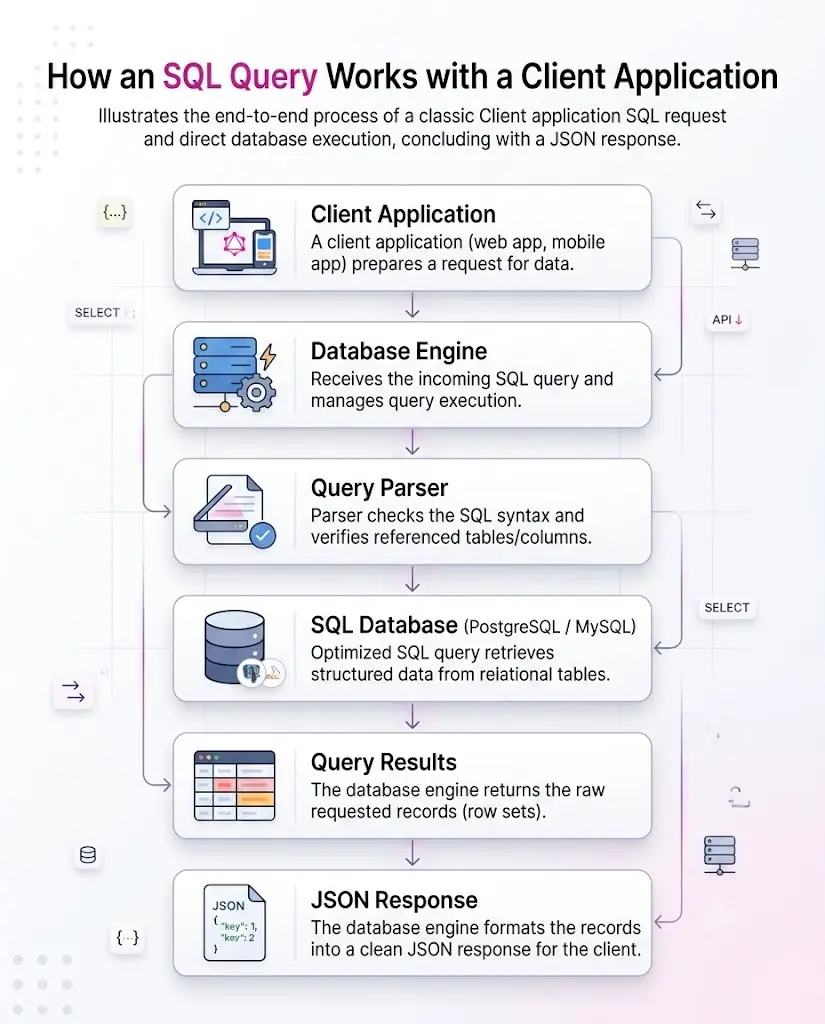
Here’s what happens when a user opens your application.
- The frontend sends a GraphQL query.
- The GraphQL server validates the request.
- Resolvers execute one or more SQL queries.
- The database returns the requested records.
- GraphQL formats everything into a clean JSON response.
- The client receives only the fields it requested.
This layered approach combines the strengths of both technologies.
SQL handles data storage and retrieval.
GraphQL handles API communication and response formatting.
When Should You Use GraphQL?
GraphQL isn’t a silver bullet, and it shouldn’t be your default choice for every project.
However, it excels when your application reaches a certain level of complexity or client-side demand.
Choose GraphQL if you have:
Multiple Frontend Applications
Many businesses support:
- Web apps
- Android apps
- iOS apps
- Smart TVs
- Desktop software
Each client needs different pieces of data.
GraphQL allows every client to request exactly what it needs without creating dozens of custom API endpoints.
Mobile Applications
Mobile connections are inherently unpredictable—high latency, packet loss, and throttled bandwidth can ruin an otherwise solid user experience.
Reducing unnecessary network traffic doesn’t just improve transmission speeds over poor connections; it drastically reduces bandwidth consumption for users on limited data plans and lowers load on your server infrastructure.
Complex Dashboards
Dashboards are notorious for creating frontend bottlenecks because they aggregate data from across your entire application architecture. Rendering a single overview page often means pulling from multiple isolated domain services at the same time:
For example:
- User Profiles (Account service)
- Sales & Revenue Metrics (Billing service)
- Unread Notifications (Alerts service)
- Real-time Analytics (Data warehouse)
- Recent Activity Feeds (Event log service)
GraphQL can aggregate everything into a single response; there is no need to go through the trouble of sending multiple API requests.
Microservices
Modern backend applications are frequently split into specialized microservices. While this keeps services isolated and scalable, it often complicates client-side development:
Payment methods are handled by a Billing service
Customer profiles live in an Identity service
Order history resides in a Commerce service
Without a unified interface, frontend developers are burdened with mapping out multiple microservice endpoints, managing separate authentication tokens, and piecing together disparate response objects on the client.
Rapid Frontend Development
Front-end teams often require new fields as features expand.
With GraphQL, developers do not have to wait for back-end teams to create new REST endpoints; they can update their queries themselves.
This capability accelerates development.
When Should You Use SQL?
SQL remains the best choice whenever you’re working directly with relational data.
Here are some common scenarios.
Banking Systems
Financial applications require:
- Transactions
- Consistency
- Accuracy
- Reliability
Relational databases and SQL excel in these environments.
Business Applications
Enterprise software frequently stores information in structured tables.
Examples include:
- Employee records
- Inventory
- Payroll
- Customer management
SQL handles these relationships efficiently.
Analytics and Reporting
Need to answer questions like:
- Which product sold the most?
- What was last month’s revenue?
- Which customers spent over $5,000?
SQL provides aggregation functions, filtering, grouping, and joins that make these reports straightforward.
Traditional CRUD Applications
Many applications simply need to:
- Create
- Read
- Update
- Delete
SQL databases are a natural fit for these workloads.
Large Relational Datasets
Applications with millions of related records often rely on SQL because relational databases are optimized for these workloads.
Indexes, query planners, and execution engines help keep performance high even as data grows.
GraphQL vs SQL: Which One Should You Choose?
By now, you’ve probably realized something important.
The GraphQL vs SQL discussion isn’t really about choosing one technology over the other.
Instead, it’s about understanding what each technology was designed to do.
Here’s a quick decision guide.
- You need flexible APIs
- Multiple frontend clients consume your API
- Reducing over-fetching matters
- You aggregate multiple services
- Your frontend changes frequently
- You work directly with relational databases
- Transactions are critical
- You perform complex joins
- You build reports and analytics
- You manage structured business data
In many production systems, relying on either GraphQL or SQL alone is insufficient; having both is essential.
GraphQL optimizes the way applications request data.
SQL ensures that data is managed securely and queried efficiently.
Together, they create a scalable architecture that supports everything from small startup projects to enterprise-level platforms.
Frequently Asked Questions
Is GraphQL faster than SQL?
It depends on where you measure.
GraphQL optimizes the network layer by batching requests into a single round-trip and cutting out payload bloat, which makes frontends load much faster. SQL, on the other hand, optimizes disk and memory access inside the database engine. In short: GraphQL makes the app feel snappy over the wire; SQL makes data retrieval efficient at the source.
Can GraphQL query SQL databases?
Yes—in fact, that is how most production apps work.
GraphQL doesn’t connect directly to tables. Instead, its resolver functions act as a bridge: they capture incoming GraphQL requests, run the appropriate SQL queries against databases like PostgreSQL or MySQL, and format the output into JSON for the client.
Is GraphQL a database?
No.
GraphQL has zero storage capabilities. It’s an API query language and execution runtime that acts as an orchestration layer between your frontends and your underlying infrastructure—whether that infrastructure is a SQL database, a NoSQL store, or third-party microservices.
Is GraphQL replacing SQL?
No. They operate on entirely different layers.
GraphQL works at the API gateway level, while SQL operates at the database persistence level. Rather than competing, they work together: GraphQL handles client-facing requests, and SQL manages how that data is stored and joined underneath.
Which companies use GraphQL?
Major tech companies rely heavily on it for their frontend architectures.
- Meta: Developed GraphQL internally to power their mobile applications.
- GitHub: Shifted their public API v4 entirely to GraphQL for maximum developer flexibility.
- Shopify & Airbnb: Use it to serve multi-platform storefronts and manage complex client state without building dozens of REST endpoints.
Is GraphQL better than SQL?
Neither is better—they solve completely different problems.
GraphQL is designed for flexible client-side data fetching. SQL is designed for deep relational data manipulation and transactions. Comparing them is like comparing a highway to an engine: you need both to get where you’re going.
Should beginners learn SQL or GraphQL first?
Start with SQL.
Understanding data structures, relationships, indexes, and normalized schemas gives you a foundation in how data actually lives. Once you know how to query a database directly, learning how GraphQL queries, resolves, and exposes that data becomes intuitive.
Conclusion
The GraphQL vs SQL comparison can seem confusing at first, especially since both technologies use the word query. However, once you understand their roles, the distinction becomes much clearer.
GraphQL is designed to improve how applications request and deliver data through APIs. It gives clients the flexibility to fetch exactly what they need while reducing unnecessary network traffic.
SQL serves a different purpose. It remains the standard language for managing and querying relational databases, offering powerful features for transactions, reporting, joins, and data integrity.
Rather than competing, these technologies often complement one another. A GraphQL server can sit on top of an SQL database, translating client requests into efficient database queries before returning a clean, structured JSON response.
If you’re building a data-driven application, the smartest choice usually isn’t GraphQL vs SQL—it’s understanding when to use each one. GraphQL delivers flexibility at the API layer, while SQL provides the reliable foundation for storing and retrieving data. Together, they form a powerful combination that’s used in countless modern applications.
About the Author