Every pipeline architecture review hits the same wall. A critical deployment passes every unit test, yet production drops to zero throughput within minutes. The failure wasn’t in the business logic—it was a choked queue inside the processing pipeline.
Most engineering teams view pipelines through a narrow lens: a sequence of YAML files driving GitHub Actions or a handful of Python scripts moving data into a warehouse. But in modern distributed software engineering, pipeline architecture is much bigger. It is the fundamental architectural spine underlying software delivery, distributed data systems, high-throughput API gateways, and machine learning lifecycles.
Designing an enterprise-grade pipeline isn’t just about stringing scripts together. It is a strict exercise in defining boundaries, managing state, enforcing fault tolerance, and satisfying core functional vs non functional requirements. When done right, pipelines operate invisibly. When done wrong, they cause production outages.
What Is a Pipeline?
At its core, what is a pipeline? In software engineering, a pipeline is a structured, sequential or parallel series of processing stages where the output of one stage acts as the direct input to the next.
Think of an automated vehicle assembly line. Raw steel and individual components enter on one side. Distinct, isolated assembly stations transform the materials step by step—welding the frame, installing the engine, applying the paint—until a finished vehicle rolls off the terminus. No single station understands the entire end-to-end manufacturing process; each station only knows its precise contract with the upstream and downstream stages.
Modern technology relies entirely on these primitives. Whether you are transforming raw network sockets into validated JSON, compiling source code into immutable container images, or streaming billions of clickstream events into a cloud lakehouse, you are building and operating pipelines.
What Is Pipeline Architecture?
If a pipeline is the sequence of stages, pipeline architecture is the overarching blueprint. It defines how data, tasks, or code move through discrete processing components with decoupled boundaries, strict interfaces, and managed failure modes.
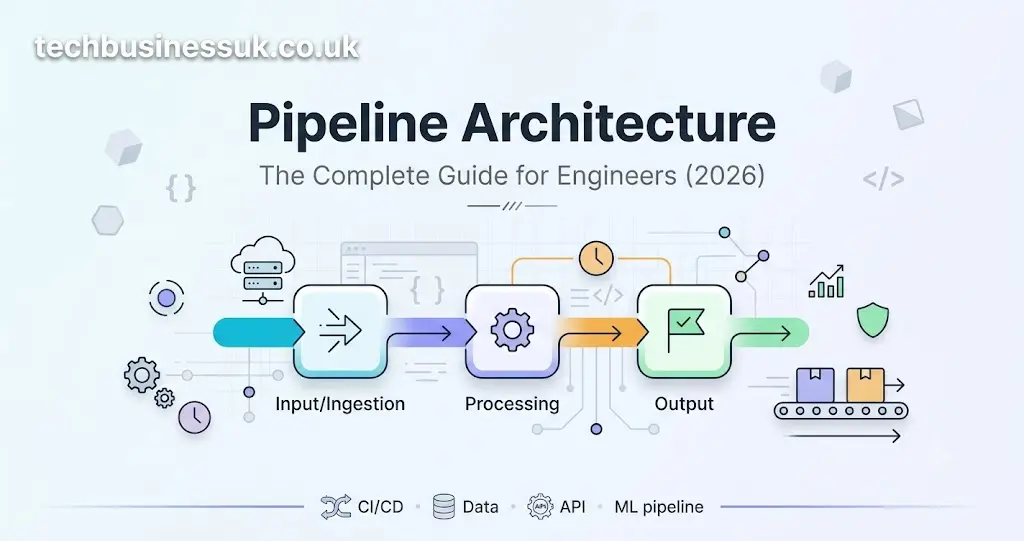
Every robust pipeline architecture, regardless of domain, splits into three fundamental stages:
- Input / Ingestion Layer: Standardizing, validating, and queuing incoming payloads or triggers.
- Processing / Transformation Layer: Mutating, filtering, compiling, or enriching workloads across parallel or sequential worker nodes.
- Output / Sink Layer: Persisting, serving, or deploying the final state to downstream consumers or production environments.
Without deliberate architecture, pipelines quickly degrade into tightly coupled, monolithic scripts. The result? Cascading failures, untraceable latency spikes, lost data, and silent corruptions that escape into production.
Types of Pipelines in Modern Tech
While the architectural principles remain consistent, pipelines manifest differently depending on the engineering domain. Modern tech stack architectures rely primarily on four core pipeline categories:
- CI/CD Pipelines: Automated software delivery systems designed to assemble, verify, test, and release code artifacts.
- Data Pipelines: High-throughput data movement engines that ingest, transform, and load batch or real-time event streams.
- API Pipelines: High-concurrency request processing chains that handle authentication, rate limiting, validation, and proxy routing.
- ML Pipelines: Continuous machine learning workflows that automate feature engineering, model training, evaluation, and edge deployment.
CI/CD Pipeline Architecture
A well-designed CI/CD pipeline architecture accelerates release velocity without sacrificing stability, drawing directly from foundational deployment pipeline design principles. It acts as the primary quality gate between local developer workspaces and live production environments.
The Four Structural Stages
The continuous delivery pipeline follows a strict execution chain:
$$\text{[ Source Commit ]} \longrightarrow \text{[ Build Artifact ]} \longrightarrow \text{[ Test Verification ]} \longrightarrow \text{[ Deployment ]}$$
- Source: Intercepting Git events (pushes, pull requests, version tags) to trigger pipeline runners.
- Build: Compiling binaries, packaging container images, and pushing immutable artifacts to a secure repository.
- Test: Executing unit, integration, and security static analysis (SAST) in parallel test environments.
- Deploy: Orchestrating zero-downtime release strategies (blue/green, canary, or rolling updates).
Architectural Best Practices for Software Delivery
Never rely on “snowflake” runner environments. Modern CI/CD runners must be entirely ephemeral and containerized, ensuring that every build starts from a pristine, deterministic state. Furthermore, sophisticated delivery suites embed automated verification early. Integrating robust API testing tools directly into the integration testing stage ensures breaking API changes are caught before hitting staging environments.
Data Pipeline Architecture
While CI/CD pipelines move code, a data pipeline architecture moves the lifeblood of modern enterprise applications: data. Designing data pipelines requires making fundamental trade-offs between processing latency, storage costs, and consistency models.
ETL vs. ELT Paradigms
Traditionally, ETL (Extract, Transform, Load) required heavy computation on dedicated transformation servers before writing cleaned data to legacy warehouses. Modern cloud architectures have shifted overwhelmingly toward ELT (Extract, Load, Transform). Raw data is dumped directly into high-scale object storage or cloud warehouses (Snowflake, BigQuery), leveraging massively parallel processing engines to transform data in place using tools like dbt.
Batch vs. Real-Time Streaming
- Batch Pipelines: Process accumulated blocks of data on scheduled intervals (e.g., nightly financial reconciliations using Apache Spark).
- Event Streaming Pipelines: Process continuous streams of event data with sub-second latency (e.g., real-time fraud detection using Apache Kafka or Apache Flink).
Maintaining high data quality across complex transformations requires continuous telemetry. Unifying your pipeline health metrics with an enterprise-level API monitoring platform gives SREs complete visibility into downstream data pipeline delays.
API Pipeline Architecture
An API pipeline processes short-lived, synchronous HTTP/gRPC requests at scale. Unlike background batch processors, an API request pipeline must execute every transformation step within milliseconds to maintain system responsiveness.
The Request Lifecycle Chain
When a client hits an endpoint, the request moves through a dedicated, sequential processing pipeline:
- Authentication & Identity: Validating JWTs, API keys, or OAuth tokens at the edge.
- Rate Limiting: Enforcing request quotas to protect downstream microservices.
- Payload Schema Validation: Dropping malformed JSON bodies before consuming application logic.
- Transformation & Header Injection: Enriching requests with context tags (e.g., correlation IDs).
- Upstream Routing: Proxying the payload to the appropriate internal microservice.
Here’s where architectural centralized points matter. Rather than implementing these stages independently within every backend service, modern microservice platforms deploy an enterprise API gateway to act as the centralized enforcement point for the entire API pipeline.
CI/CD Pipeline vs Data Pipeline: What’s the Difference?
Understanding data pipeline vs CI/CD pipeline architectural differences is crucial for choosing the right infrastructure, state management, and retry patterns.
| Architectural Dimension | CI/CD Pipeline Architecture | Data Pipeline Architecture |
| Primary Workload | Code artifacts, binaries, and test suites | Unstructured, semi-structured, or structured records |
| Execution Trigger | Event-driven (Git push, PR merge, release tag) | Schedule-driven (Cron) or continuous event streams |
| State Management | Ephemeral; runner state is discarded post-build | Stateful; persistence, data lineage, and schemas are vital |
| Failure Impact | Blocked release velocity, developer friction | Data corruption, inaccurate analytics, operational downtime |
| Latency Tolerance | Minutes to hours | Milliseconds (streaming) to hours (batch) |
Pipeline Orchestration
As systems grow, individual pipelines turn into interconnected webs of dependencies. This is where pipeline orchestration becomes necessary.
An orchestrator manages task execution graphs (often structured as Directed Acyclic Graphs, or DAGs), ensuring that Stage B only executes once Stage A successfully completes. Orchestrators track system state, handle retries, allocate compute resources, and enforce rate limits.
Architects must evaluate communication models when building orchestration layers: choosing between blocking synchronous workflows or event-driven asynchronous architectures. Leading orchestration engines include Apache Airflow and Prefect for data processing, alongside Temporal for complex distributed service workflows.
Pipeline Monitoring & Observability
You cannot manage what you do not measure. Effective pipeline monitoring requires moving beyond basic binary status alerts (“pass/fail”) into full system observability.
The Golden Signals of Pipeline Telemetry
- Throughput: The volume of items, records, or requests processed per second.
- Stage Latency: The duration elapsed within individual processing steps.
- Error Rate: The percentage of dead-lettered, dropped, or failed workloads.
- Backpressure & Queue Depth: The accumulation of unprocessed items upstream.
Integrating telemetry tools like Prometheus, Grafana, and Datadog into your pipelines gives teams real-time visibility. Connecting pipeline health to your broader API monitoring strategy ensures SREs spot performance drops before end users notice them.
Real-World Failure: When Pipelines Break
Consider a major e-commerce platform preparing for a flash sale. The application code was load-tested and optimized. However, within two minutes of the sale going live, the core checkout service suffered a complete blackout.
Here’s what happened behind the scenes:
An unauthenticated partner webhook began hammering an API endpoint. The underlying API pipeline lacked localized enforcement of API rate limiting. Unfiltered requests flowed straight through the ingestion stage, bypassing schema validation and overwhelming the primary database connection pool. The pipeline lacked a short-circuiting mechanism, allowing a single malformed traffic spike to bring down the entire infrastructure.
The Architectural Lesson: Pipelines must enforce defensive boundaries (rate limiters, circuit breakers, dead-letter queues) at the very first ingestion point.
Pipeline Architecture Best Practices
- Enforce Stage Idempotency: Re-running a failed pipeline stage with identical inputs must yield the exact same output without duplicating side effects.
- Implement Dead-Letter Queues (DLQ): Isolate corrupted or unparseable payloads into a DLQ for offline analysis without halting the main queue.
- Decouple Compute from Storage: Scale worker pools dynamically based on queue depth without re-architecting persistent data stores.
- Pipeline Configuration as Code: Store all pipeline definitions (YAML, Python DAGs, Terraform) in version control with strict code review requirements.
- Shift-Left Security Verification: Embed static code analysis, secret detection, and dependency vulnerability scans into early pipeline phases.
- Design for Fail-Fast Execution: Validate payloads, permissions, and environments immediately upon ingestion to save expensive compute cycles.
- Maintain Strict Data Lineage: Log source commits, container hashes, and schema versions alongside every processed output.
Pipeline Decision Matrix
Use this architectural framework to pick the right strategy for your workload:
| Operational Scenario | Primary Architecture Goal | Recommended Enforcement Layer | Recommended Algorithm | Recommended Keying Strategy |
| Public Unauthenticated API | Prevent DDoS & scraping | Edge Gateway / Reverse Proxy | Fixed Window or Sliding Counter | Client IP Address |
| Multi-Tenant SaaS Platform | Ensure fair usage across pricing tiers | API Gateway | Token Bucket | Authenticated User / Account ID |
| High-Volume Financial Trading | Strict boundary enforcement | Application Layer Middleware | Sliding Window Log | API Key + Session ID |
| Asynchronous Job Processing | Protect downstream database resources | Message Queue Consumer | Leaky Bucket | Worker / Tenant ID |
| Third-Party Partner Webhooks | Prevent sudden burst congestion | API Gateway | Sliding Window Counter | Partner Organization ID |
Conclusion
Mastering pipeline architecture means moving past quick-and-dirty scripts and approaching automation as a structured engineering discipline. Whether you are delivering microservices, streaming real-time analytics, or managing high-volume APIs, a clear pipeline design ensures high throughput, security, and uptime.
As you build and refine your pipelines, remember that automated verification is critical. Pair your architecture with robust enterprise API testing tools to continuously validate every stage from code push to production delivery.
Frequently Asked Questions
What is a pipeline in software engineering?
A pipeline in software engineering is a sequence of processing elements (stages) arranged so that the output of each element is the input to the next. It automates and structures repetitive processes such as software deployment, data transformation, or request handling.
What is pipeline architecture?
Pipeline architecture is the structural design pattern that defines how components within a pipeline interact, transfer state, handle errors, and scale. It establishes clear boundaries between ingestion, processing, and output stages across CI/CD, data engineering, and API gateways.
What is the difference between a CI/CD pipeline and a data pipeline?
A CI/CD pipeline automates code integration, testing, and deployment to deliver software updates. A data pipeline automates the ingestion, transformation, and storage of business data for analytics or operational use. CI/CD pipelines handle ephemeral code builds, while data pipelines manage persistent datasets.
What is pipeline orchestration?
Pipeline orchestration is the automated management, scheduling, and execution tracking of multi-stage processing workflows. An orchestrator manages dependencies between pipeline tasks, handles retries, balances compute resources, and provides status visibility.
What tools are used for pipeline orchestration?
Popular pipeline orchestration tools include Apache Airflow, Prefect, Dagster, Temporal, GitHub Actions, Jenkins, and AWS Step Functions, depending on whether the workload is focused on data processing, microservice workflows, or CI/CD.
How do you monitor a pipeline?
Pipeline monitoring requires tracking key metrics such as execution duration (latency), throughput (items/sec), stage failure rates, and queue depth (backpressure). Tools like Prometheus, Grafana, Datadog, and OpenTelemetry provide real-time alerts and tracing across pipeline stages.
About the Author

1 thought on “Pipeline Architecture: The Complete Guide for Engineers (2026)”