1. What is an API Governance Model? (And Why Modern Enterprises Need One)
1.1 Core Definition
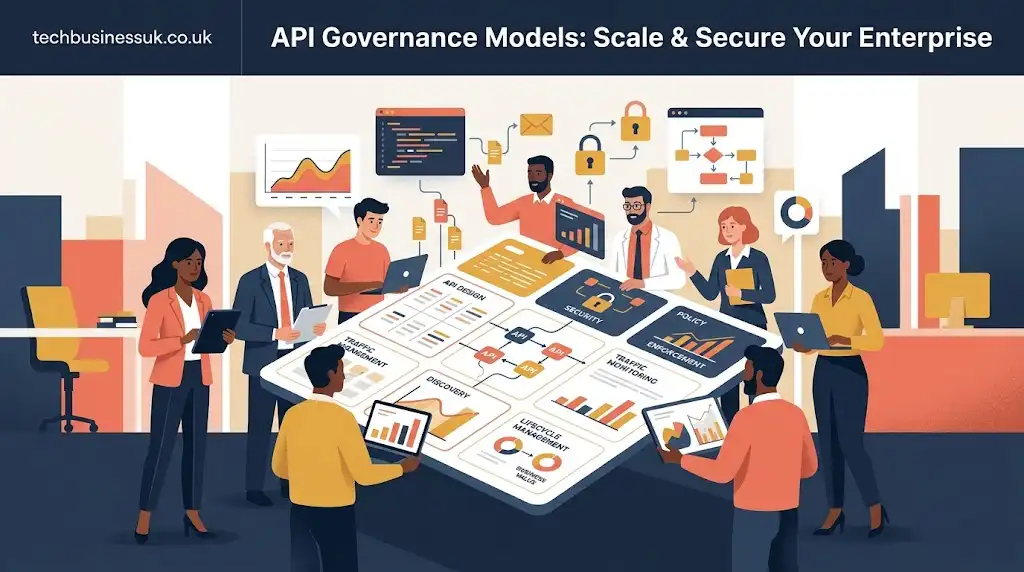
An API governance model is an enterprise-wide organizational and technical framework that defines how Application Programming Interfaces (APIs) are designed, secured, deployed, versioned, and retired across the software development lifecycle (SDLC).
In modern cloud-native architectures—characterized by microservices, multi-cloud deployments, and distributed engineering teams—an API governance model establishes the rules of engagement. It transforms ad-hoc endpoint creation into a predictable, standardized, and secure digital supply chain.
1.2 API Governance vs. c
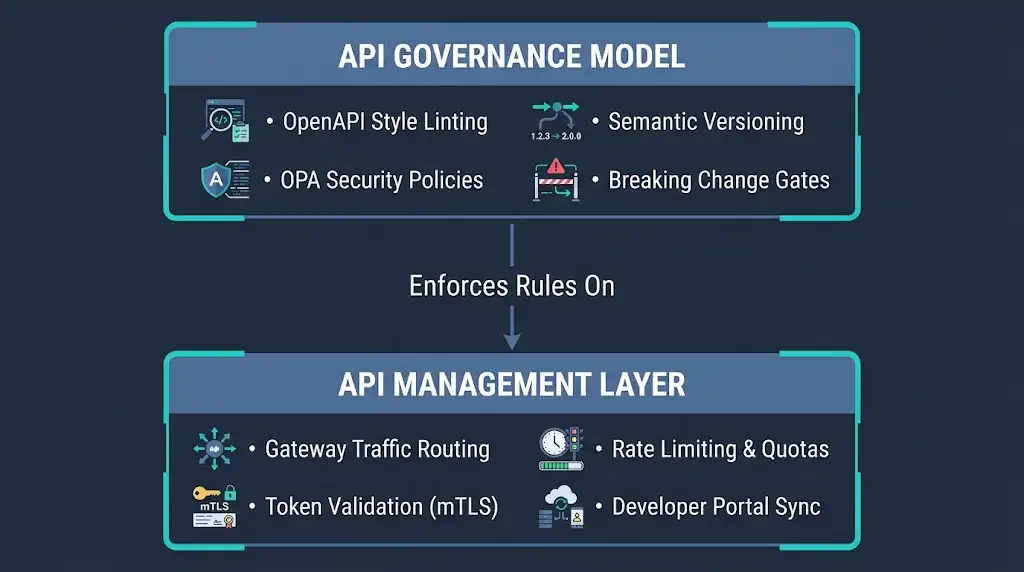
A common point of confusion among platform teams is conflating governance with runtime management:
- API Governance (Strategy & Policy): Establishes the guardrails, policies, design standards, and compliance boundaries before and during development. It answers: “Is this API built correctly, safely, and predictably according to organizational standards?”
- API Management (Operational Execution): Handles the runtime traffic, lifecycle operations, and developer portal delivery after deployment—explore our detailed enterprise API management platform guide for architectural breakdowns.
1.3 The Strategic ROI of a Structured Model
Without a cohesive API governance strategy, enterprises suffer from architectural drift, delayed release cycles, and unmitigated security vulnerabilities. Implementing a formal model yields three tangible business outcomes:
- Accelerated Time-to-Market: Standardized schemas, reusable domain contracts, and automated linters eliminate repetitive architectural review meetings and custom SDK re-work.
- Defensible Cybersecurity & Compliance: Direct alignment with standards like NIST SP 800-228 (Guidelines for API Protection) and the OWASP API Security Top 10 ensures that zero-trust authorization and data privacy rules (GDPR, HIPAA, PCI-DSS) are programmatically enforced before code reaches production.
- Elimination of Duplicative Engineering: Centralized discovery prevents different business units from independently building redundant services (e.g., three separate “Customer Address Verification” microservices).
2. Key Pillars of a Modern API Governance Framework
A comprehensive enterprise API governance framework rests upon four foundational operational pillars:
                  ┌──────────────────────────────────────────┐
                  │          API Governance Model            │
                  └────────────────────┬─────────────────────┘
                                       │
     ┌──────────────────┬──────────────┴───────┬──────────────────┐
     ▼                  ▼                      ▼                  ▼
┌─────────┐       ┌───────────┐          ┌───────────┐      ┌───────────┐
│ Pillar 1│       │ Pillar 2  │          │ Pillar 3  │      │ Pillar 4  │
│ Design  │       │ Security  │          │ Lifecycle │      │ Catalog & │
│ & Style │       │ & Privacy │          │ Management│      │ Discovery │
└─────────┘       └───────────┘          └───────────┘      └───────────┘
2.1 Pillar 1: Design & Style Standardization
Consistency across endpoints reduces developer cognitive load and accelerates consumer integration. Standardized design requirements must specify:
- Resource URIs & Naming Conventions: Mandating lower-case kebab-case for URIs, plural nouns for resource collections (
/v1/payment-intents), and explicit HTTP verb semantics (GET,POST,PUT,PATCH,DELETE). - Standardized Error Responses: Enforcing standard application-level error payloads using standard frameworks such as RFC 7807 Problem Details (
application/problem+json).
2.2 Pillar 2: Security, Identity & Data Privacy
APIs represent the primary external attack surface for enterprise data stores. Security governance enforces zero-trust principles:
- Identity Propagation & Authentication: Mandating modern API authentication methods like OAuth 2.0 with OpenID Connect (OIDC), accompanied by mutual TLS (mTLS) for inter-service mesh communication.
- Granular Authorization Controls: Requiring Role-Based Access Control (RBAC) or Attribute-Based Access Control (ABAC) claims embedded in JWTs to prevent Broken Object-Level Authorization (BOLA) vulnerabilities.
2.3 Pillar 3: Lifecycle State Management & Versioning
Without formal deprecation policies, legacy APIs remain running indefinitely, consuming infrastructure resources and leaking data:
- Versioning Policies: Adhering to proven API versioning best practices by requiring Semantic Versioning (v1.2.0 vs v2.0.0) across all service contracts.
- Sunsetting Rules: Enforcing standard HTTP response headers (
DeprecationandSunsetheaders per RFC 8594) alongside contractual migration windows (e.g., minimum 180-day deprecation notice).
2.4 Pillar 4: Cataloging & Active Discovery
APIs cannot be governed or secured if they are invisible to platform leads:
- Automated Registry Sync: Registering deployed services automatically into an internal portal (e.g., Backstage, Kong Developer Portal, Apigee) via CI/CD pipelines.
- Metadata Attachment: Requiring every catalog entry to declare service ownership (Team/Slack channel), data classification level (Public, Internal, Confidential), and repository links.
3. Comparing the 3 Core API Governance Models
Selecting the right governance model depends on your engineering organization’s maturity, velocity demands, and regulatory constraints.
4. Operationalizing Your API Governance Model: Shifting Left
To enforce an enterprise API governance strategy without creating developer bottlenecks, modern organizations adopt Governance-as-Code.
4.1 Contract-First (OpenAPI-First) Methodology
In a contract-first workflow, developers design machine-readable OpenAPI Specifications (OAS 3.x) or AsyncAPI files before writing application code. The contract serves as the single source of truth for mock servers, client SDK generation, security analysis, and backend controller scaffolding.
┌──────────────────┐      ┌──────────────────┐      ┌──────────────────┐
│ Write OpenAPI    │─────►│ Run Automated    │─────►│ Generate Code &  │
│ Specification    │      │ Spectral Linters │      │ CI/CD Deploy     │
└──────────────────┘      └──────────────────┘      └──────────────────┘
4.2 Automated Linting with Custom Spectral Rulesets
Using open-source tools like Spectral or Vacuum, platform teams write declarative linting rules to enforce design guidelines automatically.
YAML
# .spectral.yaml - Enterprise API Governance Ruleset
extends: ["spectral:oas"]

rules:
  # Enforce RFC 7807 Problem Details on HTTP Error Responses
  rfc7807-error-schema:
    description: "HTTP 4xx and 5xx responses must reference standard RFC 7807 error structures."
    severity: error
    given: "$.paths..responses[?(@property >= 400)]"
    then:
      field: "content.application/problem+json.schema.$ref"
      function: defined

  # Enforce kebab-case URI Path formatting
  path-kebab-case:
    description: "API path segments must use kebab-case formatting."
    severity: error
    given: "$.paths~"
    then:
      function: pattern
      functionOptions:
        match: "^(/[a-z0-9-]+)+$"

  # Require explicit OAuth2 security schemes
  oauth2-security-required:
    description: "All operations must declare explicit OAuth2 security scopes."
    severity: error
    given: "$.paths..[get,post,put,delete,patch]"
    then:
      field: "security"
      function: defined
4.3 Infrastructure Policy Enforcement via Open Policy Agent (OPA)
While Spectral validates contract structure, Open Policy Agent (OPA) evaluates deployment artifacts against declarative Rego policies to strengthen API gateway security rules before deployment:
Code snippet
# api_gateway_policy.rego
package enterprise.api.governance

default allow = false

# Grant deployment permission only if OAuth2 and rate limiting are configured
allow {
    has_oauth2_plugin
    has_rate_limiting_plugin
}

has_oauth2_plugin {
    input.kind == "GatewayRoute"
    input.spec.plugins[_].name == "oauth2-jwt-validator"
    input.spec.plugins[_].enabled == true
}

has_rate_limiting_plugin {
    input.kind == "GatewayRoute"
    plugin := input.spec.plugins[_]
    plugin.name == "rate-limiting"
    plugin.config.minute_limit <= 1000
}
4.4 Mapping Automated Rules to Security Frameworks
Automated linting and Rego policies should map directly to cybersecurity standards:
- NIST SP 800-228 Controls: Map rules requiring TLS 1.3 encryption and mTLS headers directly to NIST network protection requirements.
- OWASP API Top 10: Enforce strict array limits and string patterns in schema files to mitigate API8:2023 Security Misconfiguration and API1:2023 Broken Object Level Authorization.
5. Gating the API Lifecycle in CI/CD Pipelines
Automated governance requires embedding policy checks across all four stages of the deployment pipeline:
┌─────────────────┐     ┌─────────────────────┐     ┌──────────────────────┐     ┌──────────────────────┐
│ Stage 1:        │───► │ Stage 2:            │───► │ Stage 3:             │───► │ Stage 4:             │
│ Pre-Commit      │     │ Build & PR Gate     │     │ Staging DAST         │     │ Production Gateway   │
│ (Local IDE)     │     │ (Spectral + Diff)   │     │ (Security Scans)     │     │ (Catalog Sync)       │
└─────────────────┘     └─────────────────────┘     └──────────────────────┘     └──────────────────────┘
- Stage 1: Pre-Commit (Local Developer IDE): Developers get real-time feedback in VS Code or JetBrains via Spectral extensions and pre-commit Git hooks.
- Stage 2: Pull Request / Build Gate: The CI runner executes Spectral linting and checks for breaking changes against the target branch contract.
- Stage 3: Staging Dynamic Testing: Integrated automated API security testing tools execute DAST scans against staging endpoints to catch authorization bypasses and rate-limiting vulnerabilities.
- Stage 4: Production Deployment & Gateway Sync: The updated, verified contract is published to the centralized catalog and synchronized with gateway routing tables.
5.2 GitHub Actions Pipeline Walkthrough
Below is an operational GitHub Actions pipeline that enforces Spectral linting and checks for breaking schema changes:
YAML
name: Enterprise API Governance Gatekeeper

on:
  pull_request:
    branches: [ "main" ]
    paths:
      - 'schemas/openapi/**'

jobs:
  governance-validation:
    runs-on: ubuntu-latest
    steps:
      - name: Checkout Code Repository
        uses: actions/checkout@v4
        with:
          fetch-depth: 0 # Required for breaking change comparison

      - name: Setup Node.js
        uses: actions/setup-node@v4
        with:
          node-version: '20'

      - name: Install Spectral & OpenAPI Diff Tooling
        run: |
          npm install -g @stoplight/spectral-cli
          npm install -g oasdiff

      - name: Run Spectral Linting Validation
        run: |
          echo "==> Validating OpenAPI Contract against Governance Ruleset..."
          spectral lint schemas/openapi/api-spec.yaml --ruleset .spectral.yaml --fail-severity=error

      - name: Detect Unintentional Breaking Changes
        run: |
          echo "==> Comparing Pull Request Schema against Main Branch..."
          git show origin/main:schemas/openapi/api-spec.yaml > main-spec.yaml
          oasdiff breaking main-spec.yaml schemas/openapi/api-spec.yaml --fail-on-ERR
6. Active Mitigation: Stopping Shadow and Zombie APIs
Unmanaged endpoints are a primary vector for modern corporate data breaches. An effective API governance framework must remediate two major runtime risks:
- Shadow APIs: Undocumented endpoints deployed outside official pipelines without governance—implementing shadow API security best practices is critical to closing these visibility gaps.
- Zombie APIs: Outdated, deprecated endpoints that remain running on backend servers after newer versions are released, often unpatched and vulnerable.
┌────────────────────────────────────────────────────────────────────────┐
│                        RUNTIME DRIFT DETECTION                         │
│                                                                        │
│  Live Network Traffic ───► eBPF Sniffer / Gateway Logs                 │
│                                    │                                   │
│                                    ▼                                   │
│                        Discovered Endpoints                            │
│                                    │                                   │
│                                    ▼                                   │
│                    Diff Engine vs. Central Catalog                     │
│                                    │                                   │
│            ┌───────────────────────┴───────────────────────┐           │
│            ▼                                               ▼           │
│   [ MATCH: Authorized ]                           [ MISMATCH: Drift ]  │
│   Traffic Allowed                                 Flag Shadow / Zombie │
│                                                   Trigger Alert / Block│
└────────────────────────────────────────────────────────────────────────┘
6.2 eBPF Traffic Sniffing & Gateway Log Analysis
Enterprise platforms deploy discovery mechanisms across the infrastructure stack:
- eBPF (Extended Berkeley Packet Filter): Kernel-level agents monitor Linux network sockets on Kubernetes worker nodes to discover active HTTP/gRPC routes in real time without application modifications.
- Gateway Log Parsing: Access logs are continuously matched against published catalog specifications to detect undocumented routes.
6.3 Automated Remediation Playbooks
When runtime drift is detected, automated incident response playbooks execute:
- Flag: Generate an automated high-severity ticket in Jira/ServiceNow for the engineering owner.
- Throttle: Apply restrictive API rate limiting algorithms (e.g., maximum 5 requests per minute) to diminish data exfiltration exposure.
- Quarantine: Block gateway routing to the endpoint if a valid OpenAPI contract is not supplied within a set grace period.
7. 90-Day Roadmap to Roll Out Your Enterprise API Governance Model
Transforming enterprise API governance from manual gatekeeping to automated policy enforcement is best executed in three 30-day phases:
┌────────────────────────────────────────────────────────────────────────┐
│                        90-DAY IMPLEMENTATION ROADMAP                    │
├───────────────────┬──────────────────────────┬─────────────────────────┤
│ Days 1-30: Assess │ Days 31-60: Standardize  │ Days 61-90: Automate    │
│ • Audit Traffic   │ • Draft Style Guide      │ • CI/CD Pipeline Gates  │
│ • Catalog APIs    │ • Build Spectral Rules   │ • Gateway Enforcement   │
│ • Identify Drift  │ • Pilot with 2 Teams     │ • Full Portal Launch    │
└───────────────────┴──────────────────────────┴─────────────────────────┘
- Phase 1: Days 1–30 (Audit & Discovery Baseline)
- Deploy passive network traffic sniffing (eBPF or log analysis) to audit existing endpoints.
- Catalog all active APIs across internal, partner, and public networks.
- Establish baseline metrics for shadow APIs and unmanaged legacy endpoints.
- Phase 2: Days 31–60 (Standardization & Tooling)
- Form a federated API Guild to author enterprise design standards.
- Translate standards into machine-readable Spectral rulesets and OPA policy packages.
- Pilot contract-first linting and IDE plugins across two high-velocity engineering teams.
- Phase 3: Days 61–90 (CI/CD Integration & Full Rollout)
- Embed automated governance gates into central CI/CD pipeline templates.
- Connect deployment pipelines directly to your centralized developer portal.
- Mandate contract-first workflows for all new microservice deployments.
8. Conclusion & Next Steps
Building a modern API governance model requires shifting away from slow, manual review boards toward automated Governance-as-Code. By pairing an OpenAPI-contract-first approach with automated Spectral linters, OPA runtime policy checks, and CI/CD quality gates, platform engineering teams can achieve high developer velocity while maintaining enterprise cybersecurity standards.
Strategic Action Items for Lead Architects & CISOs
- Audit Your Runtime Estate: Run an inventory check across your API Gateways to quantify undocumented endpoints.
- Standardize Your Ruleset: Create a centralized
.spectral.yamlfile containing your organization’s core URI, error handling, and security rules. - Automate Pipeline Gates: Integrate contract linting and breaking change checks directly into your baseline CI/CD build templates.
9. Frequently Asked Questions (FAQ)
How do you measure the success of an API governance model?
Key performance indicators (KPIs) include Developer Onboarding Time (time to first API call), Policy Compliance Rate (percentage of endpoints passing Spectral rulesets without manual waivers), Mean Time to Detect (MTTD) shadow APIs, and the Reduction in Breaking Change Incidents in production environments.
What is the difference between API Governance and API Management?
API Governance establishes the operational policies, design rules, security standards, and lifecycle guardrails before code is deployed. API Management enforces runtime rules—such as traffic routing, rate limiting, token verification, and analytics collection—at the gateway layer during active execution.
How does an OpenAPI-first approach improve API governance?
An OpenAPI-first approach treats the API contract as the single source of truth prior to writing backend implementation code. This enables automated linters, security scanners, mock engines, and client generators to catch architectural flaws and security oversights early in the design phase when remediation is fastest and least expensive.
How can platform teams enforce governance without slowing down developers?
Enforce governance by shifting policy evaluation into developer IDEs (VS Code linters), pre-commit hooks, and automated CI/CD pipeline gates. Providing inline auto-fixes and clear error messages transforms governance from an administrative bottleneck into an automated developer enablement tool.
About the Author

1 thought on “API Governance Models: How to Choose the Right Framework for Enterprise Scale”