LLM API
Your test suite is green. Every assertion passes. Then a model update ships on the provider’s side, and your production output quietly starts returning malformed JSON your parser can’t handle — and nothing in your test suite caught it, because it was never built to catch this kind of failure in the first place.
This is the problem almost every team building on an LLM API eventually runs into. Traditional API testing assumes the same input produces the same output, every time. An LLM API breaks that assumption completely — the same prompt can produce different, equally “correct” text on every single call, which means the testing playbook that works for a REST API handling user records simply doesn’t transfer.
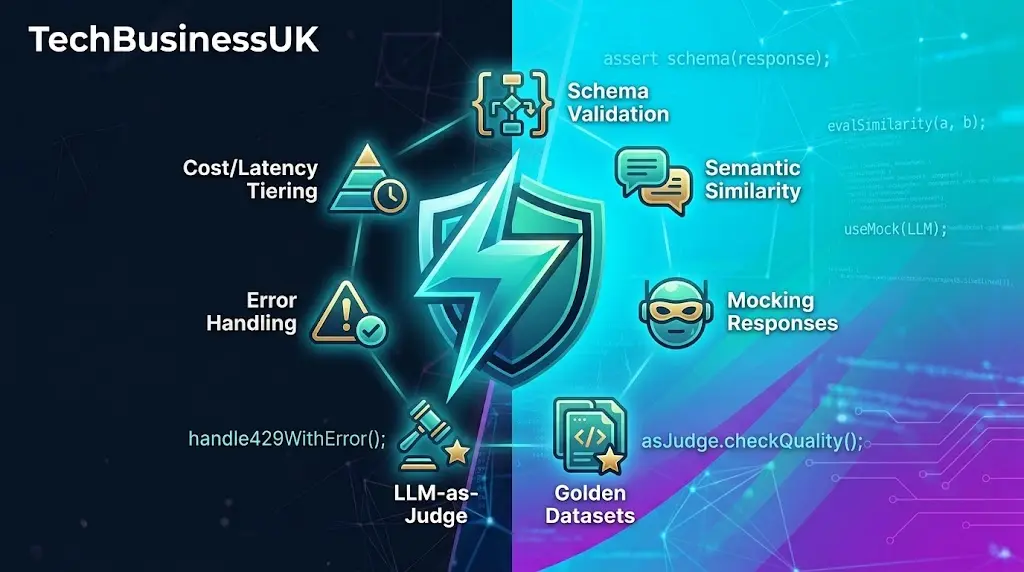
This guide covers what makes an LLM API structurally different from a traditional API, why non-determinism breaks conventional testing approaches, and the concrete strategies — schema validation, semantic testing, mocking, golden datasets — that actually work for testing an integration you can’t predict output-for-output.
TL;DR:
- An LLM API returns non-deterministic output — the same input can produce different, equally valid responses.
- Traditional exact-match test assertions don’t work; you need structure validation, semantic similarity checks, or LLM-graded evaluation instead.
- Mock LLM responses in CI/CD — hitting a live model on every test run is slow, expensive, and still non-deterministic.
- LLM APIs typically rate-limit by tokens per minute, not just request count — your retry and backoff logic needs to account for this.
- Build a golden dataset of known-good test cases to catch regressions when you change prompts or swap models.
- Test error handling explicitly — content filtering rejections and streaming interruptions are failure modes traditional APIs don’t have.
What Is an LLM API?
An LLM API is an interface that lets an application send a prompt to a large language model and receive a generated text (or structured) response back over HTTP, the same general request/response pattern as any other web API — but with a fundamentally different contract underneath it.
A typical request sends a prompt, optional conversation history, and configuration parameters (temperature, max tokens, model selection). The response returns generated text, often alongside metadata like token usage and a completion reason. Structurally, this looks like a normal REST or streaming API call. Behaviorally, it’s a different animal entirely.
How LLM APIs Differ From Traditional APIs
- Non-determinism: Call a traditional
GET /users/123endpoint twice, and you get the identical record both times (assuming nothing changed). Call an LLM API with the exact same prompt twice, and you can get two meaningfully different — both entirely valid — responses. This single property is the root cause of almost every testing challenge covered in this guide. - Streaming responses: Many LLM APIs return output incrementally, token by token, rather than a single complete response. This changes both how your client code needs to handle the response and how you test it — a truncated or interrupted stream is a real failure mode that a simple request/response test won’t catch.
- Token-based pricing and rate limits: Instead of a flat per-request cost or limit, LLM APIs typically meter and rate-limit based on tokens — a unit tied to input and output length, not request count. A single long prompt can consume a rate-limit budget that ten short ones wouldn’t.
- Variable latency: Response time depends heavily on output length and model load, making latency testing and timeout configuration meaningfully less predictable than with a typical CRUD endpoint.
The Core Challenge: Testing Non-Deterministic Outputs
This is the problem every other section in this guide exists to solve. A traditional API test asserts an exact match: send this input, expect exactly this output. Apply that same pattern to an LLM API, and your tests will fail constantly — not because anything is actually broken, but because the model legitimately phrased its response differently this time.
The instinct to just loosen the assertion — “does the response contain roughly the right words” — creates its own problem: tests that are so permissive they’d pass even if the actual output quality degraded significantly. The real challenge is building test assertions precise enough to catch genuine regressions, while flexible enough to tolerate the model’s natural output variation.
Strategies for Testing LLM API Integrations
Schema and Structure Validation
Rather than asserting exact text content, validate the shape of the response. If you’ve instructed the model to return JSON with specific fields, assert that the response is valid JSON containing those fields with the correct data types — regardless of the exact wording inside string values.
This connects directly to disciplined API error handling practices: a response that fails schema validation should be treated and logged the same way any other malformed API response would be, rather than silently passed through to downstream code.
Semantic Similarity Testing
For free-text responses where exact structure isn’t the point, semantic similarity testing compares the meaning of a response against a reference answer, rather than the exact wording — typically using embedding-based comparison or a scoring threshold, rather than string matching.
This is meaningfully more complex to set up than a traditional assertion, but it’s often the only realistic way to catch a genuine quality regression in open-ended text generation without an unmanageable rate of false test failures.
Mocking LLM Responses for Reliable CI/CD
Hitting a live LLM API on every CI run is slow, costs real money per test execution, and — because of the non-determinism problem — still can’t guarantee a stable, repeatable test result. Mocking the LLM API layer, returning fixed, known responses for your automated test suite, solves all three problems simultaneously.
The tradeoff: mocked tests validate your application’s handling of a given response shape, but they don’t validate the model’s actual output quality — which is exactly why mocked unit tests and live-model evaluation need to coexist as separate, complementary layers of your testing strategy, not substitutes for each other.
Golden Dataset / Regression Testing
Build a curated set of representative prompts alongside known-good expected outputs or acceptance criteria — your “golden dataset.” Every time you change a prompt, swap models, or update your integration logic, run the full dataset through and compare results against your established baseline.
This is the closest LLM-testing equivalent to traditional regression testing, and it’s specifically what catches the “a model update silently changed behavior” failure mode described at the start of this guide — the kind of drift that a one-off manual test would never surface. Paired with continuous API monitoring in production, it ensures complete coverage against silent model updates.
For a dedicated, purpose-built framework covering exactly these evaluation patterns — assertions, golden datasets, and CI/CD integration for LLM outputs specifically — promptfoo’s documentation is a solid, provider-agnostic reference that works the same way regardless of which underlying LLM API you’re integrating with.
Handling Rate Limits and Retries in LLM API Integrations
LLM APIs commonly enforce limits based on tokens per minute, not just raw request count — meaning a handful of long prompts can exhaust your rate limit budget just as fast as many short ones. This makes naive request-count-based throttling insufficient; your client-side rate management needs to account for token consumption directly.
When a rate limit is hit, LLM APIs typically respond the same way any well-designed API should — with a 429 status and retry guidance — which is exactly the pattern smoothed and enforced by the leaky bucket algorithm, whether you’re implementing client-side throttling to stay under a provider’s limits or protecting your own LLM-backed endpoint from being overwhelmed by callers.
Exponential backoff with jitter is the standard retry strategy here — waiting progressively longer between retries, with some randomness added, to avoid many clients retrying in lockstep and immediately re-triggering the same rate limit.
LLM API Testing Comparison Table
| Testing Approach | What It Validates | Speed | Cost | Best For |
|---|---|---|---|---|
| Schema/Structure Validation | Response shape and data types | Fast | Free (mocked) or low | Structured output (JSON, function calls) |
| Semantic Similarity Testing | Meaning of free-text output | Moderate | Moderate (embedding calls) | Open-ended text generation |
| Mocked Response Testing | Application logic handling responses | Fast | Free | CI/CD, unit-level testing |
| Golden Dataset Regression | Output consistency across changes | Slow | Higher (live model calls) | Catching drift after prompt/model changes |
| LLM-as-Judge Evaluation | Subjective output quality | Slow | Highest | Complex, nuanced quality assessment |
Common Mistakes When Testing LLM API Integrations
- Using exact-match assertions on free-text output. This is the single most common mistake, and it produces a test suite that fails constantly on legitimate output variation, training the team to ignore test failures altogether.
- Only testing with mocked responses, never against the live model. Mocked tests validate your code’s handling logic, but they can’t catch a genuine degradation in the model’s actual output quality — both layers are necessary.
- Ignoring streaming-specific failure modes. A response that starts streaming and then cuts off partway through is a real production failure mode that a simple “did I get a 200 response” test won’t detect.
- No golden dataset, so regressions go unnoticed until a user reports them. Without a baseline to compare against, a subtle behavioral drift after a prompt tweak or model upgrade can ship to production entirely undetected by your test suite.
- Treating rate limit errors as generic failures rather than retry signals. A 429 from an LLM API is expected, routine behavior under load, not an exceptional error — your error handling needs to distinguish it from genuine failures and respond with backoff, not alarm.
Error Handling for LLM APIs
LLM APIs introduce failure modes that don’t exist in traditional CRUD APIs, and your error handling needs to account for each explicitly:
- Content filtering rejections: The request itself may be valid, but the model refuses to generate a response due to safety or policy constraints; this needs distinct handling from a technical failure.
- Truncated or interrupted streaming responses: A connection drop mid-stream leaves a partial response your application needs to detect and handle gracefully, not treat as a complete answer.
- Malformed structured output: Even when instructed to return JSON, a model can occasionally produce invalid JSON; your parsing layer needs a defined fallback rather than crashing.
- Timeout on long generations: Longer requested outputs take longer to generate, and a fixed, short timeout tuned for traditional APIs may cut off legitimate, in-progress LLM responses.
Cost and Latency Considerations During Testing
Every live call to an LLM API during testing carries real, direct cost — unlike a traditional API test hitting a database, which is essentially free to run repeatedly. Running a full test suite against a live model on every commit, across every pull request, can become a meaningful and unnecessary expense at scale.
The practical answer is tiering your testing strategy: fast, free, mocked tests run on every commit; a smaller golden-dataset evaluation against the live model runs before merging or on a scheduled cadence, rather than on every single code change. Our guide to API Testing Tools covers how to structure exactly this kind of tiered testing pipeline — separating fast, cheap validation from slower, more expensive checks — so cost and speed don’t force you to skip testing altogether.
Real-World Example: An LLM Integration Bug That Slipped Through Testing
Consider a common scenario: a customer support tool used an LLM API to generate structured JSON responses categorizing incoming tickets. The test suite mocked every LLM call, asserting only that the application correctly parsed and displayed whatever JSON structure the mock returned.
When the underlying model provider updated their model version, the live model began occasionally wrapping its JSON output in a brief explanatory sentence before the actual JSON — a subtle formatting change that broke the application’s parser in production, silently dropping a portion of ticket categorizations. Because every test used mocked responses that never reflected this change, the entire test suite continued passing throughout the outage.
The lesson: Mocked tests alone create a false sense of coverage. Without a golden dataset or periodic live-model evaluation running alongside mocked unit tests, a real-world drift in model behavior can pass through a fully “green” test suite completely undetected.
Decision Matrix: Which Testing Approach Fits Your LLM Integration?
| Scenario | Recommended Approach | Why |
|---|---|---|
| Validating application logic in CI/CD | Mocked Response Testing | Fast, free, and deterministic for every run |
| Structured output (JSON, function calls) | Schema/Structure Validation | Catches format regressions without over-constraining wording |
| Open-ended text generation quality | Semantic Similarity or LLM-as-Judge | Captures meaning-level regressions traditional assertions miss |
| Catching drift after model/prompt changes | Golden Dataset Regression | Provides a stable baseline to compare against over time |
| Handling provider rate limits | Exponential Backoff + Leaky Bucket-style throttling | Matches token-based limiting behavior LLM providers actually use |
Conclusion
Testing an LLM API integration well means accepting a premise traditional API testing doesn’t have to deal with: the correct answer isn’t a single fixed string, it’s a range of acceptable outputs. Schema validation, semantic similarity checks, mocked CI/CD testing, and golden-dataset regression testing each solve a different piece of that problem — and a genuinely reliable testing strategy needs several of them working together, not just one.
Build your fast, mocked tests first, then layer in periodic live-model evaluation against a golden dataset to catch the kind of silent drift that mocked tests alone will always miss.
Whether you’re validating response schemas or catching regressions after a model update, having the right API Testing Tools in your workflow is what turns LLM integration testing from an afterthought into a genuinely reliable safety net.
Frequently Asked Questions
What is an LLM API?
An LLM API is an interface that allows an application to send a prompt to a large language model over HTTP and receive a generated response, following a similar request/response pattern to traditional web APIs but with non-deterministic output.
Why is testing an LLM API different from testing a traditional REST API?
LLM APIs produce non-deterministic output, meaning the same input can generate different, equally valid responses on separate calls, which makes traditional exact-match test assertions unreliable and requires structure-based, semantic, or evaluation-based testing approaches instead.
How do you handle rate limits when integrating with an LLM API?
Most LLM APIs rate-limit based on tokens consumed per minute rather than request count alone, so client-side throttling needs to account for token usage directly, typically paired with exponential backoff and jitter when retrying after a rate limit response.
What is a golden dataset in LLM testing?
A golden dataset is a curated set of representative prompts with known-good expected outputs or acceptance criteria, used as a stable baseline to detect regressions whenever prompts, models, or integration logic change.
Should I mock LLM API responses in my test suite?
Yes, for fast and cost-effective validation of your application’s logic, but mocked tests alone cannot catch genuine degradation in the model’s actual output quality, so they should be paired with periodic testing against the live model.
What are common error handling scenarios specific to LLM APIs?
Common LLM-specific failure modes include content filtering rejections, truncated or interrupted streaming responses, malformed structured output despite explicit formatting instructions, and timeouts on longer generation requests.
About the Author

1 thought on “LLM API Testing: 7 Critical Best Practices for Developers”